Building Blocks
Sottocategorie di "Building Blocks"
- Acidi boronici e derivati dell'acido boronico(5.784 prodotti)
- Building Blocks Chirali(1.242 prodotti)
- Building Blocks Idrocarburici(6.105 prodotti)
- Building Blocks organici(61.061 prodotti)
Trovati 205399 prodotti di "Building Blocks"
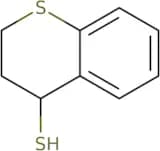
3,4-Dihydro-2H-1-benzothiopyran-4-thiol
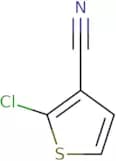
CAS:Versatile small molecule scaffoldFormula:C9H10S2Purezza:Min. 95%Peso molecolare:182.3 g/mol2-Chlorothiophene-3-carbonitrile
CAS:Versatile small molecule scaffold
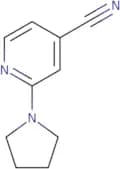
Formula:C5H2ClNSPurezza:Min. 95%Peso molecolare:143.59 g/mol2-Pyrrolidinoisonicotinonitrile
CAS:Versatile small molecule scaffold
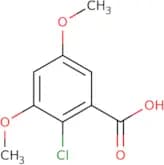
Formula:C10H11N3Purezza:Min. 95%Peso molecolare:173.22 g/mol2-Chloro-3,5-dimethoxybenzoic acid
CAS:Versatile small molecule scaffold
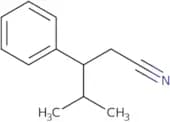
Formula:C9H9ClO4Purezza:Min. 95%Peso molecolare:216.62 g/mol4-Methyl-3-phenylpentanenitrile
CAS:Versatile small molecule scaffold
Formula:C12H15NPurezza:Min. 95%Peso molecolare:173.3 g/mol1-[(Dimethylamino)methyl]cyclopropane-1-carboxylic acid hydrochloride
CAS:Versatile small molecule scaffold
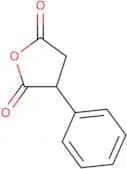
Formula:C7H14ClNO2Purezza:Min. 95%Peso molecolare:179.64 g/molPhenylsuccinic anhydride
CAS:Phenylsuccinic anhydride is a reactive, receptor binding, expressed, polycarboxylic acid that has nitrogen atoms. It can be used as an anticancer agent and has shown anticancer activity against α7 nicotinic acetylcholine receptors in the central nervous system. Phenylsuccinic anhydride is also used for the preparation of fluorinated anhydrides for use in nonaqueous solvents.
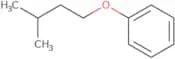
Formula:C10H8O3Purezza:Min. 95%Peso molecolare:176.17 g/mol(3-Methylbutoxy)benzene
CAS:(3-Methylbutoxy)benzene is a cyclic monomer that can be used in the production of polyester plastics. It has been shown to polymerize with isopentyl by means of an initiator. This reaction system produces a polymerized polymer. The phenyl group in this molecule has been shown to interact with eugenol through transition-state profile and reaction system studies, as well as polymerization reactions with benzene. The fluorescent properties of this compound make it suitable for use in fluorescent labelling of proteins and DNA.
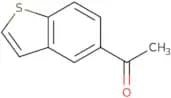
Formula:C11H16OPurezza:Min. 95%Peso molecolare:164.24 g/mol5-Acetylbenzothiophene
CAS:Versatile small molecule scaffold
Formula:C10H8OSPurezza:Min. 95%Peso molecolare:176.23 g/mol(R)-β-Fluorophenethylamine hydrochloride
CAS:Versatile small molecule scaffold
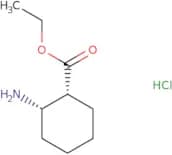
Formula:C8H10FN·HClPurezza:Min. 95%Peso molecolare:175.63 g/molEthyl (1S,2R/1R,2S)-2-aminocyclohexanecarboxylate hydrochloride
CAS:Versatile small molecule scaffold
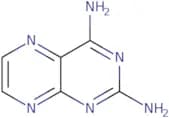
Formula:C9H18ClNO2Purezza:Min. 95%Peso molecolare:207.7 g/molPteridine-2,4-diamine
CAS:Pteridine-2,4-diamine is a peroxide that is found in nature. It has been shown to have an inhibitory effect on mutant enzymes that are involved in the production of hydrogen peroxide. Pteridine-2,4-diamine binds to a ligand and prevents it from reacting with hydrogen peroxide. This compound is used as a surfactant in pharmaceutical preparations. It also has an inhibitory effect on soybean lipoxygenase, which may be due to its ability to bind to the phosphonium salt at the active site and prevent the catalytic reaction with hydrogen peroxide.
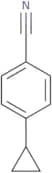
Formula:C6H6N6Purezza:Min. 95%Peso molecolare:162.15 g/mol4-Cyclopropylbenzonitrile
CAS:4-Cyclopropylbenzonitrile is an electrophilic compound that reacts with a nucleophile to form a covalent bond. The reactivity of 4-cyclopropylbenzonitrile is activated by the addition of chloride. It can be used as a precursor to yield chloroform and other compounds, such as chloride and oxide. 4-Cyclopropylbenzonitrile can also react with sulfur or nitrosyl to form an electrophilic sulfur or nitrosyl compound.
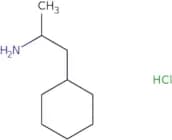
Formula:C10H9NPurezza:Min. 95%Peso molecolare:143.19 g/mol(2S)-1-Cyclohexylpropan-2-amine hydrochloride
CAS:Versatile small molecule scaffoldFormula:C9H20ClNPurezza:Min. 95%Peso molecolare:177.71 g/mol3,4-Dihydrobenzo[e][1,3]oxazin-2-one
CAS:3,4-Dihydrobenzo[e][1,3]oxazin-2-one is an organic compound that is used as a catalyst in the synthesis of pharmaceuticals. It reacts with halides and alkali metal to form quaternary ammonium salts. This reaction can be represented by the following scheme:
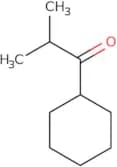
Formula:C8H7NO2Purezza:Min. 95%Peso molecolare:149.15 g/mol1-Cyclohexyl-2-methylpropan-1-one
CAS:Versatile small molecule scaffold
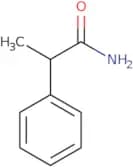
Formula:C10H18OPurezza:Min. 95%Peso molecolare:154.25 g/mol2-Phenylpropanamide
CAS:2-Phenylpropanamide is an amide that has been shown to have anti-inflammatory activity in a variety of animal models. It is also a metalloprotease inhibitor and suppresses the release of inflammatory cytokines. 2-Phenylpropanamide has shown some efficacy against cancer in human cell lines, and inhibits the production of the enzyme acetylcholinesterase. This drug also binds to adenosine A3 receptors, which are involved in inflammatory processes. 2-Phenylpropanamide has antioxidant properties, as it can scavenge radicals and inhibit hydroxyl radical formation. 2-Phenylpropanamide also has a high affinity for magnesium ions, which may explain its long elimination half-life after oral administration.
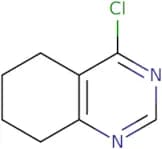
Formula:C9H11NOPurezza:Min. 95%Peso molecolare:149.19 g/mol4-Chloro-5,6,7,8-tetrahydroquinazoline
CAS:Versatile small molecule scaffold
Formula:C8H9ClN2Purezza:Min. 95%Peso molecolare:168.62 g/mol2-azaspiro[4.4]nonane-1,3-dione
CAS:2-Azaspiro[4.4]nonane-1,3-dione is a linker that is used in the synthesis of active derivatives of drugs. It has pharmacological and physicochemical properties that are similar to those of methylene. 2-Azaspiro[4.4]nonane-1,3-dione is used as an analytical standard for rp-hplc analysis and x-ray structural analysis. It can be used to synthesize pentylenetetrazole and imine derivatives for anticonvulsant properties, which have been shown to have properties similar to those of phenytoin.
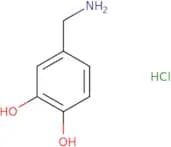
Formula:C8H11NO2Purezza:Min. 95%Peso molecolare:153.18 g/mol4-(Aminomethyl)-1,2-benzenediol hydrochloride
CAS:4-(Aminomethyl)-1,2-benzenediol hydrochloride is a potent inhibitor of monoamine neurotransmitter synthesis. It has been shown to inhibit the polymerase chain reaction (PCR) and is effective in the preparation of samples for PCR analysis. 4-(Aminomethyl)-1,2-benzenediol hydrochloride is chemically stable and has an electrochemical detector that can be used in its detection. This chemical also inhibits the incorporation of thymidine into DNA during DNA synthesis, leading to a decrease in DNA synthesis. The monoclonal antibody technique has been used to detect this compound in human serum and tissue biopsies.
Formula:C7H10ClNO2Purezza:Min. 95%Peso molecolare:175.61 g/mol

![1-[(Dimethylamino)methyl]cyclopropane-1-carboxylic acid hydrochloride](/_next/image/?url=https%3A%2Fstatic.cymitquimica.com%2Fproducts%2F3D%2Fthumb-webp%2FDXC60395.webp&w=3840&q=75)

![3,4-Dihydrobenzo[e][1,3]oxazin-2-one](/_next/image/?url=https%3A%2Fstatic.cymitquimica.com%2Fproducts%2F3D%2Fthumb-webp%2FBAA12585.webp&w=3840&q=75)
![2-azaspiro[4.4]nonane-1,3-dione](/_next/image/?url=https%3A%2Fstatic.cymitquimica.com%2Fproducts%2F3D%2Fthumb-webp%2FBAA12495.webp&w=3840&q=75)