Building Blocks
Questa sezione contiene prodotti fondamentali per la sintesi di composti organici e biologici. Building blocks sono i materiali di partenza essenziali utilizzati per costruire molecole complesse attraverso varie reazioni chimiche. Svolgono un ruolo critico nella scoperta di farmaci, nella scienza dei materiali e nella ricerca chimica. Presso CymitQuimica, offriamo una gamma diversificata di building blocks di alta qualità per supportare le tue ricerche innovative e progetti industriali, assicurandoti di avere i componenti essenziali per una sintesi di successo.
Sottocategorie di "Building Blocks"
- Acidi boronici e derivati dell'acido boronico(5.756 prodotti)
- Building Blocks Chirali(1.242 prodotti)
- Building Blocks Idrocarburici(6.095 prodotti)
- Building Blocks organici(60.526 prodotti)
Trovati 195848 prodotti di "Building Blocks"
Ordinare per
Purezza (%)
0
100
|
0
|
50
|
90
|
95
|
100
tert-Butyl N-{7-azaspiro[3.5]nonan-1-yl}carbamate
CAS:<p>Versatile small molecule scaffold</p>Formula:C13H24N2O2Purezza:Min. 95%Peso molecolare:240.34 g/mol2-[4-(Propan-2-yloxy)phenyl]acetonitrile
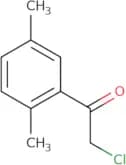
CAS:<p>Versatile small molecule scaffold</p>Formula:C11H13NOPurezza:Min. 95%Peso molecolare:175.23 g/mol2-Chloro-1-(2,5-dimethylphenyl)ethanone
CAS:<p>2-Chloro-1-(2,5-dimethylphenyl)ethanone is a synthetic intermediate for the production of a variety of pharmaceuticals. This product can be used in phase chromatography, mass spectrometry detection, and miniaturised techniques such as ring-opening. 2-Chloro-1-(2,5-dimethylphenyl)ethanone can also be used in on-line electrochemical methods and guanosine synthesis techniques. This product has been shown to inhibit the growth of bacteria that cause tuberculosis and anthrax. 2-Chloro-1-(2,5-dimethylphenyl)ethanone has also been found to have affinity for DNA bases guanosine.</p>Formula:C10H11ClOPurezza:Min. 95%Peso molecolare:182.65 g/mol4-(Chloromethyl)-N-ethyl-N-methylaniline hydrochloride
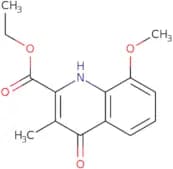
CAS:<p>Versatile small molecule scaffold</p>Formula:C10H15Cl2NPurezza:Min. 95%Peso molecolare:220.14 g/molEthyl 4-hydroxy-8-methoxy-3-methylquinoline-2-carboxylate
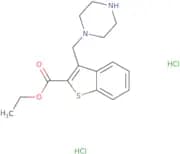
CAS:<p>Versatile small molecule scaffold</p>Formula:C14H15NO4Purezza:Min. 95%Peso molecolare:261.27 g/molEthyl 3-(piperazin-1-ylmethyl)-1-benzothiophene-2-carboxylate dihydrochloride
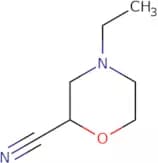
CAS:<p>Versatile small molecule scaffold</p>Formula:C16H22Cl2N2O2SPurezza:Min. 95%Peso molecolare:377.3 g/mol4-Ethylmorpholine-2-carbonitrile
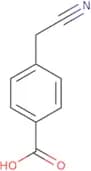
CAS:<p>Versatile small molecule scaffold</p>Formula:C7H12N2OPurezza:Min. 95%Peso molecolare:140.18 g/mol4-(Cyanomethyl)benzoic acid
CAS:<p>4-(Cyanomethyl)benzoic acid is a photocurrent generating molecule that has been shown to be an efficient acceptor in organic photovoltaic devices. It is also used as a sensitizer for the production of benzothiadiazole. The functional theory behind this reaction is that 4-(Cyanomethyl)benzoic acid first acts as an electron acceptor and then becomes a proton donor by accepting hydrogen from benzonitrile, which leads to the formation of benzothiadiazole. The bathochromic shift of the absorption spectrum of 4-(Cyanomethyl)benzoic acid was observed due to the presence of benzothiadiazole. This molecule can be used for solar cells because it contains a dipole, which facilitates charge separation and recombination in solar cells.</p>Formula:C9H7NO2Purezza:Min. 95%Peso molecolare:161.16 g/molN-Methyl-1-azabicyclo[2.2.2]octan-3-amine
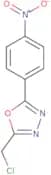
CAS:<p>Versatile small molecule scaffold</p>Formula:C8H16N2Purezza:Min. 95%Peso molecolare:140.23 g/mol2-(Chloromethyl)-5-(4-nitrophenyl)-1,3,4-oxadiazole
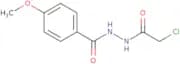
CAS:<p>Versatile small molecule scaffold</p>Formula:C9H6ClN3O3Purezza:Min. 95%Peso molecolare:239.62 g/molN'-(2-Chloroacetyl)-4-methoxybenzohydrazide
CAS:<p>Versatile small molecule scaffold</p>Formula:C10H11ClN2O3Purezza:Min. 95%Peso molecolare:242.66 g/molN'-(2-Chloroacetyl)benzohydrazide
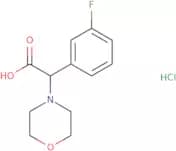
CAS:<p>Versatile small molecule scaffold</p>Formula:C9H9ClN2O2Purezza:Min. 95%Peso molecolare:212.63 g/mol2-(3-Fluorophenyl)-2-(morpholin-4-yl)acetic acid hydrochloride
CAS:<p>Versatile small molecule scaffold</p>Formula:C12H15ClFNO3Purezza:Min. 95%Peso molecolare:275.7 g/mol2,2-Dimethylcyclopropane-1-carbonyl chloride
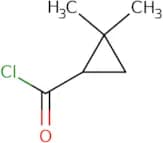
CAS:<p>2,2-Dimethylcyclopropane-1-carbonyl chloride is a diastereomeric mixture of two diastereoisomers. It is soluble in chloroform and diethyl ether and crystallizes from acetone. 2,2-Dimethylcyclopropane-1-carbonyl chloride is used as a feedstock to produce cyhalothrin, an insecticide that acts by contact. The insecticide is made by esterification of the 2,2-dimethylcyclopropane-1-carbonyl chloride with 3-phenoxybenzaldehyde and then chlorination of the ester.<br>A mixture of two diastereoisomers can be separated using chromatography techniques such as gas chromatography or high performance liquid chromatography (HPLC). In this case it would be possible to use HPLC to separate the two diastereoisomers.</p>Formula:C6H9ClOPurezza:Min. 95%Peso molecolare:132.59 g/mol1-(Pyridine-3-sulfonyl)piperidine-4-carbohydrazide
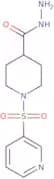
CAS:<p>Versatile small molecule scaffold</p>Formula:C11H16N4O3SPurezza:Min. 95%Peso molecolare:284.34 g/molMethyl 4-cyclohexylpyrrolidine-2-carboxylate hydrochloride
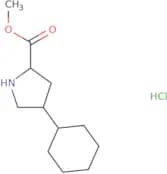
CAS:<p>Versatile small molecule scaffold</p>Formula:C12H22ClNO2Purezza:Min. 95%Peso molecolare:247.76 g/mol1-[2-Fluoro-6-(2-methoxyethoxy)phenyl]ethan-1-ol
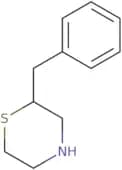
CAS:<p>Versatile small molecule scaffold</p>Formula:C11H15FO3Purezza:Min. 95%Peso molecolare:214.23 g/mol2-Benzylthiomorpholine
CAS:<p>Versatile small molecule scaffold</p>Formula:C11H15NSPurezza:Min. 95%Peso molecolare:193.31 g/mol2,2,2-Trifluoroethyl N-[4-(2-methyl-6-oxo-1,6-dihydropyrimidin-4-yl)phenyl]carbamate
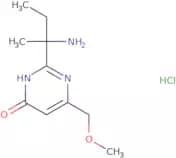
CAS:<p>Versatile small molecule scaffold</p>Formula:C14H12F3N3O3Purezza:Min. 95%Peso molecolare:327.26 g/mol2-(2-Aminobutan-2-yl)-6-(methoxymethyl)-3,4-dihydropyrimidin-4-one hydrochloride
CAS:<p>Versatile small molecule scaffold</p>Formula:C10H18ClN3O2Purezza:Min. 95%Peso molecolare:247.72 g/mol
![tert-Butyl N-{7-azaspiro[3.5]nonan-1-yl}carbamate](/_next/image/?url=https%3A%2Fstatic.cymitquimica.com%2Fproducts%2F3D%2Fthumb-webp%2FEEC95049.webp&w=3840&q=75)

![2-[4-(Propan-2-yloxy)phenyl]acetonitrile](/_next/image/?url=https%3A%2Fstatic.cymitquimica.com%2Fproducts%2F3D%2Fthumb-webp%2FACA69053.webp&w=3840&q=75)

![N-Methyl-1-azabicyclo[2.2.2]octan-3-amine](/_next/image/?url=https%3A%2Fstatic.cymitquimica.com%2Fproducts%2F3D%2Fthumb-webp%2FACA68424.webp&w=3840&q=75)

![1-[2-Fluoro-6-(2-methoxyethoxy)phenyl]ethan-1-ol](/_next/image/?url=https%3A%2Fstatic.cymitquimica.com%2Fproducts%2F3D%2Fthumb-webp%2FEEC95029.webp&w=3840&q=75)
![2,2,2-Trifluoroethyl N-[4-(2-methyl-6-oxo-1,6-dihydropyrimidin-4-yl)phenyl]carbamate](/_next/image/?url=https%3A%2Fstatic.cymitquimica.com%2Fproducts%2F3D%2Fthumb-webp%2FEEC95025.webp&w=3840&q=75)