Building Blocks
Sottocategorie di "Building Blocks"
- Acidi boronici e derivati dell'acido boronico(5.780 prodotti)
- Building Blocks Chirali(1.241 prodotti)
- Building Blocks Idrocarburici(6.100 prodotti)
- Building Blocks organici(61.017 prodotti)
Trovati 205265 prodotti di "Building Blocks"
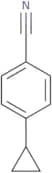
4-Cyclopropylbenzonitrile
CAS:4-Cyclopropylbenzonitrile is an electrophilic compound that reacts with a nucleophile to form a covalent bond. The reactivity of 4-cyclopropylbenzonitrile is activated by the addition of chloride. It can be used as a precursor to yield chloroform and other compounds, such as chloride and oxide. 4-Cyclopropylbenzonitrile can also react with sulfur or nitrosyl to form an electrophilic sulfur or nitrosyl compound.
Formula:C10H9NPurezza:Min. 95%Peso molecolare:143.19 g/mol3-Oxo-7-azaspiro[3.4]octane-7-carboxylate tert-butyl ester
CAS:Versatile small molecule scaffoldFormula:C12H19NO3Purezza:Min. 95%Peso molecolare:225.28 g/moltert-Butyl 9-amino-3-oxa-7-azabicyclo[3.3.1]nonane-7-carboxylate
CAS:Versatile small molecule scaffold
Formula:C12H22N2O3Purezza:Min. 95%Peso molecolare:242.31 g/mol5-[(tert-butoxy)carbonyl]-4H,5H,6H,7H,8H-pyrazolo[1,5-a][1,4]diazepine-7-carboxylic acid
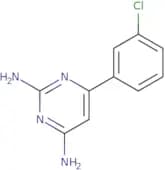
CAS:Versatile small molecule scaffoldFormula:C13H19N3O4Purezza:Min. 95%Peso molecolare:281.31 g/mol6-(3-Chlorophenyl)pyrimidine-2,4-diamine
CAS:Versatile small molecule scaffold
Formula:C10H9ClN4Purezza:Min. 95%Peso molecolare:220.66 g/mol7-Bromoimidazo[1,2-a]pyrimidine
CAS:Versatile small molecule scaffold
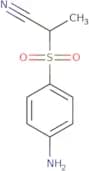
Formula:C6H4BrN3Purezza:Min. 95%Peso molecolare:198.02 g/mol2-(4-Aminobenzenesulfonyl)propanenitrile
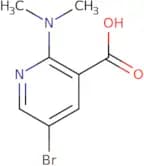
CAS:Versatile small molecule scaffoldFormula:C9H10N2O2SPurezza:Min. 95%Peso molecolare:210.26 g/mol5-Bromo-2-(dimethylamino)pyridine-3-carboxylic acid
CAS:Versatile small molecule scaffold
Formula:C8H9BrN2O2Purezza:Min. 95%Peso molecolare:245.07 g/mol1-(1H-Pyrrol-1-yl)cyclopentane-1-carboxylic acid
CAS:Versatile small molecule scaffold
Formula:C10H13NO2Purezza:Min. 95%Peso molecolare:179.22 g/mol2-(Phenoxymethyl)pyrimidin-4-amine
CAS:Versatile small molecule scaffold
Formula:C11H11N3OPurezza:Min. 95%Peso molecolare:201.22 g/mol[1-(6-Chloropyrimidin-4-yl)pyrrolidin-2-yl]methanol
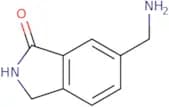
CAS:Versatile small molecule scaffoldFormula:C9H12ClN3OPurezza:Min. 95%Peso molecolare:213.66 g/mol6-(Aminomethyl)isoindolin-1-one
CAS:6-(Aminomethyl)isoindolin-1-one is a cyano compound that has been shown to be an effective hydrogenation catalyst. It can be used to catalyze reactions in which the hydrogen source is not the only carbon source. The synthetic reaction for 6-(aminomethyl)isoindolin-1-one involves the conversion of an aminomethyl ketone with sodium cyanide and a transition metal catalyst. This process produces two products: 6-(aminomethyl)isoindolin-1-one and 2,4,6-trichlorophenol. The use of this compound as a catalyst has been shown to be more efficient than traditional catalysts, such as palladium on carbon, in some instances.
Formula:C9H10N2OPurezza:Min. 95%Peso molecolare:162.19 g/mol2-Cyclohexylmorpholine
CAS:Versatile small molecule scaffold
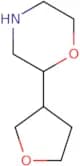
Formula:C10H19NOPurezza:Min. 95%Peso molecolare:169.26 g/mol2-(Oxolan-3-yl)morpholine
CAS:Versatile small molecule scaffold
Formula:C8H15NO2Purezza:Min. 95%Peso molecolare:157.21 g/mol2,4-Dichloro-6-phenylpyrimidine
CAS:2,4-Dichloro-6-phenylpyrimidine is a nucleophilic reagent that has been used to synthesize pyrimidine derivatives. It has been shown to react with cyanoacetic acid and malononitrile in the presence of an organolithium reagent to form 2,6-dichloro-2,4-dihydroxypyrimidine. This compound reacts with chlorine gas to give 2,4-dichloro-6-(chloromethyl)pyrimidine. This reaction is regioselective and does not affect the other substituents on the ring. The reaction proceeds via a nucleophilic attack on the carbon atom adjacent to the nitrogen atom.
Formula:C10H6Cl2N2Purezza:Min. 95%Peso molecolare:225.07 g/mol1-(Trifluoromethyl)isoquinoline
CAS:1-(Trifluoromethyl)isoquinoline is an organic compound that is made from a photoredox reaction, which involves the use of a metal catalyst and light to produce reactive species. This chemical can be used in the synthesis of vinyl compounds, such as styrene, by regiospecifically adding an isocyanide. 1-(Trifluoromethyl)isoquinoline has been shown to be a useful reagent for experiments involving regiospecific reactions.
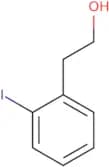
Formula:C10H6F3NPurezza:Min. 95%Peso molecolare:197.16 g/mol2-(2-iodophenyl)ethanol
CAS:2-(2-iodophenyl)ethanol is a ketone that can be made by refluxing benzene with phosphite and halides. It can also be synthesized from 2-phenylethanol, which is obtained from the reaction of acetone with sodium hydroxide. 2-(2-Iodophenyl)ethanol has been used as a precursor to other compounds in organic chemistry. This compound has been shown to react with dichlorophosphite or sulphonium to form organopalladium intermediates. Carbonylation reactions are another method for synthesizing this compound.
Formula:C8H9IOPurezza:Min. 95%Peso molecolare:248.06 g/mol3-iso-Propoxybenzyl alcohol
CAS:3-iso-Propoxybenzyl alcohol is an insect repellent used to prevent insect bites. It is a screening agent that can be used as a solution in ethanol to test for the presence of insects. 3-iso-Propoxybenzyl alcohol is added to a solution and then sprayed onto plants or animals. The solution will turn yellow if it comes into contact with an insect. This product should be stored in a cool, dry place away from direct sunlight and out of reach of children.
Formula:C10H14O2Purezza:Min. 95%Peso molecolare:166.22 g/molTricyclo[3.3.1.13,7]decane-2-acetic acid
CAS:Tricyclo[3.3.1.13,7]decane-2-acetic acid is a catalyst that can be used in the reduction of 2-adamantanone to butyric acid by aluminium. This compound has also been used as an analog for other catalytic systems such as lactams and monoamides. Tricyclo[3.3.1.13,7]decane-2-acetic acid has been shown to have an affinity for 11β-hydroxysteroid dehydrogenase (11βHSD). This enzyme is involved in the conversion of cortisone to cortisol and is critical for the regulation of glucocorticoid hormones and mineralocorticoids in humans and other mammals. It has also been shown to inhibit chloride ion transport, which increases sodium ion uptake by cells and leads to a decrease in blood pressure when combined with sodium hypochlorite (bleach) treatment.br>br
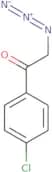
Formula:C12H18O2Purezza:Min. 95%Peso molecolare:194.27 g/mol2-Azido-1-(4-chlorophenyl)ethan-1-one
CAS:Versatile small molecule scaffold
Formula:C8H6ClN3OPurezza:Min. 95%Peso molecolare:195.6 g/mol

![3-Oxo-7-azaspiro[3.4]octane-7-carboxylate tert-butyl ester](/_next/image/?url=https%3A%2Fstatic.cymitquimica.com%2Fproducts%2F3D%2Fthumb-webp%2FBAC01017.webp&w=3840&q=75)
![tert-Butyl 9-amino-3-oxa-7-azabicyclo[3.3.1]nonane-7-carboxylate](/_next/image/?url=https%3A%2Fstatic.cymitquimica.com%2Fproducts%2F3D%2Fthumb-webp%2FBAC01574.webp&w=3840&q=75)
![5-[(tert-butoxy)carbonyl]-4H,5H,6H,7H,8H-pyrazolo[1,5-a][1,4]diazepine-7-carboxylic acid](/_next/image/?url=https%3A%2Fstatic.cymitquimica.com%2Fproducts%2F3D%2Fthumb-webp%2FBAC01761.webp&w=3840&q=75)
![7-Bromoimidazo[1,2-a]pyrimidine](/_next/image/?url=https%3A%2Fstatic.cymitquimica.com%2Fproducts%2F3D%2Fthumb-webp%2FBAC03357.webp&w=3840&q=75)


![[1-(6-Chloropyrimidin-4-yl)pyrrolidin-2-yl]methanol](/_next/image/?url=https%3A%2Fstatic.cymitquimica.com%2Fproducts%2F3D%2Fthumb-webp%2FBAC14677.webp&w=3840&q=75)




![Tricyclo[3.3.1.13,7]decane-2-acetic acid](/_next/image/?url=https%3A%2Fstatic.cymitquimica.com%2Fproducts%2F3D%2Fthumb-webp%2FBBA08222.webp&w=3840&q=75)