Alcoli
Sottocategorie di "Alcoli"
Trovati 5818 prodotti di "Alcoli"
Gemcitabine monophosphate disodium monohydrate
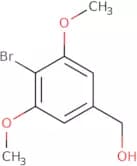
CAS:Please enquire for more information about Gemcitabine monophosphate disodium monohydrate including the price, delivery time and more detailed product information at the technical inquiry form on this pageFormula:C9H12F2N3O7P•Na2•H2OPurezza:90%Min By HplcColore e forma:PowderPeso molecolare:407.16 g/mol4-Bromo-3,5-dimethoxybenzyl alcohol
CAS:4-Bromo-3,5-dimethoxybenzyl alcohol is a bromoarene that can be used as a ligand in coupling reactions. It has been shown to be an efficient coupling partner for the synthesis of triphylla, featuring a skeleton of chelating 4-bromo-3,5-dimethoxybenzyl alcohol.Formula:C9H11BrO3Purezza:Min. 95%Colore e forma:PowderPeso molecolare:247.09 g/molBis-(1,3-diethylthiobarbituric acid)trimethine oxonol
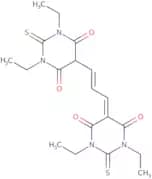
CAS:Bis-(1,3-diethylthiobarbituric acid)trimethine oxonol (BTTMO) is a compound class of drugs that inhibit the ATP-binding cassette transporter and block the transport of cellular metabolites across the mitochondrial membrane. This inhibition leads to a decrease in cellular ATP levels and an increase in cytosolic calcium. BTTMO has shown promising results in animal models for treatment of cervical cancer, which may be due to its ability to stimulate epidermal growth factor receptor signaling. BTTMO also inhibits energy metabolism by inhibiting mitochondrial membrane potential and blocking atp-sensitive potassium channels. It also induces gamma-aminobutyric acid release from neurons, leading to hyperpolarization of the cell membrane.Formula:C19H24N4O4S2Purezza:Min. 95%Colore e forma:Dark Purple SolidPeso molecolare:436.55 g/mol16-Dehydropregnenolone acetate
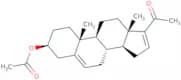
CAS:Prodotto controllato16-Dehydropregnenolone acetate is a synthetic compound that can be used in wastewater treatment. It reacts with phosphorus pentoxide to form an insoluble solid product. 16-Dehydropregnenolone acetate has been shown to inhibit the growth of human prostate cancer cells and breast cancer cells in vitro and in vivo. 16-Dehydropregnenolone acetate is also a specific agonist for the progesterone receptor, which may be due to its ability to bind to the stereospecific (S) binding site on this receptor. The optimum concentration for 16-dehydropregnanediol is 10 mM and it requires the presence of phosphotungstic acid for maximum activity. This substance has biological properties that are similar to those of natural progesterones, but it does not have any estrogenic properties.Formula:C23H32O3Purezza:Min. 95%Colore e forma:PowderPeso molecolare:356.5 g/mol1-Benzylglycerol
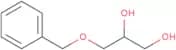
CAS:1-Benzylglycerol is a bifunctional reagent that can be used as an inorganic base or an organic solvent. It has been used to synthesize enantiopure compounds, such as fatty acids. 1-Benzylglycerol reacts with boron trifluoride etherate to form the corresponding ester, which is a reaction system for the synthesis of persulfates. The hydroxyl group on 1-benzylglycerol can be reacted with hydroxyl groups on fatty acids, catalyzed by lipase or chemoenzymes, to produce esters. 1-Benzylglycerol has been used in asymmetric synthesis and carbon tetrachloride immobilization reactions.
Formula:C10H14O3Purezza:Min. 95%Colore e forma:Clear LiquidPeso molecolare:182.22 g/mol4-Bromo-2-fluorophenol
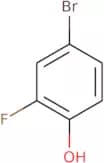
CAS:4-Bromo-2-fluorophenol is a mesomorphic substance that has a helical structure. It has been shown to have ferroelectric properties and light emission, as well as being spontaneously polar. 4-Bromo-2-fluorophenol is a dipole molecule with two hydrogen bonds on each side of the molecule. The fluorine atom in 4-bromo-2-fluorophenol interacts with chlorine atoms through an intramolecular hydrogen bond.Formula:C6H4BrFOPurezza:Min. 95%Colore e forma:Clear LiquidPeso molecolare:191 g/mol5-Methylpyrimidin-2-ol
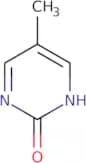
CAS:5-Methylpyrimidin-2-ol is a photophysical, hydroxy group, and hydroxyl group. It has been shown to have an inhibitory effect on DNA methylation by glycosidic bond with the sugar moiety of the nucleotide. 5-Methylpyrimidin-2-ol reacts with the base moiety of the nucleotide to form an analog that inhibits RNA synthesis and is competitive against pyrimidine nucleosides. 5-Methylpyrimidin-2-ol also has a hydrogen bonding property that can react with other molecules such as proteins or sugars to form hydrogen bonds. This reaction rate is increased by fluorescence resonance energy transfer (FRET).
Formula:C5H6N2OPurezza:Min. 95%Colore e forma:PowderPeso molecolare:110.11 g/mol3-Bromo-4-hydroxybenzyl alcohol
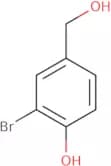
CAS:3-Bromo-4-hydroxybenzyl alcohol (3BHA) is a synthetic compound that is used as an antagonist in the treatment of platelet aggregation. It inhibits the activity of benzoxazine, an enzyme involved in the synthesis of 4-hydroxybenzoic acid. 3BHA blocks this pathway at high concentrations, inhibiting biosynthesis and leading to the accumulation of bromophenols. This inhibition may explain why aspirin has a potent inhibitory effect on platelet aggregation when combined with 3BHA.Formula:C7H7BrO2Purezza:Min. 95%Colore e forma:PowderPeso molecolare:203.03 g/mol5β-Pregnane-3α,11α,20β-triol
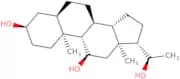
CAS:Prodotto controllato5-b-Pregnan-3-a,11-a-,20-b-triol is a high quality research chemical with CAS No. 55647-22-8. It is a complex compound that can be used as an intermediate in the synthesis of other compounds. 5-b-Pregnan-3-a,11-a-,20-b-triol is a speciality chemical that has many uses and is also a versatile building block for synthesis. This reagent can be used to create new compounds or to react in different ways with other chemicals to produce useful scaffolds or building blocks for reactions. 5 b pregna 3 a, 11 a, 20 b triol has been shown to have the ability to react with other chemicals in order to form useful reaction components.Formula:C21H36O3Purezza:Min. 95%Colore e forma:PowderPeso molecolare:336.51 g/mol3,5-Dimethylbenzyl alcohol
CAS:3,5-Dimethylbenzyl alcohol (3,5-DMB) is an organic solvent that is used as a degreaser and wetting agent for metals. It has been shown to have anticancer properties in vitro, but not in vivo. 3,5-DMB binds to the active site of the enzyme dehydrogenase and prevents it from binding with substrates. This inhibition leads to a decrease in the activity of this enzyme and a decrease in the production of reactive oxygen species. 3,5-DMB has also been shown to be effective against cancer cells both in vitro and in vivo. In addition, 3,5-DMB has been shown to bind tightly to ferula (a dye used for staining), xylene (a hydrocarbon), and hexane (an organic solvent).Formula:C9H12OPurezza:Min. 95%Peso molecolare:136.19 g/mol2-(2-Methoxyphenethyl) alcohol
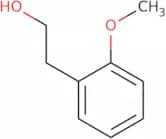
CAS:2-(2-Methoxyphenethyl) alcohol (2MPE) is a ligand that binds to the phenylpropanoid glycosides, which are responsible for the biosynthesis of plant pigments. It has been shown to inhibit tyrosinase and tyrosinase activity in vitro. 2MPE is used in radiopharmaceuticals as a radioactive label. It has also been shown to inhibit melanogenesis and the synthesis of volatile compounds in corncob at high temperatures. 2MPE is found in rhodiola and together with 2-hydroxyphenylacetic acid, it inhibits bacterial growth by inhibiting protein synthesis.Formula:C9H12O2Purezza:Min. 98%Colore e forma:Clear LiquidPeso molecolare:152.19 g/mol4-[3-[2-(Trifluoromethyl)-9H-thioxanthen-9-ylidene]propyl]-1-piperazineethanol dihydrochloride
CAS:Prodotto controllato4-[3-[2-(Trifluoromethyl)-9H-thioxanthen-9-ylidene]propyl]-1-piperazineethanol dihydrochloride is a potent antagonist of the 5-HT2A receptor. It has been shown to reduce body weight and food intake in animal models. The compound has also been shown to decrease motor activity and increase grooming behavior, which are symptoms of Parkinson's disease. 4-[3-[2-(Trifluoromethyl)-9H-thioxanthen-9-ylidene]propyl]-1-piperazineethanol dihydrochloride is a Pgp substrate and can be used to measure the activity of this transporter in human serum, as well as determining its effect on renal function in rats.Formula:C23H27Cl2F3N2OSPurezza:Min. 95%Colore e forma:PowderPeso molecolare:507.44 g/mol2,4-Dichloro-α-(chloromethyl)benzyl alcohol
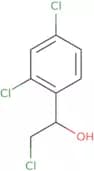
CAS:2,4-Dichloro-alpha-(chloromethyl)benzyl alcohol is an enantiopure compound that belongs to the class of acetylating agents. This drug is used in organic chemistry as a hydrophobic reagent to acetylate hydrophobic or electron-deficient carbon centers. It reacts with alcohols in the presence of aluminium and catalysts such as pyridine, 2,6-lutidine, or benzoyl chloride. The reaction time is dependent on the substrate binding and the kinetic effect. 2,4-Dichloro-alpha-(chloromethyl)benzyl alcohol has been shown to be an antifungal agent against Candida albicans. It has also been shown to be a chiral compound that can inhibit the growth of fungi by inhibiting the enzyme alcohol dehydrogenase which controls cellular levels of NADH2 and NAD+.Formula:C8H7Cl3OPurezza:Min. 95%Colore e forma:SolidPeso molecolare:225.5 g/mol4,6-Diacetylresorcinol
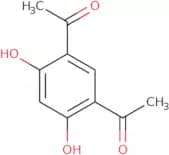
CAS:4,6-Diacetylresorcinol is a tetradentate ligand that can be used for the palladium-catalyzed hydrogenation of phenols. The compound has been shown to have anticancer activity and was found to be selective against cancer cell lines. It also inhibits the growth of staphylococcus bacteria in biological studies. 4,6-Diacetylresorcinol is thermodynamically stable and has a high binding affinity with nitrogen nucleophiles such as amines and anilines. Molecular modeling studies show that the nitrogen atoms are located near the center of the molecule, making them accessible for intramolecular hydrogen transfer reactions.Formula:C10H10O4Purezza:Min. 95%Colore e forma:PowderPeso molecolare:194.18 g/mol9-Fluoro-3-methyl-7-oxo-10-(1-piperazinyl)-2,3-dihydro-7H-[1,4]oxazino[2,3,4-Ij]quinoline-6-carboxylic acid
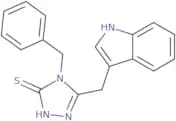
CAS:9-Fluoro-3-methyl-7-oxo-10-(1-piperazinyl)-2,3-dihydro-7H-[1,4]oxazino[2,3,4-Ij]quinoline (FQ) is a fluoroquinolone antibiotic. It inhibits the DNA gyrase and topoisomerase IV enzymes that maintain the integrity of bacterial DNA. FQ has been used to treat urinary tract infections in humans and other animals. This drug is also effective against methicillin resistant Staphylococcus aureus (MRSA) and Clostridium perfringens. FQ binds to bacterial 16S ribosomal RNA and inhibits protein synthesis leading to cell death by inhibiting the production of proteins vital for cell division. The 9 position on the quinoline ring can be detected using UV detection at 260 nm. FQ can be analyzed using mass spectrometry with fluorFormula:C17H18FN3O4Purezza:Min. 95 Area-%Colore e forma:White PowderPeso molecolare:347.34 g/mol5-(Indol-3-ylmethyl)-4-benzyl-1,2,4-triazole-3-thiol
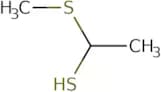
CAS:Please enquire for more information about 5-(Indol-3-ylmethyl)-4-benzyl-1,2,4-triazole-3-thiol including the price, delivery time and more detailed product information at the technical inquiry form on this pageFormula:C18H16N4SPurezza:Min. 95%Colore e forma:PowderPeso molecolare:320.41 g/mol1-(Methylthio)ethanethiol
CAS:1-(Methylthio)ethanethiol (MTET) is a highly volatile, naphthenic compound that has been shown experimentally to be a sulfide and ethanal precursor. It is also an ethyl cinnamate solvent. MTET is soluble in organic solvents such as chloroform and benzene. MTET has been used to produce polymers by coating sensor surfaces with polymer film and evaporating the solvent. The fluorescence of MTET increases in the presence of oxygen, which may be due to its oxidation by air.Formula:C3H8S2Purezza:Min. 95%Colore e forma:PowderPeso molecolare:108.23 g/mol2-Bromo-4-methoxybenzyl alcohol
CAS:2-Bromo-4-methoxybenzyl alcohol is a fine chemical that can be used as a versatile building block, intermediate, or reaction component in research. It is also a useful building block for the synthesis of complex compounds. 2-Bromo-4-methoxybenzyl alcohol has been shown to be a reagent with high quality and can be used as a speciality chemical. This compound has been shown to react with ammonia to form an amide bond, which has led to the development of several new drugs.Formula:C8H9BrO2Purezza:Min. 95%Colore e forma:PowderPeso molecolare:217.06 g/molEstratetraenol
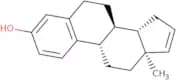
CAS:Estratetraenol is a synthetic estrogen that has the same structure as 17β-estradiol, but with three additional hydroxyl groups. It is used in research to study the effects of estrogens on humans and animals. Estratetraenol has been shown to activate the cell membrane receptors, which leads to a physiological response. This drug also causes an increase in oxygen consumption and inhibits ovulation. Estratetraenol binds to estrogen receptor cells and is metabolized by chemical substances in the liver into 17β-estradiol, which is then excreted by the kidneys. The drug does not bind to other types of receptor cells in humans or animals, such as those for progesterone or testosterone.Formula:C18H22OPurezza:Min. 98 Area-%Colore e forma:PowderPeso molecolare:254.37 g/mol4-Benzyloxy-2-chlorobenzyl alcohol
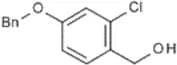
CAS:4-Benzyloxy-2-chlorobenzyl alcohol is an intermediate in the synthesis of a number of complex compounds. It has been found to be useful as a reagent and as a building block in the synthesis of fine chemicals and speciality chemicals. This chemical has also been used as a reaction component in the synthesis of versatile building blocks. CAS No. 219764-60-0, this compound is often used by researchers for its versatility and ability to act as a scaffold.
Formula:C14H13ClO2Purezza:Min. 95%Colore e forma:PowderPeso molecolare:248.7 g/mol



![4-[3-[2-(Trifluoromethyl)-9H-thioxanthen-9-ylidene]propyl]-1-piperazineethanol dihydrochloride](/_next/image/?url=https%3A%2Fstatic.cymitquimica.com%2Fproducts%2F3D%2Fthumb-webp%2FFT23498.webp&w=3840&q=75)
![9-Fluoro-3-methyl-7-oxo-10-(1-piperazinyl)-2,3-dihydro-7H-[1,4]oxazino[2,3,4-Ij]quinoline-6-carbox…](/_next/image/?url=https%3A%2Fstatic.cymitquimica.com%2Fproducts%2F3D%2Fthumb-webp%2FFF102861.webp&w=3840&q=75)