Ciano-, Nitrile-
I composti ciano e nitrile sono molecole organiche che contengono gruppi ciano (C≡N) o nitrile nella loro struttura, caratterizzati dalla presenza di azoto. Questi gruppi svolgono ruoli importanti in varie reazioni chimiche e applicazioni industriali. In questa categoria, troverete un'ampia gamma di composti ciano e nitrile, che vanno da strutture semplici a complesse. Da CymitQuimica, offriamo composti ciano e nitrile di alta qualità adattati per soddisfare le esigenze di ricerca e industriali. I nostri composti sono adatti a una varietà di applicazioni di sintesi e analisi.
Trovati 9624 prodotti di "Ciano-, Nitrile-"
Ordinare per
Purezza (%)
0
100
|
0
|
50
|
90
|
95
|
100
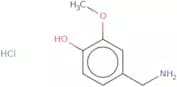
4-Hydroxy-3-methoxybenzylamine hydrochloride
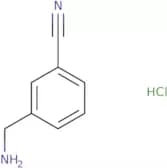
CAS:<p>4-Hydroxy-3-methoxybenzylamine hydrochloride is a reagent, complex compound and useful intermediate for the production of speciality chemicals. CAS No. 7149-10-2 is not a hazardous chemical and does not pose any significant risk to human health or the environment when used as intended. This chemical has many uses including being a useful scaffold in organic synthesis, a useful building block for the preparation of other compounds, and a versatile building block for the preparation of various compounds. It also has many applications in research such as being an intermediate for the synthesis of other compounds, or as a reactant in various reactions.</p>Formula:C8H12NO2ClPurezza:Min. 98 Area-%Colore e forma:White PowderPeso molecolare:189.64 g/mol3-Cyanobenzylamine HCl
CAS:<p>3-Cyanobenzylamine HCl is a high quality chemical that is used as a reagent, intermediate, or building block in the synthesis of complex compounds. It is a fine chemical and speciality chemical that may be used as a research chemical and versatile building block for the synthesis of organic compounds. 3-Cyanobenzylamine HCl has been shown to react with other chemicals to form useful scaffolds and building blocks, such as amides, amino acid esters, and ureas.</p>Formula:C8H9ClN2Purezza:Min. 95%Colore e forma:PowderPeso molecolare:168.62 g/mol4-tert-Butylcalix[4]arene - contains 12% residual solvent (ethyl acetate and acetonitrile)
CAS:<p>4-tert-Butylcalix[4]arene is a polymorphic compound with transport properties. It has been shown to have an activation energy of ˜30 kcal/mol, and can be characterized by its nmr spectra. The molecule can be found in n-hexane and zirconium. 4-tert-Butylcalix[4]arene is a coordination complex with a transfer mechanism that contains chloride or metal ion. It forms an acid complex with thermally stable molecules.</p>Formula:C44H56O4Purezza:Min. 95%Colore e forma:PowderPeso molecolare:648.91 g/molEthyl (2Z)-2-cyano-3-(2-furyl)acrylate
CAS:<p>Please enquire for more information about Ethyl (2Z)-2-cyano-3-(2-furyl)acrylate including the price, delivery time and more detailed product information at the technical inquiry form on this page</p>Formula:C10H9NO3Purezza:Min. 95%Peso molecolare:191.18 g/molXylene cyanol
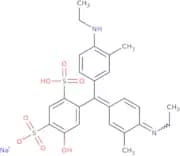
CAS:<p>Xylene cyanol is a chemical compound that belongs to the group of phenols. It has been shown to be active in vitro against human skin cancer cells, and induces cell lysis. Xylene cyanol has also been found to bind to the BCR-ABL kinase domain, which is an enzyme that plays a crucial role in the development of leukemia and other autoimmune diseases. Xylene cyanol binds to dna binding domains on the protein surface and forms an adduct with bcr-abl kinase, which inhibits its activity. This inhibition prevents activation of this enzyme and leads to cell death by preventing DNA synthesis.</p>Formula:C25H27N2O7S2•NaPurezza:Min. 90%Colore e forma:PowderPeso molecolare:554.61 g/mol2-Bromo-5-cyanonitrobenzene
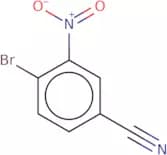
CAS:<p>2-Bromo-5-cyanonitrobenzene is a chemical compound that has been shown to have broad-spectrum activity against drug-resistant bacteria. It is able to kill gram-negative and gram-positive bacteria, including drug-resistant strains. The mechanism of action for 2-bromo-5-cyanonitrobenzene is not well understood but it has been observed that the molecule undergoes an oxidative cyclization reaction in the presence of chloride ions or hydroxides. This process leads to the formation of a nitrosobenzene metabolite which reacts with DNA to inhibit protein synthesis and cause cell death. 2-Bromo-5-cyanonitrobenzene has also been shown to be potent against a wide range of different types of bacteria, including those most commonly associated with skin infections, respiratory tract infections, and urinary tract infections.</p>Formula:C7H3BrN2O2Purezza:Min. 95%Colore e forma:PowderPeso molecolare:227.02 g/mol2-Phenoxyphenylacetonitrile
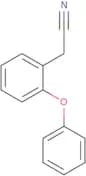
CAS:<p>2-Phenoxyphenylacetonitrile is a pyrethroid n-oxide that is chemically related to other insecticides that are used in agriculture and against insects such as mosquitoes. 2-Phenoxyphenylacetonitrile is a synthetic compound that has been shown to have an optimum pH of 5.5, which makes it difficult to dissolve in water. The compound's high stability at low pH levels means that it can be used in acidic environments. It also has been shown to have strong activity against human serum and food composition, with no detectable activity against bacteria or fungi.</p>Formula:C14H11NOPurezza:Min. 95%Colore e forma:Clear LiquidPeso molecolare:209.24 g/mol4-Ethylbenzonitrile
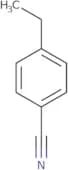
CAS:<p>4-Ethylbenzonitrile is a chemical that is found in human lung. It is a terminal alkene, which undergoes aerobic photooxidation to form reactive oxygen species such as superoxide radical anion and hydrogen peroxide. 4-Ethylbenzonitrile is also converted to triazine, which has been shown to have tumorigenic properties in the lungs of rats and mice. The functional groups on 4-ethylbenzonitrile are amines, hydroxyls, carbonyls, and nitriles. This compound has an inhibitory effect on lung fibroblasts due to its ability to interfere with the function of β-unsaturated ketones. 4-Ethylbenzonitrile's basic structure contains three carbon atoms, two double bonds, and one triple bond.</p>Formula:C9H9NPurezza:Min. 95%Colore e forma:Clear LiquidPeso molecolare:131.17 g/molm-Hydroxybenzonitrile
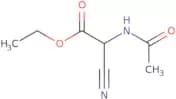
CAS:<p>m-Hydroxybenzonitrile is a cationic surfactant that has the ability to form hydrogen bonds with an intramolecular hydrogen. It is used in the production of detergents, textile processing aids, and inks. m-Hydroxybenzonitrile inhibits fatty acids by forming an inhibitory complex at the surface of the cell membrane. This complex disrupts lipid bilayers and inhibits protein synthesis. m-Hydroxybenzonitrile also has been shown to have vibrational properties that can be seen when it absorbs ultraviolet light.</p>Formula:C7H5NOPurezza:Min. 95%Colore e forma:Off-White PowderPeso molecolare:119.12 g/molEthyl acetamidocyanoacetate
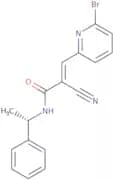
CAS:<p>Ethyl acetamidocyanoacetate is an amide which inhibits the enzyme thrombin. It inhibits the conversion of fibrinogen to fibrin, and thus prevents blood clot formation. Ethyl acetamidocyanoacetate has been shown to inhibit serine protease, one of the most abundant enzymes in the human body. This inhibition causes a decrease in inflammatory diseases caused by these enzymes. Ethyl acetamidocyanoacetate also has analog properties that can be used for solid-phase synthesis.</p>Formula:C7H10N2O3Purezza:Min. 98 Area-%Peso molecolare:170.17 g/mol(S,E)-3-(6-Bromopyridin-2-yl)-2-cyano-N-(1-phenylethyl)acrylamide
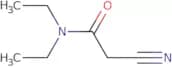
CAS:<p>(S,E)-3-(6-Bromopyridin-2-yl)-2-cyano-N-(1-phenylethyl)acrylamide (MBI-23) is a potential antineoplastic agent that has been shown to induce regression of bladder cancer in mice. MBI-23 induces apoptosis by inhibiting the proliferation of cancer cells and inducing differentiation of cancer stem cells. It is also shown to inhibit tumor growth and progression in glioma and prostate cancer models. MBI-23 binds to the KDR receptor subtype, which is activated by organic acids and inhibited by inorganic compounds. This binding leads to constitutive activation of the KDR receptor, thereby inducing apoptosis. The tautomers and stereoisomers of MBI-23 have not been fully elucidated yet.</p>Formula:C17H14ON3BrPurezza:Min. 98 Area-%Colore e forma:White PowderPeso molecolare:356.22 g/molN,N-Diethylcyanoacetamide
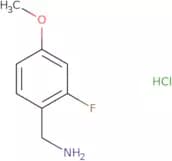
CAS:<p>N,N-Diethylcyanoacetamide is an organic compound that is used in the industrial production of polyurethane. It reacts with a nucleophile to form a new carbon-nitrogen bond. The reaction can be monitored in real time, and it has high specificity for the desired product. N,N-Diethylcyanoacetamide reacts with piperidine to produce a mixture of isomers in which the methyl group is attached to either the nitrogen or the oxygen atom. This mixture can be separated by crystallization, and it generates a pure product that can be used as a monocarboxylic acid.</p>Formula:C7H12N2OPurezza:Min. 95%Colore e forma:Clear LiquidPeso molecolare:140.18 g/mol2-Fluoro-4-methoxybenzylamine hydrochloride
CAS:<p>2-Fluoro-4-methoxybenzylamine hydrochloride is a potent inhibitor of polymerase (DNA and RNA). It has been shown to inhibit the growth of human breast cancer cells and to induce apoptosis. 2-Fluoro-4-methoxybenzylamine hydrochloride binds to the polymerase, which blocks synthesis of DNA or RNA. The binding site is located near the active site of the enzyme. This drug also has an insulin-like effect by stimulating IGF-I production and increasing protein synthesis in somatotrophic cells.</p>Formula:C8H11ClFNOPurezza:Min. 95%Colore e forma:PowderPeso molecolare:191.63 g/mol2-Amino-5-chlorobenzonitrile
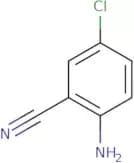
CAS:<p>2-Amino-5-chlorobenzonitrile is a potent inhibitor of butyrylcholinesterase (BChE) and has been shown to inhibit the activity of this enzyme in cell lung cancer and muscle. 2-Amino-5-chlorobenzonitrile also inhibits the activity of other enzymes, such as acetylcholinesterase (AChE) and phosphatidylcholine esterase (PCE), that are found in the membranes of cells. This inhibition leads to increased levels of acetylcholine in the synaptic cleft, which may lead to an increase in muscular contractions. 2-Amino-5-chlorobenzonitrile is also a product yield enhancer for chromene synthesis.</p>Formula:C7H5ClN2Purezza:Min. 95%Colore e forma:PowderPeso molecolare:152.58 g/mol3-Cyanobenzamide
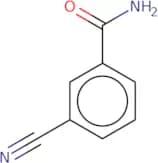
CAS:<p>3-Cyanobenzamide is an organic compound with the formula CHC(N)NH. It is a white crystalline solid that can be obtained by reacting benzamide with cyanoacetylene. There are three possible isomers of 3-cyanobenzamide: 3-cyano-1-(substituted phenyl)benzamide, 3-cyano-2-(substituted phenyl)benzamide, and 3-cyano-3-(substituted phenyl)benzamide. The optimal reaction conditions for the synthesis of 3-cyanobenzamide are in the presence of hydrogen bonding, such as n-hexane, amide, and phase equilibrium. Studies have determined that 3-cyanobenzamide has the potential to cause cancer or liver toxicity in humans. In addition, this chemical has been shown to be an effective inhibitor of alpha glucosidase enzymes in vitro and in vivo.</p>Formula:C8H6N2OPurezza:Min. 90%Peso molecolare:146.15 g/molN-(5-Cyano-2-chlorophenyl)acetamide
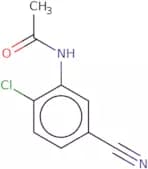
CAS:<p>N-(5-Cyano-2-chlorophenyl)acetamide is a high quality, reagent, and versatile building block. It is a fine chemical that can be used as a building block for the synthesis of other compounds. N-(5-Cyano-2-chlorophenyl)acetamide is also a speciality chemical that can be used in research or as a reaction component. It has been found to be useful as an intermediate in the synthesis of complex compounds.<br>END></p>Formula:C9H7ClN2OPurezza:Min. 95%Peso molecolare:194.62 g/mol2-Acetoxybenzonitrile
CAS:<p>2-Acetoxybenzonitrile is an atypical, acidic organic compound with a molecular weight of 136.06 g/mol. It has a melting point of -5.5 °C and decomposes spontaneously at high temperatures to form benzonitrile, carbon dioxide, and water. 2-Acetoxybenzonitrile is able to act as a competitive inhibitor of acetylsalicylic acid (ASA) in the kinetic determination of ASA using acetylation as the rate-determining step. In this experiment, 2-acetoxybenzonitrile was found to be an effective inhibitor of acetylation with a KI value of 1.8 x 10 M. The spectrometer can be used to determine the molecular weight and purity of 2-acetoxybenzonitrile by measuring its absorbance in the ultraviolet region.<br>2-Acetoxybenzonitrile binds metal cations such as Cu(II), Fe(</p>Formula:C9H7NO2Purezza:Min. 95%Colore e forma:Clear LiquidPeso molecolare:161.16 g/mol2-(Diphenylamino)benzoic acid
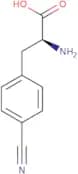
CAS:<p>Please enquire for more information about 2-(Diphenylamino)benzoic acid including the price, delivery time and more detailed product information at the technical inquiry form on this page</p>Formula:C19H15NO2Purezza:Min. 95%Peso molecolare:289.33 g/mol4-Cyano-L-phenylalanine
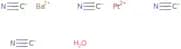
CAS:<p>4-Cyano-L-phenylalanine is an unnatural aminoacid that has been shown to bind to amyloid protein, which is associated with Alzheimer's disease. The binding of 4-Cyano-L-phenylalanine inhibits the synthesis of amyloid protein and prevents the formation of amyloid fibrils. 4-Cyano-L-phenylalanine also irreversibly inhibits the enzyme responsible for the production of hydrochloric acid in bacteria. The x-ray crystal structures of 4-Cyano L-phenylalanine have been determined and show that this compound binds to the active site of the enzyme synthetase, preventing it from forming an amino acid bond. 4-Cyano L-phenylalanine is an analog of 4-L-phenylalanine and, thanks to its cyano (nitrile) group, is a good candidate for use as a fluorescence marker to study the peptide membrane interactions.</p>Formula:C10H10N2O2Purezza:Min. 95%Colore e forma:PowderPeso molecolare:190.2 g/molBarium tetracyanoplatinate(II) hydrate
CAS:Prodotto controllato<p>Please enquire for more information about Barium tetracyanoplatinate(II) hydrate including the price, delivery time and more detailed product information at the technical inquiry form on this page</p>Formula:C4H2BaN4OPtPurezza:Min. 95%Peso molecolare:454.5 g/mol

![4-tert-Butylcalix[4]arene - contains 12% residual solvent (ethyl acetate and acetonitrile)](/_next/image/?url=https%3A%2Fstatic.cymitquimica.com%2Fproducts%2F3D%2Fthumb-webp%2FFB59591.webp&w=3840&q=75)