


Amidi
Le amidi sono una vasta gamma di composti chimici che contengono almeno un anello eterociclico, che possiede atomi di almeno due elementi diversi nella struttura dell'anello, e almeno un gruppo ammidico (-CONH2). Questi composti sono cruciali nella sintesi di prodotti farmaceutici, polimeri e agrochimici. Le amidi presentano proprietà e reattività uniche, che le rendono intermedi preziosi nella sintesi organica. Presso CymitQuimica, offriamo una selezione completa di amidi di alta qualità per supportare le vostre esigenze di ricerca e industriali.
Trovati 16483 prodotti di "Amidi"
Ordinare per
Purezza (%)
0
100
|
0
|
50
|
90
|
95
|
100
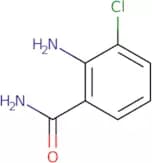
2-Amino-3-chlorobenzamide
CAS:This compound is a benzamide derivative that is oxidized by nature. It has been shown to undergo ring-opening in the presence of reducing agents, such as sodium borohydride, and yields 2-amino-4-chlorobenzaldehyde. This reaction system uses an efficient catalyst such as manganese dioxide to help speed up the rate of this reaction. The product of this reaction is then converted into a variety of isatins depending on the conditions used.Formula:C7H7ClN2OPurezza:Min. 95%Colore e forma:Off-White PowderPeso molecolare:170.6 g/molTrifluoromethanesulfonamide
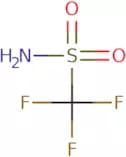
CAS:Trifluoromethanesulfonamide is a strong acid that has been shown to inhibit the proteolytic activity of human secretase. It binds to a specific site on the enzyme and prevents it from cleaving the substrate. This inhibition slows down the progression of Alzheimer's disease, Parkinson's disease, and other related disorders. Trifluoromethanesulfonamide has also been shown to bind to metal hydroxides, such as iron hydroxide, which may be due to its ability to form hydrogen bonds with these metals. Structural analysis reveals that trifluoromethanesulfonamide contains a pyrazole ring and two chlorine atoms, one in the para position and one in the meta position.Formula:CH2F3NO2SColore e forma:PowderPeso molecolare:149.09 g/molN-(n-Butyl)phosphoric triamide
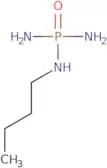
CAS:N-(n-Butyl)phosphoric triamide is an analog of phosphoric acid that has a matrix effect on the uptake of water molecules by cells. N-(n-Butyl)phosphoric triamide is used as a sample preparation agent in microbiological analysis and as an antimicrobial agent to inhibit the growth of bacteria. This compound inhibits the growth rate of triticum aestivum, which may be due to its ability to inhibit nitrous oxide, a key intermediate in bacterial metabolism. N-(n-Butyl)phosphoric triamide has been shown to have an inhibitory effect on water molecule formation and growth rate in bacteria.Formula:C4H14N3OPPurezza:Min. 98 Area-%Colore e forma:White Off-White PowderPeso molecolare:151.15 g/mol2,3-Dichlorobenzamide
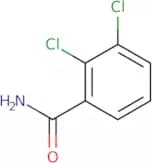
CAS:2,3-Dichlorobenzamide is a herbicide with a stable structure. It has been shown to be effective against the weed species Agropyron repens and other grasses that grow in wetland conditions. 2,3-Dichlorobenzamide inhibits the growth of these plants by causing chlorosis, which is characterized by yellowing of leaves. 2,3-Dichlorobenzamide is toxic to aquatic organisms and can cause pollution in water systems. The molecular electrostatic potential of 2,3-Dichlorobenzamide has been studied using computer models and the parameters have been used to predict its toxicity to various tissues such as nerves or liver cells.Formula:C7H5Cl2NOPurezza:Min. 95%Colore e forma:PowderPeso molecolare:190.03 g/mol(E)-N-(3-Methylaminopropyl)-2-thiopheneacrylamide hydrochloride
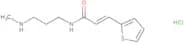
CAS:(E)-N-(3-Methylaminopropyl)-2-thiopheneacrylamide hydrochloride is a high quality, reagent, complex compound, useful intermediate, fine chemical. It has CAS No. 1449108-90-0 and is used as a research chemical and building block in the synthesis of other compounds. (E)-N-(3-Methylaminopropyl)-2-thiopheneacrylamide hydrochloride can be used as a versatile building block in organic synthesis reactions and is an important reaction component for the preparation of speciality chemicals.Formula:C11H17N2OSClPurezza:Min. 95%Colore e forma:White PowderPeso molecolare:260.78 g/molN-(2-(3,4-dimethoxyphenyl)ethyl)(4-nitrophenyl)formamide
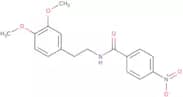
CAS:Prodotto controllatoPlease enquire for more information about N-(2-(3,4-dimethoxyphenyl)ethyl)(4-nitrophenyl)formamide including the price, delivery time and more detailed product information at the technical inquiry form on this pagePurezza:Min. 95%Clorsulon
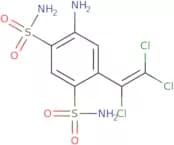
CAS:Clorsulon is an anthelmintic drug that belongs to the group of benzimidazoles. It is used in veterinary medicine to treat nematode and cestode infections, as well as tapeworm infections. Clorsulon is a dispersive solid-phase extraction (DSPE) extractant that can be used for the separation of drugs and their metabolites from biological fluids. The chemical stability of clorsulon was assessed by exposing it to various solvents and pHs. Clorsulon was found to be stable in acetate, benzene, chloroform, ethyl acetate, ethanol, methanol, and water at pH 1-14 and a variety of temperatures ranging from -20 ˚C to 50 ˚C. No significant loss or degradation occurred after exposure to these conditions for up to 24 hours.Formula:C8H8Cl3N3O4S2Purezza:(Hplc) Min. 98.0%Colore e forma:PowderPeso molecolare:380.66 g/molN-Chloro-4-toluenesulfonamide sodium
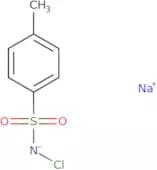
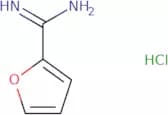
CAS:N-Chloro-4-toluenesulfonamide sodium (NCTS) is a disinfectant that is used to treat wastewater and as a preservative for water. It has been shown to be effective against bacteria, fungi, and viruses. NCTS is an antimicrobial agent that reacts with the matrix in which it is applied to form chloramines-T (NHClO). The chloramines-T inhibits the activity of enzymes such as those involved in DNA synthesis and protein synthesis. This reaction also generates an electric current due to the redox potentials of the reactants. The presence of aziridines in NCTS leads to crosslinking between proteins, which enhances its effectiveness as a disinfectant. NCTS has been shown to have no adverse effects on human erythrocytes or DNA when used at concentrations up to 100 µg/mL.Formula:C7H8ClNO2S•NaPurezza:Min. 95%Colore e forma:PowderPeso molecolare:228.65 g/molFuran-2-carboximidamide hydrochloride
CAS:Please enquire for more information about Furan-2-carboximidamide hydrochloride including the price, delivery time and more detailed product information at the technical inquiry form on this pageFormula:C5H6N2O•HClPurezza:Min. 95%Peso molecolare:146.57 g/mol(2-Chlorophenyl)-N-[4-(trifluoromethyl)phenyl]carboxamide
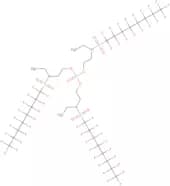
CAS:This is a high quality reagent, complex compound, useful intermediate, and fine chemical. It is also a useful scaffold and can be used as a reaction component in the synthesis of speciality chemicals. The CAS number for this compound is 3873-79-8. [[Category:Chemical Compounds]]Formula:C14H9ClF3NOPurezza:Min. 95%Peso molecolare:299.68 g/molTris[N-Ethyl-1,1,2,2,3,3,4,4,5,5,6,6,7,7,8,8,8-heptadecafluoro-N-(2-hydroxyethyl)-1-Octanesulfonamide] phosphate
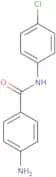
CAS:Prodotto controllatoTris[N-ethyl-1,1,2,2,3,3,4,4,5,5,6,6,7,7,8,8-heptadecafluoro-N-(2-hydroxyethyl)-1-octanesulfonamide] phosphate is a sulfonate that has been mixed with other chemicals. It is used as a chemical substance for the production of other substances. Tris[N-ethyl-1,1,2,2,3]3,[4],4,[5],5,[6],6-[7],7,[8],8-[heptadecafluoro-N-(2-hydroxyethyl)-1-octanesulfonamide] phosphate has not been classified by the International Agency for Research on Cancer (IARC).Formula:C36H27F51N3O10PS3Purezza:Min. 95%Peso molecolare:1,757.7 g/mol(4-Aminophenyl)-N-(4-chlorophenyl)formamide
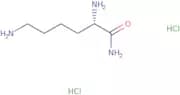
CAS:Please enquire for more information about (4-Aminophenyl)-N-(4-chlorophenyl)formamide including the price, delivery time and more detailed product information at the technical inquiry form on this pageFormula:C13H11ClN2OPurezza:Min. 95%Colore e forma:PowderPeso molecolare:246.69 g/molL-Lysine amide dihydrochloride
CAS:L-Lysine amide dihydrochloride is a crystalline compound that is used for the treatment of tumours. It has been shown to bind to the enzyme iridoid synthase, which is involved in the formation of imines and aldehydes. L-Lysine amide dihydrochloride also inhibits the production of staining compounds, such as fluorine and heterocycles. The compound may also be used cosmetically as an anti-aging agent because it can inhibit the production of collagenase and elastase, which cause degradation of collagen.Formula:C6H15N3O•HCl2Purezza:Min. 95%Colore e forma:Off-White PowderPeso molecolare:218.12 g/molHexadecanamide
CAS:Hexadecanamide is a reactive amide that has an optimum concentration of 1.5-2.0 M in water and a pH range of 3.0-8.0. Hexadecanamide is oxidized by an oxidation catalyst to form hexadecane, which can be analyzed by gas chromatography or high performance liquid chromatography. The oxidation reaction can be monitored under constant pressure conditions using electrochemical impedance spectroscopy. Hexadecanamide reacts with hydroxyl groups and fatty acids to form hexadecanoic acid, which can be analyzed using gas chromatography or high performance liquid chromatography. Hexadecanamide also reacts with viral life to form hexadecanoic acid, which can be analyzed using gas chromatography or high performance liquid chromatography. Hexadecanamide has been shown to have anti-inflammatory properties, which may be due to its ability to inhibit the production of pro-inflammatory cytokines such as histamine and leukotrienesFormula:C16H33NOPurezza:Min. 95%Colore e forma:PowderPeso molecolare:255.44 g/molD-Valine amide hydrochloride
CAS:Please enquire for more information about D-Valine amide hydrochloride including the price, delivery time and more detailed product information at the technical inquiry form on this pageFormula:C5H12N2O•HClPurezza:Min. 95%Colore e forma:PowderPeso molecolare:152.62 g/mol(E)-N-(2-Chloro-6-methylphenyl)-3-ethoxyacrylamide
CAS:(E)-N-(2-Chloro-6-methylphenyl)-3-ethoxyacrylamide is a reagent and research chemical that can be used as a building block in the synthesis of other compounds. It is also a versatile building block in organic chemistry. (E)-N-(2-Chloro-6-methylphenyl)-3-ethoxyacrylamide has been shown to be an effective intermediate for the synthesis of various complex compounds, such as pharmaceuticals and pesticides. This compound is also a useful scaffold for the synthesis of other fine chemicals.
Formula:C12H14ClNO2Purezza:(¹H-Nmr) Min. 95 Area-%Colore e forma:PowderPeso molecolare:239.7 g/molN-(4-(((2-Indol-3-ylethyl)amino)sulfonyl)phenyl)ethanamide
CAS:Please enquire for more information about N-(4-(((2-Indol-3-ylethyl)amino)sulfonyl)phenyl)ethanamide including the price, delivery time and more detailed product information at the technical inquiry form on this page
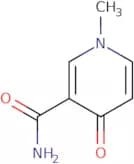
Formula:C18H19N3O3SPurezza:Min. 95%Colore e forma:PowderPeso molecolare:357.43 g/molN-Methyl-4-pyridone-3-carboxamide
CAS:N-Methyl-4-pyridone-3-carboxamide is a nonnutritive sweetener that has been shown to have no effect on peroxisome proliferation. It also had no effect on the levels of fatty acids in rat cardiomyocytes and did not affect uv absorption. N-Methyl-4-pyridone-3-carboxamide binds to the receptor α subunit of the taste receptor and inhibits adenosine uptake, which may be responsible for its effects on depression. This compound also alters energy metabolism by inhibiting mitochondrial ATP production and glycolysis.Formula:C7H8N2O2Purezza:(%) Min. 95%Colore e forma:PowderPeso molecolare:152.15 g/molL-Leucine b-naphthylamide hydrochloride
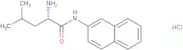
CAS:Please enquire for more information about L-Leucine b-naphthylamide hydrochloride including the price, delivery time and more detailed product information at the technical inquiry form on this pageFormula:C16H20N2O·HClPurezza:Min. 95%Colore e forma:PowderPeso molecolare:292.8 g/mol2-Amino-N-[2-(2-chlorobenzoyl)-4-nitrophenyl]acetamide
CAS:2-Amino-N-[2-(2-chlorobenzoyl)-4-nitrophenyl]acetamide is a fine chemical that is used as a building block in organic synthesis. It is a versatile intermediate for the synthesis of other compounds and can be used to make a variety of useful scaffolds. 2-Amino-N-[2-(2-chlorobenzoyl)-4-nitrophenyl]acetamide has been used in research and development of pharmaceuticals, agrochemicals, herbicides, and other compounds.Formula:C15H12ClN3O4Purezza:Min. 95%Colore e forma:Slightly Yellow PowderPeso molecolare:333.73 g/mol

![(2-Chlorophenyl)-N-[4-(trifluoromethyl)phenyl]carboxamide](/_next/image/?url=https%3A%2Fstatic.cymitquimica.com%2Fproducts%2F3D%2Fthumb-webp%2FFC145671.webp&w=3840&q=75)



![2-Amino-N-[2-(2-chlorobenzoyl)-4-nitrophenyl]acetamide](/_next/image/?url=https%3A%2Fstatic.cymitquimica.com%2Fproducts%2F3D%2Fthumb-webp%2FFA17795.webp&w=3840&q=75)