Standard farmaceutici
Gli standard farmaceutici sono un insieme completo di materiali di riferimento essenziali per garantire la sicurezza, l'efficacia e la qualità dei prodotti farmaceutici. Questa categoria include standard per ingredienti farmaceutici attivi (API), che sono i componenti principali responsabili degli effetti terapeutici. Inoltre, copre composti e metaboliti rilevanti sia per l'industria farmaceutica che veterinaria, fornendo punti di riferimento per la misurazione e l'analisi precisa di queste sostanze. Gli standard di controllo delle nitrosammine sono cruciali per rilevare e mitigare le nitrosammine potenzialmente dannose nelle formulazioni di farmaci. Gli standard di tossicologia aiutano a valutare la sicurezza e i potenziali effetti avversi dei composti farmaceutici. Inoltre, gli standard per attivatori e inibitori enzimatici sono vitali per la ricerca e lo sviluppo, consentendo studi precisi delle vie biochimiche e dei meccanismi d'azione dei farmaci. Questi standard farmaceutici sono strumenti indispensabili per la conformità normativa, il controllo di qualità e la ricerca, garantendo che i prodotti farmaceutici soddisfino rigorosi criteri di sicurezza ed efficacia.
Sottocategorie di "Standard farmaceutici"
- APIs per la ricerca e le impurità(273.482 prodotti)
- Attivatori e inibitori enzimatici(2.827 prodotti)
- Nitrosamine(2.606 prodotti)
- Composti e metaboliti farmaceutici e veterinari(2.602 prodotti)
- Tossicologia(13.652 prodotti)
Trovati 7836 prodotti di "Standard farmaceutici"
Ordinare per
Purezza (%)
0
100
|
0
|
50
|
90
|
95
|
100
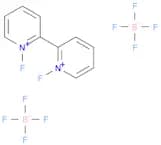
2,2'-Bipyridinium, 1,1'-difluoro-, tetrafluoroborate(1-) (1:2)
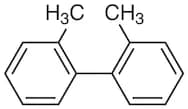
CAS:Formula:C10H8B2F10N2Purezza:95%Colore e forma:SolidPeso molecolare:367.79002,2'-Dimethylbiphenyl
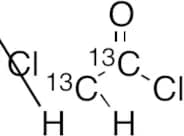
CAS:Formula:C14H14Purezza:>95.0%(GC)Colore e forma:Colorless to Light yellow to Light red clear liquidPeso molecolare:182.27Chloroacetyl Chloride-13C2
CAS:Formula:C2H2Cl2OColore e forma:Clear Colourless OilPeso molecolare:114.93Ref: TR-C363754
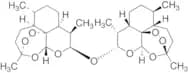
Prodotto fuori produzioneDihydro Artemisinin Dimer
CAS:<p>Applications Dihydro Artemisinin (D448360) dimer with anticancer and antiprotozoal activity.<br>References Galal, A. et al.: Bioorg. Med. Chem., 17, 741 (2009); Beekman, A. et al.: Phytother. Res., 10, 140 (1996)<br></p>Formula:C30H46O9Colore e forma:White to Off-White SolidPeso molecolare:550.68Artemether
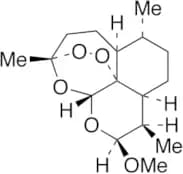
CAS:<p>Applications Derivative of Artemisinin (A777500). Antimalarial, used to treat strains of malaria which are multi-drug resistant.<br>References Hombhanje, F., et al.: Pharma., 3, 3581 (2010), Michael, O., et al.: Malaria J., 9, 335 (2010), Cesar, I., et al.: J. Pharm. Biomed. Anal., 54, 114 (2011),<br></p>Formula:C16H26O5Colore e forma:White to Off-White SolidPeso molecolare:298.37α-Artemether
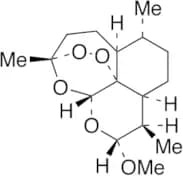
CAS:<p>Impurity Artemether USP Related Compound B<br>Applications Derivative of Artemisinin (A777500). Shows antimalarial and antifungal activity.<br>References Michael, O., et al.: Malaria J., 9, 335 (2010), Cesar, I., et al.: J. Pharm. Biomed. Anal., 54, 114 (2011), Galal, A. et al.: J. Nat. Prod. 68, 1274 (2005)<br></p>Formula:C16H26O5Colore e forma:Off-WhitePeso molecolare:298.37Ref: TR-A777410
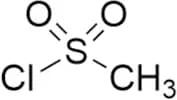
Prodotto fuori produzioneMethanesulfonyl Chloride
CAS:Formula:CH3ClO2SColore e forma:Colourless to Pale Yellow OilPeso molecolare:114.55DL-Methionine Methylsulfonium Chloride
CAS:Prodotto controllato<p>Applications DL-Methionine methylsulfonium chloride (cas# 3493-12-07) is a useful research chemical.<br></p>Formula:C6H14ClNO2SColore e forma:NeatPeso molecolare:199.7Vanillin-13C6
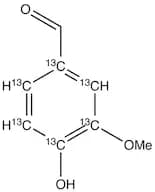
CAS:<p>Applications Labelled Vanillin. Occurs naturally in a wide variety of foods and plants such as orchids; major commercial source of natural vanillin is from vanilla bean extract. Synthetically produced in-bulk from lignin-based byproduct of paper processes or from guaicol.<br>References Jenner, P.M., et al.: Food Cosmet. Toxicol., 2, 327 (1964), Clark, G.S., et al.: Perfum. Flavor., 15, 45 (1990),<br></p>Formula:C6C2H8O3Colore e forma:NeatPeso molecolare:158.101-(3,4-Methylenedioxyphenyl) 2-nitropropene
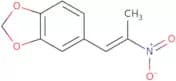
CAS:<p>1-(3,4-Methylenedioxyphenyl) 2-nitropropene (1-MPNP) is a phosphatase inhibitor that is active against gram-negative bacteria by inhibiting enterotoxins and chlamydia. 1-MPNP inhibits the activity of tyrosine phosphatases, which are enzymes that play a major role in bacterial virulence. 1-MPNP competitively inhibits the activity of tyrosine phosphatases and prevents them from catalyzing the hydrolysis of polyphosphate substrates. This inhibition leads to an accumulation of polyphosphates in the bacterial cell membrane, which disrupts its permeability and leads to cell death.</p>Formula:C10H9NO4Purezza:Min. 97.5 Area-%Colore e forma:Yellow PowderPeso molecolare:207.18 g/mol3,3',4',5,5',8-Hexahydroxyflavone
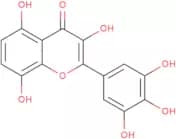
CAS:<p>3,3',4',5,5',8-Hexahydroxyflavone is a naturally occurring flavonoid, which is a type of polyphenolic compound. It is derived from various plant sources, including fruits, vegetables, and certain medicinal herbs. The compound is characterized by its chemical structure, which includes multiple hydroxyl groups, contributing to its biological activity.<br><br>The mode of action of 3,3',4',5,5',8-Hexahydroxyflavone involves its interaction with various cellular pathways and enzymes. Primarily, it is known for its antioxidant properties, where it scavenges free radicals and reactive oxygen species, thereby reducing oxidative stress. Additionally, it may exhibit anti-inflammatory effects by modulating signaling pathways involved in inflammation.<br><br>In terms of uses and applications, 3,3',4',5,5',8-Hexahydroxyflavone is primarily explored in scientific research focusing on its potential health benefits. Studies investigate its role in disease prevention, particularly conditions associated with oxidative stress and inflammation, such as cardiovascular diseases and neurodegenerative disorders. While it holds promise in these areas, further research is necessary to fully understand its mechanisms and therapeutic potential.</p>Formula:C15H10O8Purezza:Min. 95%Peso molecolare:318.24 g/molL-Methionine
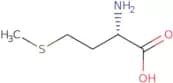
CAS:<p>L-Methionine is a non-essential amino acid that belongs to the group of essential amino acids. It is a major constituent of proteins and is used in the metabolism of lipids, carbohydrates, and nucleic acids. Methionine is also involved in the synthesis of cysteine, which is an important antioxidant. L-Methionine can be found in many foods such as eggs, dairy products, fish, poultry, soybean products, peanuts, beans and seeds. Studies have shown that L-methionine has effects on liver function and may be useful for prevention or treatment of liver disorders such as primary sclerosing cholangitis (PSC). This compound also plays a role in the formation of body tissues and cells. L-Methionine has been shown to increase glutathione levels which are important for detoxification reactions and protection against oxidative stress. It also helps regulate calcium metabolism by reducing calcium absorption from food and increasing excretion via</p>Formula:C5H11NO2SPurezza:(Titration) 98.5 To 101.5%Colore e forma:White PowderPeso molecolare:149.21 g/molN-Acetylethylene Urea-d4
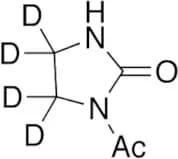
CAS:Prodotto controllato<p>Applications N-Acetylethylene Urea-d4 (cas# 1189701-94-7) is a compound useful in organic synthesis.<br></p>Formula:C5H4H4N2O2Colore e forma:NeatPeso molecolare:132.15Guanosine-5'-triphosphate Disodium Salt (~85%)
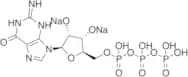
CAS:Prodotto controllato<p>Applications Guanosine-5'-triphosphate disodium salt (CAS# 56001-37-7) is a nucleotide used in the preparation of photoreactive GTP affinity probes, and in inhibitors of eukaryotic initiation factor eIF-4E.<br>References George Cisar, E. A.; J. Am. Chem. Soc., 135, 4676 (2013); Ghosh, P.; et al.: Bioorg. Med. Chem. Lett., 16, 750 (2006).<br></p>Formula:C10H14N5O14P3Na2Purezza:~85%Colore e forma:NeatPeso molecolare:567.14Ref: TR-G838608
Prodotto fuori produzioneTriethylborane (1.0 M in THF)
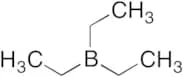
CAS:Prodotto controllato<p>Applications Triethylborane reacted with 8-hydroxyquinoline to synthesize three 8--hydroxyquinolato (q) boron compounds B(C2H5)2q (1), BPh2q (2), and B(2-naph)2q (3).<br>References Wu, Q., et al.: Chem. Mater., 12, 79 (2000).<br></p>Formula:C6H15BColore e forma:Single SolutionPeso molecolare:97.99Ethyl Dichlorophosphate
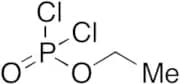
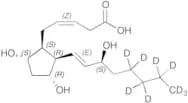
CAS:Prodotto controllatoFormula:C2H5Cl2O2PColore e forma:White to Off-White SolidPeso molecolare:162.942,3-Dinor iPF2α-III-d9
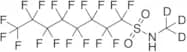
CAS:Prodotto controllatoFormula:C18D9H21O5Colore e forma:NeatPeso molecolare:335.483N-Methylperfluorooctanesulfonamide-d3 (50μg/mL in Methanol)
CAS:Prodotto controllatoFormula:C9HD3F17NO2SColore e forma:Single SolutionPeso molecolare:516.19