Glicoscienza
Sottocategorie di "Glicoscienza"
- Amminozucchero(108 prodotti)
- Glico-anticorpi(282 prodotti)
- Glicolipidi(46 prodotti)
- Glicosaminoglicani (GAGs)(55 prodotti)
- Glicosidi(419 prodotti)
- Monosaccaridi(6.624 prodotti)
- Oligosaccaridi(3.682 prodotti)
- Polisaccaridi(504 prodotti)
Trovati 11047 prodotti di "Glicoscienza"
2-Acetamido-6-azido-2,6-dideoxy-D-galactopyranose
CAS:2-Acetamido-6-azido-2,6-dideoxy-D-galactopyranose is a synthetic, unnatural monosaccharide bearing an azido biorthogonal reaction group. This compound can enter the cell and is processed by biosynthetic enzymes, in a manner similar to the natural O-linked N-acetyl-β-D-glucosamine. The glycans produced bear the azido functional group which can be chemically tagged with fluorescent dyes or biotin for visualisation or affinity.
Formula:C8H14N4O5Purezza:Min. 95%Peso molecolare:246.22 g/mol4-Methoxyphenyl 4,6-O-benzylidene-2-deoxy-2-phthalimido-β-D-glucopyranoside
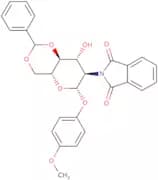
CAS:4-Methoxyphenyl 4,6-O-benzylidene-2-deoxy-2-phthalimido-b-D-glucopyranoside is an organic compound with the formula C13H14N4O8. It is a white solid that is soluble in water, methanol and ethanol. The compound has been synthesized using Click chemistry, fluorination, glycosylation, and methylation of the sugar. It has also been modified with an oligosaccharide and monosaccharide to form a complex carbohydrate.Formula:C28H25NO8Purezza:Min. 98 Area-%Colore e forma:PowderPeso molecolare:503.51 g/mol6-Monodeoxy-6-monoamino-gamma-cyclodextrin,
CAS:This gamma-cyclodextrin (γ-CD) derivative is a modified cyclic oligosaccharide composed of eight glucose units, featuring a larger cavity size than α- and β-cyclodextrins. This structural characteristic allows γ-CDs to form inclusion complexes with a wider range of guest molecules, making it particularly versatile in various industries. In the food sector, it is used as a carrier and stabilizer for flavors, fat-soluble vitamins, and polyunsaturated fatty acids, protecting volatile compounds from evaporation. In pharmaceuticals, it enhances the solubility and bioavailability of poorly water-soluble drugs and, thanks to its larger ring size, allows for the encapsulation of larger molecules or even entire drug molecules. γ-CDs and derivatives are also used for environmental remediation and, in analytical chemistry, for the extraction and concentration of target substances.Formula:C48H81NO39Purezza:Min. 95%Peso molecolare:1,296.14 g/mol3,4,6-Tri-O-acetyl-1,2-O-ethoxyethylidene-β-D-mannopyranose
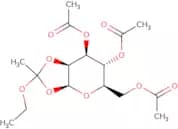
CAS:3,4,6-Tri-O-acetyl-1,2-O-ethoxyethylidene-b-D-mannopyranose is a synthetic monosaccharide that is used as a substrate for the production of various oligosaccharides and polysaccharides. This substance can be fluorinated to produce 3,4,6-tri-O-(3′,5′ -difluoro) acetyl-1,2:5′,6′ -di(O—ethoxyethylidene)-b-D mannopyranose. It has been shown that methylation of the C1 position in this compound results in a variety of different compounds with different properties. In addition to its use as a substrate in organic synthesis, 3,4,6 triacetyl 1,2:5', 6'-di(O—ethoxyethylidene)-b D mannopyranose is alsoFormula:C16H24O10Purezza:Min. 95%Peso molecolare:376.36 g/molMethyl b-D-fructofuranoside
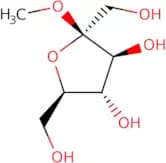
CAS:Methyl b-D-fructofuranoside is a chemical compound that is used in the production of esters and fatty acids. Methyl b-D-fructofuranoside is produced by a dehydration reaction between two molecules of acetone. The product of this reaction, methyl b-D-fructopyranoside, can be broken down into two molecules of acetone and one molecule each of methyl alcohol and carbon dioxide. This process is called alkylation. Furanocoumarin derivatives are often found in plants such as asperulosidic acid and quinquefasciatus. These compounds are found in many species of plant, but they are most concentrated in the roots of these plants because they are more metabolically active there than other parts of the plant. Environmental pollution can lead to high concentrations of furanocoumarins in plants, which can have toxic effects on organisms that come into contact with them.
Formula:C7H14O6Purezza:Min. 98 Area-%Colore e forma:Clear LiquidPeso molecolare:194.18 g/molTetragalacturonic acid
CAS:Tetragalacturonic acid (α-1,4 galacturonotetraose) is derived from pectin or pectic acid by enzymatic or partial acid hydrolysis (Combo, 2012). It is used inâ¯galacturonic acidâ¯metabolism research as a substrate to identify, differentiate, and characterize endo- and exopolygalacturonase(s), and gluconase(s) (Jayani, 2005). The addition of very short fragments of homogalacturonan, tri-galacturonate, and tetra-galacturonate oligosaccharides restores development in dark-grown, de-etiolated seedling mutants, suggesting that they are unable to generate de-methylesterified pectin fragments. A model of spatiotemporally separated photoreceptive and signal-responsive cell types has been proposed, that contains overlapping subsets of the regulatory network of light-dependent seedling development (Sinclair, 2017).Formula:C24H34O25Purezza:(%) Min. 95%Colore e forma:White PowderPeso molecolare:722.51 g/molPhenylmethyl N-[3-[[1-oxo-5-[[3,4,6-tri-O-acetyl-2-(acetylamino)-2-deoxy-β-D-galactopyranosyl]oxy]pentyl]amino]propyl]carbamate
CAS:Please enquire for more information about Phenylmethyl N-[3-[[1-oxo-5-[[3,4,6-tri-O-acetyl-2-(acetylamino)-2-deoxy-β-D-galactopyranosyl]oxy]pentyl]amino]propyl]carbamate including the price, delivery time and more detailed product information at the technical inquiry form on this page
Formula:C30H43N3O12Peso molecolare:637.68 g/molAtorvastatin acyl-b-D-glucuronide
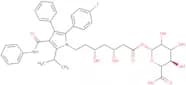
CAS:Atorvastatin acyl-b-D-glucuronide is a synthetic compound that has been modified with fluorine and methyl groups. It is a glycosylated molecule with a carbohydrate moiety. It has been shown to be active against Saccharide-producing bacteria, such as the genus Clostridium, which are responsible for the production of polysaccharides and glycans.Formula:C39H45FN2O11Purezza:90%MinPeso molecolare:736.8 g/molGlyco-diosgenin
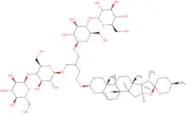
CAS:Glyco-diosgenin is an amphipathic molecule that has been found to stabilize proteins. It has the potential to be developed as a drug target for stabilizing proteins in cells. Glyco-diosgenin was synthesized by chemical modification of diosgenin, which is a steroidal saponin found in plants. The chemical modification that occurred at the 3-hydroxyl position of glyco-diosgenin produced a more effective molecule due to increased solubility and decreased toxicity. The protein stabilization properties of glyco-diosgenin have been shown by cryo-electron microscopy on plant cells, titration calorimetry, and functional studies on various proteins.
Formula:C56H92O25Purezza:Min. 97 Area-%Colore e forma:PowderPeso molecolare:1,165.31 g/mol2-Deoxy-2-fluoro-D-fucose
2-Deoxy-2-fluoro-D-fucose is a custom synthesis, which is a complex carbohydrate. It has CAS No. and polysaccharide modification and can be methylated, glycosylated, or fluorinated. The molecular weight of this product is high purity and it can be used as a sugar or carbohydrate. Click modification is possible with 2-deoxy-2 fluoro-D-fucose.
Formula:C6H11FO4Purezza:Min. 95%Colore e forma:PowderPeso molecolare:166.15 g/molLipid IVa
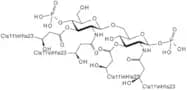
CAS:Lipid IVA is a tetra-acylated precursor molecule of lipid A which is a component of lipopolysaccharides (LPS) on the outer membrane of gram-negative bacteria. On the innate immune cells of hosts there are toll-like receptor 4 (TLR4) and MD-2 which recognize LPS. This recognition event ultimately leads to the activation of NFκB which in turn results in pro-inflammatory cytokine production. Studies have suggested lipid A in Escherichia coli to be an agonist for both mouse and human TLR4, while lipid IVA can induce species specific TLR4 responses. For example for horse and mouse TLR4 and MD-2, Lipid IVA is an agonist where as it is an antagonist for TLR4 and MD-2 in humans.Formula:C68H130N2O23P2Purezza:One Main SpotColore e forma:White PowderPeso molecolare:1,405.7 g/molBenzyl 2,3-O-isopropylidene-α-D-mannofuranoside
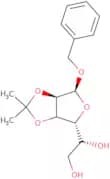
CAS:Benzyl 2,3-O-isopropylidene-a-D-mannofuranoside is a fluorinated monosaccharide that is synthesized using glycosylation and polysaccharide modification. This product has a CAS number of 20689-03-6 and can be used for complex carbohydrate synthesis. It has been shown to have high purity.
Formula:C16H22O6Purezza:Min. 95%Colore e forma:PowderPeso molecolare:310.34 g/molTetradecyl b-D-maltopyranoside
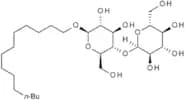
CAS:Tetradecyl b-D-maltopyranoside is a crystalline polymer of high molecular weight that is made up of repeating units of tetradecyl b-D-maltose. It has a lamellar morphology and can be sectioned with techniques such as electron microscopy, X-ray diffraction, and differential scanning calorimetry. Tetradecyl b-D-maltopyranoside is a metastable form of the compound. It has been found in nature in the form of the monomer unit, tetradecyl maltosyl (tetramethyleneglycol) b-d-maltoside. In order to produce this compound as a polymer, it must first be heated to about 160°C for several hours, which causes the monomers to assemble into chains of tetrahedrons. The properties of tetradecyl b-D-maltopyranoside depend on its environmentFormula:C26H50O11Purezza:Min. 95 Area-%Colore e forma:PowderPeso molecolare:538.67 g/molCellulose acetate - MW 30,000
CAS:Cellulose acetate fiber is one of the earliest synthetic fibers and is based on cotton or tree pulp cellulose. Cellulose acetate is used as a film base in photography, as a component in some coatings, and as a frame material for eyeglasses. It is also used as a synthetic fiber in the manufacture of cigarette filters and playing cards. In photographic film, cellulose acetate replaced nitrate film in the 1950s, being far less flammable and cheaper to produce but in recent years has been rendered obsolete by the advent of digital cameras.Colore e forma:PowderMono-(6-(diethylenetriamine)-6-deoxy)-β-Cyclodextrin
CAS:Please enquire for more information about Mono-(6-(diethylenetriamine)-6-deoxy)-β-Cyclodextrin including the price, delivery time and more detailed product information at the technical inquiry form on this page
Formula:C46H81N3O34Purezza:Min. 95%Peso molecolare:1,220.1 g/molD-Fructose-1,6-diphosphate dibarium
CAS:D-Fructose-1,6-diphosphate dibarium salt is a synthetic sugar that is used in the synthesis of oligosaccharides and polysaccharides. This compound can be custom synthesized to meet your specifications. D-Fructose-1,6-diphosphate dibarium salt has been shown to be soluble in water, ethanol, acetone, and chloroform. D-Fructose-1,6-diphosphate dibarium salt is a fluorinated carbohydrate with a purity of 99%. It can be modified with methylation or click modification for further applications.Formula:C6H14O12P2•(Ba)2Purezza:Min. 95%Colore e forma:PowderPeso molecolare:614.75 g/molMethyl 2,3,6-tri-O-benzyl-α-D-galactopyranoside
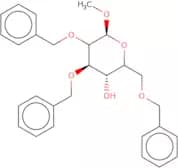
CAS:Methyl 2,3,6-tri-O-benzyl-a-D-galactopyranoside is a carbohydrate that belongs to the class of saccharides. It is a sugar with a glycosidic linkage that has been fluorinated at the 3 position. Methyl 2,3,6-tri-O-benzyl-a-D-galactopyranoside is a synthetic chemical created by modification of an existing carbohydrate using methylation and glycosylation reactions. It's CAS number is 5569749 and it has been synthesized for use in research. Methyl 2,3,6-tri-O-benzyl-a-D-galactopyranoside is not approved for use in food applications and should be handled with caution.
Formula:C28H32O6Purezza:Min. 95%Peso molecolare:464.55 g/molGum cassia tora
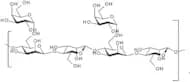
CAS:Cassia gum is obtained from the ground purified endosperm of the seeds of Cassia tora and Cassia obtusifolia (Fam. Leguminosae) containing less than 0.05% of Cassia occidentalis. It consists mainly of high molecular weight (approximately 200,000-300,000) The polysaccharide is composed of galactomannans with a mannose:galactose ratio of about 5:1. The seeds are dehusked and degermed by thermal and mechanical treatment followed by milling and screening of the endosperm. The ground endosperm is purified by extraction with isopropanol. It is used as a thickener, emulsifier, foam stabilizer, moisture retention agent and texturizing agent in cheese, frozen dairy desserts and mixes, meat products and poultry products.Purezza:Min. 95%2-Keto-D-gluconic acid
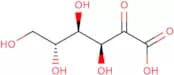
CAS:2-Keto-D-gluconic acid is a naturally occurring compound that can be synthesized from sodium carbonate and 2-keto-d-gluconic acid. 2-Keto-D-gluconic acid has been shown to have antimicrobial properties against many bacterial strains, including its ability to inhibit the growth of wild type strains of Staphylococcus aureus, Streptococcus pneumoniae, Escherichia coli, and Pseudomonas aeruginosa. It has also been shown to have antiinflammatory properties. The synthesis of 2-keto-D-gluconic acid requires optimization of the process with respect to the monoclonal antibody surface methodology used.Formula:C6H10O7Purezza:Min. 95%Colore e forma:PowderPeso molecolare:194.14 g/molMaltose syrup
Used for making baked goods, soft drinks, sweets, alcoholic drinks, and infant food. It is also used to produce the sugar substitute maltitol.Purezza:Min. 95%




![Phenylmethyl N-[3-[[1-oxo-5-[[3,4,6-tri-O-acetyl-2-(acetylamino)-2-deoxy-β-D-galactopyranosyl]oxy]…](/_next/image/?url=https%3A%2Fstatic.cymitquimica.com%2Fproducts%2F3D%2Fthumb-webp%2FMP184464.webp&w=3840&q=75)