Zuccheri e nucleobasi della spina dorsale
Gli zuccheri dello scheletro e le basi azotate sono componenti essenziali degli acidi nucleici come DNA e RNA. Lo scheletro è composto da gruppi zuccheri e fosfati, mentre le basi azotate formano il codice genetico attraverso l'appaiamento delle basi. Questi composti sono fondamentali nello studio della genetica e della biologia molecolare. Presso CymitQuimica, è possibile trovare una varietà di zuccheri dello scheletro e basi azotate per la ricerca e l'uso in laboratorio.
Trovati 1001 prodotti di "Zuccheri e nucleobasi della spina dorsale"
Ordinare per
Purezza (%)
0
100
|
0
|
50
|
90
|
95
|
100
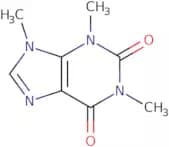
1,3,9-Trimethylxanthine
CAS:Prodotto controllato<p>1,3,9-Trimethylxanthine is a naturally occurring purine alkaloid that has been shown to have cytosolic calcium ion-antagonistic properties. It can also act as an antioxidant by donating electrons to free radicals and inhibiting lipid peroxidation. This compound is found in coffee beans and other sources of caffeine. It binds to the receptor for adenosine, which causes the antagonistic effects on intracellular calcium concentration. Trimethylxanthine can also be used to treat ventricular arrhythmias and increase locomotor activity in mammals. Trimethylxanthine has been shown to be effective in wastewater treatment as it removes organic pollutants from water by oxidizing them with hydrogen peroxide or chlorine gas.</p>Formula:C8H10N4O2Purezza:Min. 95%Colore e forma:White PowderPeso molecolare:194.19 g/mol6-Aminouracil
CAS:<p>6-Aminouracil is a hydroxylated form of uracil. It has inhibitory properties against protein synthesis in bacteria, acting as an inhibitor of the enzyme dihydroorotase. 6-Aminouracil has been shown to be effective against PC3 cells and has high resistance to hydrolysis by acid or alkali. The reaction mechanism for the conversion of uracil to 6-aminouracil is unclear; however, it may involve a nucleophilic attack on the hydroxyl group.</p>Formula:C4H5N3O2Purezza:Min. 95%Colore e forma:PowderPeso molecolare:127.1 g/mol3’-Azido-3’-deoxyguanosine
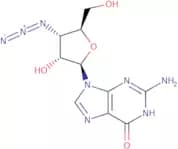
CAS:<p>Please enquire for more information about 3’-Azido-3’-deoxyguanosine including the price, delivery time and more detailed product information at the technical inquiry form on this page</p>Formula:C10H12N8O4Purezza:Min. 95%Peso molecolare:308.09815N2,9-Diacetylguanine
CAS:<p>N2,9-Diacetylguanine is a synthetic molecule that can be used to inhibit the replication of herpes simplex virus. It has been found to inhibit the growth of viruses in vitro by binding to the viral DNA and inhibiting viral RNA synthesis. N2,9-Diacetylguanine is also a substrate for acetylation and may undergo this reaction with acetyl coenzyme A to form N4,9-diacetylguanine. The acetylated form of guanine inhibits the virus by blocking its ability to replicate DNA. The potential mechanism for this drug's anti-viral activity includes inhibition of the enzyme ribonucleotide reductase, which converts ribonucleotides into deoxyribonucleotides.</p>Formula:C9H9N5O3Purezza:Min. 95%Colore e forma:Off-White PowderPeso molecolare:235.2 g/mol5-Aminouracil
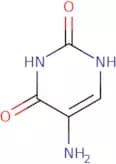
CAS:<p>5-Aminouracil is a pyrimidine nucleoside that is used in the treatment of cancer, psoriasis and other autoimmune disorders. 5-Aminouracil is a prodrug that undergoes intracellular transformation to become an inhibitor of DNA synthesis. It promotes apoptosis by inhibiting the production of RNA and protein synthesis, leading to cell death. 5-Aminouracil has been shown to be effective against malignant cells in tissue culture as well as various types of cancer cells. A study using hydrogen bonding interactions showed that 5-aminouracil binds to the ribosomal protein L10 and inhibits its function in the polymerase chain reaction (PCR). Molecular docking studies have also shown that this drug can bind with redox potentials in both the active site and ligand binding site of human topoisomerase II alpha, which may lead to inhibition of enzyme activity or cell death.</p>Formula:C4H5N3O2Purezza:Min. 95%Colore e forma:White PowderPeso molecolare:127.1 g/mol6-Methyluracil
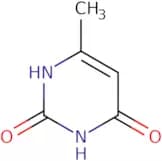
CAS:<p>6-Methyluracil is an antimetabolite that inhibits protein synthesis and is therefore used in the treatment of infectious diseases. 6-Methyluracil has two hydroxyl groups, which are located in adjacent positions on the ring. The optimum concentration for this drug is 3-10 μM, which can be achieved with a malonic acid buffer solution at pH 7.4. 6-Methyluracil reacts with sodium succinate to form an acid complex, which may have antiinflammatory activity. 6-Methyluracil has been shown to inhibit prostaglandin synthesis and exhibits a reaction with radiation to produce photoproducts that can be detected by analytical chemistry.</p>Formula:C5H6N2O2Purezza:Min. 95%Colore e forma:PowderPeso molecolare:126.12 g/mol3-Benzyladenine
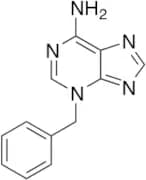
CAS:Prodotto controllato<p>Applications 3-BENZYLADENINE (cas# 7280-81-1) is a useful research chemical.<br></p>Formula:C12H11N5Colore e forma:NeatPeso molecolare:225.259N-Trityl Guanine
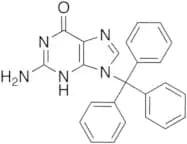
CAS:Prodotto controllato<p>Applications Protected Guanine.<br>References Hakimelahi, G., et al.: J. Med. Chem., 44, 3710 (2001),<br></p>Formula:C24H19N5OColore e forma:NeatPeso molecolare:393.44N-Allyl-1,7-dideazaadenine
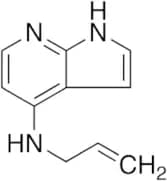
CAS:Prodotto controllato<p>Applications Used in the preparation of pyrrolotriazines.<br></p>Formula:C10H11N3Colore e forma:NeatPeso molecolare:173.21Uracil Lyxonucleoside-13C,15N2 5'-Phosphate
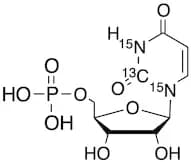
CAS:Prodotto controllato<p>Applications Uracil Lyxonucleoside 5'-Phosphate is an intermediate in the synthesis of Trilithium UDP-glucuronic Acid-13C1, 15N2 (T886287), which is an isotope labelled analog of Trisodium UDP-glucuronic Acid (T886285). Trisodium UDP-glucuronic Acid is a reactant used in the enzymatic preparation of β-glucuronides.<br>References Stevenson, D.E., et. al.: Collect Czech. Chem. C., 65, 117 (2000); Robotham, S.A., Brodbelt, J.S.: Biochem. Pharmacol., 82, 1764 (2011); Kren, V., et. al.: Drug Metab. Dispos., 28, 1513 (2000)<br></p>Formula:C813CH1315N2O9PColore e forma:NeatPeso molecolare:327.161,3-Diethyl-5-nitroso-6-aminouracil
CAS:Prodotto controllato<p>Applications 1,3-Diethyl-5-nitroso-6-aminouracil (cas# 89073-60-9) is a compound useful in organic synthesis.<br></p>Formula:C8H12N4O3Colore e forma:NeatPeso molecolare:212.218-Nitroguanine
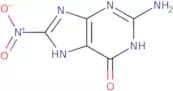
CAS:<p>8-Nitroguanine is a reactive cell factor that can be found in the skin and other tissues. It is an endogenous product of nitric oxide, which can be formed by the reaction of nitric oxide with superoxide in the presence of peroxynitrite. 8-Nitroguanine has been shown to inhibit matrix metalloproteinase-9 activity and to have a protective effect on cells from UV radiation. 8-Nitroguanine also has been shown to be a potential biomarker for bowel disease and damage. The levels of 8-nitroguanine increase in chronic viral hepatitis and cancer tissues. This compound can also be used as an analytical method for detection of inflammation, oxidative stress, or DNA damage.</p>Formula:C5H4N6O3Purezza:Min. 95%Colore e forma:PowderPeso molecolare:196.13 g/mol2-Mesitylenesulfonyl Chloride
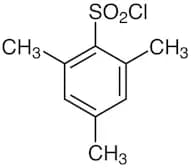
CAS:Formula:C9H11ClO2SPurezza:>99.0%(T)Colore e forma:White powder to crystalPeso molecolare:218.702-Dimethylamino-6-hydroxypurine
CAS:<p>2-Dimethylamino-6-hydroxypurine is a biochemical that belongs to the group of purines. It is a methylated form of 2,6-diaminopurine and has been shown to be an antigenic product in wheat germ. 2,6-Diaminopurine is involved in the synthesis of protein and other biomolecules by transferring methyl groups from S-adenosyl methionine to amino acid side chains. This gene product is also involved in enzyme preparations and reactions that are related to the biochemical properties of mammalian cells. The methyltransferase enzyme catalyzes the reaction mechanism for 2,6-dimethylamino-purine. 2,6-Dimethylamino-purine has been shown to have anticancer effects on various types of cancer cells with modifications on their DNA.</p>Formula:C7H9N5OPurezza:Min. 95%Colore e forma:Off-white to yellow solid.Peso molecolare:179.18 g/mol5-Methyl-2-thiouracil
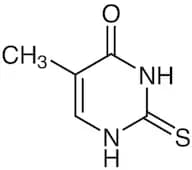
CAS:Formula:C5H6N2OSPurezza:>98.0%(T)(HPLC)Colore e forma:White to Almost white powder to crystalPeso molecolare:142.183’-O-t-Bulyldimethylsilyl thymidine
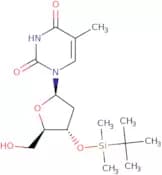
CAS:<p>3’-O-t-Bulyldimethylsilyl thymidine is a nucleoside analog that is chemically stable and has been shown to be a potential biomarker for the diagnosis of fetal bovine spongiform encephalopathy (BSE). 3’-O-t-Bulyldimethylsilyl thymidine binds to basic proteins in the cell nucleus, which can be detected by immunoassay. It also has been shown to inhibit protein synthesis in tubule cells of the kidney and skin cancer cells. The drug is metabolized by dephosphorylation to t-butyldeoxyuridine, which is then converted into thymidine.</p>Formula:C16H28N2O5SiPurezza:Min. 95%Colore e forma:White PowderPeso molecolare:356.49 g/mol7-Deaza-6-hydroxypurine
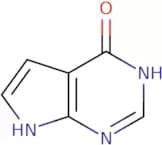
CAS:<p>7-Deaza-6-hydroxypurine is a skeleton of nucleosides that inhibits enzymes. It has been shown to inhibit the activity of hydrochloric acid, a tumor metastasis promoter. The constant for this drug was determined using molecular modeling and inhibition constants. 7-Deaza-6-hydroxypurine has anticancer activity and can be used for the treatment of cancer. This drug is used as a noncompetitive inhibitor in which it binds to two different sites on the enzyme. It has also been shown to bind to subunits, which are parts of a protein that make up its structure, in biological studies.br><br>7-Deaza-6-hydroxypurine is an inhibitor that binds to two different sites on an enzyme. It has been shown to have anticancer activity and can be used for the treatment of cancer. This drug is used as a noncompetitive inhibitor in which it binds to two different sites on the enzyme. It</p>Formula:C6H5N3OPurezza:Min. 95%Colore e forma:PowderPeso molecolare:135.12 g/mol8-Azaadenine
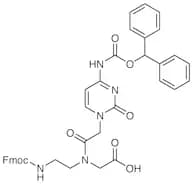
CAS:<p>8-Azaadenine is an analog of adenine that binds to the purine receptor in the cell membrane. It has been shown to inhibit the growth of bacterial strains, such as Klebsiella pneumoniae and Staphylococcus aureus, by targeting their DNA gyrase and topoisomerase IV. 8-Azaadenine has also been shown to have a high resistance to bacterial mutants resistant to other antibiotics. It has been found that the nitrogen atoms in 8-azaadenine are important for its biological properties. The optimum pH for this antibiotic is 7.4.</p>Formula:C4H4N6Purezza:Min. 95%Colore e forma:PowderPeso molecolare:136.12 g/molFmoc-PNA-C(Bhoc)-OH
CAS:Formula:C39H35N5O8Purezza:>98.0%(HPLC)(qNMR)Colore e forma:White to Light yellow powder to crystalPeso molecolare:701.748-Chloroadenine
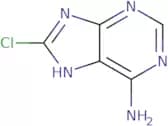
CAS:<p>8-Chloroadenine is an antimicrobial agent that inhibits the DNA replication of bacteria by binding to the dna template. It is a potent inhibitor of oxidative DNA damage and has been shown to be effective against various bacteria, including Staphylococcus aureus. 8-Chloroadenine also has reactive properties and can react with chloride in the environment to form hypochlorous acid (HOCl) and 8-chloroguanine. This compound may also act as an enzyme catalyst for the enzymatic reaction between hypochlorous acid and chloride ions.</p>Formula:C5H4ClN5Purezza:Min. 95%Colore e forma:PowderPeso molecolare:169.57 g/mol