Nucleotidi
I nucleotidi sono composti organici che fungono da mattoni per la costruzione degli acidi nucleici, essenziali per la formazione del DNA e dell'RNA. Ogni nucleotide è composto da una base azotata, una molecola di zucchero e uno o più gruppi fosfato. Questi nucleotidi si uniscono per formare lunghe catene, creando il materiale genetico che porta e trasmette informazioni genetiche in tutti gli organismi viventi. In questa sezione, troverai una vasta gamma di nucleotidi cruciali per la ricerca in genetica, biologia molecolare e biochimica. Sono fondamentali per studiare i processi genetici, sintetizzare acidi nucleici e sviluppare strumenti diagnostici e terapeutici. Da CymitQuimica, offriamo nucleotidi di alta qualità per supportare la tua ricerca scientifica e applicazioni, garantendo precisione e affidabilità nei tuoi esperimenti.
Sottocategorie di "Nucleotidi"
Trovati 2634 prodotti di "Nucleotidi"
Ordinare per
Purezza (%)
0
100
|
0
|
50
|
90
|
95
|
100
1-(α-D-Ribofuranosyl)uracil
CAS:1-(α-D-Ribofuranosyl)uracil is a nucleoside analog made up of a uracil attached to a ribose sugar at the 1-position, with the sugar in the α configuration. This compound is of interest in biochemistry research and nucleoside chemistry, especially when studying stereochemistry or synthesizing analogs.Formula:C9H12N2O6Purezza:(¹H-Nmr) Min. 95 Area-%Colore e forma:PowderPeso molecolare:244.2 g/mol2',3'-Dideoxyinosine
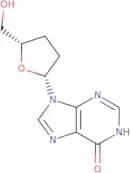
CAS:<p>2',3'-Dideoxyinosine is a purine analog that can suppress human immunodeficiency virus (HIV) replication after intracellular metabolic conversion</p>Formula:C10H12N4O3Purezza:Min. 95 Area-%Colore e forma:White Off-White PowderPeso molecolare:236.23 g/molUridine 5'-monophosphate disodium salt
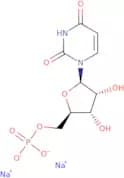
CAS:Uridine 5'-monophosphate disodium salt (UDP-MS) is a structural analog of uridine that is used as a dietary supplement. It has been shown to inhibit phosphodiesterases and cyclic nucleotide phosphodiesterases, which are enzymes that degrade the secondary messenger, cyclic adenosine monophosphate (cAMP). This inhibition leads to increased levels of cAMP in cells, which stimulates protein kinase A activity and promotes cellular differentiation. The analysis of UDP-MS has been performed using liquid chromatography with ultraviolet detection.Formula:C9H11N2Na2O9PPurezza:Min. 98 Area-%Colore e forma:White Off-White PowderPeso molecolare:368.15 g/mol2'-Deoxy-5-formylcytidine
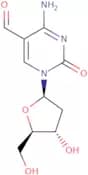
CAS:<p>2'-Deoxy-5-formylcytidine is a nucleoside analog that is used as a chemotherapeutic agent. It is cytotoxic to cells by binding to DNA and preventing the synthesis of DNA, RNA, and protein. The drug has been shown to induce cellular senescence in human fibroblasts, which can be reversed by the addition of deuterium. 2'-Deoxy-5-formylcytidine also inhibits the production of reactive oxygen species (ROS) by inducing the expression of antioxidant enzymes such as superoxide dismutase 2 and glutathione peroxidase 1. The oxidation products are misincorporated into DNA strands, leading to intramolecular hydrogen bonds with cytosine bases. These modifications lead to denaturation of DNA and inhibition of transcription and replication.<br>2'-Deoxy-5-formylcytidine also interacts with oligodeoxynucleotides, which leads to misinc</p>Formula:C10H13N3O5Purezza:Min. 97 Area-%Colore e forma:White PowderPeso molecolare:255.23 g/molUridine 5'-diphosphate choline ammonium
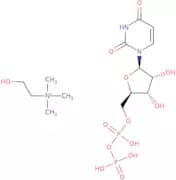
CAS:Uridine 5'-diphosphate choline ammonium salt is a chemical compound that contains two molecules of uridine and one molecule of choline. It is a hexamer with an empirical formula of C6H14N4O13P3. Uridine 5'-diphosphate choline ammonium salt can be found in plants and animals, as well as being synthesized by the human body. This compound is present in the interstitium, which are the spaces between cells, and may play a role in the nutritional status of humans.Formula:C14H28N4O12P2Purezza:Min. 90 Area-%Colore e forma:PowderPeso molecolare:506.34 g/mol2'-Deoxy-2'-fluoroinosine
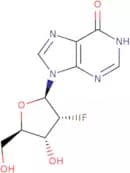
CAS:<p>2'-Deoxy-2'-fluoroinosine is a modified nucleoside analog derived from inosine, where the 2' hydroxyl group of the sugar (normally present in ribonucleosides) is replaced with a fluorine atom, and the molecule contains a deoxyribose sugar.</p>Formula:C10H11FN4O4Purezza:Min. 95%Colore e forma:White PowderPeso molecolare:270.22 g/mol2,4,6-Trichloro-5-methylpyrimidine
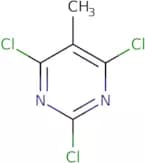
CAS:2,4,6-Trichloro-5-methylpyrimidine is a nucleoside for use in research applicationsFormula:C5H3Cl3N2Purezza:Min. 95%Colore e forma:PowderPeso molecolare:197.45 g/molThymidine-5'-diphosphate-L-rhamnose disodium
CAS:Thymidine-5'-diphosphate-L-rhamnose disodium is a nucleoside that belongs to the class of modified nucleosides. It is a synthetic, modified thymidine with a phosphate group at the 5'-position and L-rhamnose at the 2' position. Thymidine-5'-diphosphate-L-rhamnose disodium has antiviral and anticancer activities, as well as high purity and high quality. This compound has been shown to inhibit HIV replication in vitro and in vivo. Thymidine-5'-diphosphate-L-rhamnose disodium is also used in the synthesis of DNA and RNA.Formula:C16H24N2O15P2Na2Purezza:Min. 95 Area-%Colore e forma:PowderPeso molecolare:592.29 g/mol2'-Azido-2'-deoxyadenosine
CAS:<p>2'-Azido-2'-deoxyadenosine is a synthetic nucleoside analog of adenosine in which the 2'-hydroxyl group of the ribose sugar is replaced by an azido group (–N₃), and the 3'- and 5'-hydroxyl groups remain intact. This modification confers unique chemical properties, including the ability to participate in bioorthogonal "click" chemistry reactions, particularly azide-alkyne cycloadditions, making it useful for labeling and tracking nucleic acids in biochemical studies. Additionally, the azido substitution can influence enzymatic recognition and incorporation by polymerases, allowing its use in studying nucleic acid metabolism, drug design, and therapeutic nucleoside analog development.</p>Formula:C10H12N8O3Purezza:Min. 95%Colore e forma:PowderPeso molecolare:292.25 g/mol2'-C-Methyluridine
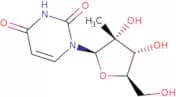
CAS:2'-C-Methyluridine is a synthetic nucleoside analog derived from uridine, modified with a methyl group at the 2'-carbon of the ribose sugar. This small chemical change has important implications for RNA biology, antiviral drug development, and biochemical research, especially in targeting RNA viruses.Formula:C10H14N2O6Purezza:Min. 95%Colore e forma:PowderPeso molecolare:258.23 g/mol5'-O-DMT-5-[N-(6-(trifluoroacetamido)hexyl)-3-E-acrylamido]-2'-deoxyuridine
CAS:5'-O-DMT-5-[N-(6-(trifluoroacetamido)hexyl)-3-E-acrylamido]-2'-deoxyuridine is a novel phosphoramidate nucleoside monophosphate, which is a phosphate analog of 2'-deoxyuridine. It has been shown to be an activator for DNA polymerases and is able to inhibit the replication of DNA in vitro. It also has antiviral properties, as it inhibits the synthesis of viral RNA. 5'-O-DMT-5-[N-(6-(trifluoroacetamido)hexyl)-3-E-acrylamido]-2'-deoxyuridine also has anti-inflammatory effects, as it inhibits prostaglandin synthesis.Formula:C41H45F3N4O9Purezza:Min. 95%Colore e forma:White PowderPeso molecolare:794.83 g/mol3'-O-Methylcytidine
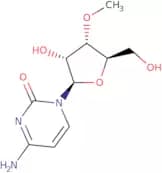
CAS:<p>3'-O-Methylcytidine is an acidic guanine nucleoside that is a component of RNA. It is a biochemical building block and a co-substrate in the synthesis of DNA and RNA. 3'-O-Methylcytidine has been shown to be hydroxylated by the enzyme cytidine 5'-monophosphate, which leads to its termination when it reaches the ribosome. This nucleoside also inhibits bacterial growth through inhibition of ribosomal function, leading to reduced protein synthesis. 3'-O-Methylcytidine can act as an environmental pollutant, especially in chloride environments such as seawater. It has been found to be globally distributed in dinucleotides and monomethylated forms, with biosynthetic pathways similar to other nucleic acids.</p>Formula:C10H15N3O5Purezza:Min. 98 Area-%Colore e forma:White PowderPeso molecolare:257.24 g/molADP monosodium salt - Bio-X ™
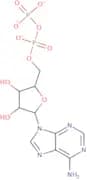
CAS:<p>Adenosine 5'-diphosphate monosodium salt (ADP) is an adenine nucleotide which is phosphorylated into ATP by the enzyme ATPase. This phosphorylation is essential in cellular homeostasis due to its role in energy storage and nucleic acid metabolism.</p>Formula:C10H15N5O10P2•NaPurezza:Min. 95%Colore e forma:PowderPeso molecolare:449.18 g/mol2'-Deoxy-5-propynylcytidine
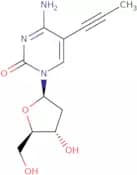
CAS:<p>Deoxynucleoside with an alkyne handle on the base which can be used for conjugation via click chemistry.</p>Formula:C12H15N3O4Purezza:Min. 95%Colore e forma:PowderPeso molecolare:265.27 g/mol2'-Deoxyguanosine 3'-monophosphate sodium
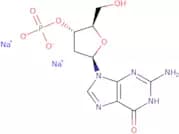
CAS:2'-Deoxyguanosine 3'-monophosphate sodium is a novel, synthetic nucleoside that inhibits DNA replication and transcription. It has been shown to be a potent inhibitor of human immunodeficiency virus type 1 (HIV-1) and human T-cell leukemia virus type I (HTLV-I). 2'-Deoxyguanosine 3'-monophosphate sodium is in the category of nucleosides, which are phosphorylated compounds that can be incorporated into DNA by DNA polymerase. This product has a high purity and is synthesized from diphosphate.Formula:C10H12Na2N5O7PPurezza:Min. 95%Colore e forma:White Off-White PowderPeso molecolare:391.19 g/molN-Succinyl-5-aminoimidazole-4-carboxamide ribose disodium salt
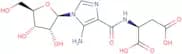
CAS:N-Succinyl-5-aminoimidazole-4-carboxamide ribose disodium salt is a novel modified nucleoside with anticancer activity. The compound is a monophosphate, which activates DNA and RNA synthesis. This agent also has antiviral and antifungal effects. N-Succinyl-5-aminoimidazole-4-carboxamide ribose disodium salt is synthesized from diphosphate and deoxyribonucleosides. It was first patented in 1979 and has been approved by the US Food and Drug Administration (FDA) for use as a pharmaceutical agent. N-Succinyl-5-aminoimidazole-4-carboxamide ribose disodium salt can be used to produce phosphoramidites, which are synthetic DNA building blocks that are used in the production of DNA and RNA synthesis.Formula:C13H16N4O9Na2Purezza:Min. 95 Area-%Colore e forma:Off-White PowderPeso molecolare:418.27 g/mol1-(3',5'-Di-O-benzoyl-2'-chloro-2'-deoxy-beta-L-arabinofuranosyl)thymine
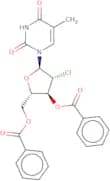
CAS:<p>1-(3`,5`-Di-O-benzoyl-2`-chloro-2`-deoxy-beta-L-arabinofuranosyl)thymine is a nucleoside analog for research applications. This compound is made up of a thymine base and the sugar 2'-Chloro-2'-deoxy-β-L-arabinofuranose. The sugar has the L-arabinose configuration and a 2'-Chloro substitution which can alter its interactions with enzymes and enhance resistance to degradation. It also contains benzoyl groups that protect the hydroxyls during chemical synthesis.</p>Formula:C24H21FN2O7Purezza:Min. 95%Peso molecolare:468.43 g/molUridine-5-oxyacetic acid methyl ester
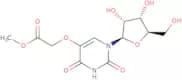
CAS:<p>Uridine-5-oxyacetic acid methyl ester is a modified nucleotide that is an intermediate in the biosynthesis of uridine. This molecule can be synthesized from 5-hydroxymethyluridine and malonic acid by a methyltransferase. Uridine-5-oxyacetic acid methyl ester can also be obtained from the metabolism of deoxyribose. Analysis of this molecule is possible with spectrometric, mass spectrometric, and chemical structures methods. It has been shown to have a function in translation and protein synthesis. The chemical structure of uridine-5-oxyacetic acid methyl ester has been determined to be guanosine-3',5'-bis(2'-carboxyethyl)phosphate, which is different from that found in DNA or RNA.</p>Formula:C12H16N2O9Purezza:Min. 95%Colore e forma:PowderPeso molecolare:332.26 g/mol2'-O-Methyl-5-propynylcytidine
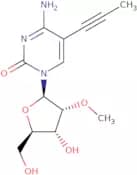
CAS:<p>2'-O-Methyl-5-propynylcytidine is an antiviral drug that inhibits the replication of retroviruses by competitive inhibition of the viral RNA polymerase. It has been shown to be effective against HIV, HSV and CMV. This drug also has shown anticancer activity in vitro and in vivo. 2'-O-Methyl-5-propynylcytidine has a novel mechanism of action and is used as a building block for oligonucleotide synthesis because it is resistant to degradation by nucleases.</p>Formula:C13H17N3O5Purezza:Min. 95%Colore e forma:PowderPeso molecolare:295.29 g/molRiboflavin 5'-adenosine diphosphate disodium salt hydrate
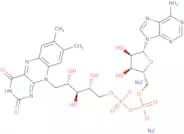
CAS:Riboflavin 5'-adenosine diphosphate disodium salt hydrate is a chemical compound that can be used as a substrate for nitrate reductase in the presence of molecular oxygen. It can be used to identify mollicutes and diagnose radiation-induced lesions. The reaction mechanism involves the conversion of riboflavin 5'-adenosine monophosphate to riboflavin 5'-adenosine diphosphate by an enzyme called nitrate reductase, which is present in the microorganism. This reaction is accompanied by the release of electrons, which are detected by a fluorescence detector. The rate constant for this reaction is k=1.5x10^-4/s at pH 7 and 37 degrees Celsius with an electrochemical detector and k=2.0x10^-3/s at pH 7 and 37 degrees Celsius with a carbonyl oxygens detector. Riboflavin 5'-Formula:C27H31N9Na2O15P2·xH2OPurezza:(Uv) Min. 95%Colore e forma:Yellow Orange PowderPeso molecolare:829.51 g/mol


![5'-O-DMT-5-[N-(6-(trifluoroacetamido)hexyl)-3-E-acrylamido]-2'-deoxyuridine](/_next/image/?url=https%3A%2Fstatic.cymitquimica.com%2Fproducts%2F3D%2Fthumb-webp%2FND08237.webp&w=3840&q=75)