Nucleotidi
I nucleotidi sono composti organici che fungono da mattoni per la costruzione degli acidi nucleici, essenziali per la formazione del DNA e dell'RNA. Ogni nucleotide è composto da una base azotata, una molecola di zucchero e uno o più gruppi fosfato. Questi nucleotidi si uniscono per formare lunghe catene, creando il materiale genetico che porta e trasmette informazioni genetiche in tutti gli organismi viventi. In questa sezione, troverai una vasta gamma di nucleotidi cruciali per la ricerca in genetica, biologia molecolare e biochimica. Sono fondamentali per studiare i processi genetici, sintetizzare acidi nucleici e sviluppare strumenti diagnostici e terapeutici. Da CymitQuimica, offriamo nucleotidi di alta qualità per supportare la tua ricerca scientifica e applicazioni, garantendo precisione e affidabilità nei tuoi esperimenti.
Sottocategorie di "Nucleotidi"
Trovati 2636 prodotti di "Nucleotidi"
Ordinare per
Purezza (%)
0
100
|
0
|
50
|
90
|
95
|
100
Inosine
CAS:Inosine is a purine nucleoside in which hypoxanthine is attached to ribofuranose via a beta-N(9)-glycosidic bond. Inosine derives from a hypoxanthine and a ribofuranose. Inosine plays a key role as a metabolite in bacteria, fungi, humans, and other animals. There is preliminary evidence that inosine may have neurorestorative, anti-inflammatory, immunomodulatory, and cardioprotective effects.
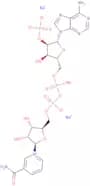
Formula:C10H12N4O5Purezza:Min. 98 Area-%Colore e forma:White PowderPeso molecolare:268.23 g/molb-Nicotinamide adenine dinucleotide phosphate disodium salt
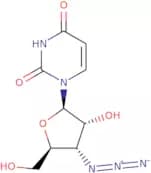
CAS:Coenzyme and regenerating electron donor in catabolic processesFormula:C21H26N7Na2O17P3Purezza:Min. 93 Area-%Colore e forma:White PowderPeso molecolare:787.4 g/mol3'-Azido-3'-deoxyuridine
CAS:3'-Azido-3'-deoxyuridine is a nucleoside analog that is used as a substrate for DNA synthesis in the cell. 3'-Azido-3'-deoxyuridine is transported across the blood-brain barrier by a sodium-independent transporter and accumulates in the carotid artery, where it is converted to uridine. This drug has been shown to be activated at the site of infection and may have regiospecific activity against bacteria. 3'-Azido-3'-deoxyuridine has an imidazole ring and dinucleoside structure, which are important for its activity as a terminal half-life enhancer and anticancer agent. 3'-Azido-3'-deoxyuridine has also been used in liquid chromatography to purify nucleic acids research products.Formula:C9H11N5O5Purezza:Min. 95%Colore e forma:PowderPeso molecolare:269.21 g/molUridine-2',3'-cyclic monophosphate sodium salt
CAS:Uridine-2',3'-cyclic monophosphate sodium salt (CAS No. 15718-50-0) is a novel anticancer agent that has been shown to inhibit the growth of cancer cells in vitro and in vivo. It is a nucleoside analog that inhibits the synthesis of DNA by inhibiting ribonucleotide reductase and deoxyribonucleotide reductase, two enzymes involved in the production of DNA. Uridine-2',3'-cyclic monophosphate sodium salt is also an antiviral agent used to treat herpesvirus infections, such as herpes simplex type 1 and 2. This drug binds to viral RNA polymerase, which prevents viral replication by preventing mRNA synthesis.Formula:C9H10N2NaO8PPurezza:Min. 98 Area-%Colore e forma:PowderPeso molecolare:328.15 g/mol4-Thiouridine
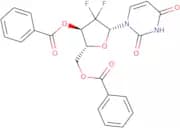
CAS:4-Thiouridine (4-SU) is a photoactivatable ribonucleoside analogue that is widely used for RNA analysis, including short-range RNA-RNA crosslinking and nascent RNA labelling. 4-SU is typically used to modify RNA oligonucleotides, or in structure studies of RNA-protein complexes. The crosslinking thiol moiety is attached directly to the nucleotide base, thus 4-SU differs from the nucleoside uridine only by a single sulfur substitution. This means it can be incorporated into an RNA chain with minimal structural perturbation and with similar base-pairing properties, reducing the likelihood that substitution will significantly impair RNA interactions or activities.Formula:C9H12N2O5SPurezza:Min. 98 Area-%Colore e forma:PowderPeso molecolare:260.27 g/mol3',5'-Di-O-benzoyl-2'-deoxy-2',2'-difluorouridine
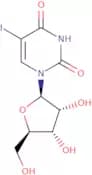
CAS:An intermediate for the preparation of modified oligonucleotides and other uridine derivatives containing a 2',2'-difluoro modification.Formula:C23H18F2N2O7Purezza:Min. 95%Colore e forma:White PowderPeso molecolare:472.4 g/mol5-Iodouridine
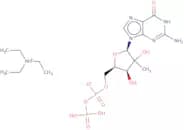
CAS:5-Iodouridine is a pyrimidine nucleoside that is found in the human body. It is used as a starting material for the synthesis of 5-iodo-2'-deoxyuridine, which has been shown to have biological properties. 5-Iodouridine binds to the dna template and prevents radiation from altering it's conformation. This binding has been shown to be specific for ultraviolet (UV) radiation, with little absorption at visible wavelengths. The biological effects of 5-iodouridine are dependent on its acidic pH and hydrogen bonding ability. In vitro assays have demonstrated that this compound can inhibit prostate cancer cells from proliferating and may be useful in treating cervical cancer.Formula:C9H11IN2O6Purezza:Min. 95%Colore e forma:White PowderPeso molecolare:370.1 g/mol2'-C-Methylguanosine 5'-diphosphate triethylammonium salt
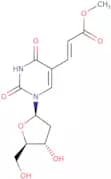
2'-C-Methylguanosine 5'-diphosphate triethylammonium salt is a synthetic nucleotide analog for use in researchFormula:C11H16N5O11P2·C18H45N3Purezza:Min. 95%Colore e forma:PowderPeso molecolare:759.79 g/molE-5-(2-Carbomethoxyvinyl)-2'-deoxyuridine
CAS:E-5-(2-Carbomethoxyvinyl)-2'-deoxyuridine is a nucleoside that is a modified form of uridine. It is a nucleotide analog that inhibits the synthesis of DNA and RNA and can be used to treat cancer. E-5-(2-Carbomethoxyvinyl)-2'-deoxyuridine is an activator that activates the phosphoramidites in the synthesis of DNA and RNA. This drug can also be used as antiviral therapy for herpes simplex virus type 1, influenza virus, and HIV. E-5-(2-Carbomethoxyvinyl)-2'-deoxyuridine has been shown to have anti-inflammatory properties by inhibiting prostaglandin synthesis.Formula:C13H16N2O7Purezza:Min. 95%Colore e forma:White to off-white solid.Peso molecolare:312.28 g/mol5-O-[[[(1S)-1-Methyl-2-(1-methylethoxy)-2-oxoethyl]amino]-phenoxyphosphinyl]-cytidine
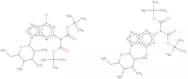
CAS:5-O-[[[(1S)-1-Methyl-2-(1-methylethoxy)-2-oxoethyl]amino]-phenoxyphosphinyl]-cytidine is a modified nucleoside analog that inhibits the synthesis of DNA and RNA. It has been shown to have antiviral, anticancer, and antiinflammatory activities. 5-O-[[[(1S)-1-Methyl-2-(1-methylethoxy)-2-oxoethyl]amino]-phenoxyphosphinyl]-cytidine is a ribonucleoside that can be used as a building block for the production of deoxyribonucleosides (i.e., as an activator). This product also has high purity and quality, as well as being novel in structure.Formula:C21H29N4O9PPurezza:Min. 95%Colore e forma:White to off-white solid.Peso molecolare:512.45 g/molN2-Diboc-7/9-(2,3,4,6-tetra-O-acetyl-D-mannopyranosyl)-6-chloro-2-aminopurine
N2-Diboc-7/9-(2,3,4,6-tetra-O-acetyl-D-mannopyranosyl)-6-chloro-2-aminopurine is a nucleoside that is modified with a chlorine group. The modification of the nucleoside may enhance its anticancer activity. N2-Diboc-7/9-(2,3,4,6-tetra-O-acetyl-D-mannopyranosyl)-6-chloro-2 aminopurine has been shown to inhibit the growth of virus and cancer cells by inhibiting DNA synthesis. It has also been shown to induce apoptosis in human leukemia cells.Formula:C21H30ClN5O9Purezza:Min. 95%Colore e forma:White to beige solid.Peso molecolare:531.94 g/molCytidine-2'-monophosphate sodium
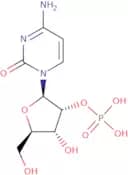
CAS:Cytidine-2'-monophosphate sodium (CMP) is a nucleotide that is used as a monophosphate or diphosphate. It can be used to synthesize DNA and RNA. CMP also has antiviral, anticancer, and high purity properties. CMP is an activator of DNA polymerases and helps in the synthesis of DNA. It has novel properties that make it different from other nucleotides, such as its modified sugar moiety.Formula:C9H12Na2N3O8PPurezza:Min. 90%Colore e forma:PowderPeso molecolare:367.18 g/mol5'-O-DMT-2'-O-methyl-N6-phenylacetyladenosine
5'-O-DMT-2'-O-methyl-N6-phenylacetyladenosine is a synthetic nucleoside with anticancer properties. It is modified to be more resistant to phosphodiesterase which blocks the synthesis of DNA and RNA. This drug has been shown to activate the immune system, inhibit tumor growth, and inhibit viral replication. It has been shown to be effective in animal models against leukemia and lymphoma. The high quality pure chemical will be used for use in research purposes only.Purezza:Min. 95%6-O-Methylinosine
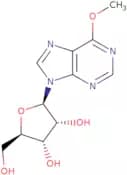
CAS:6-O-Methylinosine is a modified nucleoside that is used in the synthesis of recombinant proteins. It is synthesized from the reaction of methylphosphate and 6-O-methylguanosine. The phosphate group of the 6-O-methylguanosine molecule reacts with methylphosphate in an acid or neutral environment, while it reacts with phosphoric acid in a basic environment. This reaction can be monitored by measuring the amount of free phosphate groups present after the reaction. The rate of this reaction can be increased by increasing temperature and pH. 6-O-Methylinosine has been shown to have anticancer activity, which may be due to its ability to inhibit enzyme catalysis and modify DNA structure.Formula:C11H14N4O5Purezza:Min. 95%Colore e forma:White PowderPeso molecolare:282.25 g/mol7-Deaza-2'-deoxyguanosine
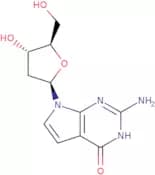
CAS:7-Deaza-2'-deoxyguanosine is an analog of guanosine that has been shown to inhibit the activity of telomerase. This enzyme synthesizes a sequence of DNA called a telomere, which protects the ends of chromosomes from deterioration and prevents chromosomal end-to-end fusion. 7-Deaza-2'-deoxyguanosine has an inhibitory effect on the polymerase chain reaction (PCR) in mammalian cells and inhibits the transcription-polymerase chain reaction (PCR) in vitro. It has also been shown to be potent against cancer cells. 7-Deaza-2'-deoxyguanosine is synthesized by solid phase synthesis, which is a chemical process that involves attaching one molecule to another molecule with similar structure, using organic solvents as intermediates.Formula:C11H14N4O4Purezza:Min. 95%Colore e forma:White PowderPeso molecolare:266.26 g/mol2-Amino-6-chloro-9-(2'-deoxy-b-D-ribofuranosyl)purine
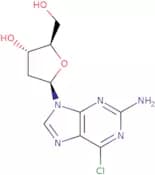
CAS:2-Amino-6-chloro-9-(2'-deoxy-b-D-ribofuranosyl)purine is a purine nucleoside where the purine base has a 2-amino group at position 2 and a chlorine at position 6. The sugar is 2'-deoxy, meaning it is like the sugar found in DNA, lacking the 2'-hydroxyl group that is present in RNA. The amino and chloro groups on the purine base modify how this molecule behaves in biological systems making it useful in research applications.Formula:C10H12ClN5O3Purezza:Min. 97 Area-%Colore e forma:White PowderPeso molecolare:285.69 g/mol5-Methyluridine
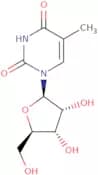
CAS:5-Methyluridine is a nucleoside that is used to inhibit the replication of cells. It is also used for the treatment of cancer, infectious diseases, and other conditions. 5-Methyluridine inhibits cellular replication by binding to ribothymidine and uridine in the nucleus. The inhibition of cellular proliferation is due to a lack of dna synthesis and RNA synthesis. This nucleoside has been shown to have inhibitory properties against mouse tumor cells grown in vitro, as well as the wild-type strain grown in vivo. 5-Methyluridine may be useful for the treatment of cancer tissues because it can suppress the growth of tumors by inhibiting their ability to replicate.Formula:C10H14N2O6Purezza:Min. 98 Area-%Colore e forma:White PowderPeso molecolare:258.23 g/molTrifluorothymidine
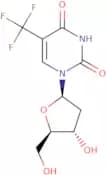
CAS:Treats herpes-associated keratitis and keratoconjunctivitis; antineoplasticFormula:C10H11F3N2O5Purezza:Min. 95%Colore e forma:PowderPeso molecolare:296.2 g/molCytidine-5'-diphosphate trisodium
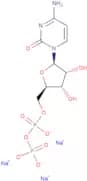
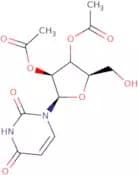
CAS:Cytidine-5'-diphosphate trisodium (CDP-Tris) is a copolymerization agent that contains a formamide molecule, which is used to increase the viscosity of the polymer. It is also used as a hydrogen bond donor and acceptor in the synthesis of polymers. CDP-Tris can be used for DNA replication and repairs damaged DNA by binding to 7-methylguanine, one of the most common lesions found in DNA. This agent has been shown to be effective in diluting crude cell extracts from E. coli bacteria. CDP-Tris is also used to synthesize polymers with 3-methylcytidine monomers that contain nitrogen atoms. These polymers are then used as substitutes for natural polymers such as cellulose and starch, which can be difficult to process because they are hydrophobic.Formula:C9H12N3Na3O11P2Purezza:Min. 95 Area-%Colore e forma:White Yellow PowderPeso molecolare:469.12 g/mol2',3'-Di-O-acetyl-D-uridine
CAS:2',3'-Di-O-acetyl-D-uridine is a nucleoside for use in research applicationsFormula:C13H16N2O8Purezza:Min. 98 Area-%Colore e forma:White PowderPeso molecolare:328.27 g/mol




![5-O-[[[(1S)-1-Methyl-2-(1-methylethoxy)-2-oxoethyl]amino]-phenoxyphosphinyl]-cytidine](/_next/image/?url=https%3A%2Fstatic.cymitquimica.com%2Fproducts%2F3D%2Fthumb-webp%2FNM46513.webp&w=3840&q=75)