Vitamine
Le vitamine sono composti organici richiesti in piccole quantità per funzioni fisiologiche essenziali e per la salute generale. Svolgono ruoli cruciali nel metabolismo, nella funzione immunitaria e nel mantenimento cellulare. In questa categoria troverete una vasta gamma di vitamine, includendo tipi solubili in acqua e in grassi, necessari per la ricerca in nutrizione, biochimica e scienze della salute. Da CymitQuimica, offriamo vitamine di alta qualità per supportare i vostri sforzi di ricerca e sviluppo, garantendo la precisione e l'efficacia dei vostri studi sulle funzioni e le carenze vitaminiche.
Trovati 1123 prodotti di "Vitamine"
Ordinare per
Purezza (%)
0
100
|
0
|
50
|
90
|
95
|
100
α-Tocopherol
CAS:<p>Stability Light Sensitive<br>Applications α-Tocopherol is the most bioactive of the naturally occurring forms of Vitamin E. Richest sources are green vegetables, grains, and oils, particularly palm, safflower and sunflower oils.<br>References Bianchi, G., et al.: Eur. J. Lipid Sci. Technology, 105, 229 (2003), Sakouhi, F., et al.: Food Chem., 108, 833 (2008),<br></p>Formula:C29H50O2Colore e forma:NeatPeso molecolare:430.71Isovitamin D3 (90%)
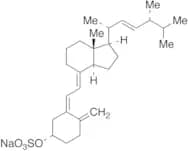
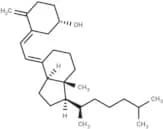
CAS:Prodotto controllato<p>Stability Light Sensitive<br>Applications Isovitamin D3 is a metabolite of Vitamin D. Studies show that Isovitamin D3 is biologically active in normal rats but inactive in anephric rats.<br>References Holick, M.F. et al.: Science, 180, 964 (1973); Wilczek, H. et al.: Prak. Lek., 59, 794 (1979);<br></p>Formula:C27H44OPurezza:90%Colore e forma:NeatPeso molecolare:384.64Lumiflavin
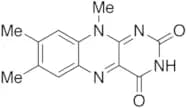
CAS:Prodotto controllato<p>Applications Lumiflavin is a toxic photolysis product of vitamin B2 (R415000).<br>References Zhao, X. et al.: Chemosphere, 63, 1116 (2006); Litke, S.V. et al.: Khim. Fiz., 10, 48 (1991); Ye, W. et al.: Guang. Yaox. Xueb., 12, 175 (1996);<br></p>Formula:C13H12N4O2Colore e forma:Dark YellowPeso molecolare:256.26Saikosaponin A
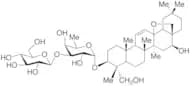
CAS:Prodotto controllato<p>Stability Hygroscopic<br>Applications Saikosaponin A was shown to exhibit anti-inflammatory activities by suppressing activation of NF-kB signaling pathway.<br>References Wu, S.J., et al.: Am. J. Chin. Med., 38, 99 (2010); Wu. S.J., et al.: J. Med. Food., 11, 224 (2008); Yoon, S.S., et al.: Neurosci. Lett., 529, 97 (2012); Lu, C.N., et al.: Int. Immunopharmacol., 14, 121 (2012);<br></p>Formula:C42H68O13Colore e forma:NeatPeso molecolare:780.984-Deoxy Pyridoxine Hydrochloride
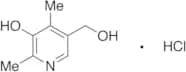
CAS:Prodotto controllato<p>Stability Hygroscopic<br>Applications 4-Deoxypyridoxine is the deoxy analogue of Pyridoxine (P991735). 4-Deoxypyridoxine is a vitamin B6 antimetabolite; 4-Deoxypyridoxine can induce a deficient status that alters the function and ultrastructure of EC similar to vascular disease.<br>References La Pesa, M. et al.: Pathologia, 62, 907 (1970); Chang, S..: J. Nutrit. Sci. Vitaminol., 46, 149 (2000); Yamashita, J.: J. Nutrit. Sci. Vitaminol., 22, 1 (1976);<br></p>Formula:C8H12ClNO2Colore e forma:Off-WhitePeso molecolare:189.64Pyridoxine-d3 hydrochloride
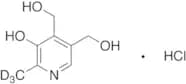
CAS:Prodotto controllato<p>Applications Labelled Pyridoxine. One of the vitamins of the B6 complex; present in many foodstuffs (yeast, liver and cereals). Pyridoxine has a role in transporting protein Bsu1, Pyridoxine contributes to thiamine uptake; characterization of thiamine (vitamin B1) transporter Thi9 from Schizosaccharomyces pombe.<br>References Williams, R., et al.: J. Biol. Chem., 87, 581 (1930), Rodionov, D., et al.: J. Biol. Chem., 277, 48949 (2002),Nosaka, K., et al.: Mol. Microbiol., 58, 467 (2005),<br></p>Formula:C82H3H8NO3·ClHColore e forma:White To Off-WhitePeso molecolare:208.66all-trans-Retinol
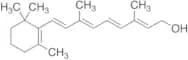
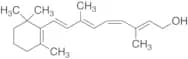
CAS:Prodotto controllato<p>Stability Liight Sensitive, Temperature Sensitive<br>Applications Occurs preformed only in animals; metabolized from carotenoids, such β-carotene, in the intestinal mucosa. Dietary sources include liver, milk, butter, cheese, eggs and fish liver oils or as carotenois from fruits and vegetables. Stored primarily in the liver in esterified form; transported in the blood by retinol binding protein (RBP). Nutritional factor.<br>References Davis, M., et al.: J. Biol. Chem., 15, 167 (1913), Crouch, R.K., et al.: Photochem. Photobiol., 64, 613 (1996),<br></p>Formula:C20H30OColore e forma:Off-White To Dark YellowPeso molecolare:286.45Pterine-6-carboxylic Acid
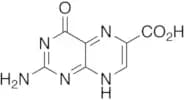
CAS:Prodotto controllato<p>Applications Pterine-6-carboxylic Acid is a degradation product of Folic acid (F680300).<br>References Akhtar, M., et al.: J. Pharm. Biomed. Anal., 19, 269 (1999), Andrisano, V., et al.: J. Pharm. Biomed. Anal., 32, 983 (2003), Patro, B., et al.: Bioorg. Med. Chem. Lett., 15, 67 (2005),<br></p>Formula:C7H5N5O3Colore e forma:NeatPeso molecolare:207.1511-cis-Retinol, >85%
CAS:<p>Stability Light Sensitive, Temperature Sensitive<br>Applications A metabolite of Vitamin A (R252000(M)).<br>References Touma, S., et al.: Biochem. Pharmacol., 78, 1127 (2009), Muniz, A., et al.: Biochem., 48, 6854 (2009), Guignard, T., et al.: J. Biol. Chem., 285, 18759 (2010),<br></p>Formula:C20H30OPurezza:>85%Colore e forma:NeatPeso molecolare:286.4525-Hydroxy Vitamin D2-d6
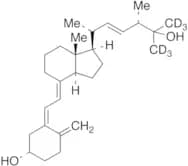
CAS:Prodotto controllato<p>Stability Light Sensitive, Temperature Sensitive, Toxic<br>Applications A labelled metabolite of Vitamin D2 (V676040).<br> Not a dangerous good if item is equal to or less than 1g/ml and there is less than 100g/ml in the package<br>References Barnes, P., et al.: J. Clin. Invest., 83, 1527 (1989), Holick, M., et al.: J. Cell Biochem., 88(2), 296 (2003), Maunsell, Z., et al.: Clin. Chem., 51, 1683 (2005),<br></p>Formula:C282H6H38O2Colore e forma:White To Off-WhitePeso molecolare:418.68δ-Tocotrienol
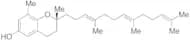
CAS:<p>Stability Light Sensitive<br>Applications δ-Tocotrienol is a natural substance with vitamin E activity. It can work as an antioxidant. It inhibits the growth of human breast cancer cells.<br>References Sen, C., et al.: Life Sci., 78, 2088 (2006); Yoshida, Y., et al.: Chem. Phys. Lipids, 123, 63 (2005)<br></p>Formula:C27H40O2Colore e forma:Light Yellow To Dark OrangePeso molecolare:396.612-O-a-D-Glucopyranosyl-L-ascorbic Acid
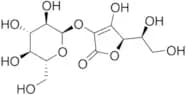
CAS:Prodotto controllato<p>Applications 2-O-a-D-Glucopyranosyl-L-ascorbic Acid is a useful cosmetic gel and skin cleanser.<br>References Aizawa, K., et al.: PCT Int. Appl. (2020), WO 2020226147 A1<br></p>Formula:C12H18O11Colore e forma:White To Off-WhitePeso molecolare:338.26Pyridoxal 5-Phosphate Hydrate
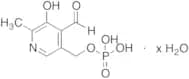
CAS:Prodotto controllato<p>Applications Pyridoxal 5-phosphate Hydrate (cas# 853645-22-4) is a useful research chemical.<br></p>Formula:C8H10NO6P·xH2OColore e forma:NeatPeso molecolare:247.14 + x(18.02)2-Hydroxy Estrone
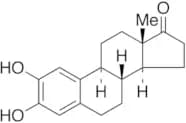
CAS:Prodotto controllatoFormula:C18H22O3Colore e forma:Off-White To Light BrownPeso molecolare:286.37Riboflavin Phosphate Sodium Salt (~70%)
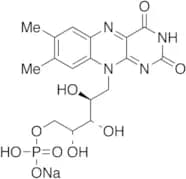
CAS:<p>Stability Hygroscopic<br>Applications One of the bioactive forms of Riboflavin. Nutritional factor found in milk, eggs, malted barley, liver, kidney, heart, leafy vegetables. Richest natural source is yeast. Minute amounts present in all plant and animal cells. Vitamin (enzyme cofactor).<br>References Unna, K., et al.: J. Pharmacol. Exp. Ther., 76, 75 (1942), Rivlin, et al.: N. Engl. J. Med., 283, 463 (1970), Al-Shammary, F.J., et al.: Anal. Profiles Drug Subs., 19, 429 (1990),<br></p>Formula:C17H20N4O9P·NaPurezza:~70%Colore e forma:Yellow-OrangePeso molecolare:478.33Zymostenol
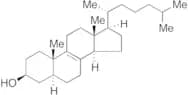
CAS:Prodotto controllato<p>Applications Zymostenol, is the derivative of Zymosterol (Z701520), which is an sterol intermediate in the biosynthesis of cholesterol (C432501).<br>References Roland, E.D., et al.: J. Am. Chem. Soc., 111, 278 (1989); Echevarria, F., et al.: J. Biol. Chem., 265, 8484 (1990); Baranovskii, A.V., et al.: Russian. J. Bioorg. Chem., 28, 250 (2002); Schoenheimer, et al.: J. Biol. Chem., 105, 355 (1934);<br></p>Formula:C27H46OColore e forma:NeatPeso molecolare:386.65Parathyroid Hormone Fragment (1-34)
CAS:Prodotto controllato<p>Applications A fragment of human parathyroid hormone (hPTH) peptide sequence containing the 34 N-terminal residues of hPTH. This fragment was also found to be an agonist at PTH1 and PTH2 receptors.<br>References Niall, et al.: Proc. Natl. Acad. Sci., 71, 384 (1974); Dobnig,T., et al.: Endocrinol., 138, 4607 (1997); Manabe. et al.: Bone., 40, 1475 (2007);<br></p>Formula:C181H291N55O51S2Colore e forma:NeatPeso molecolare:4117.725,6-trans-Vitamin D3
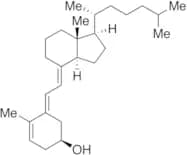
CAS:5,6-trans-Vitamin D3(5,6-trans-Cholecalciferol) is an isoform of Vitamin D3, which is converted from Vitamin D3 on the skin surface after light exposure.Formula:C27H44OPurezza:98.23%Colore e forma:SolidPeso molecolare:384.64