Nucleosidi
Trovati 3569 prodotti di "Nucleosidi"
6-(2-Cyanoethylthio)-2'-deoxy-5'-O-DMT-N2-trifluoroacetylguanosine 3'-CE phosphoramidite
CAS:6-(2-Cyanoethylthio)-2'-deoxy-5'-O-DMT-N2-trifluoroacetylguanosine 3'-CE phosphoramidite is a novel, modified nucleoside with antiviral, anticancer and other potential therapeutic activities. It is synthesized by the reaction of 6-(2-cyanoethylthio)-2'-deoxy-5'-O-DMT nucleoside with 2,4,6-trifluoroacetic anhydride in the presence of N,N'-diisopropylethylamine. The product is purified on a column to yield high quality material. The CAS number for this compound is 146691-59-0.Formula:C45H50N8O7PSPurezza:Min. 95%Peso molecolare:934.96 g/mol5'-O-tert-Butyldimethylsilyluridine
CAS:5'-O-tert-Butyldimethylsilyluridine (5'-O-TBDMSU) is a nucleoside that is used in the synthesis of nucleic acid probes. It is selective for the uridine residues in RNA and DNA, which are found at the 5' position. Sodium hydride reacts with this compound to form the corresponding hydroxyl group. This allows for further nucleobase additions or halogen substitutions to be made to the molecule, as well as desilylation reactions. 5'-O-TBDMSU can also be used to synthesize heteroaromatic nucleic acids and nucleotide derivatives.Formula:C15H26N2O6SiPurezza:Min. 98 Area-%Colore e forma:PowderPeso molecolare:358.46 g/mol3-(2'-Deoxy-β-D-2-ribofuranosyl)pyrido[2,3-d]pyrimidine-2,7(8H)-dione
CAS:3-(2'-Deoxy-β-D-2-ribofuranosyl)pyrido[2,3-d]pyrimidine-2,7(8H)-dione is a synthetic nucleoside analogue that has been modified by the replacement of the 2' oxygen atom. The phosphoramidite is used to produce 3-(2'-Deoxy-β-D-2-ribofuranosyl)pyrido[2,3-d]pyrimidine-2,7(8H)-dione in high purity and high quality. This product can be used as an antiviral agent and as an anticancer agent. It has also been shown to inhibit DNA synthesis and RNA synthesis.Formula:C12H13N3O5Purezza:Min. 95%Peso molecolare:279.25 g/molN6-Benzoyl-8-benzyloxy-2'-deoxyadenosine
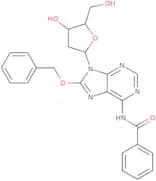
CAS:N6-Benzoyl-8-benzyloxy-2'-deoxyadenosine is a novel nucleoside with anticancer and antiviral properties. It is an antiviral that inhibits the synthesis of viral DNA by blocking the incorporation of ribonucleotide triphosphates into DNA, while leaving intact the synthesis of deoxyribonucleotides and phosphoramidites. In addition, it is a potent inhibitor of cellular DNA polymerases that catalyze synthesis of DNA from deoxyribonucleoside triphosphates. N6-Benzoyl-8-benzyloxy-2'-deoxyadenosine also has antitumor activity in animal models.
Formula:C24H23N5O5Purezza:Min. 95%Peso molecolare:461.5 g/mol3'-Deoxythymidine-5'-triphosphate lithium salt - 100mM aqueous solution
CAS:3'-Deoxythymidine-5'-triphosphate lithium salt - 100mM aqueous solution is a phosphoramidite. It is an antiviral agent that inhibits the replication of DNA and RNA viruses by inhibiting the synthesis of viral nucleic acid. 3'-Deoxythymidine-5'-triphosphate lithium salt - 100mM aqueous solution has been shown to be effective against some cancer cells with high purity and novel properties.Formula:C10H17N2O13P3·xLiPurezza:Min. 95%Peso molecolare:466.17 g/mol2-Methylthio-6-chloro-9-methylpurine
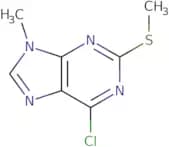
CAS:2-Methylthio-6-chloro-9-methylpurine is an activator that inhibits the enzyme ribonucleotide reductase, which is involved in the synthesis of DNA and RNA. 2-Methylthio-6-chloro-9-methylpurine has been shown to inhibit viral replication and may be used as a antiviral agent. This compound has novel properties and is a potential anticancer drug due to its ability to inhibit the growth of tumor cells.Formula:C7H7CIN4SPurezza:Min. 95%Peso molecolare:318.14 g/mol2'-Deoxy-5'-O-DMT-N2-isobutyryl-guanosine-3'-lcaa-CPG
2'-Deoxy-5'-O-DMT-N2-isobutyryl-guanosine-3'-lcaa-CPG is a modified nucleoside, which is synthetically prepared. It is an activator of DNA polymerase and has been shown to be active against human leukemia cells. 2'-Deoxy-5'-O-DMT-N2-isobutyryl Guanosine 3'-lcaa CPG has also been shown to inhibit the replication of the herpes simplex virus type 1 in vitro. The compound is a novel high quality nucleoside phosphoramidite that can be used as a building block in the synthesis of deoxyribonucleosides and modified nucleosides with novel chemical structures.
Purezza:Min. 95%8-Bromoadenosine 3',5'-cyclic monophosphorothioate, Sp-isomer sodium salt
CAS:8-Bromoadenosine 3',5'-cyclic monophosphate is a nucleotide analog that binds to RNA polymerase and blocks the elongation of RNA. It has been shown to stimulate axonal regeneration in the rat spinal cord, by increasing the level of glutamate in the extracellular space. 8-Bromoadenosine 3',5'-cyclic monophosphate also stimulates nerve growth factor (NGF) production and activates protein kinase C (PKC). This drug also inhibits apoptosis by inhibiting the activity of Mcl-1 protein, which is involved in mitochondrial membrane permeability.Formula:C10H10BrN5O5PS·NaPurezza:Min. 95%Colore e forma:White to off-white solid.Peso molecolare:446.51 g/mol2'-Deoxy-5'-O-DMT-5-methylzebularine 3'-CE phosphoramidite
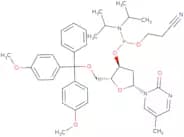
CAS:2'-Deoxy-5'-O-DMT-5-methylzebularine 3'-CE phosphoramidite is a novel nucleoside that has been modified to contain a 5-methyl group at the 2′ position. It is phosphorylated with a phosphate group at the 3′ position and linked to an oligonucleotide via a 3′-O,O′-dimethoxytrityl (DMT) spacer. This novel nucleoside has antiviral activity against hepatitis C virus and cytomegalovirus, as well as anticancer properties. 2'-Deoxy-5'-O-DMT-5-methylzebularine 3'-CE phosphoramidite has shown antitumour activity in animal models of human breast cancer and melanoma.Formula:C40H49N4O7PPurezza:Min. 95%Colore e forma:SolidPeso molecolare:728.81 g/molBiotin-16-deoxyuridine-5'-triphosphate, lithium salt - 1 mM aqueous solution
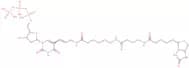
CAS:Biotin-16-deoxyuridine-5'-triphosphate, lithium salt (Biotin-16-dUTP) is a nucleotide analog that is used in the detection of RNA and DNA. It is incorporated into the growing DNA or RNA strand by DNA polymerase and then detected by an enzyme that can detect biotin. Biotin-16-dUTP has been shown to be effective in identifying the occipital cortex during basic protein localization studies. The use of biotin-16-dUTP has also been shown to increase immune response as well as neuronal death in vivo models. This drug has also been shown to cause necrotic cell death in hl-60 cells, which may be due to its ability to inhibit creatine kinase and interfere with cellular ATP production. Biotin-16-dUTP has also been used for the detection of genome dna from HLA class I genes with monoclonal antibodiesFormula:C32H52N7O18P3S·xLiPurezza:Min. 95%Colore e forma:Colourless liquid.Peso molecolare:947.78 g/mol6-Chloro-2-hydroxy-9-(2',3',5'-tri-O-acetyl-b-D-ribofuranosyl)purine
CAS:6-Chloro-2-hydroxy-9-(2',3',5'-tri-O-acetyl-b-D-ribofuranosyl)purine is a novel nucleoside that has been shown to have anticancer activity. It is synthesized by the condensation of 2,6 dichloropurine with 3,5 diacetyl b ribofuranosyl chloride in the presence of triethylamine and pyridine. The compound has been shown to inhibit viral replication and induce apoptosis in cancer cells. 6C2H9(2',3',5'-tri-O-acetylb-D-ribofuranosyl)purine may also be useful for the treatment of human immunodeficiency virus (HIV) infection.Formula:C16H17ClN4O8Purezza:Min. 95%Peso molecolare:428.78 g/mol2'-Deoxy-2',2'-difluorocytidine 5'-monophosphate triethylammonium salt
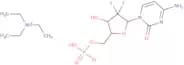
2'-Deoxy-2',2'-difluorocytidine 5'-monophosphate triethylammonium salt is an antiviral nucleotide that inhibits the synthesis of viral DNA by competing with natural substrates. It has been shown to be a potent activator of the phosphoramidite method, which is a synthetic method for the production of oligonucleotides. This nucleotide is synthesized by reacting 2-deoxy-2',2'-difluorocytidine 5'-triphosphate with TEA in DMF. The CAS number for this compound is 62533-81-7 and it has a molecular weight of 298.3 Da.Purezza:Min. 95%3'-Deoxy-3'-fluoro-5'-O-tritylthymidine
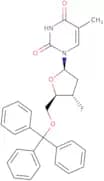
CAS:3'-Deoxy-3'-fluoro-5'-O-tritylthymidine is a monophosphate nucleoside that inhibits the viral DNA polymerase. It has antiviral activity against herpes viruses, including HSV-1 and HSV-2. 3'-Deoxy-3'-fluoro-5'-O-tritylthymidine is a synthetic nucleoside with modified phosphate groups to improve stability and purity. This product has shown anticancer effects in vitro and in vivo by inhibiting DNA synthesis and promoting apoptosis of cancer cells.Formula:C29H27FN2O4Purezza:Min. 95%Peso molecolare:486.53 g/mol2,4,6-Trimethoxy-pyrimidine
CAS:Prodotto controllato2,4,6-Trimethoxy-pyrimidine is a heterobicyclic compound that contains three methoxy groups. It is a synthetic nucleobase that can be found in the nucleosides uridine and cytidine, as well as in other compounds such as pyrimidines. 2,4,6-Trimethoxy-pyrimidine has been shown to be reactive to nucleophilic solutes and has been used with success in the synthesis of lactams. The isomers of this compound have different efficiencies for reaction with nucleophilic solutes.
Purezza:Min. 95%5'-O-DMT-2'-O-methylinosine
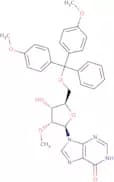
CAS:5'-O-DMT-2'-O-methylinosine is a monophosphate nucleotide that has antiviral effects. It is synthesized from the synthetic nucleoside 5'-O-DMT-2'-deoxyuridine and 2'-O-methylinosine. The synthesis of 5'-O-DMT-2'-O-methylinosine is achieved through phosphoramidite chemistry, which produces a novel antiviral agent with high purity and quality. This compound has been shown to inhibit HIV replication in vitro, but further research is needed to determine its efficacy in vivo.
Formula:C32H32N4O7Purezza:Min. 95%Peso molecolare:584.63 g/mol5-Aminoallyl- 2'-deoxyuridine 5'-triphosphate, labeled with 5/6-TAMRA - 1mM aqueous solution
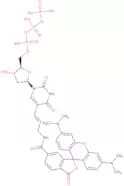
CAS:5-Aminoallyl-2'-deoxyuridine 5'-triphosphate is a novel chemical compound that is modified with 5/6-TAMRA and has anticancer, antiviral, and antitumor properties. It is an activator of ribonucleosides and deoxyribonucleosides. CAS No. 151345-35-6Formula:C37H40N5O18P3Purezza:Min. 95%Peso molecolare:935.66 g/molCytidine hemisulfate salt
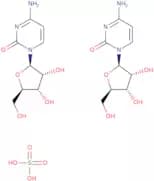
CAS:Cytidine hemisulfate salt is a postulated inhibitor of the blood group antigen. It inhibits the phosphatase activity of blood group-specific phosphatases, which may be caused by its specific inhibition of α-tocopherol and phenolphthalein. Cytidine hemisulfate salt has been shown to inhibit both adenylic and uridylic phosphatases, but does not inhibit other phosphatases. This drug is also an antigen that can stimulate B cells, which produce antibodies against it. Cytidine hemisulfate salt is found in DNA and RNA.Formula:C9H13N3O5H2SO4Purezza:Min. 95%Peso molecolare:292.26 g/mol5'-O-p-Anisoyl-3'-fluoro-3'-deoxythymidine
5'-O-p-Anisoyl-3'-fluoro-3'-deoxythymidine is a novel anticancer agent that has been shown to be active against leukemia, lymphoma and myeloma. The compound is a nucleoside analogue that inhibits DNA synthesis by inhibiting the activity of DNA polymerase. It has been shown to have antiviral activity in vitro against herpes simplex virus type 1 and type 2, influenza A virus and HIV. 5'-O-p-Anisoyl-3'-fluoro-3'-deoxythymidine can also inhibit protein synthesis by blocking the incorporation of amino acids into protein. This drug is synthesized from 3',5'-dideoxyuridine (dU) and fluoroacetyl chloride to produce 5'-O-p-anisoyl-3',5'-difluoroacetyl dU (ADUF). ADUF is then reacted with anisole to produce 5
Formula:C18H19FN2O6Purezza:Min. 95%Peso molecolare:378.4 g/mol3'-Azido-3'-deoxythymidine-methyl-D3-2,3,4-tri-O-acetyl-b-D-glucuronide methyl ester
Prodotto controllato3'-Azido-3'-deoxythymidine-methyl-D3-2,3,4-tri-O-acetyl-b-D-glucuronide methyl ester (AZT) is a novel nucleoside compound that is a phosphoramidite. AZT has antiviral activity against various DNA and RNA viruses, including HIV. It is also effective in the treatment of cancer. AZT inhibits viral replication by competitively inhibiting the incorporation of diphosphate into viral DNA or RNA. This process prevents the synthesis of new virus particles and the spread of infection to healthy cells. In addition, AZT may inhibit tumor growth by interfering with cell division and DNA synthesis.Formula:C23H26D3N5O13Purezza:Min. 95%Peso molecolare:586.52 g/molN4-Acetyl-2'-deoxy-5'-O-DMT-cytidine 3'-Sp-oxazaphospholidine
N4-Acetyl-2'-deoxy-5'-O-DMT-cytidine 3'-Sp-oxazaphospholidine is a novel antiviral drug that has been synthesized for the treatment of cancer and viral infections. This compound has been modified to increase its antiviral activity, which is due to its ability to inhibit DNA synthesis. The antiviral activity of N4-Acetyl-2'-deoxy-5'-O-DMT-cytidine 3'-Sp-oxazaphospholidine was shown in vitro using human and mouse cells infected with herpes simplex virus (HSV) type 1 and 2.
Purezza:Min. 95%


![3-(2'-Deoxy-β-D-2-ribofuranosyl)pyrido[2,3-d]pyrimidine-2,7(8H)-dione](/_next/image/?url=https%3A%2Fstatic.cymitquimica.com%2Fproducts%2F3D%2Fthumb-webp%2FZDA51798.webp&w=3840&q=75)