Nucleosidi
I nucleosidi sono building blocks fondamentali degli acidi nucleici, composti da una base azotata legata a una molecola di zucchero. In questa sezione, puoi trovare una vasta gamma di nucleosidi essenziali per la ricerca in biologia molecolare, biochimica e farmacologia. Questi composti svolgono ruoli cruciali nella sintesi del DNA e dell'RNA e sono vitali in vari processi metabolici. I nucleosidi vengono utilizzati per studiare il materiale genetico, sviluppare terapie antivirali e antitumorali e comprendere i meccanismi cellulari. Da CymitQuimica, forniamo nucleosidi di alta qualità per supportare le tue esigenze di ricerca e sviluppo, garantendo purezza e affidabilità per le tue applicazioni sperimentali.
Trovati 3569 prodotti di "Nucleosidi"
Ordinare per
Purezza (%)
0
100
|
0
|
50
|
90
|
95
|
100
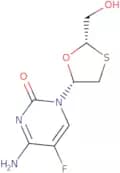
(+)-Emtricitabine
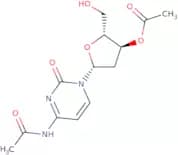
CAS:Emtricitabine is a synthetic nucleoside analog of cytidine. It is used in the treatment of HIV infection and hepatitis B virus infection. Emtricitabine binds to human DNA polymerase, preventing the incorporation of viral DNA into the host cell's genome. This prevents the virus from multiplying and reproducing, thereby inhibiting the spread of HIV in humans. The drug has been shown to inhibit replication at all stages of HIV-1, including reverse transcription and integration into host cell DNA. Emtricitabine also inhibits replication of other viruses such as herpes simplex virus type 1 (HSV-1) and hepatitis C virus (HCV). Emtricitabine is a prodrug that must be activated by phosphorylation before it can be incorporated into DNA. This activation requires tenofovir alafenamide hemifumarate as an activator, which is an experimental drug with improved bioavailability, reduced renal clearance, andFormula:C8H10FN3O3SPurezza:Min. 95%Peso molecolare:247.25 g/molN4-Acetyl-3'-O-acetyl-2'-deoxycytidine
CAS:N4-Acetyl-3'-O-acetyl-2'-deoxycytidine is a novel, modified nucleoside that contains a phosphoramidate linkage. It has been shown to have anticancer and antiviral properties. N4-Acetyl-3'-O-acetyl-2'-deoxycytidine is also an activator of the immune system and has been shown to be effective against HIV.Purezza:Min. 95%Fluorescein-dt cep
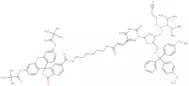
CAS:Fluorescein-dt cep is a monophosphate nucleoside analog that is modified with an activated ester group. It is used as a prodrug for the treatment of influenza in humans. Fluorescein-dt cep has antiviral activity, which may be due to its ability to inhibit viral RNA synthesis. This agent also has anticancer activity and has been shown to kill leukemia cells by interfering with DNA synthesis. The chemical name for fluorescein-dt cep is 1-(2,6-dichloro-4-(5,7-dimethoxy-4-methylpyridiniumyl)phenyl)cytosine monophosphate. Fluorescein-dt cep is also known by the following synonyms: 1-(2,6-Dichloro-4-(5,7-dimethoxyquinoliniumyl)phenyl)-1H-[1,3]dioxFormula:C79H89N6O17PPurezza:Min. 95%Peso molecolare:1,425.6 g/molCaged Strand-Breaker II CE-Phosphoramidite
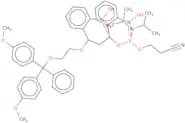
CAS:When included in an oligonucleotide, irradiation at 365 nm causes strand cleavage. This will leave a hydroxyl residue on the 3' end and a phosphate on the 5' end.Formula:C47H53N4O10PPurezza:Min. 95%Peso molecolare:864.92 g/mol4-Amino-3-benzyl-1H-pyrazolo[3,4-d]pyrimidine 1-b-D-ribofuranose
CAS:4-Amino-3-benzyl-1H-pyrazolo[3,4-d]pyrimidine 1b-D-ribofuranose is a novel diphosphate activator that can modify the properties of deoxyribonucleosides and nucleosides. It has antiviral activity against human immunodeficiency virus type 1 (HIV) and herpes simplex virus type 2 (HSV). 4-Amino-3-benzyl-1H-pyrazolo[3,4-d]pyrimidine 1b -D--ribofuranose is also an anticancer agent that has been shown to have DNA binding ability, in addition to its ability to inhibit the proliferation of cancer cells.Formula:C17H19N5O4Purezza:Min. 95%Peso molecolare:357.36 g/mol5-Chloro-5'-deoxycytidine
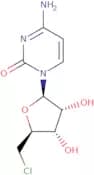
CAS:<p>5-Chloro-5'-deoxycytidine is a nucleoside with antiviral activity. It is used for the synthesis of phosphoramidites, which are used in DNA and RNA synthesis. 5-Chloro-5'-deoxycytidine has been shown to be an effective activator for novel DNA and RNA analogues, such as phosphorothioates, phosphotriesters, and phosphorodithioates. This compound is also widely used in the preparation of oligodeoxynucleotide analogues that are modified chemically or structurally to improve their biological properties. 5-Chloro-5'-deoxycytidine has been synthesized by modifying the nucleobase with a 5-chloro group at the 5' position on the ribose ring, making it more resistant to degradation by enzymes than other cytosine derivatives.</p>Formula:C9H12ClN3O4Purezza:Min. 95%Colore e forma:White to off-white solid.Peso molecolare:261.67 g/molTFA-ap-dU
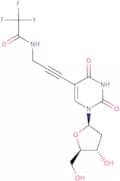
CAS:<p>TFA-ap-dU is a modified, ribonucleosides that are used in DNA synthesis. The polymerase chain reaction (PCR) technique can be used to generate a large number of copies of a specific sequence of nucleotides from the original DNA template. This product is used for antiviral and anticancer research. TFA-ap-dU has been shown to be effective against Hepatitis B virus and Human Immunodeficiency Virus (HIV). It is also an activator of DNA and RNA synthesis.</p>Formula:C14H14F3N3O6Purezza:Min. 95%Peso molecolare:377.27 g/mol3-Deazauridine-5'-triphosphate triethylamine salt
CAS:3-Deazauridine-5'-triphosphate triethylamine salt is a xanthosine analog that has been used as a biochemical reagent in animals and humans. It is postulated to be a potential cancer therapeutic agent because of its ability to inhibit DNA synthesis and cell division. 3-Deazauridine-5'-triphosphate triethylamine salt inhibits the biosynthesis of uridine in leukemic mice, hamster V79 cells, and mammalian cells. This drug inhibits the incorporation of uracil into RNA by competitive inhibition with respect to ATP. 3DATTP also inhibits the incorporation of thymidine into DNA by competitive inhibition with respect to dCTP.Formula:C10H16NO15P3Purezza:Min. 95%Peso molecolare:483.15 g/mol2-Chloro-3-deazaadenosine
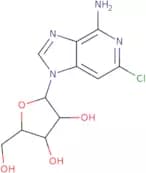
CAS:<p>2-Chloro-3-deazaadenosine is an antiviral drug that inhibits the synthesis of DNA by acting as a competitive inhibitor for adenosine. It has been shown to be effective in the treatment of hepatitis B virus and herpes simplex virus infections. 2-Chloro-3-deazaadenosine prevents the incorporation of the natural nucleoside adenosine into DNA, which leads to inhibition of viral replication and cell division. This drug also has been shown to inactivate liver cells in bovines, which may account for its toxicity. The synthesis of 2-chloroadenosine is difficult and laborious due to its glycosylation, making it more expensive than other analogues that are more easily synthesized.</p>Formula:C11H13ClN4O4Purezza:Min. 95%Colore e forma:PowderPeso molecolare:300.7 g/molCarbodine
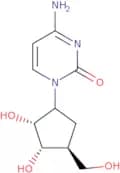
CAS:Carbocyclic analog of cytidineFormula:C10H15N3O4Purezza:Min. 95%Colore e forma:PowderPeso molecolare:241.24 g/molGuanosine 5'-O-(1-thiotriphosphate) lithium salt - 100mM aqueous solution
CAS:Guanosine 5'-O-(1-thiotriphosphate) lithium salt is a nucleotide analogue that binds to the guanine nucleotide-binding site on the enzyme. This agent has been shown to inhibit the growth of viruses, such as influenza virus and human immunodeficiency virus, by inhibiting viral transcription. The drug also has antiviral activity against herpesviruses and cytomegalovirus in cell culture. Guanosine 5'-O-(1-thiotriphosphate) lithium salt inhibits the binding of RNA polymerase to DNA templates and prevents the initiation of transcription. It also reduces the expression of a number of genes in cells by inhibiting protein synthesis in the cytoplasm. Guanosine 5'-O-(1-thiotriphosphate) lithium salt may be used for treating congestive heart failure due to its ability to reduce levels of cytosolic Ca2+ ions, which have been shown to promote cardiac myFormula:C10H16N5O13P3S·4LiPurezza:Min. 95%Colore e forma:Colourless liquid.Peso molecolare:567.01 g/mol5'-Fluoro-5'-deoxy-adenosine
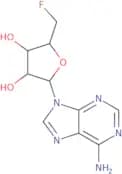
CAS:5'-Fluoro-5'-deoxy-adenosine (FDA) is a fluorinated adenosine derivative that has been shown to regulate glucose levels in plasma. It has been shown to increase the uptake of glucose in cells and improve insulin sensitivity, which may be due to its ability to increase the production of nitric oxide. FDA is also thought to act as an antioxidant and may be useful for treating autoimmune diseases such as insulin resistance and type II diabetes.Formula:C10H12FN5O3Purezza:Min. 95%Colore e forma:PowderPeso molecolare:269.23 g/mol2-Amino-5-pyrimidinesulfonamide
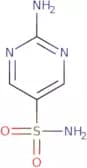
CAS:<p>2-Amino-5-pyrimidinesulfonamide is a synthetic nucleoside. It is an analog of cytidine and is used as a building block for the synthesis of modified nucleosides, phosphoramidites, diphosphate, and ribonucleosides. 2-Amino-5-pyrimidinesulfonamide is also known as an activator in DNA synthesis. The chemical compound has CAS number 99171-23-0 and molecular weight of 174.2 g/mol. This product is soluble in water or ethanol, but insoluble in ether or chloroform.</p>Formula:C4H6N4O2SPurezza:Min. 95%Peso molecolare:174.18 g/molCytidine-5'-triphosphate, lithium salt
Cytidine-5'-triphosphate, lithium salt (CTP, Li) is a monophosphate that is used as a cofactor in the synthesis of DNA and RNA. It is also used for the treatment of viral infections. CTP, Li has antiviral activity against herpes simplex virus type 1 and 2 (HSV-1 and HSV-2), varicella zoster virus (VZV), human cytomegalovirus (CMV) and Epstein-Barr virus (EBV). CTP, Li can be used to inhibit the growth of cancer cells by modifying DNA.Purezza:Min. 95%5-O-Tritylinosine
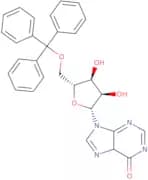
CAS:5-O-Tritylinosine is a modified nucleoside that has shown anticancer and antiviral properties. It is the monophosphate ester of 5-methyluracil and has been shown to inhibit DNA synthesis in vitro. 5-O-Tritylinosine has also been shown to inhibit the replication of herpes simplex virus type 1, which may be due to its ability to inhibit viral DNA polymerase.Formula:C29H26N4O5Purezza:Min. 95%Peso molecolare:510.54 g/mol5’-Azido-2’,5’-dideoxyuridine
CAS:<p>5’-Azido-2’,5’-dideoxyuridine (5ADU) is a pyrimidine nucleoside that has been used to treat cancer. It is converted to 5-azidouracil which inhibits the synthesis of thymidylate, an essential component of DNA. 5ADU is also active against herpes virus and can be used as an antiviral agent. This drug has been shown to protect against radiation damage by inhibiting the formation of free radicals. The protonation of 5ADU leads to a stereochemical rearrangement that prevents the formation of free radicals. 5ADU does not inhibit bacterial enzymes, but it does have some effect on viruses, such as herpes virus, because they contain DNA or RNA similar to human cells.</p>Formula:C9H11N5O4Purezza:Min. 95%Peso molecolare:253.21 g/molN4-Benzoyl-5'-O-DMT-2'-O-methyl-5-methylcytidine
CAS:N4-Benzoyl-5'-O-DMT-2'-O-methyl-5-methylcytidine is a modified nucleoside that is used as an antiviral. It is phosphorylated by the enzyme kinase to form a diphosphate, which inhibits viral DNA synthesis by inhibiting the action of DNA polymerases. N4-Benzoyl-5'-O-DMT-2'-O-methyl-5-methylcytidine has been shown to have anticancer activity in vitro and in vivo. The drug also has high purity and quality, making it suitable for use in laboratory research.Formula:C39H39N3O8Purezza:Min. 95%Colore e forma:Slightly Yellow PowderPeso molecolare:677.74 g/molN4-Benzoyl-2'-deoxy-3'-O-levulinoylcytidine
<p>N4-Benzoyl-2'-deoxy-3'-O-levulinoylcytidine is a nucleoside that is used as an antiviral and anticancer agent. It is a modified deoxyribonucleoside that has antiviral activity against HSV-1, HSV-2, and HIV. N4-Benzoyl-2'-deoxy-3'-O-levulinoylcytidine also has anticancer effects against leukemia cells in mice. This drug is synthesized from 2′,3′,5′triacetyladenosine by the reaction of 4-(1H)-benzoyloxymethyl)phenylacetic acid with triethylamine and levulinic acid chloride.</p>Formula:C21H23N3O7Purezza:Min. 95%Peso molecolare:429.43 g/mol8-(4-Amino-(2',3',4',5',6'-D5-biphenyl)-2'-deoxyguanosine
Prodotto controllato<p>8-(4-Amino-(2',3',4',5',6'-D5-biphenyl)-2'-deoxyguanosine is a novel, diphosphate nucleoside with antiviral and anticancer activity. It has been shown to activate the transcription of genes that are involved in cell growth and differentiation. This drug also inhibits the synthesis of viral DNA by binding to the viral DNA polymerase, thereby inhibiting its function. 8-(4-Amino-(2',3',4',5',6'-D5-biphenyl)-2'-deoxyguanosine can be used as a phosphoramidite for the preparation of oligonucleotides for use in gene therapy.</p>Formula:C22H17N6O4D5Purezza:Min. 95%Colore e forma:PowderPeso molecolare:439.48 g/molN6-Propargyladenosine
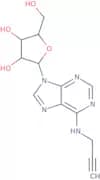
CAS:N6-Propargyladenosine is an alkyne functionalised nucleoside.Formula:C13H15N5O4Purezza:Min. 95%Colore e forma:PowderPeso molecolare:305.29 g/mol

![4-Amino-3-benzyl-1H-pyrazolo[3,4-d]pyrimidine 1-b-D-ribofuranose](/_next/image/?url=https%3A%2Fstatic.cymitquimica.com%2Fproducts%2F3D%2Fthumb-webp%2FNA16507.webp&w=3840&q=75)