Nucleosidi
I nucleosidi sono building blocks fondamentali degli acidi nucleici, composti da una base azotata legata a una molecola di zucchero. In questa sezione, puoi trovare una vasta gamma di nucleosidi essenziali per la ricerca in biologia molecolare, biochimica e farmacologia. Questi composti svolgono ruoli cruciali nella sintesi del DNA e dell'RNA e sono vitali in vari processi metabolici. I nucleosidi vengono utilizzati per studiare il materiale genetico, sviluppare terapie antivirali e antitumorali e comprendere i meccanismi cellulari. Da CymitQuimica, forniamo nucleosidi di alta qualità per supportare le tue esigenze di ricerca e sviluppo, garantendo purezza e affidabilità per le tue applicazioni sperimentali.
Trovati 3569 prodotti di "Nucleosidi"
Ordinare per
Purezza (%)
0
100
|
0
|
50
|
90
|
95
|
100
5-[(Methylamino)methyl]uridine
CAS:<p>5-[(Methylamino)methyl]uridine is a proton-containing analog of uridine. It is an epigenetic modifier that has been shown to have conformational properties that are similar to those of uridine. 5-[(Methylamino)methyl]uridine has been shown to modify the glycosidic bond and ring structures, which are important for its function in protein synthesis. The compound can also be found as a chemical structure in the ribosomal subunit, where it is involved in protein synthesis and translation. 5-[(Methylamino)methyl]uridine has shown potential as a therapeutic agent for cancer treatment due to its ability to inhibit the expression of oncogenes in cells and induce programmed cell death (apoptosis).</p>Formula:C11H17N3O6Purezza:Min. 95%Peso molecolare:287.27 g/mol2-Amino-4-methoxypyrimidine
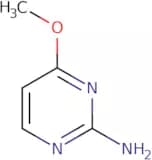
CAS:<p>2-Amino-4-methoxypyrimidine is an organic compound that can be synthesized from 2-amino-4-chloropyrimidine. It is a colorless, water soluble solid with a melting point of 166°C. The UV spectrum of 2-amino-4-methoxypyrimidine exhibits absorption maxima at 240 nm and 280 nm. When 2-amino-4-methoxypyrimidine is exposed to UV light, it emits fluorescent light at 360 nm. The IR spectrum exhibits absorption bands at 3200 cm−1, 1650 cm−1, and 1530 cm−1. Hydrogen bonding interactions occur between the methoxy group and the protonated amine group in the molecule's structure. The yield of this reaction was found to be 65% by GC analysis. This reaction occurs in two steps: first, the imino group reacts with n hexane to form an iminium ion</p>Purezza:Min. 95%2'-Deoxy-5'-O-DMT-adenosine
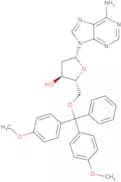
CAS:<p>2'-Deoxy-5'-O-DMT-adenosine is a nucleoside that is structurally related to adenosine. It is synthesized by the phosphoramidite approach and can be used as an activator for RNA synthesis. 2'-Deoxy-5'-O-DMT-adenosine has shown anticancer activity in vitro and in vivo, which may be due to its ability to inhibit RNA synthesis and DNA replication.</p>Formula:C31H31N5O5Purezza:Min. 95%Colore e forma:PowderPeso molecolare:553.61 g/mol[1',2',3',4',5'-13C5]-4-Thiothymidine
<p>[1',2',3',4',5'-13C5]-4-Thiothymidine is an antiviral, anticancer, and activator of DNA synthesis. It is a monophosphate analog of thymidine that has been modified to include a radioactive isotope. [1',2',3',4',5'-13C5]-4-Thiothymidine binds to the active site of the enzyme ribonucleotide reductase which is responsible for the production of DNA from RNA. The incorporation of this radioactively labeled analog into DNA prevents its degradation by nucleases and allows for the detection and quantification of DNA synthesis via autoradiography.</p>Purezza:Min. 95%2'-Deoxy-1,N6-dimethyladenosine
<p>2'-Deoxy-1,N6-dimethyladenosine is a nucleoside that is used for the synthesis of DNA and RNA. It has antiviral activity against HIV and herpes simplex virus type 1 (HSV-1). 2'-Deoxy-1,N6-dimethyladenosine binds to viral DNA and inhibits viral replication by preventing the viral DNA from being replicated. It also inhibits the synthesis of viral proteins. This nucleoside is synthesized in a high purity and quality, which makes it an excellent starting material for use in the synthesis of other nucleosides or phosphoramidites.</p>Purezza:Min. 95%4-Methyl-6-phenyl-pyrimidine-2-thiol
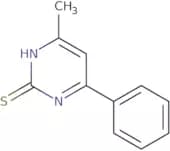
CAS:4-Methyl-6-phenyl-pyrimidine-2-thiol is a copper(II) dehalogenating agent that belongs to the group of amplifiers. It has been used in the preparation of syntheses, including as an intermediate in the synthesis of phenylpyrimidines and amidines. The synthesis of 4-methyl-6-phenyl-pyrimidine-2-thiol can be accomplished by condensation of phleomycin with a biaryl. This reaction is followed by oxidation to give a biaryl sulfone, which is then reduced with hydrogen gas and ammonium formate.Formula:C11H10N2SPurezza:Min. 95%Peso molecolare:202.28 g/mol2'-O-(tert-Butyldimethylsilyl)-3'-deoxy-5'-O-trityluridine
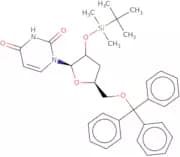
CAS:2'-O-(tert-Butyldimethylsilyl)-3'-deoxy-5'-O-trityluridine is a nucleoside that has antiviral and anticancer properties. It is a monophosphate of uridine, which is an important precursor in the synthesis of DNA and RNA. This product has been modified to improve its purity and quality, making it suitable for use in laboratory research.Formula:C34H40N2O5SiPurezza:Min. 95%Peso molecolare:584.78 g/molO6-Benzyl guanosine
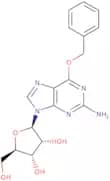
CAS:<p>O6-Benzyl guanosine is a polymerized compound that has been shown to have anticancer efficacy. It has been tested in mice with medulloblastoma, a type of brain tumor, and in rats with breast cancer. O6-Benzyl guanosine was found to be hydrophobic and bound to the methyltransferase enzyme, which resulted in the inhibition of DNA synthesis. The polymerized compound is able to form conjugates with other molecules such as iron oxide nanoparticles or hydrazone derivatives, which can be used for treatments that involve bioconjugate chemistry.</p>Formula:C17H19N5O5Purezza:Min. 95%Peso molecolare:373.36 g/molAFB-guanine
CAS:<p>AFB-guanine is a purine nucleoside that has been found to be an intermediate in the conversion of adenosine to inosine. The toxicity of AFB-guanine was studied using the model system of rat liver microsomes and human liver. It was observed that AFB-guanine is metabolized by glycosylases, which act on purines and pyrimidines. The glycosylase activity was inhibited by dicoumarol, which results in a decrease in the amount of AFB-guanine that is converted to adenosine triphosphate (ATP). The study also showed that histological analysis revealed degenerative diseases and cancer in mice fed with AFB-guanine, suggesting that this compound may be carcinogenic.</p>Formula:C22H17N5O8Purezza:Min. 95%Peso molecolare:479.4 g/mol5-Methylcytidine HCl
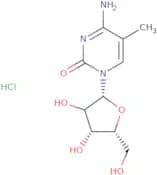
<p>5-Methylcytidine HCl is a novel antiviral and anticancer agent. It possesses two important properties: it is an activator of the enzyme ribonucleotide reductase, which regulates DNA synthesis and repair; and it inhibits the activity of DNA polymerases. It is also chemically modified to allow its use in phosphoramidite synthesis. 5-Methylcytidine HCl has been shown to cause apoptosis in cancer cells, as well as inhibit the growth of bacteria.</p>Formula:C10H15N3O5·HClPurezza:Min. 95%Peso molecolare:293.7 g/mol2-[2-(4-Fluorophenyl)ethoxy]adenosine
CAS:<p>2-[2-(4-Fluorophenyl)ethoxy]adenosine is a hydrogen-bonded, hydrated, switchable molecule. The techniques used to characterize this compound include vibrational spectroscopy and Raman spectroscopy. 2-[2-(4-Fluorophenyl)ethoxy]adenosine has been shown to have high salt and thermal stability. It has also been shown to undergo conformational changes in the presence of chemists.</p>Formula:C18H20FN5O5Purezza:Min. 95%Peso molecolare:405.38 g/molCarbocyclic 2'-deoxyguanosine
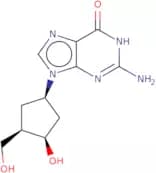
CAS:Carbocyclic 2'-deoxyguanosine is an analog of the nucleoside guanosine, and it is a prodrug that is converted to the active form, carbocyclic 2'-deoxyguanosin-8-yl-1-beta-D-arabinofuranoside, in vivo. This drug inhibits viral thymidine kinase and has been shown to be effective against HIV infection in clinical studies. Carbocyclic 2'-deoxyguanosine has been shown to inhibit virus proliferation by interfering with viral DNA synthesis and replication. It also blocks transcription of the HLA class I molecule by binding to its promoter region. Carbocyclic 2'-deoxyguanosine may have therapeutic potential for treating herpes simplex virus infections. The drug is being developed as an oral prodrug to treat patients with mild to moderate symptoms of herpes simplex virus infection.Formula:C11H15N5O3Purezza:Min. 95%Peso molecolare:265.27 g/mol2,5'-Anhydro-thymidine
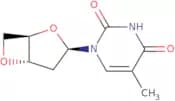
CAS:2,5'-Anhydro-thymidine is an analog of thymidine that is used in the diagnosis of women with suspected acute ischemic brain damage. It is a colony-stimulating factor that can be activated by the presence of inflammatory bowel disease or bowel disease. 2,5'-Anhydro-thymidine has been shown to cause ventricular dysfunction and to increase levels of brain natriuretic peptide in mice undergoing rotarod tests. The use of this compound has been shown to improve outcomes in animal models of acute ischemic brain damage and cancer.Formula:C10H12N2O4Purezza:Min. 95%Peso molecolare:224.21 g/mol7’-OH-N-trityl morpholino uracil
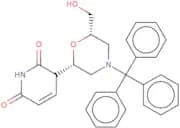
CAS:<p>Please enquire for more information about 7’-OH-N-trityl morpholino uracil including the price, delivery time and more detailed product information at the technical inquiry form on this page</p>Formula:C28H27N3O4Peso molecolare:469.53 g/mol5-Chloro-2',3'-O-isopropylidenecytidine
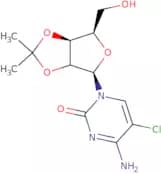
<p>5-Chloro-2',3'-O-isopropylidenecytidine is a synthetic nucleoside that is activated by phosphorylation to form the corresponding nucleotide. It has antiviral and anticancer properties, and can be used as a building block for synthesis of other nucleosides. 5-Chloro-2',3'-O-isopropylidenecytidine is synthesized from 2,4-dichlorophenoxyacetic acid (DCA) and 2,5-dichloroaniline in the presence of sodium cyanide. The compound was first synthesized in 1972 and its chemical structure was determined in 1974. 5-Chloro-2',3'-O-isopropylidenecytidine has been shown to inhibit DNA synthesis by binding to viral diphosphate and deoxyribonucleosides. This compound also inhibits the activity of bacterial DNA gyrase and DNA top</p>Formula:C12H16ClN3O5Purezza:Min. 95%Peso molecolare:317.73 g/molUridine 5'-triphosphate tris salt
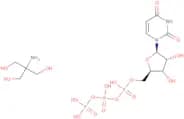
CAS:<p>Uridine 5'-triphosphate tris salt is a pyrimidine nucleotide that is used in the synthesis of RNA. It has been shown to be an effective inhibitor of hamster ovary and human ovarian cells. Uridine 5'-triphosphate tris salt is water-soluble and does not interfere with cellular assays or microfluidic devices. Uridine 5'-triphosphate tris salt has also been shown to have potential as a model system for analytical chemistry and pharmacological research.</p>Formula:C13H26N3O18P3Purezza:Min. 95%Colore e forma:White PowderPeso molecolare:484.14 g/molUridine diphosphate choline (UDPC) sodium
CAS:<p>Uridine diphosphate choline (UDPC) sodium is a nucleotide that is used as a phosphoramidite for DNA synthesis. The chemical formula for UDPC is C8H14N4O8P. The activation of the molecule occurs in acidic conditions, which may be due to the formation of an amide bond between the terminal phosphate and the amino group on the phosphorylcholine. This same reaction can also occur in alkaline conditions. UDPC has been shown to inhibit viral replication, including HIV-1, by blocking reverse transcription of viral RNA into DNA. It also has anticancer effects, as it inhibits cell proliferation and induces apoptosis in cancer cells. UDPC does not have any known side effects or toxicity.</p>Formula:C14H25N3O12P2•NaPurezza:Min. 95%Colore e forma:PowderPeso molecolare:512.3 g/mol3'-Deoxyadenosine-5'-triphosphate sodium salt - 10mM aqueous solution
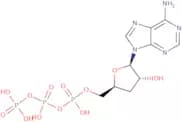
CAS:3'-Deoxyadenosine-5'-triphosphate sodium salt is a nucleotide that has been shown to be effective in chemotherapy. It is a substrate for the synthesis of DNA, RNA, and ATP. 3'-Deoxyadenosine-5'-triphosphate sodium salt is also a building block for DNA polymerase, which is an enzyme that synthesizes DNA from a template. It has been shown to have anticancer activity in drug-resistant cells and can be used as an alternative to purine analogs such as 6-mercaptopurine or cladribine. 3'-Deoxyadenosine-5'-triphosphate sodium salt has been shown to inhibit the production of nucleotides by blocking their conversion into triphosphates, which are necessary for DNA replication and repair. This inhibition leads to apoptosis in cells with high levels of nucleotide turnover such as cardiac and myeloid cells. The drug interactions may depend on theFormula:C10H16N5O12P3Purezza:Min. 95%Colore e forma:Colorless PowderPeso molecolare:491.18 g/mol2'-O-(2-Methoxyethyl)adenosine 5'-α-thiotriphosphate sodium
<p>2'-O-(2-Methoxyethyl)adenosine 5'-a-thiotriphosphate sodium salt is a synthetic nucleoside with antiviral and anticancer properties. It is an analog of adenosine 5'-triphosphate (ATP) in which the ribose sugar has been replaced by a 2'-O-(methoxyethyl) moiety. It has shown to be cytotoxic against cancer cells, and it is a potent activator of human telomerase, the enzyme that synthesizes telomeres at the end of chromosomes. This compound has been shown to have high purity and quality and does not have any CAS numbers assigned to it.</p>Formula:C13H18N5O13P3S·4NaPurezza:Min. 95%Peso molecolare:669.25 g/molCaffeoyl-coenzym A
CAS:Please enquire for more information about Caffeoyl-coenzym A including the price, delivery time and more detailed product information at the technical inquiry form on this pageFormula:C30H42N7O19P3SPurezza:Min. 95%Peso molecolare:929.68 g/mol
![5-[(Methylamino)methyl]uridine](/_next/image/?url=https%3A%2Fstatic.cymitquimica.com%2Fproducts%2F3D%2Fthumb-webp%2FNM159410.webp&w=3840&q=75)

![[1',2',3',4',5'-13C5]-4-Thiothymidine](/_next/image/?url=https%3A%2Fstatic.cymitquimica.com%2Fproducts%2F3D%2Fthumb-webp%2FNT35287.webp&w=3840&q=75)


![2-[2-(4-Fluorophenyl)ethoxy]adenosine](/_next/image/?url=https%3A%2Fstatic.cymitquimica.com%2Fproducts%2F3D%2Fthumb-webp%2FNF16548.webp&w=3840&q=75)