Nucleosidi
Trovati 3569 prodotti di "Nucleosidi"
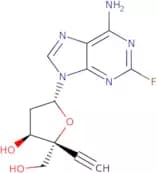
2'-Deoxy-4'-ethynyl-2-fluoroadenosine
CAS:2'-Deoxy-4'-ethynyl-2-fluoroadenosine (EFdA) is an analog of adenosine. EFdA is a potent inhibitor of HIV replication, and has been shown to be effective against other viruses such as influenza virus, herpes simplex virus, and vesicular stomatitis virus. EFdA was the first nucleoside analog to show antiviral activity in tissue culture against these viruses. This drug also inhibits the synthesis of mitochondrial rRNA and reduces the formation of mitochondrial DNA in human cells by inhibiting mitochondrial DNA polymerase γ. EFdA also prevents the binding of monoclonal antibodies to human B lymphocytes, which may be due to its steric interactions with plasma RNA. This drug is metabolized by cytochrome P450 2C8 and 2C9 into a variety of metabolites that are excreted in urine as glucuronides or sulfates. EFdA has a long
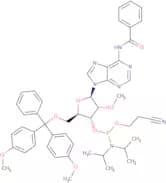
Formula:C12H12FN5O3Purezza:Min. 95%Peso molecolare:293.25 g/molN6-Benzoyl-5'-O-DMT-2'-O-methyladenosine 3'-CE phosphoramidite
CAS:N6-Benzoyl-5'-O-DMT-2'-O-methyladenosine 3'-CE phosphoramidite is a nucleoside phosphoramidite used as a building block in the chemical synthesis of oligonucleotides containing a 2’-O-methyl adenosine nucleoside unit. The use of a chemical synthesis rather than an enzymatic one allows oligonucleotides of a desired sequence to be produced. 3’-Cyanoethyl phosphoramidites are typically used by substitution of the di-isopropylamine group with an appropriate alcohol in the presence of an azole catalyst. Oligonucleotides containing 2'-O-methylribonucleoside units have shown site-specific cleavage with E. coli RNase H, either at a hairpin loop or at a stem region.Formula:C48H54N7O8PPurezza:Min. 98 Area-%Colore e forma:White Off-White PowderPeso molecolare:887.98 g/molPropionyl coenzyme A lithium salt
CAS:Propionyl coenzyme A lithium salt is a phosphoramidite that can be used in the synthesis of DNA and RNA. It is a novel chemical compound that has been modified to include ribonucleosides in addition to deoxyribonucleosides. This product is of high purity and quality, with a CAS number of 108321-21-7.
Formula:C24H40N7O17P3S·xLiPurezza:85%Colore e forma:White PowderPeso molecolare:823.6 g/mol5′-O-DMT-LNA N-Bz 5-Me cytidine
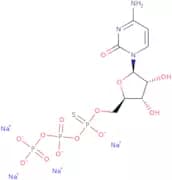
CAS:5′-O-DMT-LNA N-Bz 5-Me cytidine is a protected LNA cytidine nucleoside.Formula:C39H37N3O8Purezza:Min. 95%Peso molecolare:675.73 g/molCytidine-5'-O-(1-thiotriphosphate) lithium salt - 100mM aqueous solution
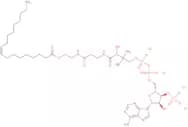
CAS:Cytidine-5'-O-(1-thiotriphosphate) lithium salt is a monophosphate nucleotide analog. It is soluble in water, and is used in the synthesis of DNA and RNA. Cytidine-5'-O-(1-thiotriphosphate) lithium salt has antiviral, anticancer, and anti-inflammatory properties. This compound can be used as an activator for phosphoramidites in the synthesis of DNA or RNA. Cytidine-5'-O-(1-thiotriphosphate) lithium salt is a novel nucleoside that can be used in the synthesis of modified oligonucleotides.Formula:C9H16N3O13P3S·xLiPurezza:Min. 95%Peso molecolare:499.22 g/molOleoyl coenzyme A lithium salt
CAS:Oleoyl coenzyme A lithium salt is a fatty acid that belongs to the class of organic compounds known as aliphatic acyl-coenzyme A. It is synthesized by the enzyme synthetase and can be used to diagnose cascading, linear response, and aldehyde synthesis in carbon nanotubes. Oleoyl coenzyme A lithium salt has been shown to bind to sephadex G-100 and immobilize it on a surface. This immobilization process aids in the diagnosis of various diseases such as diabetes mellitus, cancer, and cardiovascular problems. The chloride anion present in oleoyl coenzyme A lithium salt buffers and stabilizes the pH levels during this process. Oleoyl coenzyme A lithium salt also binds to multi-walled carbon nanotubes (MWNTs) due to its hydrophobic nature, which aids in the detection of markers such as lipids or proteins using immunological techniques.Formula:C39H68N7O17P3S·xLiPurezza:Min. 95%Peso molecolare:1,031.98 g/molUridine 5'-triphosphate tris salt
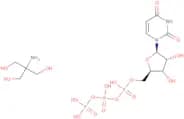
CAS:Uridine 5'-triphosphate tris salt is a pyrimidine nucleotide that is used in the synthesis of RNA. It has been shown to be an effective inhibitor of hamster ovary and human ovarian cells. Uridine 5'-triphosphate tris salt is water-soluble and does not interfere with cellular assays or microfluidic devices. Uridine 5'-triphosphate tris salt has also been shown to have potential as a model system for analytical chemistry and pharmacological research.Formula:C13H26N3O18P3Purezza:Min. 95%Colore e forma:White PowderPeso molecolare:484.14 g/molGuanosine5'-diphosphate
CAS:Pyruvate kinase substrateFormula:C10H15N5O11P2Purezza:Min. 95%Colore e forma:PowderPeso molecolare:443.2 g/mol5′-O-DMT-LNA N-Bz adenosine
CAS:5′-O-DMT-LNA N-Bz adenosine is a novel nucleoside that has been modified with an aminooxy group. The compound is synthesized by the phosphoramidite method and it is designed for use in antiviral and anticancer research. 5′-O-DMT-LNA N-Bz adenosine can be used as a substrate for DNA polymerases and other enzymes to produce nucleic acid strands. This product is CAS No. 206055-74-5, monophosphate, Phosphoramidites, Synthetic, Deoxyribonucleosides, Anticancer, Ribonuclesides, High purity.
Formula:C39H35N5O7Purezza:Min. 95%Peso molecolare:685.73 g/molKinetin riboside-5'-monophosphate sodium salt
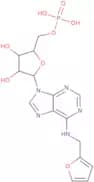
CAS:Kinetin riboside-5'-monophosphate sodium salt is a synthetic nucleotide that has been modified to include a phosphate group at the 5' position. Kinetin riboside-5'-monophosphate sodium salt is an activator of DNA synthesis and can be used for the treatment of viral infections. It also shows anticancer activity and is effective against cancer cells that are resistant to other cancer drugs.Formula:C15H16N5Na2O8P·H2OPurezza:Min. 95%Colore e forma:PowderPeso molecolare:489.29 g/mol2'-O-Propargyladenosine
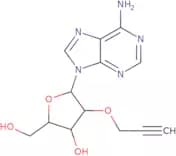
CAS:2'-O-Propargyladenosine is a modified nucleoside that belongs to the group of deoxyribonucleosides. It is an activator of viral DNA polymerases, which causes the synthesis of viral DNA to stop. This compound has antiviral and anticancer activities. 2'-O-Propargyladenosine has been shown to be effective against various human cancer cell lines in vitro and in vivo. It is a synthetic nucleoside with high purity, showing no detectable impurities by HPLC analysis.
Formula:C13H15N5O4Purezza:Min. 95%Colore e forma:White PowderPeso molecolare:305.29 g/mol7-deaza-dG-CE Phosphoramidite
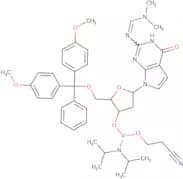
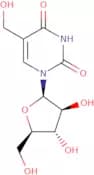
CAS:7-deaza-dG-CE Phosphoramidite is a monophosphate nucleotide, which is synthesized by modification of the 7-deaza-dG ribonucleoside. It has an antiviral and anticancer activity, and is used as a building block for novel drugs. 7-Deaza-dG-CE phosphoramidite has been shown to inhibit tumor growth and induce apoptosis in Hep2 cells. It also inhibits HIV replication in vitro. The compound is chemically stable and does not react with other biomolecules.Formula:C44H54N7O7PPurezza:Min. 95%Peso molecolare:823.9 g/mol1-(β-D-Arabinofuranosyl)-5-hydroxymethyluracil
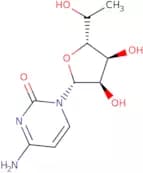
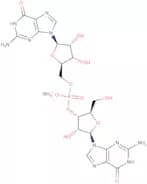
CAS:A hetero-base functionalised ara-nucleosideFormula:C10H14N2O7Purezza:Min. 95%Peso molecolare:274.23 g/molGuanylyl-3',5'-guanosine ammonium salt
CAS:Guanylyl-3',5'-guanosine ammonium salt is a novel antiviral agent that has high antiviral activity against influenza A virus. It is a guanine derivative which has been modified to include an aminopropyl group and an ammonium cation. This compound also acts as an activator for deoxyribonucleosides, nucleotides, and ribonucleosides. Guanylyl-3',5'-guanosine ammonium salt may be used in the manufacture of DNA, RNA, and phosphoramidites. This compound also has anticancer effects by inhibiting the proliferation of tumor cells and inducing apoptosis.
Formula:C20H25N10O12P·H3NPurezza:Min. 95%Peso molecolare:645.48 g/mol[(2S,6R)-6-{N6-Benzoyladenin-9-yl}-4-tritylmorpholin-2-yl]methyl dimethyl-phosphoramidochloridate
CAS:Nucleotide analogue for use in oligonucleotide synthesis
Formula:C38H37ClN7O4PPurezza:Min. 95%Colore e forma:PowderPeso molecolare:722.17 g/mol8-Nitroguanosine
CAS:8-Nitroguanosine is a nucleotide analogue that inhibits the activity of cyclic GMP in cells. It has been found to inhibit the growth of bacteria and cancer cells, as well as to stimulate the production of reactive oxygen species in brain cells. 8-Nitroguanosine has also been shown to inhibit the activity of cyclase enzymes in liver cells, which may be useful for treating liver disease. 8-Nitroguanosine is used as a chemical base for monoclonal antibodies that are used to study brain functions and pathogenic mechanisms.Formula:C10H12N6O7Purezza:Min. 95%Peso molecolare:328.24 g/molCiticoline sodium
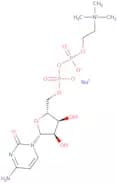
CAS:Citicoline is a complex organic molecule, a form of B-vitamin choline that acts as an intermediate in many biosynthetic pathways, for example, in the biosynthesis of cell membrane phospholipids. As a dietary supplement, citicoline is a source of choline and cytidine, two components that are quickly absorbed in the intestine and across the blood-brain barrier. The neuroprotective properties of citicoline improves mental performance increasing the levels of other brain-related chemicals like dopamine and norepinephrine, helping with recovery in stroke patients, reducing memory loss due to aging and improving vision in patients with glaucoma.Formula:C14H26N4O11P2•NaPurezza:Min. 98.0 Area-%Colore e forma:White To Off-White SolidPeso molecolare:511.31 g/mol2'-Deoxy-N4-DMF-5'-O-DMT-pseudoisocytidine 3'-CE phosphoramidite
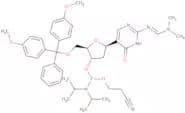
CAS:2'-Deoxy-N4-DMF-5'-O-DMT-pseudoisocytidine 3'-CE phosphoramidite is a fluorescent DNA probe that can be used for the detection of specific sequence mismatches in target DNA. This probe contains a linker, which is a short oligonucleotide, and a fluorescent label at the 5' end. The probe has been designed to hybridize to its complementary sequence in the target DNA. When it detects mismatches, it becomes fluorescent because of increased stacking interactions between the bases. This allows for easy detection of mismatches in target sequences without the need for PCR amplification or gel electrophoresis.Formula:C42H53N6O7PPurezza:Min. 95%Colore e forma:PowderPeso molecolare:784.88 g/molAdenosine 2',3'-cyclic monophosphate
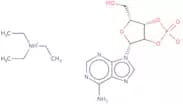
CAS:Adenosine 2',3'-cyclic monophosphate triethylammonium salt (AMP-TEA) is a structural analogue of adenosine. It is a potent inhibitor of protein synthesis by preventing the phosphodiesterase activity of cyclic nucleotide phosphodiesterases and cyclic nucleotide phosphodiesterase. AMP-TEA can be used as a tool to study translation in tissue culture, as well as to examine the effects on protein synthesis and other biochemical reactions that are regulated by cyclic nucleotides. It is also used for the preparation of tissue samples for enzymatic analysis or for radiolabeling experiments. AMP-TEA has an optimum pH of 4.5, but can be used at lower or higher pH values. The optimal temperature range for use is between 0°C and 50°C, with the maximum stability occurring at 37°C.Formula:C10H12N5O6PPurezza:Min. 95%Colore e forma:PowderPeso molecolare:329.21 g/mol





![[(2S,6R)-6-{N6-Benzoyladenin-9-yl}-4-tritylmorpholin-2-yl]methyl dimethyl-phosphoramidochloridate](/_next/image/?url=https%3A%2Fstatic.cymitquimica.com%2Fproducts%2F3D%2Fthumb-webp%2FNB58201.webp&w=3840&q=75)