Nucleosidi
I nucleosidi sono building blocks fondamentali degli acidi nucleici, composti da una base azotata legata a una molecola di zucchero. In questa sezione, puoi trovare una vasta gamma di nucleosidi essenziali per la ricerca in biologia molecolare, biochimica e farmacologia. Questi composti svolgono ruoli cruciali nella sintesi del DNA e dell'RNA e sono vitali in vari processi metabolici. I nucleosidi vengono utilizzati per studiare il materiale genetico, sviluppare terapie antivirali e antitumorali e comprendere i meccanismi cellulari. Da CymitQuimica, forniamo nucleosidi di alta qualità per supportare le tue esigenze di ricerca e sviluppo, garantendo purezza e affidabilità per le tue applicazioni sperimentali.
Trovati 3569 prodotti di "Nucleosidi"
Ordinare per
Purezza (%)
0
100
|
0
|
50
|
90
|
95
|
100
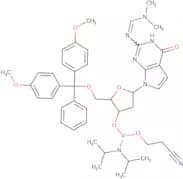
7-deaza-dG-CE Phosphoramidite
CAS:<p>7-deaza-dG-CE Phosphoramidite is a monophosphate nucleotide, which is synthesized by modification of the 7-deaza-dG ribonucleoside. It has an antiviral and anticancer activity, and is used as a building block for novel drugs. 7-Deaza-dG-CE phosphoramidite has been shown to inhibit tumor growth and induce apoptosis in Hep2 cells. It also inhibits HIV replication in vitro. The compound is chemically stable and does not react with other biomolecules.</p>Formula:C44H54N7O7PPurezza:Min. 95%Peso molecolare:823.9 g/molCytidine-5'-O-(1-thiotriphosphate) lithium salt - 100mM aqueous solution
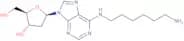
CAS:Cytidine-5'-O-(1-thiotriphosphate) lithium salt is a monophosphate nucleotide analog. It is soluble in water, and is used in the synthesis of DNA and RNA. Cytidine-5'-O-(1-thiotriphosphate) lithium salt has antiviral, anticancer, and anti-inflammatory properties. This compound can be used as an activator for phosphoramidites in the synthesis of DNA or RNA. Cytidine-5'-O-(1-thiotriphosphate) lithium salt is a novel nucleoside that can be used in the synthesis of modified oligonucleotides.Formula:C9H16N3O13P3S·xLiPurezza:Min. 95%Peso molecolare:499.22 g/molN6-(6-Aminohexyl)-2'-deoxyadenosine
CAS:<p>N6-(6-Aminohexyl)-2'-deoxyadenosine is a novel nucleoside that is structurally related to the natural nucleosides, dATP and dGTP. It has been shown to be an activator of ribonucleosides and phosphoramidites, which are used in the synthesis of DNA and RNA. N6-(6-Aminohexyl)-2'-deoxyadenosine has also been shown to inhibit cancer cells as well as antiviral activity against HIV-1.</p>Formula:C16H26N6O3Purezza:Min. 95%Colore e forma:Slightly Yellow PowderPeso molecolare:350.43 g/mol8-Nitroguanosine
CAS:8-Nitroguanosine is a nucleotide analogue that inhibits the activity of cyclic GMP in cells. It has been found to inhibit the growth of bacteria and cancer cells, as well as to stimulate the production of reactive oxygen species in brain cells. 8-Nitroguanosine has also been shown to inhibit the activity of cyclase enzymes in liver cells, which may be useful for treating liver disease. 8-Nitroguanosine is used as a chemical base for monoclonal antibodies that are used to study brain functions and pathogenic mechanisms.Formula:C10H12N6O7Purezza:Min. 95%Peso molecolare:328.24 g/mol5-Bromo-2'-deoxycytidine
CAS:5-Bromo-2'-deoxycytidine is a synthetic nucleoside analogue that is used to treat diabetic neuropathy. It is structurally similar to cytidine, and inhibits the enzyme DNA polymerase by intramolecular catalysis. This causes deamination of the 5-bromo group, which prevents further synthesis of DNA. 5-Bromo-2'-deoxycytidine has been shown to be effective in vivo in a mouse model for inflammatory bowel diseases, including colitis and eosinophilic enteritis. The drug was also found to inhibit the production of Eosinophil peroxidase from HL-60 cells in vitro.Formula:C9H12BrN3O4Purezza:Min. 95%Colore e forma:Off-White PowderPeso molecolare:306.11 g/mol2-Phenylaminoadenosine
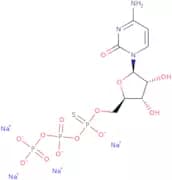
CAS:2-Phenylaminoadenosine (2-PA) is a potent and selective inhibitor of the P2Y receptor. 2-PA has been shown to reduce myocardial infarct size in vivo in mice, which may be due to its ability to inhibit the release of dopamine from the brain. In addition, 2-PA binds to LPS receptors on endothelial cells, reducing the production of proinflammatory cytokines and preventing platelet aggregation. 2-PA also inhibits the activation of toll-like receptor 4 (TLR4) in human monocytes, leading to reduced expression of proinflammatory cytokines and increased expression of anti-inflammatory cytokines. 2-PA is an agonist that binds with high affinity to P2Y receptors on erythrocytes. This binding results in decreased adenosine triphosphate (ATP) production by adenosine deaminase, which leads to decreased intracellular calcium levels and inhibition of neutrophFormula:C16H18N6O4Purezza:Min. 95%Colore e forma:PowderPeso molecolare:358.35 g/molAdenosine 5′-O-(1-thiotriphosphate) sodium, mixture of R and S isomers
<p>Please enquire for more information about Adenosine 5′-O-(1-thiotriphosphate) sodium, mixture of R and S isomers including the price, delivery time and more detailed product information at the technical inquiry form on this page</p>Formula:C10H16N5O12P3S•Na3Purezza:Min. 95%Peso molecolare:592.25 g/mol3-Methyl-8-(2-deoxy-b-D-ribofuranosyl)isoxanthopterin
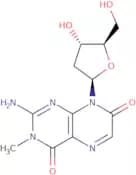
CAS:<p>3-Methyl-8-(2-deoxy-b-D-ribofuranosyl)isoxanthopterin is a nucleoside analog that is used as an activator of phosphoramidite. It can be used as a building block in the synthesis of modified phosphoramidites and it has antiviral, anticancer, and antiinflammatory properties. 3-Methyl-8-(2-deoxy-b-D-ribofuranosyl)isoxanthopterin is a novel nucleoside analog that can be used to synthesize DNA or RNA. It is also an inhibitor of deoxyribonucleoside kinase, preventing the conversion of deoxyribonucleosides into diphosphate monophosphates.</p>Formula:C12H15N5O5Purezza:Min. 95%Colore e forma:PowderPeso molecolare:309.28 g/molGuanosine5'-diphosphate
CAS:Pyruvate kinase substrateFormula:C10H15N5O11P2Purezza:Min. 95%Colore e forma:PowderPeso molecolare:443.2 g/mol2'-O-Methyl-p-thiouridynyl-(3'->5')-2'-deoxyadenosine
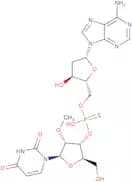
CAS:2'-O-Methyl-p-thiouridynyl-(3'->5')-2'-deoxyadenosine is an analog of the nucleoside uridine. It is a potent inhibitor of protein synthesis in cells, and has the potential to be used as a long-term treatment for tuberculosis. 2'-O-Methyl-p-thiouridynyl-(3'->5')-2'-deoxyadenosine has been shown to inhibit the production of tumor necrosis factor alpha (TNFα) in mice with influenza or hepatitis, and also inhibits the replication of HIV. This drug may also have antibacterial properties due to its ability to inhibit bacterial DNA gyrase and topoisomerase IV. 2'-O-Methyl-p-thiouridynyl-(3'->5')-2'-deoxyadenosine binds to an antigen on the surface of cells, activating them.Formula:C20H26N7O10PSPurezza:Min. 95%Peso molecolare:587.5 g/mol2'-Deoxy-3,4,5,6-tetrahydrouridine
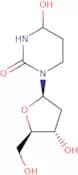
CAS:<p>2'-Deoxy-3,4,5,6-tetrahydrouridine (2DTHR) is a cytidine deaminase inhibitor that is used in vitro to inhibit the production of tumor necrosis factor (TNF). 2DTHR has been shown to be active against hepatocellular carcinoma cells. It is also reactive with tumor tissue and can be eliminated at a rate similar to that of deoxycytidine kinase. This drug binds to the enzyme target and inhibits its activity by increasing enzyme levels, which causes cell death. 2DTHR inhibits TNF production in tumor tissue by binding to cytidine deaminase and preventing conversion of cytidine into uracil. This drug has been shown to cause tumor inhibition in vitro.</p>Formula:C9H16N2O5Purezza:Min. 95%Colore e forma:PowderPeso molecolare:232.23 g/molN6-Benzoyl-L-adenosine
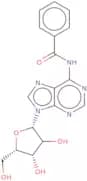
CAS:N6-Benzoyl-L-adenosine is a novel nucleoside that has been shown to have antiviral and anticancer activity. It is synthesized by the reaction of L-adenosine with benzoyl chloride in the presence of a base. The drug inhibits the growth of cancer cells by interfering with DNA synthesis. N6-Benzoyl-L-adenosine also inhibits viral replication, especially HIV, herpes simplex virus type 1, and human cytomegalovirus (HCMV). It can be used as an antiviral agent in combination with other drugs or as an anticancer agent alone. N6 Benzoyl L adenosine is a nucleoside that has been shown to have antiviral and anticancer activity. It is synthesized by the reaction of L adenosine with benzoyl chloride in the presence of a base. The drug inhibits the growth of cancer cells by interfering with DNA synthesis. N6Formula:C17H17N5O5Purezza:Min. 95%Colore e forma:White to off-white solid.Peso molecolare:371.35 g/mol5-Aminoallyl uridine 5'-triphosphate sodium salt
CAS:5-Aminoallyl uridine 5'-triphosphate sodium salt is used in Nucleic Acid Sequence Based Amplification or RNA labelling.Formula:C12H20N3O15P3·xNaPurezza:Min. 95%Peso molecolare:539.22 g/mol7-Deaza-2',3'-dideoxy-7-iodoadenosine
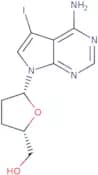
CAS:7-Deaza-2',3'-dideoxy-7-iodoadenosine is a nucleoside analogue that is used as an antiviral, anticancer, and antifungal agent. It is a modified form of adenosine which inhibits viral replication by inhibiting the activity of reverse transcriptase. 7-Deaza-2',3'-dideoxy-7-iodoadenosine has also been shown to inhibit DNA synthesis in cells by blocking the incorporation of dCTP into DNA. This nucleoside analogue has shown potential for use as an activator in phosphoramidite chemistry and as a deoxyribonucleoside in oligonucleotide synthesis.Formula:C11H13IN4O2Purezza:Min. 95%Colore e forma:PowderPeso molecolare:360.15 g/molN2-Benzoylguanosine
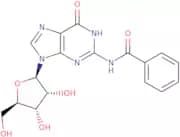
CAS:<p>N2-Benzoylguanosine is a nucleotide derivative that is formed by the acetylation of guanosine. It has been shown to act as a buffer in alkaline solutions and isomerizes to its n-oxide form when heated. N2-Benzoylguanosine reacts with peroxides such as hydrogen peroxide, glyoxal, and organic peroxides, forming hydroperoxide intermediates that can be converted into other products. The acidic hydrolysis of N2-benzoylguanosine yields the corresponding 6-benzoyladenosines. It has been shown to enhance the activity of uridine in inhibiting bacterial growth, while also acting as an inhibitor of viral RNA synthesis. This compound also reacts with nitrous acid to form an n6-benzoyladenosine derivative that inhibits the formation of RNA chains during transcription.</p>Formula:C17H17N5O6Purezza:Min. 95%Colore e forma:White to beige solid.Peso molecolare:387.35 g/mol5'-o-DMT-N4-benzoyl-5-methyl-2'-o-methylcytidine 3'-ce phosphoramidite
CAS:<p>5'-O-DMT-N4-benzoyl-5-methyl-2'-O-methylcytidine 3'-ce phosphoramidite is a high purity, diphosphate, CAS No. 166593-57-3, Modified, Anticancer, DNA. It is a novel activator monophosphate that can be used for the synthesis of phosphoramidites for oligonucleotide synthesis and as a novel building block for nucleosides and deoxyribonucleosides. 5'-O-DMT-N4-benzoyl-5-methyl-2'-O-methylcytidine 3'-ce phosphoramidite has been shown to have anticancer activity in vitro. The cytotoxic effect of this compound is mediated by its ability to inhibit DNA replication and induce apoptosis in human leukemia cells.</p>Formula:C48H56N5O9PPurezza:Min. 95%Peso molecolare:878.00 g/molN6-Benzoyl-5'-O-DMT-2'-O-(2-methoxyethyl)adenosine 3'-CE phosphoramidite
CAS:Nucleoside phosphoramidites are used in the chemical synthesis of oligonucleotides containing 2’-O-(2-methoxyethyl) adenosine nucleoside units. Using a chemical approach rather than an enzymatic one allows custom-made oligonucleotides of a desired sequence to be obtained. 3’-Cyanoethyl phosphoramidites are typically modified by reaction with an appropriate alcohol in the presence of an azole catalyst such as imidazole or 1H-tetrazole. N6-Benzoyl-5'-O-DMT-2'-O-MOE-adenosine 3'-CE phosphoramidite has been used in the synthesis of 2’-modified oligonucleotides as protein binding modulators.Formula:C50H58N7O9PPurezza:Min. 95%Colore e forma:PowderPeso molecolare:932.01 g/molGuanosine-5'-[(a,β)-methyleno]triphosphate sodium salt
CAS:Guanosine-5'-[(a,b)-methyleno]triphosphate sodium salt (GpCpp) is a non hydrolyzable nucleosidePurezza:Min. 95%[(2S,6R)-6-{Thymin-1-yl}-4-tritylmorpholin-2-yl]methyl dimethyl-phosphoramidochloridate
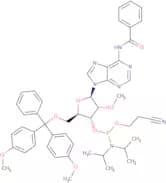
CAS:[(2S,6R)-6-{Thymin-1-yl}-4-tritylmorpholin-2-yl]methyl dimethyl-phosphoramidochloridate (TMP) is a Ribonucleoside and Deoxyribonucleoside Activator that is synthesized from Thymine (T), Thymidine (Td), and Phosphoramidites. TMP is a novel synthetic derivative of thymine with the ability to activate DNA synthesis reactions. TMP has been shown to provide high quality nucleotides with high purity in a single step reaction.Formula:C31H34ClN4O5PPurezza:Min. 95%Colore e forma:White To Light (Or Pale) Red SolidPeso molecolare:609.05 g/molN6-Benzoyl-5'-O-DMT-2'-O-methyladenosine 3'-CE phosphoramidite
CAS:N6-Benzoyl-5'-O-DMT-2'-O-methyladenosine 3'-CE phosphoramidite is a nucleoside phosphoramidite used as a building block in the chemical synthesis of oligonucleotides containing a 2’-O-methyl adenosine nucleoside unit. The use of a chemical synthesis rather than an enzymatic one allows oligonucleotides of a desired sequence to be produced. 3’-Cyanoethyl phosphoramidites are typically used by substitution of the di-isopropylamine group with an appropriate alcohol in the presence of an azole catalyst. Oligonucleotides containing 2'-O-methylribonucleoside units have shown site-specific cleavage with E. coli RNase H, either at a hairpin loop or at a stem region.Formula:C48H54N7O8PPurezza:Min. 98 Area-%Colore e forma:White Off-White PowderPeso molecolare:887.98 g/mol







![Guanosine-5'-[(a,β)-methyleno]triphosphate sodium salt](/_next/image/?url=https%3A%2Fstatic.cymitquimica.com%2Fproducts%2F3D%2Fthumb-webp%2FNG171069.webp&w=3840&q=75)
![[(2S,6R)-6-{Thymin-1-yl}-4-tritylmorpholin-2-yl]methyl dimethyl-phosphoramidochloridate](/_next/image/?url=https%3A%2Fstatic.cymitquimica.com%2Fproducts%2F3D%2Fthumb-webp%2FNT58203.webp&w=3840&q=75)