Nucleosidi
I nucleosidi sono building blocks fondamentali degli acidi nucleici, composti da una base azotata legata a una molecola di zucchero. In questa sezione, puoi trovare una vasta gamma di nucleosidi essenziali per la ricerca in biologia molecolare, biochimica e farmacologia. Questi composti svolgono ruoli cruciali nella sintesi del DNA e dell'RNA e sono vitali in vari processi metabolici. I nucleosidi vengono utilizzati per studiare il materiale genetico, sviluppare terapie antivirali e antitumorali e comprendere i meccanismi cellulari. Da CymitQuimica, forniamo nucleosidi di alta qualità per supportare le tue esigenze di ricerca e sviluppo, garantendo purezza e affidabilità per le tue applicazioni sperimentali.
Trovati 3569 prodotti di "Nucleosidi"
Ordinare per
Purezza (%)
0
100
|
0
|
50
|
90
|
95
|
100
2'-O-(2-Methoxyethyl)guanosine 5'-monophosphate
CAS:<p>10umol is approx 5mg.2'-O-(2-Methoxyethyl)guanosine 5'-monophosphate is a novel nucleoside phosphorylated on the 5' position</p>Purezza:Min. 95%[(2S,6R)-6-{N4-Benzoylcydin-1-yl}-4-tritylmorpholin-2-yl]methyl dimethyl-phosphoramidochloridate
CAS:<p>[(2S,6R)-6-{N4-Benzoylcydin-1-yl}-4-tritylmorpholin-2-yl]methyl dimethylphosphoramidochloridate is an antiviral and anticancer nucleoside phosphoramidite. It is synthesized by reacting the purified 6-(N4-benzoylcydin-1-yl) morpholine with dimethyl phosphorochloridate in pyridine at room temperature. This novel monophosphate nucleoside has been shown to be efficacious against human immunodeficiency virus (HIV) and murine leukemia virus (MLV). The antiviral activity of [(2S,6R)-6-(N4-benzoylcydin-1-yl)-4-(tritylmorpholin]-2(1H)-yl]methyl dimethylphosphoramidochloridate is due to its ability</p>Formula:C37H37ClN5O5PPurezza:Min. 95%Colore e forma:PowderPeso molecolare:698.15 g/molAbacavir 5'-phosphate
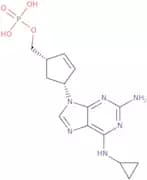
CAS:<p>Abacavir 5'-phosphate is a nucleoside analog that inhibits the replication of the herpes virus by covalently binding to the viral DNA polymerase and blocking its ability to polymerize dNTPs. Abacavir 5'-phosphate's anti-viral potency has been shown in vivo using a model with herpes simplex virus, and it has been shown to inhibit viral replication in cell culture. The drug also reacts with cellular components such as proteins, lipids, and nucleic acids, which may lead to drug reactions. Abacavir 5'-phosphate is chemically stable, so it can be subjected to analytical methods without degradation. It is an analog of zidovudine (AZT).</p>Formula:C14H19N6O4PPurezza:Min. 95%Peso molecolare:366.31 g/mol2',3'-Di-O-benzoyl-N6-benzoyl-L-adenosine
CAS:<p>2',3'-Di-O-benzoyl-N6-benzoyl-L-adenosine (DBBA) is a modified nucleoside with anticancer, antiviral, and synthetic properties. It can be used as a building block for the synthesis of DNA, RNA, or other nucleotide analogues. DBBA has shown activity against certain cancer cells and has been found to inhibit the replication of HIV and herpes simplex virus type 1 in cell culture. DBBA is also known as 2',3'-Dibenzoyl-N6-benzoyladenosine.</p>Formula:C31H25N5O7Purezza:Min. 95%Peso molecolare:579.56 g/mol2′-C-Methyl-2′,3′-O-(1-methylethylidene)adenosine
CAS:<p>Please enquire for more information about 2′-C-Methyl-2′,3′-O-(1-methylethylidene)adenosine including the price, delivery time and more detailed product information at the technical inquiry form on this page</p>Formula:C14H19N5O4Purezza:Min. 95%Peso molecolare:321.33 g/mol2'-O-Methyladenosine 5'-monophosphate triethylammonium salt
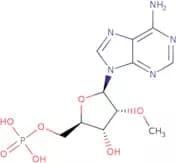
CAS:2'-O-Methyladenosine 5'-monophosphate triethylammonium salt is an antiviral nucleoside that is used in the treatment of hepatitis B and C. It is a modified nucleoside that inhibits the replication of RNA by binding to the enzyme ribonuclease, which plays a vital role in the synthesis of DNA. 2'-O-Methyladenosine 5'-monophosphate triethylammonium salt also has anticancer properties and can inhibit DNA synthesis. This compound is a novel phosphoramidite building block for oligonucleotide synthesis and has been shown to be an activator for deoxyribonucleosides.Formula:C11H16N5O7PPurezza:Min. 95%Peso molecolare:361.25 g/mol2-Chloroadenosine 5'-monophosphate triethylamine salt
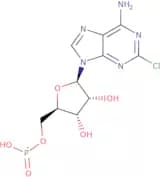
CAS:<p>2-Chloroadenosine 5'-monophosphate triethylamine salt is a phosphoramidite that has anticancer and antiviral activities. It is synthesized by reacting 2-chloroadenosine with triethylamine. This product has a novel chemical structure and it can be used as an activator for the synthesis of modified DNA, RNA, and other nucleosides. It is also used in the manufacture of deoxyribonucleosides, ribonucleosides, and other nucleotides.</p>Formula:C10H13ClN5O7P·C12H30N2Purezza:Min. 95%Peso molecolare:584.05 g/molValopicitabine
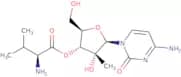
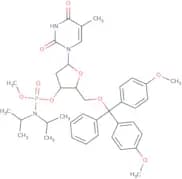
CAS:Valopicitabine is a prodrug that is converted to its active form, 3'-deoxy-3'-methylvalopicitabine, in the body. Valopicitabine inhibits viral replication by a mechanism that is not yet fully understood. It has been shown to inhibit NS3 protease and induce an interferon response. Valopicitabine has also been shown to inhibit Toll-like receptor 4 (TLR4) activity and elicit an antiviral response. Valopicitabine has low bioavailability, which may be due to its high lipophilicity.Formula:C15H24N4O6Purezza:Min. 95%Peso molecolare:356.37 g/mol5'-o-(4,4'-Dimethoxytrityl)-2'-deoxythymidine-3'-(methyl-N,N-diisopropyl)phosphoramidite
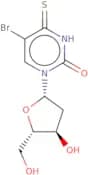
CAS:Please enquire for more information about 5'-o-(4,4'-Dimethoxytrityl)-2'-deoxythymidine-3'-(methyl-N,N-diisopropyl)phosphoramidite including the price, delivery time and more detailed product information at the technical inquiry form on this pageFormula:C38H48N3O9PPurezza:Min. 95%Peso molecolare:721.8 g/mol5-Bromo-2'-deoxy-4-thiouridine
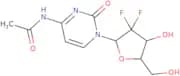
CAS:<p>5-Bromo-2'-deoxy-4-thiouridine is a high purity, diphosphate nucleoside with novel anticancer activity. It is a potent activator of the transcription factor NF-kappaB and inhibits the proliferation of cancer cells. 5-Bromo-2'-deoxy-4-thiouridine has been shown to be an effective antiviral agent against HIV and hepatitis B virus in vitro. This compound also inhibits the synthesis of DNA and RNA in human cells, which may be due to its ability to inhibit thymidylate synthase. 5-Bromo-2'-deoxy-4-thiouridine is not active against bacterial cells because they lack thymidylate synthase.</p>Purezza:Min. 95%N-Acetyl-2'-deoxy-2',2'-difluorocytidine
CAS:N-Acetyl-2'-deoxy-2',2'-difluorocytidine is a novel nucleoside analog. It is phosphorylated at the 5' position and converted to a monophosphate by adenylyl cyclase, which is an enzyme that catalyzes the conversion of ATP to cyclic AMP. This nucleoside analog has antiviral activity in vitro and in vivo against HIV-1. It also has been shown to inhibit DNA replication of human cells infected with herpes simplex virus type 1 (HSV-1).Formula:C11H13F2N3O5Purezza:Min. 95%Peso molecolare:305.23 g/mol1-(2-Deoxy-β-D-erythro-pentofuranosyl)-4-nitro-1H-indole
CAS:Please enquire for more information about 1-(2-Deoxy-β-D-erythro-pentofuranosyl)-4-nitro-1H-indole including the price, delivery time and more detailed product information at the technical inquiry form on this pageFormula:C13H14N2O5Purezza:Min. 95%Peso molecolare:278.26 g/mol2'-O-(2-Methoxyethyl)adenosine 5'-monophosphate
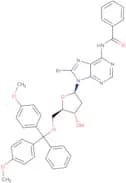
CAS:10umol is approximately 5mg.2'-O-(2-Methoxyethyl)adenosine 5'-monophosphate is a nucleoside compound that has been phosphorylated in the 5'-position.Purezza:Min. 95%5'-O-DMT-8-Bromo-N6-(benzoyl)-2′-deoxyadenosine
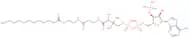
CAS:Bromo substituted deoxyadenosineFormula:C38H34BrN5O6Peso molecolare:736.61 g/molOctanoyl coenzyme A lithium salt hydrate
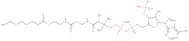
CAS:Octanoyl coenzyme A lithium salt hydrate (OCCA) is a metabolite of octanoic acid, which is formed by the oxidation of fatty acids. OCCA has been shown to have relevance in the metabolism of fatty acids, as it can be conjugated with other molecules and transported into cells. This compound has been detected in human liver tissues and was found to be metabolized by primary rat hepatocytes in vitro. The metabolic pathway of OCCA is not yet fully understood, but it has been investigated in vivo studies.Formula:C29H50N7O17P3S·xLi·yH2OPurezza:Min. 95%Peso molecolare:893.73 g/mol2,2'-Anhydro-L-thymidine
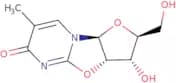
CAS:2,2'-Anhydro-L-thymidine is an antiviral, anticancer agent and a synthetic nucleoside. It is a monophosphate that was first synthesized in 1967 and has been used as a potential antiviral agent. 2,2'-Anhydro-L-thymidine has been shown to be effective against the herpes simplex virus type 1 (HSV1). However, it does not inhibit viral nucleic acid synthesis or viral protein synthesis. It also does not inhibit the growth of tumor cells in culture.Formula:C10H12N2O5Purezza:Min. 95%Colore e forma:PowderPeso molecolare:240.21 g/mol2',3'-Dehydro-5'-O-tritylthymidine
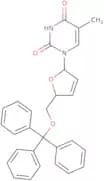
CAS:<p>2',3'-Dehydro-5'-O-tritylthymidine is an anticancer compound, which is a novel nucleoside phosphoramidite. It is synthesized from thymidine in two steps: first, the 2',3'-dideoxyribose phosphate moiety is prepared by reacting 2',3'-dideoxyribose with chloroacetic acid in the presence of triethylamine, followed by reaction with trityl chloride to form the 5' position of the thymidine. 2',3'-Dehydro-5'-O-tritylthymidine has been shown to inhibit DNA synthesis and antiviral activity.</p>Formula:C29H26N2O4Purezza:Min. 95%Peso molecolare:466.54 g/molN6-Benzoyl-2'-deoxy-5'-O-DMT-adenosine 3'-thiophosphoramidite
<p>N6-Benzoyl-2'-deoxy-5'-O-DMT-adenosine 3'-thiophosphoramidite is a modified phosphoramidite that can be used to synthesize DNA oligomers. The nucleoside is an antiviral and antitumor agent. It is also used to inhibit the replication of RNA by inhibiting the activity of DNA polymerase. N6-Benzoyl-2'-deoxy-5'-O-DMT-adenosine 3'-thiophosphoramidite has novel properties that have not been seen in any other nucleosides. This product is for research use only, not for diagnostics or therapeutic purposes.</p>Formula:C51H51N6O7PS2Purezza:Min. 95%Peso molecolare:955.09 g/mol7-Deaza-2'-deoxyguanosine-5'-triphosphate sodium salt - 10mM aqueous solution
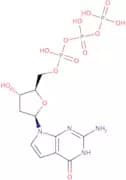
CAS:<p>7-Deaza-2'-deoxyguanosine-5'-triphosphate sodium salt is a cytosolic small molecule that inhibits the activity of telomerase, an enzyme involved in the replication of chromosomes. It also has inhibitory effects on kinase domains and may be used to treat cancer. 7-Deaza-2'-deoxyguanosine-5'-triphosphate sodium salt binds to human mitochondrial DNA and inhibits gene transcription by hybridizing with it. This results in the inhibition of dopamine production, which can be helpful for treating Parkinson's disease. 7-Deaza-2'-deoxyguanosine-5'-triphosphate sodium salt is structurally similar to 2'-deoxyadenosine 5'-triphosphate (dATP) and can be incorporated into DNA by phosphorylation to form a covalent bond that disrupts the dATP/ATP ratio. This causes cellular energy production to decrease and</p>Formula:C11H17N4O13P3·xNaPurezza:Min. 95%Peso molecolare:506.19 g/molLauroyl coenzyme A potassium salt
CAS:<p>Lauroyl coenzyme A potassium salt is a potent inhibitor of fatty acid synthase. It has the ability to inhibit the enzyme activity of fatty acid synthase in vitro, which belongs to the class of irreversible inhibitors. Lauroyl coenzyme A potassium salt inhibits the synthesis of fatty acids by inhibiting the enzyme activity of fatty acid synthase. This inhibitor also reversibly inhibits other enzymes with a similar mechanism, such as acetyl-coenzyme A carboxylase and phosphatidate phosphohydrolase. The reaction mechanism can be understood through titration calorimetry studies, demonstrating that lauroyl coenzyme A potassium salt binds to the active site of these enzymes and blocks access to substrates. The binding affinity is higher for wild type strains than for mutant strains, which may be due to differences in protein structure or other factors. Lauroyl coenzyme A potassium salt has been shown to have no effect on wild-type strains but inhibits polymer</p>Formula:C33H55N7O17P3SK3Purezza:Min. 95%Colore e forma:PowderPeso molecolare:1,064.11 g/mol


![[(2S,6R)-6-{N4-Benzoylcydin-1-yl}-4-tritylmorpholin-2-yl]methyl dimethyl-phosphoramidochloridate](/_next/image/?url=https%3A%2Fstatic.cymitquimica.com%2Fproducts%2F3D%2Fthumb-webp%2FNB58202.webp&w=3840&q=75)