Nucleosidi
Trovati 3569 prodotti di "Nucleosidi"
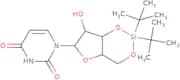
3',5'-O-(Di-tert-butylsilanediyl)uridine
CAS:3',5'-O-(Di-tert-butylsilanediyl)uridine is a novel antiviral agent that is synthesized from uridine and has been shown to be effective against herpes simplex virus. This compound was also shown in vitro to inhibit the replication of human immunodeficiency virus type 1 (HIV-1). 3',5'-O-(Di-tert-butylsilanediyl)uridine binds to single stranded DNA, preventing the synthesis of DNA by the viral enzyme reverse transcriptase. It also inhibits the production of viral proteins by binding to viral RNA polymerase. This drug may also have anticancer activity due to its ability to inhibit ribonucleotide reductase, an enzyme required for DNA synthesis.
Purezza:Min. 95%5-Aminoallyl 2'-deoxycytidine-5'-triphosphate lithium, 100mM aqueous solution
5-Aminoallyl 2'-deoxycytidine-5'-triphosphate lithium salt - 100mM aqueous solution is a novel modified nucleoside that can be activated to the corresponding phosphoramidite.
Formula:C12H17N4O13P3•Li4Purezza:Min. 95%Colore e forma:Clear LiquidPeso molecolare:545.97 g/molRef: 3D-NA32075
Prodotto fuori produzione3'-O-Aminoacetoxythymidine 5'-O-triphosphate triethylammonium salt
Please enquire for more information about 3'-O-Aminoacetoxythymidine 5'-O-triphosphate triethylammonium salt including the price, delivery time and more detailed product information at the technical inquiry form on this page
Formula:C13H22N3O14P3•(C6H15N)xPurezza:Min. 99 Area-%Colore e forma:PowderPeso molecolare:537.25 g/mol5-[4-(4,4,5,5-tetramethyl-[1,3,2]dioxaborolan-2-yl)-benzylidene]-pyrimidine-2,4,6-trione
Ribonuclease is an enzyme that cleaves the phosphodiester backbone of ribonucleotide to produce a 5'-phosphate and a 2'-deoxyribonucleoside. Ribonuclease is an activator that activates the synthesis of ribonucleotides, deoxyribonesucleotides and nucleosides. Ribonuclease has antiviral properties which may be due to its ability to inhibit DNA polymerase by catalyzing the hydrolysis of the 2'-deoxyribose-5'-phosphate bond in DNA. Ribonuclease has also been shown to have anticancer activity, which may be due to its ability to inhibit protein synthesis.
Purezza:Min. 95%Ref: 3D-NT44284
Prodotto fuori produzioneIsowyosine
CAS:Isowyosine is a protein that catalyzes the synthesis of purines, which are essential for DNA synthesis and repair. Isowyosine is found in mammalian cells, where it has been observed to play a role in the translation of messenger RNA (mRNA). Isowyosine also plays a role in the synthesis of viral proteins and viral replication. It has been shown to be active against various viruses, including herpes simplex virus and influenza virus. Isowyosine may also have anti-cancer properties due to its ability to inhibit tumor growth.
Formula:C14H17N5O5Purezza:Min. 95%Colore e forma:PowderPeso molecolare:335.32 g/mol2'-Deoxy-3'-O-DMT-N2-iBu-guanosine--succinyl-CPG 1000 Å
2'-Deoxy-3'-O-DMT-N2-iBu-guanosine--succinyl-CPG 1000 Å is a modified nucleoside that is synthesized from 2'-deoxyribonucleosides and succinic anhydride. It has antiviral, anticancer, and antimalarial activities. It can also be used to modify DNA sequences. This product is a novel phosphoramidite monomer with high purity.
Purezza:Min. 95%N4-Benzoyl-5'-O-tert-butyldimethylsilyl-2'-deoxy-5-iodocytidine
N4-Benzoyl-5'-O-tert-butyldimethylsilyl-2'-deoxy-5-iodocytidine is an antiviral drug that inhibits viral DNA synthesis by blocking the conversion of ribonucleotides to deoxyribonucleotides. It is a nucleoside analog that is used for the treatment of cancer and for the prevention of AIDS. N4-Benzoyl-5'-O-tert-butyldimethylsilyl-2'-deoxy-5 -iodocytidine is synthesized in high purity, with a purity level of > 98%. This product can be used as an activator or ligand in phosphoramidite synthesis.Formula:C22H30IN3O5SiPurezza:Min. 95%Colore e forma:PowderPeso molecolare:571.48 g/mol2',3'-Dideoxy-2',2'-difluorocytidine
CAS:2',3'-Dideoxy-2',2'-difluorocytidine is a monophosphate derivative of the antiviral and anticancer drug 2',3'-dideoxycytidine. It is an activator of DNA synthesis, nucleosides, and nucleotides. It is also a phosphoramidite for the synthesis of oligonucleotides and modified ribonucleosides. 2',3'-Dideoxy-2',2'-difluorocytidine has CAS number 124708-94-7. It is available in high purity and quality, which makes this product suitable for research purposes.
Purezza:Min. 95%Ref: 3D-ND158370
Prodotto fuori produzione3'-Deoxy-L-thymidine
CAS:3'-Deoxy-L-thymidine is a nucleoside analog that inhibits HIV replication by interfering with the synthesis of viral DNA. The drug binds to the enzyme thymidine phosphorylase, which converts thymidine into deoxyuridine monophosphate, and prevents conversion of deoxyuridine to deoxythymidine monophosphate. This leads to inhibition of both DNA synthesis and the production of RNA. 3'-Deoxy-L-thymidine has dose-limiting toxicity at high doses and is not active against other viruses such as herpes simplex virus or cytomegalovirus. It is metabolized in the liver by enzymes such as 5-fluorocytosine, which converts it into its active form, 5-fluorouracil.
Formula:C10H14N2O4Purezza:Min. 95%Peso molecolare:226.23 g/mol2',3'-Dideoxy-3'-thia-cytidine-5'-triphosphate (L isomer), lithium salt
2',3'-Dideoxy-3'-thia-cytidine-5'-triphosphate (L isomer) is a synthetic nucleoside that acts as an antiviral, anticancer and antineoplastic agent. It has been shown to inhibit the replication of DNA and RNA by inhibiting the activity of ribonucleoides. 2',3'-Dideoxy-3'-thia-cytidine-5'-triphosphate (L isomer) can be used in combination with other antiviral agents such as acyclovir or valacyclovir to treat herpes simplex virus type 1 infections. The drug is also effective against HIV, with a potency similar to that of zidovudine. It has been shown to be active in the treatment of leukemia, lymphoma, Hodgkin's disease and some solid tumors.Purezza:Min. 95%Ref: 3D-ND32051
Prodotto fuori produzioneN6-Benzoyl-2'-deoxy-5'-O-DMT adenosine-3'-Q Linker CPG 1000 Å
N6-benzoyl-2'-deoxy-5'-O-DMT adenosine-3'-Q Linker CPG 1000 Å is a novel nucleoside with antiviral activity. It is synthesized by the condensation of 2'-deoxyadenosine monophosphate and 3'-Q linker CPG 1000 Å. The molecular weight of N6-benzoyl-2'-deoxy-5'-O-DMT adenosine-3'-Q Linker CPG 1000 Å is 878.36 g/mol, and its CAS number is 628674-06-4. This substance has antiviral activity against herpes simplex virus type 1 (HSV1) and herpes simplex virus type 2 (HSV2). N6-benzoyl-2'-deoxy-5'-O-DMT adenosine can be used as an anticancer drug because it inhibits the growth
Purezza:Min. 95%Ref: 3D-NB11617
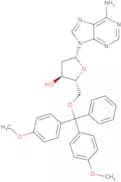
Prodotto fuori produzione2'-Deoxy-5'-O-DMT-adenosine
CAS:2'-Deoxy-5'-O-DMT-adenosine is a nucleoside that is structurally related to adenosine. It is synthesized by the phosphoramidite approach and can be used as an activator for RNA synthesis. 2'-Deoxy-5'-O-DMT-adenosine has shown anticancer activity in vitro and in vivo, which may be due to its ability to inhibit RNA synthesis and DNA replication.
Formula:C31H31N5O5Purezza:Min. 95%Colore e forma:PowderPeso molecolare:553.61 g/mol3',5'-Di-O-acetyl-2'-deoxyguanosine
CAS:3',5'-Di-O-acetyl-2'-deoxyguanosine is a nucleoside that is activated by hypochlorous acid to form a reactive intermediate, which can then react with other molecules. 3',5'-Di-O-acetyl-2'-deoxyguanosine has been shown to be selectively cytotoxic to human tumor cells and may be used as a radiosensitizer for cancer treatment. The reaction products of this compound include hypochlorite and hydrogen peroxide, which are strong oxidizing agents that cause tissue injury. This compound is also an effective reagent for the detection of myeloperoxidase in plasma samples.
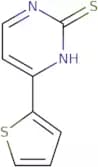
Formula:C14H17N5O6Purezza:Min. 95%Colore e forma:PowderPeso molecolare:351.32 g/mol4-(2-Thienyl)-2-pyrimidinethiol
CAS:Ribonucleosides are nucleosides that contain a ribose sugar. They are important in the synthesis of DNA and RNA. Ribonuclesides are nucleosides containing a ribose sugar with a phosphate group on the 5' carbon. The phosphate is attached to the 4' carbon on the sugar, instead of the 3' carbon as in deoxyribonucleosides. Ribonucleosides are important in the synthesis of DNA and RNA. Ribonucleotides are nucleotides that contain a ribose sugar with a phosphate group on the 5’ carbon. The phosphate is attached to the 4’ carbon on the sugar, instead of the 3’ carbon as in deoxyribonucleotides. Ribonucleotides are important in the synthesis of DNA and RNA.
In addition, Ribonucleside can be used as antiviral agent for HIV-1 through inhibition at viral reverse transcriptase (RT) step by competingFormula:C8H6N2S2Purezza:Min. 95%Peso molecolare:194.28 g/molRef: 3D-NT57413
Prodotto fuori produzioneUridylyl-3'-5'-cytidine ammonium salt
Uridylyl-3'-5'-cytidine ammonium salt is a monophosphate of cytidine. It is an antiviral agent that inhibits the replication of human immunodeficiency virus type 1 (HIV-1). Uridylyl-3'-5'-cytidine ammonium salt is synthesized by the reaction of uridyl 3'-5' -adenosine monophosphate with cytidine. This compound has been shown to be effective in inhibiting the proliferation of cancer cells. Uridylyl-3'-5'-cytidine ammonium salt has shown activity against a variety of cancers, including breast, lung, and colon cancers.
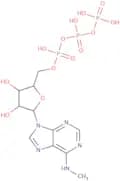
Formula:C18H27N6O13PPurezza:Min. 95%Peso molecolare:566.41 g/molN6-Methyladenosine-5'-triphosphate sodium salt - 10 mM aqueous solution
CAS:Modulator of P2Y receptors
Formula:C11H18N5O13P3Purezza:Min. 95%Peso molecolare:521.21 g/molRef: 3D-NM71656
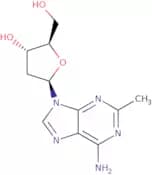
Prodotto fuori produzione2’-Deoxy-2-methyladenosine
CAS:2’-Deoxy-2-methyladenosine is a nucleoside that is chemically synthesized by the phosphorylation of 2,6-diaminopurine. It has been shown to be an effective activator of RNA polymerase and it also has anticancer properties. 2’-Deoxy-2-methyladenosine can be used as a substitute for thymidine in DNA synthesis. This nucleoside has also been shown to inhibit bacterial growth in culture by inhibiting DNA synthesis and protein synthesis. It is a modified nucleoside that can be used for the synthesis of DNA, RNA, or ribonucleic acids. The CAS number for this compound is 110952-90-4.
Purezza:Min. 95%8-Oxo-N2-isobutyryl-2-deoxyguanosine
CAS:8-Oxo-N2-isobutyryl-2-deoxyguanosine is a modified synthetic nucleoside. It finds applications in understanding mutagenesis and DNA repair mechanisms.
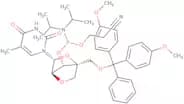
Formula:C14H19N5O6Purezza:Min. 95%Peso molecolare:353.33 g/mol5'-O-DMT-2'-O,4'-C-methylene-5-methyluridine 3'-CE-phosphoramidite
CAS:5'-O-DMT-2'-O,4'-C-methylene-5-methyluridine 3'-CE-phosphoramidite is a high purity, novel DNA monophosphate that is synthesized from 2',4'-diaminotoluene and 5'-O-dimethoxytritylthymidine. It has antiviral and anticancer properties and has shown to be an activator of RNA polymerase II in vitro. This product is used in many applications such as the synthesis of oligonucleotide probes for DNA sequencing, the synthesis of RNA for gene expression studies, and for the production of oligonucleotides for therapeutic purposes.Formula:C41H49N4O9PPurezza:Min. 95%Peso molecolare:772.82 g/mol3'-O-Acetyl-2'-deoxy-5'-O-DMT-2'-fluorouridine
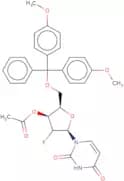
3'-O-Acetyl-2'-deoxy-5'-O-DMT-2'-fluorouridine is a novel, activator, ribonucleosides, deoxyribonucleosides, diphosphate, phosphoramidites, modified nucleosides. It can be used as an anticancer and antiviral agent.
Formula:C32H31FN2O8Purezza:Min. 95%Peso molecolare:590.6 g/mol


![5-[4-(4,4,5,5-tetramethyl-[1,3,2]dioxaborolan-2-yl)-benzylidene]-pyrimidine-2,4,6-trione](/_next/image/?url=https%3A%2Fstatic.cymitquimica.com%2Fproducts%2F3D%2Fthumb-webp%2FNT44284.webp&w=3840&q=75)