Nucleosidi
Trovati 3569 prodotti di "Nucleosidi"
2'-Deoxy-5-methylcytidine HCl
CAS:2'-Deoxy-5-methylcytidine HCl is a cytidine derivative that is used in the synthesis of DNA. It has been shown to have anticancer and antiviral properties, as well as being a synthetic activator for RNA polymerase. The chemical name for 2'-deoxy-5-methylcytidine HCl is 5'-[(2-bromoacetyl)amino]-2'-deoxyuridine 5'-O-(1,3-dithiole-2-thiocarbonyl)-3',5' -diiodo-. It belongs to the class of deoxyribonucleosides. This product may be used in applications such as DNA synthesis, modification of DNA, and antiviral treatment.Formula:C10H15N3O4·HClPurezza:Min. 95%Colore e forma:White PowderPeso molecolare:277.7 g/molN3-Methylcytidine
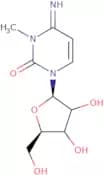
CAS:N3-Methylcytidine is a synthetic analog of uridine. It is used for the treatment of syncytial virus infection, which is a group of diseases caused by viruses that have an RNA genome and replicate by forming syncytia—large groups of infected cells. N3-Methylcytidine inhibits the synthesis of proteins in cells and inhibits the growth of bacteria. This drug has been shown to inhibit actin polymerization and prevents cell spreading. N3-Methylcytidine also binds to RNA polymerase II and blocks its interaction with DNA, inhibiting protein synthesis at the ribosome level. N3-Methylcytidine is metabolized in vivo into methylated cytidine, which can be detected in urine samples using chemical biology methods or fluorescence resonance energy transfer (FRET) analysis. Synonyms: N3-methyluridine; 3-methyluridineFormula:C10H15N3O5Purezza:Min. 95%Colore e forma:White PowderPeso molecolare:257.24 g/mol5-Methylcytidine-5'-monophosphate
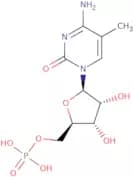
CAS:5-Methylcytidine-5'-monophosphate is a nucleotide that is an intermediate in the synthesis of DNA. It is a neutral form and has been sequenced. 5-Methylcytidine-5'-monophosphate is found in cellular components, such as mitochondria and nuclei. The biochemical properties of this molecule are dependent on its methylation state. This molecule also plays a role in mitochondrial functions and nuclear DNA modifications.
Formula:C10H16N3O8PPurezza:Min. 95%Colore e forma:White Off-White PowderPeso molecolare:337.22 g/mol1-(2’-Deoxy-2’-fluoro-b-D-arabinofuranosyl)-N3-(2S)-(2-amino-3-carbonyl]propyluracil
CAS:1-(2’-Deoxy-2’-fluoro-β-D-arabinofuranosyl)-N3-(2S)-(2-amino-3-carbonyl]propyluracil is a novel, anticancer drug. It is active against both RNA and DNA viruses, such as HIV, influenza virus and herpes virus. 1-(2’-Deoxy-2’-fluoro-β-D-arabinofuranosyl)-N3-(2S)-(2-amino-3-carbonyl]propyluracil has been shown to be an activator for phosphoramidites in aqueous solution. This compound is of high purity with CAS No. 2072145–25–4. It is also a synthesized, monophosphate nucleoside that can be used in the production of modified nucleosides for therapeutic purposes or as antiviral agentsPurezza:Min. 95%5'-O-[Bis(4-methoxyphenyl)(phenyl)methyl]-2'-deoxy-N-isobutyrylguanosine
CAS:5'-O-[Bis(4-methoxyphenyl)(phenyl)methyl]-2'-deoxy-N-isobutyrylguanosine is a synthetic nucleoside that is used as a building block in the synthesis of oligonucleotides. This chemical has an electronegativity value of 1.7, which means that it is more electronegative than guanine (1.0). It also has a conjugated system and is stable under a range of conditions. 5'-O-[Bis(4-methoxyphenyl)(phenyl)methyl]-2'-deoxy-N-isobutyrylguanosine reacts with tetrazole in the presence of phosphoramidite, yielding the corresponding 5'-O-(4,4'-dimethoxytrityl)-2'-deoxy-N-isobutyrylguanosine, which can then be used toFormula:C35H37N5O7Purezza:Min. 98 Area-%Colore e forma:White PowderPeso molecolare:639.71 g/molN3-Methylcytidine methosulfate
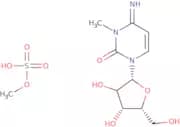
CAS:N3-Methylcytidine methosulfate is a novel antiviral agent that inhibits the synthesis of DNA and RNA. It has been shown to be effective against hepatitis B virus, herpes simplex virus, varicella-zoster virus, human immunodeficiency virus, and cytomegalovirus. N3-Methylcytidine methosulfate was found to be active in a variety of animal models including mice and rats. This drug has anticancer properties in the treatment of leukemia, lymphoma, and breast cancer. The phosphoramidite derivative of N3-methylcytidine methosulfate is used as an activator for oligonucleotide synthesis.
Formula:C10H15N3O5·CH4SO4Purezza:Min. 98 Area-%Colore e forma:PowderPeso molecolare:369.35 g/molN3-Cyanoethyl-5’-O-DMT-2’-O-methyluridine
N3-Cyanoethyl-5’-O-DMT-2’-O-methyluridine is a nucleoside that is synthesized from 5'-O-DMT-2’-O-methyluridine. It has antiviral and anticancer properties, as well as an inhibitory effect on DNA synthesis. N3-Cyanoethyl-5’-O-DMT-2’-O methyluridine is a novel nucleoside with DMT and methylated uracil at the 3' position of the sugar moiety. Synthesis may be achieved by using phosphoramidites or modified nucleosides such as N3-(cyanoethyl)-5'-0-(dimethoxytrityl)thymidine. This product meets high purity standards, with a CAS number of 68719–77–8.Purezza:Min. 95%7-[3,5-Bis-O-[(-2,4-dichlorophenyl)methyl]-2-C-methyl-b-D-ribofuranosyl]-4-chloro-5-iodo-7H-pyrrolo[2,3-d]pyrimidine
CAS:7-[3,5-Bis-O-[(-2,4-dichlorophenyl)methyl]-2-C-methyl-b-D-ribofuranosyl]-4-chloro-5-iodo-7H-pyrrolo[2,3-d]pyrimidine is a synthetic nucleoside that inhibits viral DNA synthesis by interfering with the viral enzyme polymerase. It has been shown to be active against HIV and HSV and may have potential therapeutic use in antiviral therapy. 7-[3,5-Bis-O-[(-2,4-dichlorophenyl)methyl]-2-C--methyl--b--D--ribofuranosyl]-4--chloro--5--iodo--7H--pyrrolo[2,3--d]pyrimidine has been synthesized for the first time by a novel process involving deoxyribonucleosides and phosphorPurezza:Min. 95%N6-Carbamoylthreonyladenosine sodium salt
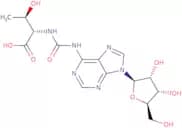
CAS:N6-Carbamoylthreonyladenosine sodium salt is a fatty acid that is found in the bacterial cell wall. It has been shown to be an essential component of the cell wall for Gram-positive and Gram-negative bacteria. N6-Carbamoylthreonyladenosine sodium salt has been used to study the mechanism of protein synthesis in bacteria, especially how enzymes are involved in this process. Chemical biology studies have shown that this molecule can bind to DNA and inhibit bacterial growth. The crystal structure of N6-Carbamoylthreonyladenosine sodium salt has also been determined using x-ray diffraction data. This molecule inhibits the binding of proteins to DNA, which prevents transcription and replication. The reaction mechanism involves hydrogen bonding between the oxygen atoms on N6-Carbamoylthreonyladenosine sodium salt and divalent metal ions such as magnesium or zinc, which are required for protein synthesis.Formula:C15H19N6O8·NaPurezza:Min. 98 Area-%Colore e forma:White PowderPeso molecolare:434.34 g/mol3-Acetylpyridine adenine dinucleotide
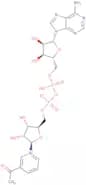
CAS:A non-physiological analog of nicotinamide adenine dinucleotide (NAD+) in biochemical research, particularly as a tool to study the mechanisms of NAD+-dependent enzymes.Formula:C22H28N6O14P2Purezza:Min. 92 Area-%Colore e forma:White Off-White PowderPeso molecolare:662.44 g/mol5'-O-p-Anisoylthymidine
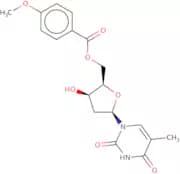
5'-O-p-Anisoylthymidine is a novel activator and ribonucleoside that has been synthesized by modifying the structure of thymidine. This compound is active against cancer and antiviral, such as herpes simplex virus type 1, herpes simplex virus type 2, varicella zoster virus, influenza A/PR/8/34 (H1N1), and influenza B/Yamagata/16/88. 5'-O-p-Anisoylthymidine activates viral transcription in cells infected with these viruses by inhibiting the synthesis of deoxyribonucleosides. It also inhibits DNA synthesis by inhibiting the incorporation of deoxyribonucleotides into DNA during replication. This product is CAS No. 138581-03-2 and comes in high purity and high quality.Formula:C18H20N2O7Purezza:Min. 95%Peso molecolare:376.36 g/mol2,2'-Anhydrocytidine HCl
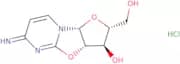
CAS:2,2'-Anhydrocytidine HCl is a nucleoside for use as a DNA synthesis inhibitor
Formula:C9H11N3O4·HClPurezza:Min. 98 Area-%Colore e forma:White PowderPeso molecolare:261.66 g/mol3'-Deoxy-3'-fluoro-isocytidine
3'-Deoxy-3'-fluoro-isocytidine is a nucleoside that belongs to the class of Deoxyribonucleosides. It is a novel nucleoside that has antiviral and anticancer properties. 3'-Deoxy-3'-fluoro-isocytidine inhibits viral replication by inhibiting the action of DNA polymerase. It also inhibits cancer cell proliferation through inhibition of DNA synthesis and protein synthesis, as well as induction of apoptosis. 3'-Deoxy-3'-fluoro-isocytidine is phosphorylated by ribonucleotide reductase in the erythrocyte to yield its active form, deoxycytidine monophosphate (dCMP).Purezza:Min. 95%2'-O-tert-Butyldimethylsilyl-5'-O-toluoyluridine 3'-CE phosphoramidite
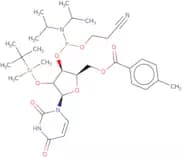
2'-O-tert-Butyldimethylsilyl-5'-O-toluoyluridine 3'-CE phosphoramidite is a modified ribonucleotide that can be used as an activator in oligonucleotide synthesis. 2'-O-tert-Butyldimethylsilyl-5'-O-toluoyluridine 3'-CE phosphoramidite is a novel nucleoside that has antiviral and anticancer properties. It has been shown to inhibit the growth of cells by inhibiting DNA synthesis, which may be due to its ability to bind to DNA and inhibit DNA polymerase. The CAS number for this product is 126214-01-3.Formula:C32H49N4O8PSiPurezza:Min. 95%Peso molecolare:676.83 g/mol2'-Deoxy-L-cytidine 3'-O-L-valinyl ester 2HCl
CAS:2'-Deoxy-L-cytidine 3'-O-L-valinyl ester 2HCl is a nucleoside analog that is converted to its active form by intracellular dephosphorylation. It inhibits viral DNA polymerase, thereby preventing the replication of the virus. This drug has been shown to be effective against hepatitis B virus and influenza A virus. The triphosphate form of 2'-deoxy-3'-O-L-valinyl cytidine 2HCl is used as an antiviral agent in the treatment of chronic hepatitis and for prophylaxis against influenza A.Formula:C14H22N4O5·2HClPurezza:Min. 95%Colore e forma:Off-White PowderPeso molecolare:399.27 g/mol2'-Deoxy-5'-O-DMT-cytidine
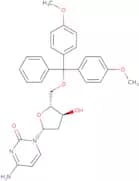
CAS:2'-Deoxy-5'-O-DMT-cytidine is an organic compound. It is a synthetic, combinational and amine nitrogen containing heterocyclic compound that is used in organic synthesis. This chemical is also used as a building block for the synthesis of heterocyclic compounds with other functional groups such as thionyl, formulae, chlorides and hydrogen atoms.Formula:C30H31N3O6Purezza:Min. 95 Area-%Colore e forma:White PowderPeso molecolare:529.58 g/mol5’-O-DMT-3’-O-levulinyl-2’-deoxyadenosine
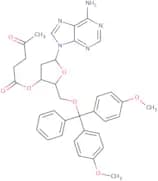
CAS:5’-O-DMT-3’-O-levulinyl-2’-deoxyadenosine is a monophosphate antiviral agent. It has been shown to inhibit the activity of DNA and RNA polymerases in vitro. The drug is novel, and its antiviral properties have not been tested in vivo. 5’-O-DMT-3’-O-levulinyl-2’-deoxyadenosine has been synthesized using phosphoramidites and was found to be of high quality and purity. It has also been modified at the 2' position with an acetyl group and at the 3' position with a levulinoyl group.Purezza:Min. 95%Queuine hydrochloride
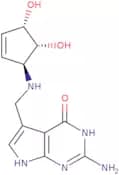
CAS:Queuine is a modified nucleoside found in tRNA. It is synthesized from guanosine by the enzyme queuine tRNA-ribosyltransferase, which converts guanosine to queuosine. Queuine hydrochloride is a synthetic form of queuine that can be used for research purposes to examine the anticodon loop and other structural features of the molecule. The prokaryotic and eukaryotic organisms studied showed different levels of synthesis of queuine, with bacteria synthesizing more than mammals. Bacteria were found to have a greater affinity for queuine than eukaryotes, which may be due to modification of the trna anticodon loop or to differences in ribosomal proteins.Formula:C12H15N5O3·HClPurezza:(%) Min. 90%Colore e forma:Light (Or Pale) Beige To Light (Or Pale) Purple SolidPeso molecolare:313.74 g/mol2-Iodoadenosine
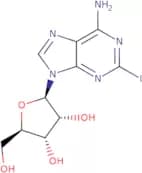
CAS:2-Iodoadenosine is a chemical compound that is produced from the oxidation of uridine. It is used in the synthesis of peptides, which are important for biological processes like signal transduction and cell growth. 2-Iodoadenosine can be made by coupling other molecules to an adenosine molecule. This process involves a cross-coupling reaction with palladium catalysts or hydroxylation reactions with sodium borohydride. The resulting product has been shown to have anticancer and anti-microbial activities against protozoan parasites and cyclic peptide structures.Formula:C10H12IN5O4Purezza:Min. 97 Area-%Colore e forma:PowderPeso molecolare:393.14 g/mol2'-Deoxy-6-thioguanosine-5'-monophosphate
CAS:Azathioprine is a drug that suppresses the immune system and is used to treat autoimmune disorders such as rheumatoid arthritis, lupus erythematosus, and inflammatory bowel disease. It is an immunosuppressant that prevents the formation of antibodies by blocking the enzyme thiopurine S-methyltransferase. Azathioprine is metabolized in the liver to 6-mercaptopurine, which has been shown to cause leukopenia. The genetic polymorphism of this enzyme can lead to differences in the metabolism and toxicity of azathioprine therapy.Formula:C10H14N5O6PSPurezza:Min. 95%Peso molecolare:363.29 g/mol


![1-(2’-Deoxy-2’-fluoro-b-D-arabinofuranosyl)-N3-(2S)-(2-amino-3-carbonyl]propyluracil](/_next/image/?url=https%3A%2Fstatic.cymitquimica.com%2Fproducts%2F3D%2Fthumb-webp%2FND162854.webp&w=3840&q=75)
![5'-O-[Bis(4-methoxyphenyl)(phenyl)methyl]-2'-deoxy-N-isobutyrylguanosine](/_next/image/?url=https%3A%2Fstatic.cymitquimica.com%2Fproducts%2F3D%2Fthumb-webp%2FND02998.webp&w=3840&q=75)

![7-[3,5-Bis-O-[(-2,4-dichlorophenyl)methyl]-2-C-methyl-b-D-ribofuranosyl]-4-chloro-5-iodo-7H-pyrrol…](/_next/image/?url=https%3A%2Fstatic.cymitquimica.com%2Fproducts%2F3D%2Fthumb-webp%2FNB14088.webp&w=3840&q=75)