


Nucleosidi
I nucleosidi sono building blocks fondamentali degli acidi nucleici, composti da una base azotata legata a una molecola di zucchero. In questa sezione, puoi trovare una vasta gamma di nucleosidi essenziali per la ricerca in biologia molecolare, biochimica e farmacologia. Questi composti svolgono ruoli cruciali nella sintesi del DNA e dell'RNA e sono vitali in vari processi metabolici. I nucleosidi vengono utilizzati per studiare il materiale genetico, sviluppare terapie antivirali e antitumorali e comprendere i meccanismi cellulari. Da CymitQuimica, forniamo nucleosidi di alta qualità per supportare le tue esigenze di ricerca e sviluppo, garantendo purezza e affidabilità per le tue applicazioni sperimentali.
Trovati 3569 prodotti di "Nucleosidi"
Ordinare per
Purezza (%)
0
100
|
0
|
50
|
90
|
95
|
100
6-Aminothymine
CAS:<p>6-Aminothymine is a polyamine that exerts its inhibitory activity by hydrogen bonding to the enzyme's active site. It has been shown to inhibit protein synthesis and growth factor synthesis in HL-60 cells. 6-Aminothymine also has cancer inhibiting properties, which may be due to its ability to bind DNA and interfere with replication or transcription.</p>Formula:C5H7N3O2Purezza:Min. 95%Peso molecolare:141.13 g/mol2,6-Dichloro-9-(2'-deoxy-b-D-ribofuranosyl)purine
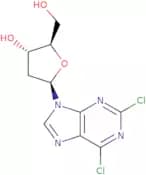
CAS:<p>2,6-Dichloro-9-(2'-deoxy-β-D-ribofuranosyl)purine is a synthetic compound that is used in the treatment of certain types of cancer. It has been shown to be an activator of DNA synthesis and an inhibitor of RNA synthesis. It has also been shown to inhibit tumor growth and prolong the survival time for patients with leukemia. The antiviral activity of 2,6-dichloro-9-(2'-deoxy-β-D-ribofuranosyl)purine may be due to its ability to inhibit viral DNA polymerase. This drug is also known as dideoxyinosine (ddI).</p>Formula:C10H10Cl2N4O3Purezza:Min. 95%Peso molecolare:305.12 g/mol2'-Deoxy-5'-O-DMT-uridine 3'-succinyl CPG 1000Å
<p>2'-Deoxy-5'-O-DMT-uridine 3'-succinyl CPG 1000Å is an anticancer drug that is used in the treatment of acute myeloid leukemia. This compound is a modified nucleoside. It has been shown to inhibit the growth of cultured cells and induce apoptosis by causing DNA damage. The anticancer properties of 2'-deoxy-5'-O-DMT-uridine 3'-succinyl CPG 1000Å are mediated by its inhibition of DNA synthesis, RNA synthesis, and protein synthesis.</p>Purezza:Min. 95%6-(Trifluoromethyl)uracil
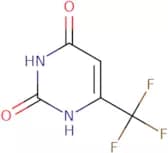
CAS:6-(Trifluoromethyl)uracil is a synthetic analog of uracil, which is a nucleobase that is found in RNA. It can be synthesized by reacting phosphorus oxychloride and trifluoromethyl chloride to form the corresponding chloroformate ester, followed by hydrolysis with anhydrous potassium carbonate. The compound has been shown to inhibit bacterial growth in bioassays and also has the ability to react with amines. 6-Trifluoromethyluracil has a constant chlorine atom that forms hydrogen bonds with other molecules, such as ammonia or amines, which may have antibacterial properties.Formula:C5H3F3N2O2Purezza:Min. 95%Peso molecolare:180.08 g/mol3'-Azido-2',3'-dideoxy-N2-isobutyrylguanosine
<p>3'-Azido-2',3'-dideoxy-N2-isobutyrylguanosine is an antiviral agent that belongs to the class of nucleosides. It is a novel phosphoramidite which can be used in the synthesis of ribonucleosides and deoxyribonucleosides. 3'-Azido-2',3'-dideoxy-N2-isobutyrylguanosine has shown anticancer activity, with a potential use as an inhibitor of cellular proliferation, including tumor cells. 3'-Azido-2',3'-dideoxy-N2-isobutyrylguanosine also inhibits viral replication by interfering with the initiation and elongation steps of viral DNA synthesis.</p>Purezza:Min. 95%5'-O-tert-Butyldimethylsilyluridine
CAS:<p>5'-O-tert-Butyldimethylsilyluridine (5'-O-TBDMSU) is a nucleoside that is used in the synthesis of nucleic acid probes. It is selective for the uridine residues in RNA and DNA, which are found at the 5' position. Sodium hydride reacts with this compound to form the corresponding hydroxyl group. This allows for further nucleobase additions or halogen substitutions to be made to the molecule, as well as desilylation reactions. 5'-O-TBDMSU can also be used to synthesize heteroaromatic nucleic acids and nucleotide derivatives.</p>Formula:C15H26N2O6SiPurezza:Min. 98 Area-%Colore e forma:PowderPeso molecolare:358.46 g/mol8-Oxo-N2-isobutyryl-2-deoxyguanosine
CAS:<p>8-Oxo-N2-isobutyryl-2-deoxyguanosine is a modified synthetic nucleoside. It finds applications in understanding mutagenesis and DNA repair mechanisms.</p>Formula:C14H19N5O6Purezza:Min. 95%Peso molecolare:353.33 g/mol2,2’-Anhydro-5’-O-DMT-uridine
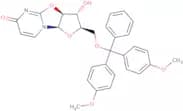
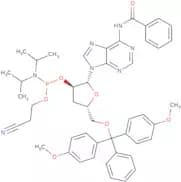
CAS:2,2’-Anhydro-5’-O-DMT-uridine is a high purity synthetic nucleoside that is modified with a hydroxymethyl group in the 2' position. It is a monophosphate and diphosphate derivative of uridine. This nucleoside has antiviral and anticancer properties, as well as the ability to inhibit HIV replication.Formula:C30H28N2O7Purezza:Min. 95%Peso molecolare:528.55 g/molN6-Benzoyl-3'-deoxy-5'-O-DMT-adenosine 2'-CE phosphoramidite
CAS:N6-Benzoyl-3'-deoxy-5'-O-DMT-adenosine 2'-CE phosphoramidite is a novel modified nucleoside that has antiviral, anticancer and antibacterial properties. The chemical name is N6-benzoyl-3'-deoxy-5'-O-DMT-adenosine 2'-CE phosphoramidite. It is a ribonucleotide. It is an activator of the enzyme kinase A which phosphorylates proteins and activates them. This product has not been tested in humans.Formula:C47H52N7O7PPurezza:Min. 95%Peso molecolare:857.93 g/mol2'-Deoxy-5'-O-DMT-5-methylcytidine
CAS:<p>2'-Deoxy-5'-O-DMT-5-methylcytidine is a nucleoside analog that can be used to treat cancer. This compound is synthesized by the conversion of 5′-O-dimethoxytrityl (DMT)-2'-deoxycytidine to its 5′-O-DMT phosphoramidite. The phosphoramidite is then reacted with methylene chloride, methanol, and ammonia to form the monophosphate. 2'-Deoxy-5'-O-DMT-5-methylcytidine has been shown to be an effective anticancer drug in vitro and in vivo. It targets DNA synthesis, which prevents the duplication of genetic material necessary for cell division.</p>Formula:C31H33N3O6Purezza:Min. 95%Colore e forma:White to off-white solid.Peso molecolare:543.63 g/mol8-(4-Aminophenyl)-2'-deoxyguanosine
<p>8-(4-Aminophenyl)-2'-deoxyguanosine is an Activator that has novel properties. It is a diphosphate of 8-(4-Aminophenyl)thymidine and is also known as 8-APT. It has been shown to have anticancer and antiviral activity in animal models, and it may be a potential treatment for HIV infection. The chemical name for 8-APT is 2'-deoxyguanosine, 8-(4-aminophenyl)-, (8R*,9S*)-.</p>Formula:C16H18N6O4Purezza:Min. 95%Peso molecolare:358.35 g/mol2'-Deoxy-5'-O-DMT-N2-isobutyryl-guanosine-3'-lcaa-CPG
<p>2'-Deoxy-5'-O-DMT-N2-isobutyryl-guanosine-3'-lcaa-CPG is a modified nucleoside, which is synthetically prepared. It is an activator of DNA polymerase and has been shown to be active against human leukemia cells. 2'-Deoxy-5'-O-DMT-N2-isobutyryl Guanosine 3'-lcaa CPG has also been shown to inhibit the replication of the herpes simplex virus type 1 in vitro. The compound is a novel high quality nucleoside phosphoramidite that can be used as a building block in the synthesis of deoxyribonucleosides and modified nucleosides with novel chemical structures.</p>Purezza:Min. 95%2,2'-Anhydro-5'-O-tert-butyldiphenylsilylthymidine
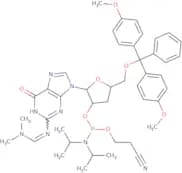
2,2'-Anhydro-5'-O-tert-butyldiphenylsilylthymidine is a novel monophosphate nucleoside analog that has antiviral activity against herpes simplex virus type 1 (HSV-1) and herpes simplex virus type 2 (HSV-2). This compound is chemically synthesized by the reaction between thymidine with bis-(2,6-diisopropylphenyl) disilazane in the presence of an activator. The synthesis of 2,2'-anhydro-5'-O-tert-butyldiphenylsilylthymidine is performed by reacting 5'-O-(4,4'-dimethoxytrityl)-thymidine with bis-(2,6-diisopropylphenyl) disilazane in the presence of tetrakis(triphenylphosphine)palladium(0Purezza:Min. 95%3'-Deoxy-N2-DMF-5'-O-DMT-guanosine 2'-CE phosphoramidite
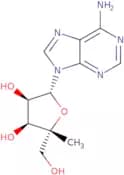
CAS:<p>3'-Deoxy-N2-DMF-5'-O-DMT-guanosine 2'-CE phosphoramidite is a novel nucleoside, which is structurally similar to cytidine and has been synthesized for the first time. 3'-Deoxy-N2-DMF-5'-O-DMT-guanosine 2'-CE phosphoramidite has antiviral and anticancer activities. It inhibits the growth of viruses by inhibiting DNA synthesis. 3'-Deoxy-N2-DMF-5'-O-DMT-guanosine 2'-CE phosphoramidite also inhibits the growth of cancer cells by inhibiting RNA synthesis.</p>Formula:C43H53N8O7PPurezza:Min. 95%Peso molecolare:824.9 g/mol4'-a-C-Methyladenosine
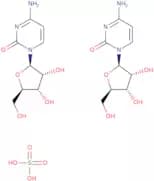
CAS:<p>4'-a-C-Methyladenosine is a nucleoside that has antiviral, anticancer and novel properties. It is a modified nucleoside with a methyl group in the 4' position. This modification prevents the phosphodiester bond from being hydrolyzed by nucleotide kinase enzymes. The methyl group also inhibits the formation of adenosine monophosphate (AMP) during DNA synthesis, which prevents the deactivation of adenosine triphosphate (ATP). 4'-a-C-Methyladenosine is used to synthesize oligonucleotides for use in DNA sequencing and gene mapping.</p>Purezza:Min. 95%Cytidine hemisulfate salt
CAS:Cytidine hemisulfate salt is a postulated inhibitor of the blood group antigen. It inhibits the phosphatase activity of blood group-specific phosphatases, which may be caused by its specific inhibition of α-tocopherol and phenolphthalein. Cytidine hemisulfate salt has been shown to inhibit both adenylic and uridylic phosphatases, but does not inhibit other phosphatases. This drug is also an antigen that can stimulate B cells, which produce antibodies against it. Cytidine hemisulfate salt is found in DNA and RNA.Formula:C9H13N3O5H2SO4Purezza:Min. 95%Peso molecolare:292.26 g/mol5'-O-p-Anisoyl-3'-fluoro-3'-deoxythymidine
<p>5'-O-p-Anisoyl-3'-fluoro-3'-deoxythymidine is a novel anticancer agent that has been shown to be active against leukemia, lymphoma and myeloma. The compound is a nucleoside analogue that inhibits DNA synthesis by inhibiting the activity of DNA polymerase. It has been shown to have antiviral activity in vitro against herpes simplex virus type 1 and type 2, influenza A virus and HIV. 5'-O-p-Anisoyl-3'-fluoro-3'-deoxythymidine can also inhibit protein synthesis by blocking the incorporation of amino acids into protein. This drug is synthesized from 3',5'-dideoxyuridine (dU) and fluoroacetyl chloride to produce 5'-O-p-anisoyl-3',5'-difluoroacetyl dU (ADUF). ADUF is then reacted with anisole to produce 5</p>Formula:C18H19FN2O6Purezza:Min. 95%Peso molecolare:378.4 g/mol5-[N(6-(Trifluoroacetamido)hexyl)-3-(E)-acrylamido] -2'-deoxyuridine
CAS:<p>5-[N(6-(Trifluoroacetamido)hexyl)-3-(E)-acrylamido] -2'-deoxyuridine is a synthetic, modified nucleoside that functions as an activator of ribonucleotide reductase. It has been shown to be effective in the treatment of viral infections, including herpes simplex virus type 1 (HSV-1), herpes simplex virus type 2 (HSV-2), and human immunodeficiency virus type 1 (HIV-1). 5-[N(6-(Trifluoroacetamido)hexyl)-3-(E)-acrylamido] -2'-deoxyuridine is also synthesized into DNA or RNA molecules, which are used to study the structure of these compounds. It can also be used for phosphoramidite synthesis.</p>Formula:C20H27F3N4OPurezza:Min. 95%Peso molecolare:396.45 g/mol3-Deazauridine-5'-triphosphate triethylamine salt
CAS:3-Deazauridine-5'-triphosphate triethylamine salt is a xanthosine analog that has been used as a biochemical reagent in animals and humans. It is postulated to be a potential cancer therapeutic agent because of its ability to inhibit DNA synthesis and cell division. 3-Deazauridine-5'-triphosphate triethylamine salt inhibits the biosynthesis of uridine in leukemic mice, hamster V79 cells, and mammalian cells. This drug inhibits the incorporation of uracil into RNA by competitive inhibition with respect to ATP. 3DATTP also inhibits the incorporation of thymidine into DNA by competitive inhibition with respect to dCTP.Formula:C10H16NO15P3Purezza:Min. 95%Peso molecolare:483.15 g/molStavudine 5'-monophosphate triethyammonium salt
<p>Stavudine 5'-monophosphate triethylammonium salt is a nucleoside analog that is structurally related to the natural deoxyribonucleosides. It has antiviral activity and is used in the treatment of HIV-1. Stavudine 5'-monophosphate triethylammonium salt inhibits viral replication by inhibiting DNA polymerase, which leads to a decrease in the production of new copies of the virus. This drug has also been shown to have anticancer properties, although it is not currently approved for this use. Stavudine 5'-monophosphate triethylammonium salt is synthesized in high purity and high quality, with a CAS number of 102747-23-2.</p>Purezza:Min. 95%










![5-[N(6-(Trifluoroacetamido)hexyl)-3-(E)-acrylamido] -2'-deoxyuridine](/_next/image/?url=https%3A%2Fstatic.cymitquimica.com%2Fproducts%2F3D%2Fthumb-webp%2FNT57552.webp&w=3840&q=75)

