


Nucleosidi
I nucleosidi sono building blocks fondamentali degli acidi nucleici, composti da una base azotata legata a una molecola di zucchero. In questa sezione, puoi trovare una vasta gamma di nucleosidi essenziali per la ricerca in biologia molecolare, biochimica e farmacologia. Questi composti svolgono ruoli cruciali nella sintesi del DNA e dell'RNA e sono vitali in vari processi metabolici. I nucleosidi vengono utilizzati per studiare il materiale genetico, sviluppare terapie antivirali e antitumorali e comprendere i meccanismi cellulari. Da CymitQuimica, forniamo nucleosidi di alta qualità per supportare le tue esigenze di ricerca e sviluppo, garantendo purezza e affidabilità per le tue applicazioni sperimentali.
Trovati 3569 prodotti di "Nucleosidi"
Ordinare per
Purezza (%)
0
100
|
0
|
50
|
90
|
95
|
100
3'-O-tert-Butyldiphenylsilyl-2'-O-methyluridine
<p>3'-O-tert-Butyldiphenylsilyl-2'-O-methyluridine is a novel nucleoside with antiviral and anticancer properties. It has been shown to inhibit the growth of human tumor cells in culture and induce apoptosis, as well as inhibit viral replication. 3'-O-tert-Butyldiphenylsilyl-2'-O-methyluridine is an analogue of uridine, which can be used for the synthesis of DNA or RNA. The phosphate group is attached to the 3' carbon on the sugar moiety. This nucleoside has been modified from a natural ribonucleoside by substitution of a tertiary butylphenylsilyl group at the 2' position with an o-methyl group.<br>3'-O-tert-Butyldiphenylsilyl-2'-O-methyluridine is supplied as a white powder with purity greater than 99</p>Purezza:Min. 95%2',3'-Di-O-methylguanosine
<p>2',3'-Di-O-methylguanosine is a nucleoside, which is a chemical compound composed of a nitrogenous base, a five-carbon sugar, and one phosphate group. It is an analog of guanosine that has been modified by replacing the 2' hydroxyl group with a methyl group. This modification prevents the phosphorylation of the monophosphate form to the diphosphate form. This modification also makes 2',3'-Di-O-methylguanosine an activator of DNA polymerase and RNA polymerase. The novel features of this compound make it an excellent candidate for anticancer and antiviral treatments.</p>Purezza:Min. 95%2-[2-(2-Naphthalenyl)ethoxy]adenosine
CAS:2-[2-(2-Naphthalenyl)ethoxy]adenosine is a structural determinant that belongs to the class of adenosine derivatives. It is an antagonist of adenosine receptors, binding to the A1 receptor with high affinity and blocking the effects of adenosine. 2-[2-(2-Naphthalenyl)ethoxy]adenosine has been shown to have a high affinity for benzyl and thioether groups in its structure, which are important for binding to the A1 receptor. This compound has been used in assays to determine the binding of other compounds with adenosine receptors. 2-[2-(2-Naphthalenyl)ethoxy]adenosine has also been shown as a radioligand for competitive binding studies with human brain membranes.Formula:C22H23N5O5Purezza:Min. 95%Peso molecolare:437.45 g/mol3'-O-DMT-thymidine
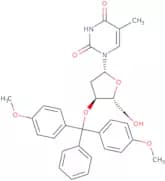
CAS:<p>3'-O-DMT-thymidine is a nucleoside analogue that is synthesized from thymidine. It has been shown to bind to the proviral dna of HIV and inhibit viral replication when present in a complex with the other nucleosides. 3'-O-DMT-thymidine is also stable at high temperatures and binds to carboxamide groups on proteins. This compound has been shown to be effective as a binder for surfaces and membranes, which may be due to its ability to form stable complexes with terminal phosphates. The stability of these complexes can be influenced by the presence of denaturants such as temperature, pH, or ionic strength parameters. 3'-O-DMT-thymidine also forms stable complexes with linkers that are sensitive to thermal denaturation.</p>Formula:C31H32N2O7Purezza:Min. 95%Peso molecolare:544.6 g/mol6-O-Benzyl-2'-deoxyguanosine
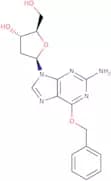
CAS:<p>6-O-Benzyl-2'-deoxyguanosine is a synthetic nucleoside analog that inhibits the synthesis of DNA. It is used in animal studies as a pancreatic carcinogen, and has been shown to inhibit tumor growth in mice. This drug specifically binds to DNA at the O6 position of guanine and methylates the adjacent cytosine residue, thereby preventing synthesis of DNA. 6-O-Benzyl-2'-deoxyguanosine also inhibits the activity of an enzyme called methyltransferase, which converts S-adenosylmethionine into S-adenosylhomocysteine, an intermediate in one of the pathways that produce methionine from homocysteine. This inhibition leads to an accumulation of methionine and its metabolites, including homocysteine and cystathione beta synthase, which can cause cell death.</p>Formula:C17H19N5O4Purezza:Min. 95%Peso molecolare:357.36 g/molN4-Acetyl-2'-deoxy-3'-O-DMT-cytidine 5'-CE phosphoramidite
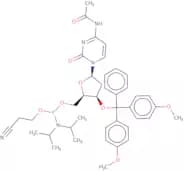
CAS:<p>N4-Acetyl-2'-deoxy-3'-O-DMT-cytidine 5'-CE phosphoramidite is a novel nucleoside. It is a monophosphate and cytidine analog that has been shown to be effective in the treatment of cancer. N4-Acetyl-2'-deoxy-3'-O-DMT-cytidine 5'-CE phosphoramidite also inhibits viral replication by preventing the synthesis of DNA and RNA. This drug can be used as an activator for synthesis of modified oligonucleotides.</p>Formula:C41H50N5O8PPurezza:Min. 95%Peso molecolare:771.84 g/molN6,5'-O-Dibenzoyl-2'-deoxy-adenosine
<p>N6,5'-O-Dibenzoyl-2'-deoxy-adenosine is a monophosphate nucleoside that is used in the synthesis of DNA. It is synthesized from 2'-deoxyadenosine, which is an antiviral agent against influenza virus and anticancer agent. N6,5'-O-Dibenzoyl-2'-deoxy-adenosine has been shown to be a potent activator of the polymerase chain reaction with high purity and novel properties.</p>Formula:C24H21N5O5Purezza:Min. 95%Peso molecolare:475.45 g/molL-Ribose NAD
<p>L-Ribose NAD is a nucleoside that belongs to the group of ribonucleosides. It is a novel modified monophosphate and diphosphate nucleotide. L-Ribose NAD has antiviral, anticancer, and immunomodulatory activities. L-Ribose NAD can activate cells with DNA damage by inhibiting the synthesis of deoxyribonucleosides, which are needed for DNA repair. This product has a high purity level and high quality.</p>Purezza:Min. 95%Peso molecolare:663 g/molN2-DMF-2'-O-methylguanosine
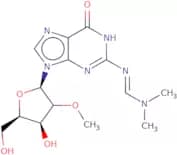
CAS:<p>N2-DMF-2'-O-methylguanosine is a nucleoside that is used as an antiviral agent and anticancer drug. It has been shown to inhibit the growth of human cancer cells in vitro and in vivo. N2-DMF-2'-O-methylguanosine has also been shown to inhibit viral replication by inhibiting DNA synthesis. This nucleoside is a novel compound that can be synthesized using phosphoramidites, which are high quality and yield high purity products.</p>Formula:C14H20N6O5Purezza:Min. 95%Peso molecolare:352.35 g/mol5'-O-DMT-2'-O-hexylaminoadenosine
<p>5'-O-DMT-2'-O-hexylaminoadenosine is a modified nucleoside that has antiviral activity. It is the monophosphate form of 5'-O-DMT-2'-O-hexylaminoadenosine, and it is used in the synthesis of phosphoramidites for DNA and RNA. This nucleoside is also an activator for novel antiviral drugs.</p>Formula:C37H44N6O6Purezza:Min. 95%Peso molecolare:668.8 g/mol5-[(Methylamino)methyl]uridine
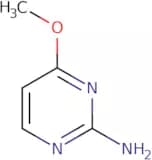
CAS:<p>5-[(Methylamino)methyl]uridine is a proton-containing analog of uridine. It is an epigenetic modifier that has been shown to have conformational properties that are similar to those of uridine. 5-[(Methylamino)methyl]uridine has been shown to modify the glycosidic bond and ring structures, which are important for its function in protein synthesis. The compound can also be found as a chemical structure in the ribosomal subunit, where it is involved in protein synthesis and translation. 5-[(Methylamino)methyl]uridine has shown potential as a therapeutic agent for cancer treatment due to its ability to inhibit the expression of oncogenes in cells and induce programmed cell death (apoptosis).</p>Formula:C11H17N3O6Purezza:Min. 95%Peso molecolare:287.27 g/mol2-Amino-4-methoxypyrimidine
CAS:<p>2-Amino-4-methoxypyrimidine is an organic compound that can be synthesized from 2-amino-4-chloropyrimidine. It is a colorless, water soluble solid with a melting point of 166°C. The UV spectrum of 2-amino-4-methoxypyrimidine exhibits absorption maxima at 240 nm and 280 nm. When 2-amino-4-methoxypyrimidine is exposed to UV light, it emits fluorescent light at 360 nm. The IR spectrum exhibits absorption bands at 3200 cm−1, 1650 cm−1, and 1530 cm−1. Hydrogen bonding interactions occur between the methoxy group and the protonated amine group in the molecule's structure. The yield of this reaction was found to be 65% by GC analysis. This reaction occurs in two steps: first, the imino group reacts with n hexane to form an iminium ion</p>Purezza:Min. 95%2'-Deoxy-5'-O-DMT-adenosine
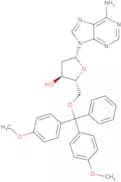
CAS:<p>2'-Deoxy-5'-O-DMT-adenosine is a nucleoside that is structurally related to adenosine. It is synthesized by the phosphoramidite approach and can be used as an activator for RNA synthesis. 2'-Deoxy-5'-O-DMT-adenosine has shown anticancer activity in vitro and in vivo, which may be due to its ability to inhibit RNA synthesis and DNA replication.</p>Formula:C31H31N5O5Purezza:Min. 95%Colore e forma:PowderPeso molecolare:553.61 g/mol[1',2',3',4',5'-13C5]-4-Thiothymidine
<p>[1',2',3',4',5'-13C5]-4-Thiothymidine is an antiviral, anticancer, and activator of DNA synthesis. It is a monophosphate analog of thymidine that has been modified to include a radioactive isotope. [1',2',3',4',5'-13C5]-4-Thiothymidine binds to the active site of the enzyme ribonucleotide reductase which is responsible for the production of DNA from RNA. The incorporation of this radioactively labeled analog into DNA prevents its degradation by nucleases and allows for the detection and quantification of DNA synthesis via autoradiography.</p>Purezza:Min. 95%2'-Deoxy-1,N6-dimethyladenosine
<p>2'-Deoxy-1,N6-dimethyladenosine is a nucleoside that is used for the synthesis of DNA and RNA. It has antiviral activity against HIV and herpes simplex virus type 1 (HSV-1). 2'-Deoxy-1,N6-dimethyladenosine binds to viral DNA and inhibits viral replication by preventing the viral DNA from being replicated. It also inhibits the synthesis of viral proteins. This nucleoside is synthesized in a high purity and quality, which makes it an excellent starting material for use in the synthesis of other nucleosides or phosphoramidites.</p>Purezza:Min. 95%2'-O-(2-Ethoxy-2-oxoethyl)adenosine
<p>2'-O-(2-Ethoxy-2-oxoethyl)adenosine is a nucleoside that is a modified version of adenosine. It is phosphorylated to form 2'-O-(2-ethoxy-2-oxoethyl)adenosin-5'-yl monophosphate, which has antiviral activity and is used as an antiviral agent in the treatment of herpes simplex virus. The chemical structure of this nucleoside is novel, and it binds to the ribonucleotide reductase enzyme to prevent the synthesis of DNA and RNA. This drug also has anticancer properties, but it is not active against bacterial infections.</p>Purezza:Min. 95%2-Chloropyrimidine-4-carboxamide
CAS:<p>2-Chloropyrimidine-4-carboxamide is an activator that is a novel chemical entity of deoxyribonucleosides, phosphoramidites, ribonuclesides, and antiviral nucleosides. It has been shown to have high purity and quality. 2-Chloropyrimidine-4-carboxamide has been used in the synthesis of oligodeoxynucleotides for antiviral activity.</p>Formula:C5H4ClN3OPurezza:Min. 95%Peso molecolare:157.56 g/molAFB-guanine
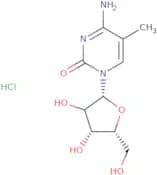
CAS:<p>AFB-guanine is a purine nucleoside that has been found to be an intermediate in the conversion of adenosine to inosine. The toxicity of AFB-guanine was studied using the model system of rat liver microsomes and human liver. It was observed that AFB-guanine is metabolized by glycosylases, which act on purines and pyrimidines. The glycosylase activity was inhibited by dicoumarol, which results in a decrease in the amount of AFB-guanine that is converted to adenosine triphosphate (ATP). The study also showed that histological analysis revealed degenerative diseases and cancer in mice fed with AFB-guanine, suggesting that this compound may be carcinogenic.</p>Formula:C22H17N5O8Purezza:Min. 95%Peso molecolare:479.4 g/mol5-Methylcytidine HCl
<p>5-Methylcytidine HCl is a novel antiviral and anticancer agent. It possesses two important properties: it is an activator of the enzyme ribonucleotide reductase, which regulates DNA synthesis and repair; and it inhibits the activity of DNA polymerases. It is also chemically modified to allow its use in phosphoramidite synthesis. 5-Methylcytidine HCl has been shown to cause apoptosis in cancer cells, as well as inhibit the growth of bacteria.</p>Formula:C10H15N3O5·HClPurezza:Min. 95%Peso molecolare:293.7 g/mol2-[2-(4-Fluorophenyl)ethoxy]adenosine
CAS:<p>2-[2-(4-Fluorophenyl)ethoxy]adenosine is a hydrogen-bonded, hydrated, switchable molecule. The techniques used to characterize this compound include vibrational spectroscopy and Raman spectroscopy. 2-[2-(4-Fluorophenyl)ethoxy]adenosine has been shown to have high salt and thermal stability. It has also been shown to undergo conformational changes in the presence of chemists.</p>Formula:C18H20FN5O5Purezza:Min. 95%Peso molecolare:405.38 g/mol



![2-[2-(2-Naphthalenyl)ethoxy]adenosine](/_next/image/?url=https%3A%2Fstatic.cymitquimica.com%2Fproducts%2F3D%2Fthumb-webp%2FNN16559.webp&w=3840&q=75)



![5-[(Methylamino)methyl]uridine](/_next/image/?url=https%3A%2Fstatic.cymitquimica.com%2Fproducts%2F3D%2Fthumb-webp%2FNM159410.webp&w=3840&q=75)
![[1',2',3',4',5'-13C5]-4-Thiothymidine](/_next/image/?url=https%3A%2Fstatic.cymitquimica.com%2Fproducts%2F3D%2Fthumb-webp%2FNT35287.webp&w=3840&q=75)




![2-[2-(4-Fluorophenyl)ethoxy]adenosine](/_next/image/?url=https%3A%2Fstatic.cymitquimica.com%2Fproducts%2F3D%2Fthumb-webp%2FNF16548.webp&w=3840&q=75)