


Nucleosidi
I nucleosidi sono building blocks fondamentali degli acidi nucleici, composti da una base azotata legata a una molecola di zucchero. In questa sezione, puoi trovare una vasta gamma di nucleosidi essenziali per la ricerca in biologia molecolare, biochimica e farmacologia. Questi composti svolgono ruoli cruciali nella sintesi del DNA e dell'RNA e sono vitali in vari processi metabolici. I nucleosidi vengono utilizzati per studiare il materiale genetico, sviluppare terapie antivirali e antitumorali e comprendere i meccanismi cellulari. Da CymitQuimica, forniamo nucleosidi di alta qualità per supportare le tue esigenze di ricerca e sviluppo, garantendo purezza e affidabilità per le tue applicazioni sperimentali.
Trovati 3569 prodotti di "Nucleosidi"
Ordinare per
Purezza (%)
0
100
|
0
|
50
|
90
|
95
|
100
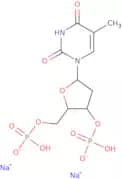
Thymidine-3',5'-diphosphate disodium salt
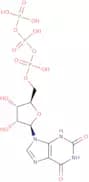
CAS:Thymidine-3',5'-diphosphate disodium salt is an antiviral and anticancer drug. It is a modified nucleoside which is synthesized from thymidine-3',5'-diphosphate and sodium bicarbonate (NaHCO3). This drug inhibits the synthesis of DNA and RNA, thereby inhibiting viral replication. Thymidine-3',5'-diphosphate disodium salt also has an antitumor effect by preventing the production of DNA in tumor cells.Formula:C10H14N2Na2O11P2Purezza:Min. 95%Colore e forma:PowderPeso molecolare:446.15 g/molXanthosine-5'-triphosphate triethylammonium salt - 100 mM aqueous solution
CAS:<p>Inhibitor of adenylyl and guanylyl cyclase</p>Formula:C10H15N4O15P3·xC6H15NPurezza:Min. 95%Colore e forma:Colorless PowderPeso molecolare:524.17 g/molPolyadenylic acid potassium
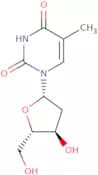
CAS:<p>Please enquire for more information about Polyadenylic acid potassium including the price, delivery time and more detailed product information at the technical inquiry form on this page</p>Formula:(C10H14N5O7P)x•KxPurezza:85% Min5-Methyl-L-uridine
CAS:<p>5-Methyl-L-uridine is an antiviral drug which belongs to a class of compounds called nucleoside analogues. It is used in the treatment of chronic hepatitis B and C, as well as for prevention of hepatitis A and B. 5-Methyl-L-uridine inhibits the virus by turning off the production of viral DNA and RNA, through interactions with the virus's polymerase chain reaction process. This drug also prevents protein synthesis in cells infected with viruses such as HIV, herpes simplex virus type 1, and influenza A virus. 5-Methyl-L-uridine is a prodrug that is converted to its active form, uridine monophosphate, by enzymes in the liver. The cytotoxic effects of 5-methyluridine on cancer cells have been shown to be due to inhibition of cellular DNA synthesis and repair pathways.</p>Formula:C10H14N2O6Purezza:Min. 95%Colore e forma:White PowderPeso molecolare:258.23 g/molRef: 3D-NM06240
1gPrezzo su richiesta2gPrezzo su richiesta5gPrezzo su richiesta10gPrezzo su richiesta25gPrezzo su richiesta5'-O-DMT-thymidine-3'-succinyl CPG 2000 Å
<p>5'-O-DMT-thymidine-3'-succinyl CPG 2000 Å is a synthetic nucleoside that contains an acetyl group at the 5' position. The succinyl group has been added to the 3' position of the nucleoside and is bonded to a carrier molecule (2000 Å). This product is used as an activator in DNA synthesis, it also has antiviral and anticancer activities.</p>Colore e forma:Powder2',3'-Dideoxy-2',3'-didehydro-2'-fluorocytidine
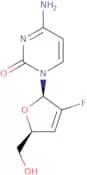
CAS:<p>2',3'-Dideoxy-2',3'-didehydro-2'-fluorocytidine (ddC) is a nucleoside with antiviral activity. The mechanism of action is not well understood, but ddC has been shown to inhibit the proliferation of human immunodeficiency virus (HIV). It is also active against isolates of herpes simplex virus and vesicular stomatitis virus. The elimination half-life of ddC in humans is about 8 hours. In humans, this drug is eliminated by methylation and glucuronidation reactions. The pharmacokinetics of ddC have been studied in animals, including rats and rabbits, with preliminary indications that the elimination half-life may be longer than in humans.</p>Formula:C9H10FN3O3Purezza:Min. 95%Peso molecolare:227.19 g/mol8-Amino-2’-deoxyadenosine
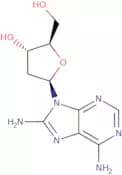
CAS:<p>8-Amino-2’-deoxyadenosine (8AAD) is a nucleoside that is used in the laboratory for the analysis of dna duplexes. It stabilizes dna duplexes in an acidic environment, and it can be used to analyze the stability of dna duplexes at neutral pH. 8AAD can also stabilize triplex structures formed by 8AAD, amines, and purines. The orientation of these bases in the triplex structure is important because they can determine which strands are cleaved during hydrolysis.</p>Formula:C10H14N6O3Purezza:Min. 95%Peso molecolare:266.26 g/molN6-Benzyladenosine 5'-diphosphate sodium salt - 10 mM aqueous solution
CAS:<p>N6-Benzyladenosine 5'-diphosphate sodium salt is a modified nucleoside that has a high purity, which is suitable for synthesis of DNA or RNA. It can be used in the modification of deoxyribonucleosides, ribonucleosides, and phosphoramidites. N6-Benzyladenosine 5'-diphosphate sodium salt has been shown to have anticancer effects and antiviral effects. This drug also has novel properties such as an ability to inhibit the proliferation of cancer cells.</p>Formula:C17H21N5O10P2Purezza:Min. 95%Colore e forma:Colorless PowderPeso molecolare:517.32 g/mol2'-Deoxy-3',5'-O-(1,1,3,3-tetraisopropyl-1,3-disiloxanediyl)uridine
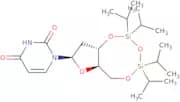
CAS:<p>2'-Deoxy-3',5'-O-(1,1,3,3-tetraisopropyl-1,3-disiloxanediyl)uridine is a novel and synthetic nucleoside analog with antiviral activity. It inhibits the synthesis of DNA by binding to the enzyme ribonucleotide reductase. This compound has been shown to be an activator of PPARs in vitro.</p>Formula:C21H38N2O6Si2Purezza:Min. 95%Peso molecolare:470.72 g/molPolyoxin B
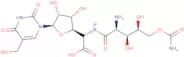
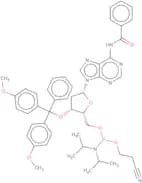
CAS:<p>Polyoxin B is a natural product that is produced by the fungus Polyporus umbellatus. It is a synthetase inhibitor that specifically inhibits the enzyme malic acid synthetase in bacteria and fungi. Polyoxin B has been shown to have antifungal activity in vitro and to inhibit the growth of Cryptococcus neoformans, which may be due to its ability to inhibit terminal residues, such as acetate extract, bacterial strain, and synthase enzyme.</p>Formula:C17H25N5O13Purezza:Min. 70%Colore e forma:Yellow PowderPeso molecolare:507.41 g/molN6-Benzoyl-2'-deoxy-3'-O-DMT-adenosine 5'-CE phosphoramidite
CAS:<p>A 5'-3’ “reverse” (or “inverse”) amidites</p>Formula:C47H52N7O7PPurezza:Min. 95%Peso molecolare:857.93 g/molLamivudine-5'-triphosphate tetratriethylammonium salt - ca.15 mM Aqueous solution
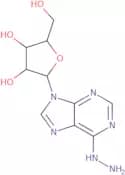
<p>Lamivudine-5'-triphosphate tetratriethylammonium salt - ca.15 mM Aqueous solution is an antiviral drug used to treat HIV/AIDS and hepatitis B infections. It is a potent inhibitor of human immunodeficiency virus type 1 (HIV-1) replication, acting by blocking the viral enzyme reverse transcriptase. Lamivudine-5'-triphosphate tetratriethylammonium salt - ca.15 mM Aqueous solution also inhibits cellular viral DNA synthesis and has been shown to exhibit anticancer activity in vitro and in vivo. This product is synthesized from raw materials through a novel process that involves modification of the phosphoramidite monophosphate with tetratriethylammonium salts.</p>Formula:C32H74N7O12P3SPurezza:Min. 95%Peso molecolare:873.96 g/molN6-Aminoadenosine
CAS:<p>N6-Aminoadenosine is a purine nucleoside that is involved in the synthesis of adenosine. It can be found in a number of tissues and has been shown to have an agonist potency similar to 2-phenylaminoadenosine, but with a longer duration of action. N6-Aminoadenosine is also present as one of two stereoisomers, the other being N2-aminoadenosine. These two aminosides are hydrolyzed by triazol and sinoatrial enzymes. The affinity of N6-aminoadenosine for cellular receptors has been shown using high affinity assays on rat heart cells.</p>Purezza:Min. 95%2'-Deoxy-3'-O-DMT-N2-isobutyrylguanosine 5'-CE phosphoramidite
<p>2'-Deoxy-3'-O-DMT-N2-isobutyrylguanosine 5'-CE phosphoramidite is a 5'-3’ “reverse” (or “inverse”) amidite.</p>Formula:C44H54N7O8PPurezza:Min. 95%Peso molecolare:839.94 g/molN6-Benzoyl-5'-O-DMT-2'-O-(2-methoxyethyl)adenosine 3'-CE phosphoramidite
CAS:<p>Nucleoside phosphoramidites are used in the chemical synthesis of oligonucleotides containing 2’-O-(2-methoxyethyl) adenosine nucleoside units. Using a chemical approach rather than an enzymatic one allows custom-made oligonucleotides of a desired sequence to be obtained. 3’-Cyanoethyl phosphoramidites are typically modified by reaction with an appropriate alcohol in the presence of an azole catalyst such as imidazole or 1H-tetrazole. N6-Benzoyl-5'-O-DMT-2'-O-MOE-adenosine 3'-CE phosphoramidite has been used in the synthesis of 2’-modified oligonucleotides as protein binding modulators.</p>Formula:C50H58N7O9PPurezza:Min. 95%Colore e forma:PowderPeso molecolare:932.01 g/mol4'-α-C-Methylcytidine
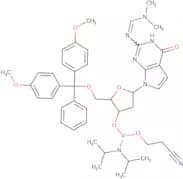
CAS:<p>4'-a-C-Methylcytidine is a nucleoside that is synthesized from 4'-a-C-methyluridine. It has antiviral and anticancer properties, and has been shown to be a potent activator of the immune system. The modified nucleosides in this compound are thought to be less toxic than other cytotoxic agents. 4'-a-C-Methylcytidine is also used as a building block for the synthesis of DNA, RNA and phosphoramidites.</p>Purezza:Min. 95%Colore e forma:PowderPeso molecolare:257.24 g/mol7-deaza-dG-CE Phosphoramidite
CAS:<p>7-deaza-dG-CE Phosphoramidite is a monophosphate nucleotide, which is synthesized by modification of the 7-deaza-dG ribonucleoside. It has an antiviral and anticancer activity, and is used as a building block for novel drugs. 7-Deaza-dG-CE phosphoramidite has been shown to inhibit tumor growth and induce apoptosis in Hep2 cells. It also inhibits HIV replication in vitro. The compound is chemically stable and does not react with other biomolecules.</p>Formula:C44H54N7O7PPurezza:Min. 95%Peso molecolare:823.9 g/molUridine diphosphate choline (UDPC) sodium
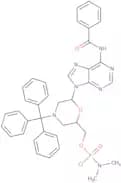
CAS:<p>Uridine diphosphate choline (UDPC) sodium is a nucleotide that is used as a phosphoramidite for DNA synthesis. The chemical formula for UDPC is C8H14N4O8P. The activation of the molecule occurs in acidic conditions, which may be due to the formation of an amide bond between the terminal phosphate and the amino group on the phosphorylcholine. This same reaction can also occur in alkaline conditions. UDPC has been shown to inhibit viral replication, including HIV-1, by blocking reverse transcription of viral RNA into DNA. It also has anticancer effects, as it inhibits cell proliferation and induces apoptosis in cancer cells. UDPC does not have any known side effects or toxicity.</p>Formula:C14H25N3O12P2•NaPurezza:Min. 95%Colore e forma:PowderPeso molecolare:512.3 g/molMorpholino A monomer
CAS:Morpholino A is a modified nucleoside amidite used to prepare morpholino oligomersFormula:C38H37ClN7O4PPurezza:Min. 98 Area-%Colore e forma:White PowderPeso molecolare:722.17 g/mol[(2S,6R)-6-{N6-Benzoyladenin-9-yl}-4-tritylmorpholin-2-yl]methyl dimethyl-phosphoramidochloridate
CAS:<p>Nucleotide analogue for use in oligonucleotide synthesis</p>Formula:C38H37ClN7O4PPurezza:Min. 95%Colore e forma:PowderPeso molecolare:722.17 g/mol







![[(2S,6R)-6-{N6-Benzoyladenin-9-yl}-4-tritylmorpholin-2-yl]methyl dimethyl-phosphoramidochloridate](/_next/image/?url=https%3A%2Fstatic.cymitquimica.com%2Fproducts%2F3D%2Fthumb-webp%2FNB58201.webp&w=3840&q=75)