Nucleosidi
I nucleosidi sono building blocks fondamentali degli acidi nucleici, composti da una base azotata legata a una molecola di zucchero. In questa sezione, puoi trovare una vasta gamma di nucleosidi essenziali per la ricerca in biologia molecolare, biochimica e farmacologia. Questi composti svolgono ruoli cruciali nella sintesi del DNA e dell'RNA e sono vitali in vari processi metabolici. I nucleosidi vengono utilizzati per studiare il materiale genetico, sviluppare terapie antivirali e antitumorali e comprendere i meccanismi cellulari. Da CymitQuimica, forniamo nucleosidi di alta qualità per supportare le tue esigenze di ricerca e sviluppo, garantendo purezza e affidabilità per le tue applicazioni sperimentali.
Trovati 3569 prodotti di "Nucleosidi"
Ordinare per
Purezza (%)
0
100
|
0
|
50
|
90
|
95
|
100
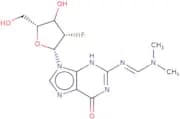
2’-Deoxy-N2-DMF-2’-fluoroguanosine
<p>Please enquire for more information about 2’-Deoxy-N2-DMF-2’-fluoroguanosine including the price, delivery time and more detailed product information at the technical inquiry form on this page</p>Formula:C13H17FN6O4Purezza:Min. 95%Peso molecolare:340.31 g/moldG-MGO
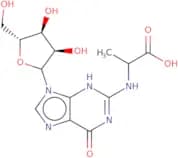
CAS:<p>Methylglyoxal (MGO) is a reactive byproduct formed by several metabolic precursors notably glycolysis. dG-MGO is therefore a useful marker to in monitoring various glycation pathways</p>Formula:C13H17N5O7Peso molecolare:355.3 g/mol3'-O-Methylcytidine 5'-triphosphate lithium salt
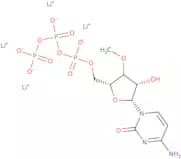
CAS:<p>3'-O-Methylcytidine 5'-triphosphate lithium salt is an antiviral agent that inhibits the synthesis of RNA by inactivating the enzyme ribonuclease. The compound has been shown to be effective against herpes simplex virus type 1 (HSV-1) and type 2 (HSV-2). 3'-O-Methylcytidine 5'-triphosphate lithium salt is a novel nucleoside analogue that can be used as a phosphoramidite building block for DNA synthesis. It is also a high quality synthetic product with high purity and high purity.</p>Formula:C10H14N3O14P3·Li4Purezza:Min. 95%Peso molecolare:520.92 g/mol2'-Amino-2'-deoxycytidine-5'-triphosphate
CAS:<p>2'-Amino-2'-deoxycytidine-5'-triphosphate is an inhibitor of viral RNA polymerase. It is a nucleoside analogue that mimics the natural substrate for the enzyme, 2'-deoxycytidine-5'-triphosphate. This compound binds to the active site of viral RNA polymerases and blocks their ability to synthesize RNA. The compound has been shown to inhibit the replication of norovirus and HIV in cell culture. 2'-Amino-2'-deoxycytidine-5'-triphosphate binds to metal ions in the active site of the enzyme, which prevents its binding with the template strand and prevents elongation of RNA synthesis.</p>Formula:C9H17N4O13P3Purezza:Min. 95%Peso molecolare:482.17 g/molGuanosine-2'(&3')-monophosphate disodium (mixed isomers)
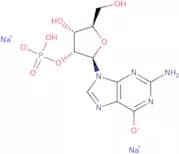
CAS:Guanosine-2'(&3')-monophosphate disodium salt (mixed isomers) is a synthetic nucleoside with antiviral and anticancer properties. It has been shown to activate the transcription of DNA in vitro by binding to the promoter region, resulting in higher levels of RNA synthesis. Guanosine-2'(&3')-monophosphate disodium salt (mixed isomers) has been shown to inhibit the replication of viruses, such as herpes simplex virus type 1 (HSV-1), and it may have potential use in cancer therapy. The drug is also used as a precursor for other antiviral drugs and antibiotics. Guanosine-2'(&3')-monophosphate disodium salt (mixed isomers) is available in high purity, high quality, and at low cost.Formula:C10H14N5O8P•2NaPurezza:Min. 95%Colore e forma:White PowderPeso molecolare:407.18 g/mol7-Deaza-2'-deoxyguanosine-5'-triphosphate sodium salt - 10mM aqueous solution
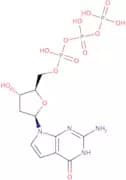
CAS:<p>7-Deaza-2'-deoxyguanosine-5'-triphosphate sodium salt is a cytosolic small molecule that inhibits the activity of telomerase, an enzyme involved in the replication of chromosomes. It also has inhibitory effects on kinase domains and may be used to treat cancer. 7-Deaza-2'-deoxyguanosine-5'-triphosphate sodium salt binds to human mitochondrial DNA and inhibits gene transcription by hybridizing with it. This results in the inhibition of dopamine production, which can be helpful for treating Parkinson's disease. 7-Deaza-2'-deoxyguanosine-5'-triphosphate sodium salt is structurally similar to 2'-deoxyadenosine 5'-triphosphate (dATP) and can be incorporated into DNA by phosphorylation to form a covalent bond that disrupts the dATP/ATP ratio. This causes cellular energy production to decrease and</p>Formula:C11H17N4O13P3·xNaPurezza:Min. 95%Peso molecolare:506.19 g/mol5-Fluorouridine-5'-diphosphate sodium
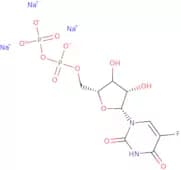
CAS:<p>5-Fluorouridine-5'-diphosphate sodium salt is a nucleoside analog that inhibits the synthesis of RNA and DNA. It is used to treat cancer, as well as opportunistic infections, such as cryptococcal disease. 5-Fluorouridine-5'-diphosphate sodium salt binds to the enzyme thymidylate synthase and prevents it from synthesizing dTMP, which is needed for DNA synthesis. This drug also has been shown to be effective against monoclonal antibodies in mice with cancer. 5-Fluorouridine-5'-diphosphate sodium salt may also be useful in gene therapy for cancer treatment. This drug can be taken up by cells where it is converted into uracil, which inhibits protein synthesis by competing with the natural substrate tRNA for binding sites on ribosomes.</p>Formula:C9H13FN2O12P2•NaxPurezza:Min. 95%Colore e forma:PowderPeso molecolare:423.16 g/mol2'-O-Methylguanosine 5'-monophosphate sodium
CAS:<p>2'-O-Methylguanosine 5'-monophosphate sodium is a nucleoside analog that has been shown to inhibit the growth of human cancer cells. It is a modified monophosphate nucleotide, which is synthesized by the chemical modification of guanosine with 2'-O-methylation at the 5' position and phosphorylation at the 3' position. This drug is not active against viruses and may be used as an anticancer agent. 2'-O-Methylguanosine 5'-monophosphate sodium has also been shown to be effective in treating hepatitis B virus infection. The drug may act as an antiviral agent by interfering with viral DNA synthesis, causing viral particles to aggregate, or by inhibiting viral DNA polymerase activity.</p>Purezza:Min. 95%3'-O-Methyladenosine 5'-triphosphate lithium salt
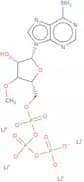
CAS:<p>3'-O-Methyladenosine 5'-triphosphate lithium salt is a phosphoramidite that is used in the synthesis of DNA and RNA. This product has antiviral and anticancer properties. 3'-O-Methyladenosine 5'-triphosphate lithium salt is a novel nucleoside that is synthesized by modifying the phosphate group with a methyl group at the 3' position. It also has high purity, as well as high quality and modified nucleosides.</p>Formula:C11H14N5O13P3·Li4Purezza:Min. 95%Peso molecolare:544.94 g/mol5-Cyano-2'-deoxycytidine
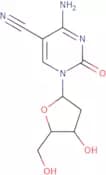
CAS:Nucleobase functionalised deoxynucleosideFormula:C10H12N4O4Purezza:Min. 95%Peso molecolare:252.23 g/mol4-Thiothymidine-5'-triphosphate lithium salt - 100mM aqueous solution
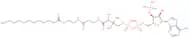
CAS:<p>4-Thiothymidine-5'-triphosphate lithium salt - 100mM aqueous solution is thio-base modified thymidine nucleotide</p>Formula:C10H17N2O13P3S·xLiPurezza:Min. 95%Peso molecolare:498.23 g/molLauroyl coenzyme A potassium salt
CAS:<p>Lauroyl coenzyme A potassium salt is a potent inhibitor of fatty acid synthase. It has the ability to inhibit the enzyme activity of fatty acid synthase in vitro, which belongs to the class of irreversible inhibitors. Lauroyl coenzyme A potassium salt inhibits the synthesis of fatty acids by inhibiting the enzyme activity of fatty acid synthase. This inhibitor also reversibly inhibits other enzymes with a similar mechanism, such as acetyl-coenzyme A carboxylase and phosphatidate phosphohydrolase. The reaction mechanism can be understood through titration calorimetry studies, demonstrating that lauroyl coenzyme A potassium salt binds to the active site of these enzymes and blocks access to substrates. The binding affinity is higher for wild type strains than for mutant strains, which may be due to differences in protein structure or other factors. Lauroyl coenzyme A potassium salt has been shown to have no effect on wild-type strains but inhibits polymer</p>Formula:C33H55N7O17P3SK3Purezza:Min. 95%Colore e forma:PowderPeso molecolare:1,064.11 g/molThymidine 3'-monophosphate sodium salt
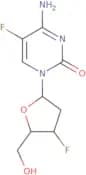
CAS:<p>Thymidine 3'-monophosphate sodium salt (TMP) is a nucleoside that is involved in the synthesis of DNA. TMP has been shown to have minimal carcinogenic effects on the liver, with no effect on the rate of DNA synthesis or cell proliferation in vivo. It has been shown to be hepatotoxic and genotoxic in animal studies and can cause DNA strand breaks and chromosomal aberrations in liver cells. TMP also causes a specific adduct, crotonaldehyde, which is considered to be an indicator of hepatic injury. The detection method for this adduct uses gas chromatography-mass spectrometry, which identifies the presence of TMP by detecting its unique mass spectrum.</p>Formula:C10H15N2O8P•xNaPurezza:Min. 95%Colore e forma:Powder2',3'-Dideoxy-3',5-difluorocytidine
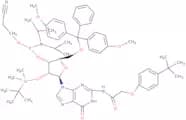
CAS:<p>2',3'-Dideoxy-3',5-difluorocytidine (ddF) is a nucleotide analogue that inhibits the viral polymerase. It binds to the enzyme and prevents it from synthesizing DNA, which is needed for viral replication. ddF has been shown to be effective against different types of cancer cells, including breast and prostate cancers. This drug also has antiviral properties and is used as an antiviral agent in AIDS therapy. ddF may also be used as a precursor in the synthesis of other nucleosides or nucleotides.</p>Purezza:Min. 95%2'-O-tert-Butyldimethylsilyl-N-(tert-butylphenoxyacetyl)-5'-O-DMT-guanosine 3'-CE phosphoramidite
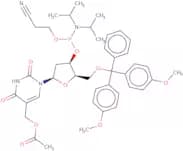
CAS:2'-O-tert-Butyldimethylsilyl-N-(tert-butylphenoxyacetyl)-5'-O-DMT-guanosine 3'-CE phosphoramidite is a synthetic nucleoside analog. The chemical name for this product is 2'-O-tert-butyldimethylsilyl-N-(tert-butylphenoxyacetyl)-5'-O-dimethoxytritylguanosine 3'-cyanoethylphosphoramidite. The molecular formula is C28H34N2O8PSi, and the molecular weight is 812.59 g/mol. This product has an EC Number of 61317 - CAS Number of 149989 - 68 - 4 and a melting point of 232°C (238°F). This compound can be used in the synthesis of oligonucleotides that are used to bind to RNA andFormula:C58H76N7O10PSiPurezza:Min. 95%Peso molecolare:1,090.32 g/mol2'-Deoxy-5'-O-DMT-5-acetoxymethyluridine 3'-CE phosphoramidite
CAS:<p>2'-Deoxy-5'-O-DMT-5-acetoxymethyluridine 3'-CE phosphoramidite is a novel nucleoside analogue with anticancer activity. It is synthesized from 2'-deoxy-5'-O-DMT-5-acetoxymethyluridine and 3'-chloroethyl phosphate. The compound has been shown to inhibit DNA, RNA, and protein synthesis in vitro, as well as to induce apoptosis in human cancer cell lines. 2'-Deoxy-5'-O-DMT-5-acetoxymethyluridine 3'-CE phosphoramidite is a modified nucleoside that can be used in the production of oligonucleotides for use in gene therapy.</p>Formula:C42H51N4O10PPurezza:Min. 95%Peso molecolare:802.85 g/mol2'-Deoxy-5-methyl-isocytidine
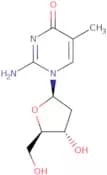
CAS:<p>2'-Deoxy-5-methyl-isocytidine is an analog of cytidine that is used in the synthesis of oligodeoxynucleotides. It has shown to be complementary to dsDNA and to inhibit hepatitis B virus replication in cell culture. 2'-Deoxy-5-methyl-isocytidine is synthesized by solid phase chemistry on a polystyrene support with monomers, depyrimidination, and purification by column chromatography. The chemical stability of this compound has been shown by its ability to withstand heating at 100°C for 10 minutes without decomposition.</p>Formula:C10H15N3O4Purezza:Min. 95%Peso molecolare:241.26 g/mol2'-O-tert-Butyldimethylsilyl-N4-(tert-butylphenoxyacetyl)-5'-O-DMT-cytidine 3'-CE phosphoramidite
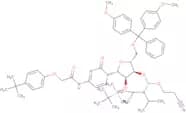
CAS:<p>2'-O-tert-Butyldimethylsilyl-N4-(tert-butylphenoxyacetyl)-5'-O-DMT-cytidine 3'-CE phosphoramidite is a DNA synthesis reagent that is used in the preparation of oligonucleotides, in particular for the synthesis of 2'-deoxyribonucleosides. It has been shown to be an activator and to have anticancer, antiviral, and antimalarial properties. This compound is synthesized by reacting 5'-O-DMT cytidine with 2',3' epoxypropyltrichlorophosphite. The product is purified by silica gel column chromatography and recrystallization from ethanol followed by vacuum drying. CAS No. 149989-66-2</p>Formula:C57H76N5O10PSiPurezza:Min. 95%Peso molecolare:1,050.3 g/mol2,2'-Anhydro-L-thymidine
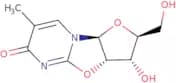
CAS:<p>2,2'-Anhydro-L-thymidine is an antiviral, anticancer agent and a synthetic nucleoside. It is a monophosphate that was first synthesized in 1967 and has been used as a potential antiviral agent. 2,2'-Anhydro-L-thymidine has been shown to be effective against the herpes simplex virus type 1 (HSV1). However, it does not inhibit viral nucleic acid synthesis or viral protein synthesis. It also does not inhibit the growth of tumor cells in culture.</p>Formula:C10H12N2O5Purezza:Min. 95%Colore e forma:PowderPeso molecolare:240.21 g/mol7-Deaza-2'-deoxy-7-ethynyladenosine
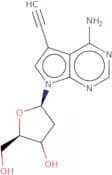
CAS:<p>7-Deaza-2'-deoxy-7-ethynyladenosine is a fluorescent analog of adenosine that has been synthesized to be used as an antimicrobial agent. This compound has shown to be effective against both Gram-positive and Gram-negative bacteria, including methicillin resistant Staphylococcus aureus and Escherichia coli. 7DDAE is also able to inhibit the growth of fungus and yeast, such as Candida albicans. This drug has been shown to have no cytotoxic effects on mammalian cells at concentrations up to 50 μM. 7DDAE has been found to be very photostable in solution, which means it does not degrade when exposed to light.</p>Formula:C13H14N4O3Purezza:Min. 95%Colore e forma:PowderPeso molecolare:274.28 g/mol