Nucleosidi
I nucleosidi sono building blocks fondamentali degli acidi nucleici, composti da una base azotata legata a una molecola di zucchero. In questa sezione, puoi trovare una vasta gamma di nucleosidi essenziali per la ricerca in biologia molecolare, biochimica e farmacologia. Questi composti svolgono ruoli cruciali nella sintesi del DNA e dell'RNA e sono vitali in vari processi metabolici. I nucleosidi vengono utilizzati per studiare il materiale genetico, sviluppare terapie antivirali e antitumorali e comprendere i meccanismi cellulari. Da CymitQuimica, forniamo nucleosidi di alta qualità per supportare le tue esigenze di ricerca e sviluppo, garantendo purezza e affidabilità per le tue applicazioni sperimentali.
Trovati 3569 prodotti di "Nucleosidi"
Ordinare per
Purezza (%)
0
100
|
0
|
50
|
90
|
95
|
100
4’,5’-Didehydro-2’-O-(2-methoxyethyl)uridine
CAS:4’,5’-Didehydro-2’-O-(2-methoxyethyl)uridine (4,5DDMU) is a novel nucleoside analog that is phosphorylated to 4,5-didehydro-2'-O-(2-methoxyethyl)uridine 5'-triphosphate. This nucleoside has been shown to inhibit the proliferation of human cancer cells in vitro and in vivo. 4,5DDMU inhibits viral replication by generating diphosphate derivatives of the viral DNA polymerase enzyme that are unable to synthesize DNA. 4,5DDMU also inhibits HIV replication by inhibiting reverse transcriptase activity in the virus.End>Purezza:Min. 95%Adenylyl-3'-5'-adenosine ammonium salt
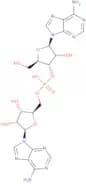
CAS:<p>Adenylyl-3'-5'-adenosine ammonium salt is a novel and activator. CAS No. 21027-46-3. Ribonuclesides, Deoxyribonucleosides, diphosphate, Phosphoramidites, Modified, Anticancer, Antiviral, monophosphate, Nucleosides, Synthetic. High quality and high purity.</p>Formula:C20H25N10O10PPurezza:Min. 95%Peso molecolare:596.45 g/mol2'-Deoxy-N2-isobutyryl-5'-O-MMT-guanosine 3'-CE phosphoramidite
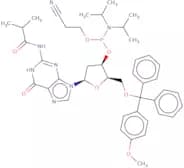
2'-Deoxy-N2-isobutyryl-5'-O-MMT-guanosine 3'-CE phosphoramidite is a modified nucleoside analogue with anticancer activity. It is synthesized by reacting 2'-deoxy-N2-isobutyryl-5'-O-methylguanosine with diethyl chlorophosphate in the presence of tetrazole. This novel compound has been shown to have antiviral and antitumor activities as well as high affinity for DNA and RNA.Formula:C43H52N7O7PPurezza:Min. 95%Peso molecolare:809.91 g/mol8-Bromoguanosine 3',5'-cyclic monophosphate sodium salt
CAS:Activator of cGMP-dependent protein kinasesFormula:C10H10BrN5NaO7PPurezza:Min. 95%Colore e forma:PowderPeso molecolare:446.08 g/mol2'-Deoxyadenosine-5'-monophosphate disodium salt
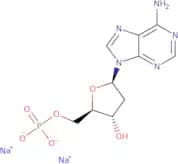
CAS:2'-Deoxyadenosine-5'-monophosphate disodium salt (DAP) is a white crystalline powder. It is soluble in water and insoluble in ethanol. DAP can be neutralised by aqueous solutions of hydroxide, such as sodium hydroxide or ammonium hydroxide. DAP is also reactive with aluminium oxide, which can be used for drying the compound to form anhydrous particles. DAP reacts with chloride ions to form 2',3'-diacetylpyridine-5'-diphosphate dibasic chloride, which has been shown to inhibit bacterial growth and act as an antibacterial agent. Autoclaving may be required for preparation of this drug due to its sensitivity to heat energy.Formula:C10H12N5Na2O6PPurezza:Min. 99 Area-%Colore e forma:White PowderPeso molecolare:375.19 g/mol4’-C-Methyl-5-methylcytidine
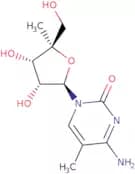
CAS:<p>4’-C-Methyl-5-methylcytidine is a phosphoramidite nucleoside that is used as a reagent in the synthesis of DNA. It is modified with a 4′-methyl and 5′-methyl group at the C4 and C5 positions of the cytosine base, respectively. The 4′-C methyl group is an antiviral agent that inhibits viral replication by inhibiting reverse transcriptase. The 5′-methyl group prevents deamination of cytosine residues by inhibiting uracil glycosylase. This product has anticancer properties due to its ability to inhibit cell division and activate apoptosis in tumor cells.</p>Purezza:Min. 95%1-(2'-Deoxy-5'-O-DMT-2'-fluoro-β-D-arabinofuranosyl)thymine 3'-O-succinate triethylammonium
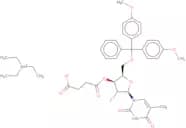
1-(2'-Deoxy-5'-O-DMT-2'-fluoro-b-D-arabinofuranosyl)thymine 3'-O-succinate triethylammonium salt is a compound used in the synthesis of oligonucleotides. The synthesis of such compounds often involves the use of protecting groups, such as the 4,4'-dimethoxytrityl (DMT) group, to prevent unwanted reactions during the synthesis process. The 2'-fluoro modification is of particular interest due to its potential to alter the chemical and biological properties of the resulting oligonucleotides. Fluorinated nucleosides and their analogs have been extensively studied for their antiviral and anticancer activitiesFormula:C35H34FN2O10•C6H16NPurezza:Min. 95%Peso molecolare:763.87 g/mol6-Dimethylamino-9-(b-D-ribofuranosyl)purine
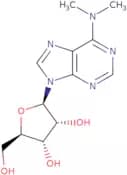
CAS:<p>6-Dimethylamino-9-(b-D-ribofuranosyl)purine (6-DMAP) is an analog of adenine that has been shown to have anticancer activity in human serum and tissue culture. 6-DMAP can inhibit the synthesis of ATP, leading to cell death by significantly inhibiting cellular processes such as glycolysis and DNA replication. 6-DMAP also has a significant cytotoxicity on various types of cancer cells and plant tissues. The mechanism of action for the anticancer activity of 6-DMAP is not yet known, but it may be due to its ability to interfere with purine metabolism or its ability to form covalent bonds with DNA.</p>Formula:C12H17N5O4Purezza:Min. 98 Area-%Colore e forma:White PowderPeso molecolare:295.3 g/molCyclopentenyl cytosine
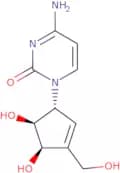
CAS:<p>Cyclopentenyl cytosine is a cytotoxic drug that inhibits the synthesis of DNA, RNA, and proteins. It is a nucleoside analogue that inhibits the enzyme activity of ribonucleotide reductase. Cyclopentenyl cytosine has significant cytotoxicity against hl-60 cells, as well as squamous carcinoma and MDA-MB-231 breast cancer cells. It also has significant activity against cyclopentenyl, dextran sulfate, and mitochondrial functions in vivo in human cells. Cyclopentenyl cytosine binds to the response element on the DNA strand, preventing transcription of genes for protein synthesis and cell division.</p>Formula:C10H13N3O4Purezza:Min. 95%Colore e forma:PowderPeso molecolare:239.23 g/mol2'-O-(2-Methoxyethyl)-5-methylcytidine 5'-monophosphate
2'-O-(2-Methoxyethyl)-5-methylcytidine 5'-monophosphate is a novel nucleoside analog that is phosphorylated to its active form, 5'-O-(4,4'-dimethoxytrityl)-2'-O-(2-methoxyethyl)-5-methylcytidine monophosphate, which has antiviral and anticancer properties. It can be used as an activator for oligonucleotide synthesis and DNA synthesis. This product is available in high purity (>98%) and high quality. CAS No.: 181297-76-7Purezza:Min. 95%3'-b-Amino-2',3'-dideoxy-5'-O-trityl-5-methyluridine
<p>3'-b-Amino-2',3'-dideoxy-5'-O-trityl-5-methyluridine is a phosphoramidite, which is an intermediate in the synthesis of nucleosides. It is a novel deoxyribonucleoside that has been modified to include a methyl group at the 5' position. 3'-b-Amino-2',3'-dideoxy-5'-O-trityl-5-methyluridine is often used as an activator for DNA polymerases and ribonucleases, as well as for the synthesis of ribonucleosides. This product has shown anticancer activity by inhibiting RNA synthesis.</p>Purezza:Min. 95%Peso molecolare:227.22 g/mol4-Demethylwyosine
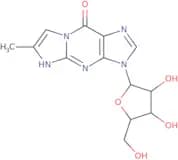
CAS:4-Demethylwyosine is a metabolite found in the bacterium Pyrococcus furiosus. It is an intermediate in the biosynthesis of 2-amino-3,5-dimethyoxybenzoic acid. 4-Demethylwyosine has been shown to inhibit cancer cell proliferation by inhibiting the synthesis of lysine residues and base formation. This inhibition may be due to its methyl transferase activity, which leads to decreased levels of methionine, or it may be due to its ability to act as a carboxylate group donor. 4-Demethylwyosine has also been shown to bind with DNA and RNA, regulating posttranscriptional processes such as protein translation and transcription.Formula:C13H15N5O5Purezza:Min. 80 Area-%Colore e forma:PowderPeso molecolare:321.29 g/mol4-Amino-6-hydroxypyrazolo(3,4-D)pyrimidine
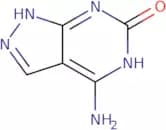
CAS:4-Amino-6-hydroxypyrazolo(3,4-D)pyrimidine is an anti-inflammatory drug that is used to treat bowel disease. It is also used as a polymer conjugate to treat cancer, and in the prevention of transplant rejection. 4-Amino-6-hydroxypyrazolo(3,4-D)pyrimidine has been shown to have antioxidant properties and may be effective in preventing inflammatory diseases such as inflammatory bowel disease. It has also been shown to act as an antihypertensive agent by inhibiting angiotensin I converting enzyme (ACE).Formula:C5H5N5OPurezza:Min. 95%Peso molecolare:151.13 g/mol3'-Azido-N4-benzoyl-5'-O-benzoyl-2',3'-dideoxycytidine
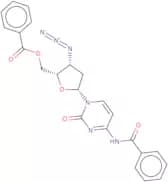
3'-Azido-N4-benzoyl-5'-O-benzoyl-2',3'-dideoxycytidine is a synthetic nucleoside with antiviral and anticancer properties. It is a modified nucleoside that has been synthesized from 2,3'-dideoxycytidine. 3'-Azido-N4-benzoyl-5'-O-benzoyl-2',3'-dideoxycytidine has shown to be effective against HIV and influenza virus. 3'-Azido-N4-benzoyl-5'-O-benzoyl-2',3'-dideoxycytidine binds to the viral RNA polymerase, preventing the production of viral mRNA. This drug also inhibits DNA synthesis by binding to deoxynucleotide triphosphates (dNTPs) and prevents DNA synthesis by inhibiting the enzyme DNA polymerase.Formula:C23H20N6O5Purezza:Min. 95%Peso molecolare:460.44 g/mol2'-Azido-2'-deoxyadenosine
CAS:<p>2'-Azido-2'-deoxyadenosine is a synthetic nucleoside analog of adenosine in which the 2'-hydroxyl group of the ribose sugar is replaced by an azido group (–N₃), and the 3'- and 5'-hydroxyl groups remain intact. This modification confers unique chemical properties, including the ability to participate in bioorthogonal "click" chemistry reactions, particularly azide-alkyne cycloadditions, making it useful for labeling and tracking nucleic acids in biochemical studies. Additionally, the azido substitution can influence enzymatic recognition and incorporation by polymerases, allowing its use in studying nucleic acid metabolism, drug design, and therapeutic nucleoside analog development.</p>Formula:C10H12N8O3Purezza:Min. 95%Colore e forma:PowderPeso molecolare:292.25 g/molAdenosine 5'-phosphosulfate sodium salt, 10 mM in water
CAS:Adenosine 5′-phosphosulfate sodium salt has been used quantify pyrophosphate and in enzyme-linked bioluminescence assay for adenosine triphosphate (ATP).Product provided as 10 mM solution in water.Formula:C10H14N5O10PSPurezza:Min. 90.0 Area-%Peso molecolare:427.28 g/mol9-(b-D-Arabinofuranosyl)-8-chloroadenine
CAS:<p>9-(b-D-arabinofuranosyl)-8-chloroadenine is a deoxyribonucleoside that is structurally related to adenosine. It has antiviral properties and has been shown to be active against herpes virus, influenza A virus, and cytomegalovirus. 9-(b-D-Arabinofuranosyl)-8-chloroadenine is an activator of cellular DNA polymerase δ and has been shown to inhibit the replication of HIV in human T lymphocytes. 9-(b-D-Arabinofuranosyl)-8-chloroadenine also inhibits the proliferation of tumor cells and is being investigated as a potential chemotherapeutic agent for cancer treatment.</p>Purezza:Min. 95%5'-O-tert-Butyldimethylsilyl-2,2'-anhydrouridine
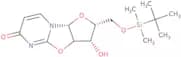
<p>5'-O-tert-Butyldimethylsilyl-2,2'-anhydrouridine is a modified nucleoside that has been used as an anticancer agent and antiviral and antifungal agent. It has been shown to inhibit the growth of tumor cells in animal models by inhibiting DNA synthesis and repair. 5'-O-tert-Butyldimethylsilyl-2,2'-anhydrouridine is also able to bind to RNA with high affinity, making it a potential candidate for use as an antiviral agent against HIV. This compound does not occur naturally in cells and can be synthesized from other nucleosides.</p>Formula:C15H24N2O5SiPurezza:Min. 95%Peso molecolare:340.45 g/mol2-Methoxy-9-(b-D-ribofuranosyl)purine
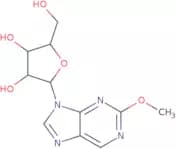
CAS:<p>2-Methoxy-9-(b-D-ribofuranosyl)purine (2MeO) is a nucleoside that is structurally similar to adenosine. It has antiviral and anticancer activities, as well as the ability to activate phosphoramidites. The 2MeO molecule consists of a modified 9-mer ribofuranose phosphate, which can be synthesized from 2-deoxyribofuranose phosphate by selective oxidation. 2MeO has been shown to inhibit the growth of tumor cells in vitro and in vivo, and also inhibits the replication of DNA and RNA viruses. This drug is considered novel because it does not exist naturally in any organism.</p>Purezza:Min. 95%5’(R)-C-Methyladenosine
CAS:<p>5’(R)-C-Methyladenosine is a nucleoside that is used as an antiviral and anticancer agent. It has been shown to inhibit the replication of the human immunodeficiency virus type 1 (HIV-1) in a dose-dependent manner, with an IC50 value of about 0.4 μM for HIV-1 reverse transcriptase activity. In addition, 5’(R)-C-Methyladenosine has been shown to inhibit DNA synthesis and promote apoptosis in cancer cells by inhibiting transcription and translation. The compound also inhibits the growth of tumor cells in mice without affecting normal tissue growth.</p>Purezza:Min. 95%