Polisaccaridi
Trovati 498 prodotti per "Polisaccaridi".
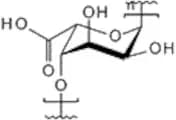
Polyguluronic acid
CAS:Polyguluronic acid is produced from alginates by partial hydrolysis and chromatography of brown algae such as Laminaria digitata, Ascophyllum nodosum and Fucus spp.
The image was kindly provided by Prof Mike Guiry from Cork who runs ‘The Seaweed Site’.MW is ca 6000 - 8000Da.poly-M levels are ca 3%Purezza:(%) Min. 80%Colore e forma:Off-White PowderPeso molecolare:194.14Laminaran - from Eisenia bicyclis
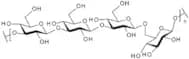
CAS:Laminaran is a polysaccharide that co-occurs with fucoidan and alginate in brown seaweeds such as Laminaria digitata, Laminaria cloustoni, Eisenia bicyclis and Thallus laminariae. It is a β-1,3-linked glucan which it is claimed stimulates the immune system in mammals and fish.
The image was kindly provided by Prof Mike Guiry from Cork who runs ‘The Seaweed Site’.Colore e forma:White Off-White PowderHyaluronic acid sodium, average MW 2.0 - 2.5 million Da
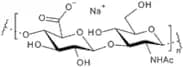
CAS:Gycosaminoglycan in many organs; joint lubricant and shock absorberFormula:(C14H20NO11Na)nPurezza:Min. 95%Colore e forma:PowderHyaluronic sodium - Average MW 0.2-0.5 million Daltons
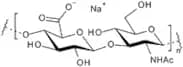
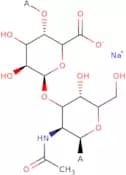
CAS:The sodium salt of hyaluronic acid is a glycosaminoglycan found in many organs, where it functions as a joint lubricant and shock absorber. It is obtained principally from synovial fluid, vitreous humor of the eye, umbilical tissue and cocks comb. The chemical structure of hyaluronic is a disaccharide repeat of β-(1,3) glucuronic acid and β-(1,4) N-acetyl glucosamine.Formula:(C14H20NO11Na)nPurezza:Min. 95%Colore e forma:PowderHyaluronic acid sodium salt - Low molecular weight 80,000 - 100,000
CAS:Gycosaminoglycan in many organs; joint lubricant and shock absorber. Made by a bacterial, Streptococcus fermentation.Formula:(C14H20NO11Na)nPurezza:Min. 91%Colore e forma:PowderFucoidan - Ascophyllum nodosum, analytical grade
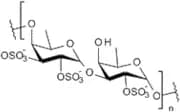
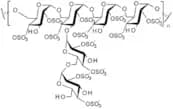
CAS:A fucan sulphate found in brown marine algae (Phaeophyta-typically Fucus vesiculotus, Ascophyllum nodosum (illustrated), Alaria and Cladosiphon) and has been shown to have anticoagulant activity. The main constituents are α-1,4 and α-1,2 linked L-fucose sulphates although galactose also occurs and there are many variations of the basic structure found in different species of Phaeophyta.Molecular weight cut off at 300kDa.The image was kindly provided by Prof Mike Guiry from Cork who runs ‘The Seaweed Site’.Colore e forma:PowderHyaluronic acid sodium - MW 30000-40000
CAS:Gycosaminoglycan in many organs; joint lubricant and shock absorberFormula:(C14H20NO11Na)nPurezza:Min. 95%Colore e forma:PowderDextran sulfate sodium salt - MW 9,000-16,000
CAS:Dextran sulphate is a dextran derivative whose ulcer (colitis) -causing properties were first reported in hamsters and extrapolated a few years later to mice and rats. The exact mechanisms through which dextran sulphate induces intestinal inflammation are unclear but may be the result of direct damage of the monolayer of epithelial cells in the colon, leading to the crossing of intestinal contents (for e.g. commensal bacteria and their products) into underlying tissue and therefore induction of inflammation. The dextran sulphate sodium induced ulceration model in laboratory animals has some advantages, when compared to other animal models of colitis, due to its simplicity and similarities to human inflammatory bowel disease.Colore e forma:PowderFucoidan - Ascophyllum nodosum
CAS:Please enquire for more information about Fucoidan - Ascophyllum nodosum including the price, delivery time and more detailed product information at the technical inquiry form on this pageColore e forma:PowderArabinoxylan
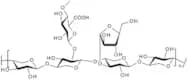
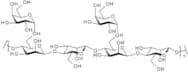
CAS:Arabinoxylans consist of α-L-arabinofuranose residues attached as branch-points to β-(1,4)-linked D-xylopyranose main chains. These may be 2- or 3-substituted or 2- and 3- di-substituted. The arabinose residues may also be linked to other groups attached such as glucuronic acid residues, ferulic acid cross links and acetyl groups. Arabinoxylans generally consist of between 1500 - 5000 residues.
Purezza:Min. 95%Colore e forma:PowderGuar gum
CAS:Guar gum is obtained from the seed of the legume Cyamopsis tetragonolobus, an annual plant that grows mainly in semi-arid regions of India. The structure of the polysaccharide consists of a main chain of (1,4)-linked β-D-mannopyranosyl units with single α-D-galactopyranosyl units linked (1,6) on average to every second main chain unit. Guar has a high viscosity in aqueous solution, shows marked pseudoplastic behaviour and forms synergistic gels in the presence of other gums such as carrageenan and xanthan gum.
Formula:C10H14N5Na2O12P3Colore e forma:White PowderPeso molecolare:535.15 g/molSodium alginate, low viscosity
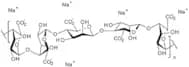
CAS:Sodium salt of a polysaccharide obtained from the brown seaweeds (e.g. Laminaria hyperborea, Fucus vesiculosus, Ascophyllum nodosum). The chemical structure consists of blocks of (1,4) linked-β-D-polymannuronic acid (poly M), (1,4) linked-α-L-polyguluronic acid (poly G) and alternating blocks of the two uronic acids (poly MG). Alginates form strong gels with divalent metal cations and the egg box model has been used to describe this form of gelation. The main use for alginate is in textile printing as a thickener in the printing of cottons with reactive dyes. In the food industry it is used as a thickener and gelling agent. Recently, it has been shown that ternary mixtures of Konjac glucomannan, Xanthan gum and Sodium alginate can form a non-covalently linked complex which exhibits enhanced rheological properties of value in, for example, functional foods. The image was kindly provided by Prof Mike Guiry from Cork who runs ‘The Seaweed Site’.Viscosity: min 50 mPa.sColore e forma:White PowderHydroxypropyl cellulose - Average MW 150,000
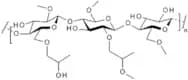
CAS:In water, hydroxypropyl cellulose forms liquid crystals with many mesophases depending on concentration. These mesophases include isotropic, anisotropic, nematic and cholesteric, the latter resulting in many colors such as violet, green and red. Pharmaceutical applications include treatments for medical conditions such as dry eye syndrome (keratoconjunctivitis sicca), recurrent corneal erosions, decreased corneal sensitivity, exposure and neuroparalytic keratitis. It is also used as a binder in tablets. Hydroxypropylcellulose is also used as a thickener, a binder and emulsion stabiliser in foods with E number E463. HPC is used as a support matrix for DNA separations by capillary and microchip electrophoresis.
Cellulose - Arbocel
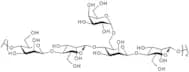
CAS:Cellulose is a linear polysaccharide of β 1-4 linked glucose residues. The polysaccharide chains are bundled as microfibrils in cell walls and provide the essential structural components within growing plants. Each microfibril exhibits a high degree of three-dimensional internal bonding resulting in a crystalline structure that is insoluble in water, resistant to reagents and very strong.Colore e forma:PowderTara gum
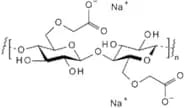
CAS:Tara gum is a galactomannan that is obtained from the seeds of the tara shrub Caesalpinia spinosa which is a native of the northern regions of Africa and South America. The gum is described as having a backbone of (1,4)-linked β-D-mannopyranosyl units one third of which possess a single unit side chain of (1,6)-linked α-D-galactopyranose. The gum forms gels with carrageenan and xanthan in a similar manner to guar and locust bean gum. Currently, only small quantities of tara gum are sold for use as food thickeners and stabilisers.Purezza:Min. 95%Colore e forma:PowderCarboxymethyl cellulose sodium - Viscosity 1000 - 1300 mPa·s
CAS:Carboxymethyl cellulose is used in food as a viscosity modifier, thickener, to stabilise emulsions and are found in gluten-free and reduced-fat products. It is also a constituent of toothpaste, laxatives, diet pills, water-based paints, detergents, textile sizing, and various paper products. In laundry detergents, it is used as a soil suspension polymer. It is also used in pharmaceuticals as a thickening agent and in the oil-drilling industry as a viscosity modifier and water-retaining agent.Purezza:Min. 95%Colore e forma:White PowderAmylopectin - from maize
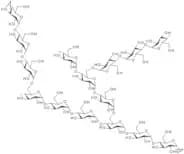
CAS:Amylopectin is composed of between 2,000 to 200,000 glucose residues linked α (1→4) with α (1→6) branching. The molecule is highly branched, every 24 to 30 glucose units, resulting in a soluble molecule with many terminal residues. Starch is made of about 70% amylopectin by weight, though it varies depending on the source (higher in medium-grain rice to 100% in glutinous rice, waxy potato starch, waxy corn, and lower in long-grain rice, amylomaize, and russet potatoes).
Colore e forma:PowderGum karaya
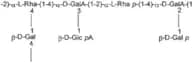
CAS:Gum karaya is exuded from Sterculia urens, a bushy tree found in dry regions of North India. Due to its extensive swelling capacity in water it is used as a laxative and as a denture adhesive. The structure consists of D-galactose, D-glucuronic acid and L-rhamnose but the detailed molecular structure is still incompletely known.
Purezza:Min. 95%Colore e forma:PowderStarch from potato
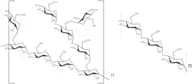
CAS:Starch is an energy storing polysaccharide produced by higher plants and some algae. Pure starch is a white, tasteless and odorless powder that is insoluble in cold water or alcohol. It consists of two types of polysaccharide: the linear and helical amylose (α-1,4-linked glucose) and the branched amylopectin (α-1,4 and α-1,6-linked glucose). Depending on the plant, starch generally contains 20 to 25% amylose and 75 to 80% amylopectin by weight.Colore e forma:White PowderLM Pectin
CAS:Pectins are regarded as linear chains of α-1,4-linked D-galacturonic acid, a homogalacturonan (pectic acid). In the products of commerce, the degree of methylation has a vital influence on the properties of pectin, especially the solubility and gel forming characteristics.
Colore e forma:Powder