Altri
Trovati 6275 prodotti di "Altri"
Ordinare per
Purezza (%)
0
100
|
0
|
50
|
90
|
95
|
100
5-Bromo-4-chloro-3-indoxyl-β-D-glucuronic acid, sodium salt trihydrate
CAS:<p>Chromogenic substrate for beta-glucuronidase (GUS) yielding blue precipitate upon cleavage. Used for identification of beta-glucuronidase. X-beta-D-glucuronide has been reported as chromogenic substrate in a number of chromogenic E. coli/ coliform culture media. About 95% of common E. coli possess beta-D-glucuronidase activity. Such chromogenic culture media are used for detection and enumeration of E. coli in food samples such as meat, dairy products and shellfish and have clinical applications in the assessment of urinary infections. It has gained international acceptance as highly accurate test for the presence of E. coli in drinking water samples. It is also used for the detection of the expression of GUS (E. coli beta-glucuronidase) gene fusion marker constructs in plants. The sodium salt has advantages over the cyclohexylammonium salt as being non-electrostatic and possessing a naturally-occurring cation.</p>Formula:C14H18BrClNNaO10Purezza:Min. 99.0 Area-%Peso molecolare:498.65 g/mol1-Naphthyl β-D-glucuronide
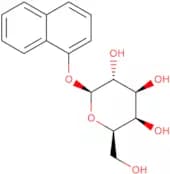
CAS:<p>1-Naphthyl beta-D-glucuronide (NPG) is a chromogenic enzyme substrate used to detect the presence of β-glucuronidase activity. Upon hydrolysis by the enzyme, it produces a yellow product that can be detected by spectrophotometry or visually. It is commonly used in clinical assays to detect the presence of the enzyme in urine samples, as elevated levels can indicate liver or urinary tract diseases. It is also utilized in environmental testing, as some bacteria strains can produce the enzyme as a by-product, making NPG a useful tool for detecting these strains in contaminated water or food sources.</p>Formula:C16H16O7Purezza:Min. 95%Colore e forma:White PowderPeso molecolare:320.29 g/molAldol® 458 nonanoate, Biosynth Patent: EP 2427431 and US 8940909
CAS:Prodotto controllato<p>Aldol 458 nonanoate is a fluorogenic substrate that can be used in the detection of enzyme activity particularly C8/C9-esterases, lipases activity producing a yellow/green-orange color. Aldol 458 nonanoate reacts with enzymes, such as oxidoreductases and hydrolases, to produce light. This product is a conjugate of aldol 458 nonanoate and an enzyme substrate for the detection of these enzymes. It has been shown to be useful in food testing, staining, fluorogenic substrate, environmental testing, chromogenic substrate, conjugate, high purity, enzyme substrate for diagnostics and ligand.</p>Formula:C25H29NO4Purezza:Min. 95%Peso molecolare:407.5 g/molCalcium 2-naphthylphosphate
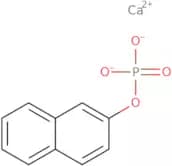
CAS:<p>Calcium 2-naphthylphosphate, which is the calcim salt of 2-naphthylphosphate, is a chromogenic substrate to measure alkaline phosphatase activity. After enzymatic cleavage, the product yielded (2-naphthol) generates a red-colored complex upon reaction with a diazonium salt like Fast Blue RR or Fast Garnet GBC.</p>Purezza:(%) Min. 95%Colore e forma:PowderPeso molecolare:282.24 g/mol2-Naphthyl caprylate
CAS:<p>Chromogenic substrate for carboxylesterase and lipase. 2-naphthol is released upon hydrolyzation. By simultaneous coupling with a diazonium salt, the corresponding azo-dye is formed. Naphthols can also be detected by fluorescence analysis. Used in an colorimetric assay for the extracellular lipase of Pseudomonas fluorescens B52.</p>Formula:C18H22O2Purezza:Min. 98.0 Area-%Peso molecolare:270.37 g/molRef: 3D-N-2220
1gPrezzo su richiesta5gPrezzo su richiesta250mgPrezzo su richiesta500mgPrezzo su richiesta2500mgPrezzo su richiesta-Unit-ggPrezzo su richiesta6-Chloro-1H-indol-3-yl octanoate
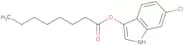
CAS:<p>6-Chloro-1H-indol-3-yl octanoate is a fluorogenic substrate that can be used to detect enzymes such as phosphatases, lipases, esterases, and proteases. 6-Chloro-1H-indol-3-yl octanoate is a ligand for metal ions such as Cu(II), Ni(II) and Zn(II). This product has high purity and quality. It is an enzyme substrate for many enzymes such as phosphatases, lipases, esterases, and proteases. This product can be used in diagnostics of various substances including food testing, environmental testing and staining. 6CIO is a chromogenic substrate that can be used to detect bioluminescence reactions.<br>6CIO is CAS No. 159954-35-5.</p>Purezza:Min. 95%Peso molecolare:293.79 g/mol5-Bromo-6-chloro-3-indoxyl phosphate, p-toluidine salt
CAS:<p>Substrate for visualizing alkaline phosphatase activity. Produces a magenta colored insoluble end product that is detected visually, when used together with Nitroblue tetrazolium. The substrate system is versatile and functions in a variety of applications, including Northern, Southern, and Western blotting, in situ hybridization, ELISAs and immunohistochemistry. DMF soluble.</p>Formula:C15H15BrClN2O4PPurezza:Min. 98.0 Area-%Peso molecolare:433.63 g/mol4-Nitrophenyl 6-O-(a-D-mannopyranosyl)-a-D-mannopyranoside
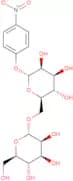
CAS:<p>4-Nitrophenyl 6-O-(alpha-D-mannopyranosyl)-alpha-D-mannopyranoside is a chromogenic substrate for alpha-mannosidase. Upon hydrolysis, para-nitrophenol is released yielding a yellowish colour. 4-Nitrophenyl 6-O-(alpha-D-mannopyranosyl)-alpha-D-mannopyranoside is used in different applications such as the Lysosomal storage disorder diagnosis (e.g., alpha-mannosidosis)</p>Purezza:Min. 95%Colore e forma:PowderPeso molecolare:463.39 g/mol5-Bromo-4-chloro-3-indoxyl butyrate
CAS:<p>Chromogenic substrate for carboxylesterase yielding a blue precipitate upon cleavage. It has been proposed for the rapid detection of Branhamella catarrhalis in a strip test because unlike most other members of the family Neisseriaceae, Branhamella catarrhalis produces a butyrateesterase.</p>Formula:C12H11BrClNO2Purezza:Min. 98.0 Area-%Peso molecolare:316.59 g/molAldol® 518 α-D-glucopyranoside, Biosynth Patent: EP 2427431 and US 8940909
CAS:<p>Aldol® 518 alpha-D-glucopyranoside is a fluorogenic enzyme substrate used for detection of alpha-D-glucosidase activity. The colorless enzyme substrate is cleaved by alpha-D-glucosidase, generating red fluorescent signal and in some conditions, an orange colour in the visible spectrum can get formed, staining bacterial colonies in faint orange coloration. Aldol® 518 alpha-D-glucopyranoside can be used under aerobic and anaerobic conditions.</p>Formula:C29H29ClN2O7Purezza:Min. 95.0 Area-%Peso molecolare:553 g/mol4-Nitrophenyl 2-acetamido-6-O-(2-acetamido-2-deoxy-b-D-glucopyranosyl)-3-O-(b-D-galactopyranosyl)-2-deoxy-a-D-galactopyranoside
CAS:<p>4-Nitrophenyl 2-acetamido-6-O-(2-acetamido-2-deoxy-b-D-glucopyranosyl)-3-O-(b-D-galactopyranosyl)-2-deoxy-a-D-galactopyranoside is a specific chromogenic substrate designed for the highly sensitive and accurate detection of glycosidase enzyme activity. Glycosidases are responsible for the cleavage of glycosidic bonds between saccharide units in various carbohydrates. The hydrolysis of this substrate by glycosidase enzymes produces 4-nitrophenol, a yellow-colored compound that can be easily monitored through spectrophotometric measurements due to its strong absorbance at 405 nm. This chromogenic substrate is widely used in the analysis of glycosidase activity in various biological samples, including bacterial, fungal, and plant tissues, as well as in environmental samples and biotechnological applications.</p>Formula:C28H41N3O18Purezza:Min. 95 Area-%Colore e forma:White PowderPeso molecolare:707.63 g/mol2-Naphthyl-α-D-glucopyranoside
CAS:<p>2-Naphthyl-α-D-glucopyranoside is a substrate for α-glucosidase. 2-Naphthol is released upon hydrolyzation. By simultaneous coupling with a suitable staining reagent, such as hexazonium p-rosaniline, the corresponding reddish-brown azo-dye is formed. Naphthols can also be detected by fluorescence analysis.</p>Formula:C16H18O6Purezza:Min. 98.0 Area-%Peso molecolare:306.32 g/molNaphthol AS-BI N-acetyl-β-D-glucosaminide
CAS:<p>Naphthol AS-BI N-acetyl-beta-D-glucosaminide is a fluorogenic substrate for the pararosaniline-glyoxalase (PG) reaction. This substrate is used to study enzymatic activity in two human isoenzymes of PG, PG I and PG II. The conversion of this substrate by PG I or PG II results in a color change from yellow to red. Naphthol AS-BI N-acetyl-beta-D-glucosaminide may be used as an experimental tool to measure the activity of these enzymes and to study the effect of inhibitors on their activity. It can also be used as a marker for studying enzyme transfer between cells.</p>Formula:C26H27BrN2O8Purezza:Min. 97.0 Area-%Peso molecolare:575.42 g/mol6-Chloro-3-indolyl butyrate
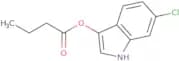
CAS:<p>6-Chloro-3-indolyl butyrate is a chromogenic substrate for lipases. Use in lipid digestion and metabolism studies, it produces a salmon-pink color when 6-chloro-3-indolyl is released after enzymatic cleavage.</p>Formula:C12H12ClNO2Purezza:Min. 95%Colore e forma:PowderPeso molecolare:237.68 g/molβ-Naphthyl stearate
CAS:<p>Beta-naphthyl stearate is a chromogenic substrate for measuring enzymatic activity.</p>Purezza:Min. 95%Colore e forma:PowderPeso molecolare:410.63 g/mol3-Indoxyl-β-D-galactopyranoside
CAS:<p>Chromogenic substrate for β-D-galactosidase, yielding a blue precipitate upon cleavage.</p>Formula:C14H17NO6Purezza:Min. 98 Area-%Peso molecolare:295.29 g/molRef: 3D-I-6000
5gPrezzo su richiesta10gPrezzo su richiesta25gPrezzo su richiesta50gPrezzo su richiesta100gPrezzo su richiesta-Unit-ggPrezzo su richiestaNaphthol AS-TR phosphate
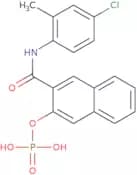
CAS:<p>Modified naphtol AS substrate used in histochemical and cytochemical staining</p>Formula:C18H15ClNO5PPurezza:Min. 95%Colore e forma:Off-White PowderPeso molecolare:391.74 g/mol5-Bromo-3-indolyl phosphate disodium salt
CAS:<p>5-Bromo-3-indolyl phosphate disodium salt is a chemiluminescent substrate that is used for the detection of bacterial activity. It reacts with oxygen to produce light, which can be measured using a luminometer. It is also used as a chromogenic substrate for detection of bacterial activity in culture media. The enzyme reaction produces an intense blue fluorescence and is used for diagnostic purposes in food testing and medical diagnostics. 5-Bromo-3-indolyl phosphate disodium salt has been shown to be effective against many bacteria and fungi, including Staphylococcus aureus, Streptococcus pyogenes, Escherichia coli, Pseudomonas aeruginosa, Candida albicans and Aspergillus niger. This product is chemically stable at room temperature but should be stored at 4°C or below.</p>Formula:C8H5BrNO4PNa2Purezza:Min. 95%Colore e forma:PowderPeso molecolare:335.99 g/mol6-Chloro-3-indoxyl-α-D-mannopyranoside
CAS:<p>Chromogenic substrate for α-mannosidase yielding a salmon colored precipitate upon cleavage.</p>Formula:C14H16ClNO6Purezza:Min. 98.0 Area-%Peso molecolare:329.74 g/mol4-Nitrophenyl 2-acetamido-2-deoxy-b-D-glucopyranoside-6-sulfate sodium salt
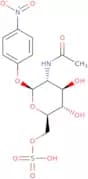
CAS:<p>4-Nitrophenyl 2-acetamido-2-deoxy-beta-D-glucopyranoside-6-sulfate sodium salt is a chromogenic substrate for N-acetylglucosamine-6-sulfatase. Upon hydrolysis, para-nitrophenol is released yielding a yellowish colour. 4-Nitrophenyl 2-acetamido-2-deoxy-beta-D-glucopyranoside-6-sulfate sodium salt is used in different applications such as the Mucopolysaccharidosis IIID (Sanfilippo D) diagnosis</p>Formula:C14H17N2O11S·NaPurezza:Min. 95 Area-%Colore e forma:PowderPeso molecolare:444.35 g/molAldol® 515 L-alanine amide, hydrochloride, Biosynth Patent: EP 2427431 and US 8940909
CAS:<p>Aldol® 515 L-alanine amide is a chromogenic and fluorogenic enzyme substrate used for detection of L-alanine aminopeptidase activity. The colorless enzyme substrate is cleaved by L-alanine aminopeptidase produced by microorganisms, grown in liquid or solid media yielding red color. In addition, red fluorescence is generated when a fluorescence enhancer or a suitable matrix is present. Aldol® 515 L-alanine amide can be used under aerobic and anaerobic conditions.</p>Formula:C26H27ClN4O2Purezza:Min. 95.0 Area-%Peso molecolare:462.97 g/mol5-Bromo-4-chloro-3-indolyl a-D-maltopyranoside
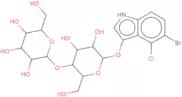
CAS:<p>5-Bromo-4-chloro-3-indolyl a-D-maltopyranoside is a chromogenic substrate used to detect the specific enzymatic activity of alpha-glucosidase. After cleavage, 5-bromo-4-chloro-indoxyl is released, resulting in a blue to blue-green color change in bacterial colonies or media. 5-Bromo-4-chloro-3-indolyl a-D-maltopyranoside is used in Pompe disease screening and glycogen storage disorder diagnosis.</p>Formula:C20H25BrClNO11Purezza:Min. 95%Colore e forma:PowderPeso molecolare:570.77 g/mol5-Bromo-4-chloro-3-indoxyl-α-L-arabinopyranoside
<p>5-Bromo-4-chloro-3-indoxyl-alpha-L-arabinopyranoside is a fluorogenic substrate that can be used in enzyme and chromogenic assays. It is a high purity, stable product with a CAS number of 53673-61-7. This product has been shown to have fluorescence properties under acidic conditions, as well as chemiluminescence properties when exposed to an oxidizing agent. This compound can be used for the detection of bacterial activity in culture media and for the detection of pathogens in environmental samples. The conjugate can also be used for food testing.</p>Formula:C13H13BrClNO5Peso molecolare:378.61 g/mol5-Bromo-4-chloro-3-indoxyl-β-D-fucopyranoside
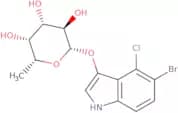
CAS:<p>Chromogenic substrate for β-D-fucosidase yielding a blue precipitate.</p>Formula:C14H15BrClNO5Purezza:Min. 99.0 Area-%Peso molecolare:392.64 g/mol5-Bromo-4-chloro-3-indolyl palmitate
CAS:<p>5-Bromo-4-chloro-3-indolyl palmitate is a chromogenic substrate used to detect the specific enzymatic activity of lipase. After cleavage, 5-bromo-4-chloro-indoxyl is released, resulting in a blue to blue-green color change in bacterial colonies or media. 5-Bromo-4-chloro-3-indolyl palmitate is used in lipase activity assays or cystic fibrosis diagnostics.</p>Purezza:Min. 95%Colore e forma:PowderPeso molecolare:484.9 g/mol6-Bromo-2-naphthyl-2-acetamido-2-deoxy-β-D-glucopyranoside
CAS:<p>6-Bromo-2-naphthyl 2-acetamido-2-deoxy-beta-D-glucopyranoside is a chromogenic substrate used for the detection of chitinase activity. Upon hydrolysis by chitinase, it releases a yellow-brown color, which is easily detected by spectrophotometry. This substrate has been used to study chitinases in various organisms, including bacteria, fungi, and insects. It can also be used to quantitate chitinase activity in various biological samples.</p>Formula:C18H20BrNO6Peso molecolare:426.26 g/mol5-Bromo-6-chloro-3-indoxyl-3-acetate
CAS:<p>Chromogenic substrate for carboxylesterase yielding a magenta precipitate upon cleavage. Mainly used in histochemistry.</p>Formula:C10H7BrClNO2Purezza:Min. 98.0 Area-%Peso molecolare:288.53 g/molRef: 3D-B-6304
1gPrezzo su richiesta5gPrezzo su richiesta10gPrezzo su richiesta500mgPrezzo su richiesta2500mgPrezzo su richiesta-Unit-ggPrezzo su richiesta5-Bromo-4-chloro-3-indolyl a-D-xylopyranoside
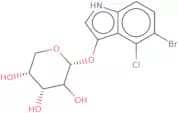
CAS:<p>5-Bromo-4-chloro-3-indolyl a-D-xylopyranoside is a chromogenic substrate used to detect the specific enzymatic activity of alpha-xylosidase. After cleavage, 5-bromo-4-chloro-indoxyl is released, resulting in a blue to blue-green color change in bacterial colonies or media. 5-Bromo-4-chloro-3-indolyl a-D-xylopyranoside is used in bacterial xylan metabolism studies and plant cell wall degradation assays.</p>Formula:C13H13BrClNO5Purezza:Min. 95%Colore e forma:White to off-white solid.Peso molecolare:378.61 g/mol4-Nitrophenyl 3-O-(β-D-glucopyranosyl)-β-D-glucopyranoside
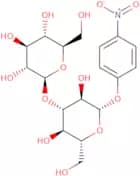
CAS:<p>Chromogenic substrate for beta-glucanase</p>Formula:C18H25NO13Purezza:Min. 95 Area-%Colore e forma:PowderPeso molecolare:463.39 g/mol2-O-(4-Nitrophenyl)-a-D-N-glycolylneuraminic acid
CAS:<p>2-O-(4-Nitrophenyl)-a-D-N-glycolylneuraminic acid is commonly used to measure the activity of sialidase enzymes, specifically those that cleave glycoconjugates containing 2-O-(4-nitrophenyl)-alpha-D-N-glycolylneuraminic acid. The resulting product can be detected by measuring the absorbance at a specific wavelength using a spectrophotometer. This substrate offers a high degree of specificity for glycolylneuraminic acid-containing substrates and is useful for both research and diagnostic purposes.</p>Purezza:Min. 95%Colore e forma:PowderPeso molecolare:446.36 g/molAldol® 515 caprylate solution, 0.50 M in DMSO, Biosynth Patent: EP 2427431 and US 8940909
CAS:<p>Aldol® 515 caprylate is a chromogenic and fluorogenic enzyme substrate used for detection of lipase activity. The colorless enzyme substrate is cleaved by C8 esterases, yielding development of red coloration. In addition, red fluorescence is generated when Aldol® 355 fluorescence enhancer or a suitable matrix is present. Aldol® 515 caprylate can be used in enzyme assays and live bacterial cultures. Aldol® 515 caprylate is suitable for use in liquid and solid media, under aerobic as well as anaerobic conditions.</p>Formula:C31H34N2O3Purezza:Min. 95%Colore e forma:Clear Liquid PowderPeso molecolare:482.62 g/molAldol® 458 acetate, Biosynth Patent: EP 2427431 and US 8940909
CAS:Prodotto controllato<p>Aldol 458 acetate is a synthetic chemical that is used in the food industry as an enzyme substrate and in diagnostic tests to measure the level of enzymes. Aldol 458 acetate is a ligand that binds to proteins, such as horseradish peroxidase and alkaline phosphatase, which are commonly used for detection of antibodies or other proteins. This product can be used as a culture medium additive for bacteria, fungi, and yeast. It can also be used for diagnostics and chemiluminescence reactions. Aldol 458 acetate has high purity and quality.</p>Formula:C18H15NO4Purezza:Min. 95.0 Area-%Peso molecolare:309.32 g/molRef: 3D-A-4690_P00
1gPrezzo su richiesta5gPrezzo su richiesta10gPrezzo su richiesta2500mgPrezzo su richiesta-Unit-ggPrezzo su richiesta1-Naphthyl β-D-galactopyranoside
CAS:<p>1-Naphthyl b-D-galactopyranoside is a chromogenic substrate used to detect the presence of beta-galactosidase enzymes. The enzyme cleaves the substrate to produce a colored product that can be quantified and visualized. This substrate is commonly used in applications such as the detection of lacZ gene expression in bacterial colonies or in histochemical staining of tissues to identify beta-galactosidase activity.</p>Formula:C16H18O6Purezza:Min. 95%Colore e forma:PowderPeso molecolare:306.32 g/mol5-Bromo-4-chloro-3-indolyl a-L-arabinofuranoside
<p>5-Bromo-4-chloro-3-indolyl a-L-arabinofuranoside is a chromogenic substrate used to detect the specific enzymatic activity of alpha-L-arabinofuranosidase. After cleavage, 5-bromo-4-chloro-indoxyl is released, resulting in a blue to blue-green color change in bacterial colonies or media. 5-Bromo-4-chloro-3-indolyl a-L-arabinofuranoside is used in bacterial arabinan degradation assays (e.g. Bacillus spp.).</p>Formula:C13H13BrClNO5Purezza:Min. 98.0 Area-%Colore e forma:PowderPeso molecolare:378.6 g/molNaphthol AS-BI β-D-glucopyranoside
CAS:<p>Substrate detecting beta-glucosidase activity</p>Colore e forma:PowderPeso molecolare:534.35 g/mol2-Nitrophenyl-N-acetyl-β-D-glucosaminide
CAS:<p>Chromogenic β-Glucosaminidase substrate yielding a yellow absorbent solution upon cleavage.</p>Formula:C14H18N2O8Purezza:Min. 99 Area-%Peso molecolare:342.31 g/mol5-Bromo-4-chloro-3-indolyl-D-thymidine-3'-phosphate cyclohexylammonium salt
CAS:<p>5-Bromo-4-chloro-3-indolyl-D-thymidine-3'-phosphate cyclohexylammonium salt is a chromogenic substrate used to detect the specific enzymatic activity of alkaline phosphatase. After cleavage, 5-bromo-4-chloro-indoxyl is released, resulting in a blue to blue-green color change in bacterial colonies or media. 5-Bromo-4-chloro-3-indolyl-D-thymidine-3'-phosphate cyclohexylammonium salt is used in immunohistochemistry (IHC) and Western blot detection, immunoassays used to detect proteins.</p>Formula:C18H17BrClN3O8P·C6H14NPurezza:Min. 95%Colore e forma:White PowderPeso molecolare:649.86 g/molAldol® 484 β-D-glucopyranoside, Biosynth Patent: EP 2427431 and US 8940909
CAS:<p>Aldol® 484 beta-D-glucopyranoside is a chromogenic and fluorogenic enzyme substrate used for detection of beta-glucosidase activity. The colorless enzyme substrate is cleaved by bacteria producing beta-glucosidase in liquid or solid media, yielding intense red color and green fluorescent signal. Aldol® 484 beta-D-glucopyranoside can be used under aerobic and anaerobic conditions.</p>Formula:C26H24ClFN2O7Purezza:Min. 95%Colore e forma:PowderPeso molecolare:530.93 g/mol6-Chloro-3-indoxyl-3-acetate
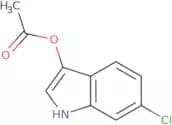
CAS:<p>6-Chloro-3-indoxyl-3-acetate is a chromogenic substrate for carboxylesterase yielding a salmon colored precipitate upon cleavage. Mainly used in histochemistry.</p>Purezza:Min. 95%Colore e forma:White PowderPeso molecolare:209.63 g/mol6-Chloro-3-indoxyl-β-D-glucopyranoside
CAS:<p>Chromogenic substrate for β-D-glucosidase. Yields a red precipitate upon cleavage.</p>Formula:C14H18ClNO7Purezza:Min. 98 Area-%Peso molecolare:347.75 g/mol4-Nitrophenyl b-L-arabinopyranoside
CAS:<p>4-Nitrophenyl beta-L-arabinopyranoside is a chromogenic substrate for beta-L-arabinosidase. Upon hydrolysis, para-nitrophenol is released yielding a yellowish colour. 4-Nitrophenyl beta-L-arabinopyranoside is used in different applications such as the Bacterial arabinan degradation assays, gut microbiome analysis</p>Formula:C11H13NO7Purezza:Min. 98 Area-%Colore e forma:White PowderPeso molecolare:271.22 g/mol3,3'-Diaminobenzidine tetrahydrochloride hydrate
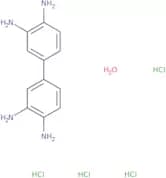
CAS:<p>3,3'-Diaminobenzidine (DAB) is an organic compound derived from benzidine. DAB is water-soluble as the tetrahydrochloride salt and is used in immunohistochemical staining of nucleic acids and proteins. Within research in Alzheimer's disease, Aβ protein amyloid plaques are targeted by a primary antibody, and subsequently by a secondary antibody, which is conjugated with a peroxidase enzyme. This will bind DAB as a substrate and oxidize it, producing an easily observable brown colour. 3,3’-Diaminobenzidine tetrahydrochloride hydrate is also available as the tetrahydrochloride salt and as the free base.</p>Formula:C12H14N4·4HCl·xH2OPurezza:Min. 97 Area-%Colore e forma:PowderPeso molecolare:360.11 g/mol3-Indoxyl caprylate
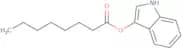
CAS:<p>3-Indoxyl caprylate is a chemiluminescent substrate that is used in the detection of bacteria. It has been shown to be a very sensitive and selective fluorogenic substrate for the detection of bacterial activity, which can be used with an appropriate enzyme reaction. 3-Indoxyl caprylate has also been shown to be a potent quencher of bioluminescence, and can be used as a chromogenic substrate in diagnostic assays. 3-Indoxyl caprylate is often used as a culture media supplement or food additive to enhance its growth properties. It has been found to have high purity and quality levels, making it suitable for use in diagnostics and research.</p>Purezza:Min. 95%Peso molecolare:259.34 g/mol4-Nitrophenyl-β-D-maltopyranoside
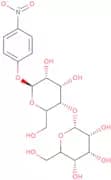
CAS:<p>Chromogenic β-maltosidase substrate yielding a yellow solution upon cleavage.</p>Formula:C18H25NO13Purezza:Min. 99.0 Area-%Peso molecolare:463.40 g/molRef: 3D-N-4492
1gPrezzo su richiesta5gPrezzo su richiesta10gPrezzo su richiesta500mgPrezzo su richiesta2500mgPrezzo su richiesta-Unit-ggPrezzo su richiesta5-Bromo-6-chloro-3-indolyl 2-acetamido-2-deoxy-b-D-glucopyranoside
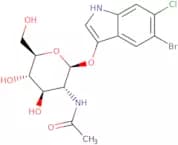
CAS:<p>5-Bromo-6-chloro-3-indolyl 2-acetamido-2-deoxy-b-D-glucopyranoside is a chromogenic substrate that yields a magenta-colored product after cleavage. The chromophore 5-bromo-6-chloro-indoxyl is released, generating the observable color. It is used in mucopolysaccharidosis screening.</p>Formula:C16H18BrClN2O6Purezza:Min. 97 Area-%Colore e forma:PowderPeso molecolare:449.68 g/mol2-Naphthyl b-D-glucopyranoside monohydrate
CAS:<p>2-Naphthyl-lpha-D-glucopyranoside is a substrate for α-glucosidase. 2-Naphthol is released upon hydrolyzation. By simultaneous coupling with a suitable staining reagent, such as hexazonium p-rosaniline, the corresponding reddish-brown azo-dye is formed. Naphthols can also be detected by fluorescence analysis.</p>Purezza:Min. 95%Colore e forma:PowderPeso molecolare:324.33 g/mol5-Bromo-4-chloro-1-methyl-3-indolyl-β-D-glucopyranoside
CAS:<p>5-Bromo-4-chloro-1-methyl-3-indolyl-β-D-glucopyranoside is a fluorescent substrate used for the detection of β-glucuronidase. It can be used in several enzyme substrates, such as 5,5'-dithiobis(2-nitrobenzoic acid), 5,5'-dithiobis(3,4,5,-trimethoxybenzoic acid), and 4-(p-[N-(7-(2,7'-dimethyl -2H -chromenyl)-2H -indazolium)]phenylazo)benzoic acid. This product is used for diagnostics and culture media as well as food testing. The product has an extremely high purity and a CAS number.</p>Formula:C15H17BrClNO6Purezza:Min. 99.0 Area-%Peso molecolare:422.66 g/mol4-Nitrophenyl β-rutinoside
CAS:<p>4-Nitrophenyl beta-rutinoside is a chromogenic substrate for beta-glucosidase. Upon hydrolysis, para-nitrophenol is released yielding a yellowish colour. 4-Nitrophenyl beta-rutinoside is used in different applications such as the Flavonoid glycoside hydrolysis, food industry applications</p>Formula:C18H25NO12Purezza:Min. 95%Colore e forma:PowderPeso molecolare:447.39 g/mol3-Nitrophenyl b-D-galactopyranoside
CAS:<p>Chromogenic substrate targeting beta-galactosidase</p>Formula:C12H15NO8Colore e forma:PowderPeso molecolare:301.25 g/mol3,4-Cyclohexenoesculetin β-D-glucuronide
<p>Chromogenic substrate for beta-glucuronidase</p>Purezza:Min. 95%