Metalli
I metalli sono elementi noti per le loro proprietà caratteristiche come l'alta conducibilità elettrica e termica, la malleabilità, la duttilità e la lucentezza, che li rendono essenziali in una vasta gamma di applicazioni industriali e di ricerca. Questi elementi, tra cui ferro, rame, alluminio e oro, svolgono ruoli critici in settori come la costruzione, l'elettronica, il trasporto e la produzione. Presso CymitQuimica, offriamo una selezione diversificata di metalli di alta purezza progettati per soddisfare i rigorosi requisiti delle applicazioni di ricerca e industriali. Il nostro catalogo comprende metalli puri, leghe metalliche e composti metallici, tutti rigorosamente testati per qualità e prestazioni. Fornendo metalli di alta qualità, supportiamo ricercatori e professionisti dell'industria nel raggiungimento di risultati precisi ed efficienti nei loro progetti, facilitando progressi nella tecnologia, nella scienza dei materiali e nell'ingegneria.
Sottocategorie di "Metalli"
Trovati 4493 prodotti di "Metalli"
Ordinare per
Purezza (%)
0
100
|
0
|
50
|
90
|
95
|
100
Dichloro[N-[2-(diphenylphosphino-κP)ethyl]-2-(methylthio-κS)ethanamine-κN](triphenylphosphine) ruthenium
CAS:Formula:C35H37Cl2NP2RuSColore e forma:yellow solidPeso molecolare:737.67Dichloro[rel-[N(S)]-N-[2-(diphenylphosphinyl-κO)ethyl]-2-[(R)-methylthio-κS]ethanamine-κN](triphenylphosphine) ruthenium
CAS:Formula:C35H37Cl2NOP2RuSColore e forma:brick red solidPeso molecolare:753.66Dichloro[rel-[N(S)]-N-[2-(diphenylphosphinyl-κO)ethyl]-2-[(R)-phenylthio-κS]ethanamine-κN](triphenylphosphine) ruthenium
Formula:C40H39Cl2NOP2RuSColore e forma:dark red xtl.Peso molecolare:815.74Magnesium trifluoroacetylacetonate dihydrate, min. 98%
CAS:<p>Magnesium trifluoroacetylacetonate dihydrate, min. 98%</p>Formula:Mg(CF3COCHCOCH3)2H2OPurezza:min. 98%Colore e forma:white pwdr.Peso molecolare:330.47 (366.50)Dichloro[rel-[N(R)]-N-[2-[(R)-(phenylmethyl)thio-κS]ethyl]-4-morpholineethanamine-κNN4,κN4](triphenylphosphine)ruthenium(II), compd. with dichloromethane
CAS:<p>Dichloro[rel-[N(R)]-N-[2-[(R)-(phenylmethyl)thio-κS]ethyl]-4-morpholineethanamine-κNN4,κN4](triphenylphosphine)ruthenium(II), compd. with dichloromethane</p>Formula:C33H39Cl2N2OPRuS·5(CH2Cl2)Colore e forma:Red xtl.Peso molecolare:799.62Dicarbonylcyclopentadienylruthenium dimer, 99%
CAS:<p>Dicarbonylcyclopentadienylruthenium dimer, 99%</p>Formula:C5H5Ru(CO)2Purezza:99%Colore e forma:orangish-brown xtl.Peso molecolare:444.36Bis(2,2,6,6-tetramethyl-3,5-heptanedionato)magnesium, anhydrous, min. 98% [Mg(TMHD)2] , 12-0900, contained in high-temp 50 ml Swagelok® cylinder (96-1071) for CVD/ALD
CAS:<p>Bis(2,2,6,6-tetramethyl-3,5-heptanedionato)magnesium, anhydrous, min. 98% [Mg(TMHD)2] , 12-0900, contained in high-temp 50 ml Swagelok® cylinder (96-1071) for CVD/ALD</p>Formula:Mg(C11H19O2)2Purezza:min. 98%Colore e forma:white pwdr.Peso molecolare:390.85Bis(N,N’-di-t-butylacetamidinato)ruthenium(II) dicarbonyl, 98% (99.99%-Ru) PURATREM
CAS:<p>Bis(N,N-di-t-butylacetamidinato)ruthenium(II) dicarbonyl, 98% (99.99%-Ru) PURATREM</p>Formula:C22H42N4O2RuPurezza:98% (99.99%-Ru)Colore e forma:beige to yellow solidPeso molecolare:495.67Bis(ethylcyclopentadienyl)ruthenium(II), 98% (99.9%-Ru), 44-0040, contained in high-temp 50 ml Swagelok® cylinder (96-1071) for CVD/ALD
CAS:<p>Bis(ethylcyclopentadienyl)ruthenium(II), 98% (99.9%-Ru), 44-0040, contained in high-temp 50 ml Swagelok® cylinder (96-1071) for CVD/ALD</p>Formula:(CH3CH2)C5H4RuPurezza:(99.9%-Ru)Colore e forma:pale yellow liq.Peso molecolare:287.37Magnesium (N,N,N',N'-tetramethylethylenediamine)bis[BREW] (99.99+%-Mg) PURATREM
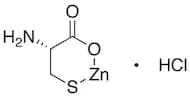
<p>Magnesium (N,N,N',N'-tetramethylethylenediamine)bis[BREW] (99.99+%-Mg) PURATREM</p>Formula:Mg(C6H16N2)CHyC(O)CHC(O)CHy(xyxPurezza:(99.99+%-Mg)Colore e forma:pale yellow liq.Zinc Cysteinate Hydrochloride
CAS:Prodotto controllato<p>Applications Increases activity of the antioxidative enzymes Catalase and Glutathione Peroxidase, thereby protecting retinal epithelial cells from high hydrogen peroxide concentrations.<br>References Hanley, W., et al.: Chem-Biol. Interactions, 21, 263 (1978),<br></p>Formula:C3H5NO2S·HCl·ZnColore e forma:NeatPeso molecolare:221.012Copper(II) Acetate Monohydrate
CAS:Prodotto controllato<p>Applications Copper(II) Acetate Monohydrate is a versatile and cost-effective reagent that is used as a catalyst for N-monoalkylation of amino derivatives that are poor nucleophiles, and also for the synthesis of symmetrical 1,3-diynes. Copper(II) Acetate is also used as a mild caustic in the medical field.<br> Not a dangerous good if item is equal to or less than 1g/ml and there is less than 100g/ml in the package<br>References Balaraman, K. & Kesavan, V.: Synthesis, 2010, 3461 (2010); Martinez-Ascencio, A., et al.: Tetrahedron Lett., 51, 325 (2010); Theophanides, T. & Anastassopoulou, J.: Crit. Rev. Oncol. Hematol., 42, 57 (2002)<br></p>Formula:C4H8O4·Cu·H2OColore e forma:NeatPeso molecolare:183.65 + (18.02)Iron Triabietate
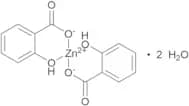
CAS:Prodotto controllatoFormula:C20H30O2FeColore e forma:NeatPeso molecolare:321.0633333333Zinc Salicylate Hydrate
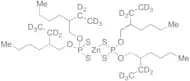
CAS:<p>Applications Zinc salicylate trihydrate (CAS# 16283-36-6) is a useful research chemical compound.<br></p>Formula:C14H10O6Zn·2H2OColore e forma:NeatPeso molecolare:375.665Zinc Bis(2-Ethylhexyl) Phosphorodithioate-d20
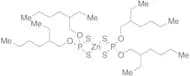
CAS:Prodotto controllato<p>Applications Isotope labelled Zinc Bis(2-Ethylhexyl) Phosphorodithioate is an analytical standard with antioxidant properties.<br>References Cermak, S. et al.: J. Am. Oil Chem. Soc., 91, 2101 (2014); Chemija. et al.: 25, 161 (2014);<br></p>Formula:C32D20H48O4P2S4ZnColore e forma:NeatPeso molecolare:792.62Zinc Bis(2-Ethylhexyl) Phosphorodithioate
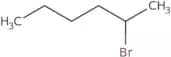
CAS:Prodotto controllato<p>Applications Zinc Bis(2-Ethylhexyl) Phosphorodithioate is an analytical standard with antioxidant properties.<br>References Cermak, S. et al.: J. Am. Oil Chem. Soc., 91, 2101 (2014); Chemija. et al.: 25, 161 (2014);<br></p>Formula:C32H68O4P2S4ZnColore e forma:NeatPeso molecolare:772.472-Bromohexane (contains 3-Bromohexane) (stabilized with Copper chip)
CAS:<p>2-Bromohexane is an organic compound and a chemical building block. It is produced by the reaction of 1,3-dibromohexane with copper. 2-Bromohexane is used in the production of epoxides and other chemicals. The synthesis of 2-bromohexane starts with the addition of bromine to 1,3-dibromohexane followed by the addition of copper (II) chloride. This reaction produces 3-bromohexane as a byproduct which can be removed from the reaction mixture using a Dean–Stark trap. In this process, two moles of hydrogen are used to convert one mole of bromine into one mole of hydrogen bromide gas, which can be easily condensed into liquid form. The monoalkylation product 2-bromohexane reacts with an alkyl halide to produce a mixture containing two different alkyl halides. These</p>Formula:C6H13BrPurezza:85%Peso molecolare:165.07 g/molErbium(III) acetate hydrate
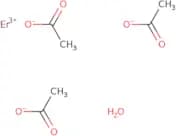
CAS:<p>Erbium(III) acetate hydrate is a crystal form of erbium. It is a rare earth metal which has been used as an optical material and in the production of optic fibers, lasers, and amplifiers. Erbium is also used in the treatment of cancer, where it can be used to destroy tumor cells by heating them with laser light. Erbium(III) acetate hydrate is typically obtained by reacting erbium oxide with acetic acid or acetic anhydride. The crystal has a linear range from 0.5-1.5 micrometers and diffraction peaks at 1.0 and 2.2 micrometers. Erbium(III) acetate hydrate has been shown to have fluorescence resonance energy transfer (FRET) properties, which may be useful in the development of aptasensors for biomolecule detection systems such as antibody-antigen interactions or DNA hybridization reactions.br>br></p>Formula:C6H9ErO6•(H2O)xPurezza:Min. 95%Peso molecolare:362 g/molNeodymium(III) Chloride
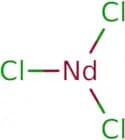
CAS:<p>Neodymium chloride is a reactive metal compound that can be used in the preparation of other neodymium compounds. Neodymium chloride is prepared by dissolving neodymium metal in hydrochloric acid and then heating the solution to about 100 degrees Celsius. The solution is then evaporated to yield the desired product, which includes magnesium salt and several nitrates. The thermal expansion coefficient of neodymium chloride is 0.063 x 10^-6/degree C, while its matrix effect on MgCl2 at 25 degrees Celsius is -0.0032 x 10^-6/degree C. Neodymium chloride has a particle size of 1-2 microns and a density of 4.4 g/cm^3. The thermal properties of this compound are important when considering how it will react with other substances during processing, such as magnesium salts and nitrogen atoms in plasma mass spectrometry due to their similar chemical properties.</p>Formula:Cl3NdPurezza:Min. 95%Peso molecolare:250.6 g/molChromium(III) chloride hexahydrate
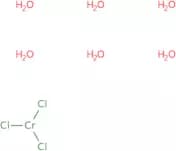
CAS:<p>Chromium(III) chloride hexahydrate is a coordination compound with the chemical formula CrCl3·6H2O. It is soluble in water and has a basic, hexagonal crystal structure. In vitro studies have shown that this compound binds to DNA and inhibits enzymes such as tyrosinase, which plays an essential role in the biosynthesis of melanin. Chromium(III) chloride hexahydrate also inhibits the activity of other enzymes that are involved in the transfer of phosphate groups in reactions involving zirconium oxide and hydrogen fluoride. This compound also has hypoglycemic effects, leading to lower blood sugar levels in rats.</p>Formula:CrCl3•(H2O)6Purezza:Min. 95%Colore e forma:Green PowderPeso molecolare:266.45 g/mol
![Dichloro[N-[2-(diphenylphosphino-κP)ethyl]-2-(methylthio-κS)ethanamine-κN](triphenylphosphine) rut…](/_next/image/?url=https%3A%2Fstatic.cymitquimica.com%2Fproducts%2F08%2Fthumb-webp%2F44-3210.webp&w=3840&q=75)

![Dichloro[rel-[N(S)]-N-[2-(diphenylphosphinyl-κO)ethyl]-2-[(R)-methylthio-κS]ethanamine-κN](triphen…](/_next/image/?url=https%3A%2Fstatic.cymitquimica.com%2Fproducts%2F08%2Fthumb-webp%2F44-3230.webp&w=3840&q=75)
![Dichloro[rel-[N(S)]-N-[2-(diphenylphosphinyl-κO)ethyl]-2-[(R)-phenylthio-κS]ethanamine-κN](triphen…](/_next/image/?url=https%3A%2Fstatic.cymitquimica.com%2Fproducts%2F08%2Fthumb-webp%2F44-3240.webp&w=3840&q=75)

![Dichloro[rel-[N(R)]-N-[2-[(R)-(phenylmethyl)thio-κS]ethyl]-4-morpholineethanamine-κNN4,κN4](triphe…](/_next/image/?url=https%3A%2Fstatic.cymitquimica.com%2Fproducts%2F08%2Fthumb-webp%2F44-0555.webp&w=3840&q=75)

![Bis(2,2,6,6-tetramethyl-3,5-heptanedionato)magnesium, anhydrous, min. 98% [Mg(TMHD)2] , 12-0900, c…](/_next/image/?url=https%3A%2Fstatic.cymitquimica.com%2Fproducts%2F08%2Fthumb-webp%2F98-4069.webp&w=3840&q=75)