Metalli
I metalli sono elementi noti per le loro proprietà caratteristiche come l'alta conducibilità elettrica e termica, la malleabilità, la duttilità e la lucentezza, che li rendono essenziali in una vasta gamma di applicazioni industriali e di ricerca. Questi elementi, tra cui ferro, rame, alluminio e oro, svolgono ruoli critici in settori come la costruzione, l'elettronica, il trasporto e la produzione. Presso CymitQuimica, offriamo una selezione diversificata di metalli di alta purezza progettati per soddisfare i rigorosi requisiti delle applicazioni di ricerca e industriali. Il nostro catalogo comprende metalli puri, leghe metalliche e composti metallici, tutti rigorosamente testati per qualità e prestazioni. Fornendo metalli di alta qualità, supportiamo ricercatori e professionisti dell'industria nel raggiungimento di risultati precisi ed efficienti nei loro progetti, facilitando progressi nella tecnologia, nella scienza dei materiali e nell'ingegneria.
Sottocategorie di "Metalli"
Trovati 4493 prodotti di "Metalli"
Ordinare per
Purezza (%)
0
100
|
0
|
50
|
90
|
95
|
100
Indium - 99.999% trace metals basis - particle size 1 - 6 mm
CAS:Indium-99.999% is a trace metal that is used in nuclear medicine to detect bowel disease, such as Crohn's disease and ulcerative colitis. Indium-99.999% binds to nuclear DNA and cell nuclei, which can then be detected using x-ray diffraction data. The response element that is activated by this metal differs from other metals in the sense that it does not require the presence of oxygen for activation. This metal also has been used for autologous stem-cell transplantation and chelation therapy for infectious diseases, such as HIV/AIDS. Toxicity studies have shown no long-term toxicity or adverse effects on erythrocytes, leukocytes, the liver, kidney, or bone marrow at doses up to 100 mg/kg/day for up to 6 months.Formula:InPurezza:Min. 99.999%Colore e forma:PowderPeso molecolare:114.82 g/molZinc 2,9,16,23-tetra-tert-butyl-29H,31H-phthalocyanine
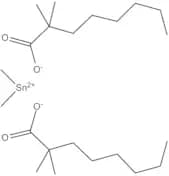
CAS:<p>Zinc 2,9,16,23-tetra-tert-butyl-29H,31H-phthalocyanine is a molecule that has an ionization potential of 1.8 eV and a photovoltaic absorption spectrum with a peak at 528 nm. It has been used as a photoelectron emitter in photoelectron spectroscopy and as the emissive layer in solar cells. Zinc 2,9,16,23-tetra-tert-butyl-29H,31H-phthalocyanine is stable to water and air but can react with methyl esters or butyric acid. This molecule has been shown to be effective for use in solar cells due to its high optical absorption coefficient (0.1 cm2/g) and low band gap energy (1.5 eV).</p>Formula:C48H48N8ZnPurezza:Min. 95%Colore e forma:PowderPeso molecolare:802.33 g/molDIMETHYLDINEODECANOATETIN, tech
CAS:Formula:C22H44O4SnPurezza:95%Colore e forma:Yellow Amber LiquidPeso molecolare:491.26Ref: 3H-SND4220
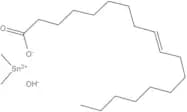
4kgPrezzo su richiesta18kgPrezzo su richiesta250gPrezzo su richiesta220kgPrezzo su richiestaDIMETHYLHYDROXY(OLEATE)TIN, tech
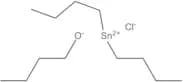
CAS:Formula:C20H40O3SnPurezza:85%Colore e forma:Yellow Amber LiquidPeso molecolare:447.23DI-n-BUTYLBUTOXYCHLOROTIN, tech
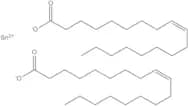
CAS:Formula:C12H27ClOSnPurezza:95%Colore e forma:Straw Amber LiquidPeso molecolare:341.48TIN(II) OLEATE, tech
CAS:Formula:C36H66O4SnPurezza:85%Colore e forma:Straw To Amber LiquidPeso molecolare:681.61TETRAMETHYLTIN
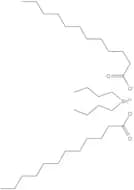
CAS:<p>ALD Material<br>Atomic layer deposition (ALD) is a chemically self-limiting deposition technique that is based on the sequential use of a gaseous chemical process. A thin film (as fine as -0.1 Å per cycle) results from repeating the deposition sequence as many times as needed to reach a certain thickness. The major characteristic of the films is the resulting conformality and the controlled deposition manner. Precursor selection is key in ALD processes, namely finding molecules which will have enough reactivity to produce the desired films yet are stable enough to be handled and safely delivered to the reaction chamber.<br>Tetramethyltin; Tetramethylstannane<br>ΔHcomb: 903.5 kcal/molΔHform, gas, 27 °: -13.6 kcal/mol ΔHvap: 6.8 kcal/molSn-Me bond dissociation energy: 227 kJ/molEa, pyrolysis: 41.1 kcal/molVapor pressure, -21 °C: 10 mmVapor pressure, 20 °C: 90 mmAllows synthesis of even numbered alkanesConverts acid chlorides to methyl ketones with benzylchlorobis(triphenyl phosphine)palladiumForms aryl methyl ketones from aryl halides and CO in the presence of dicarbonylbis(triphenylphosphine)nickelFor CVD of tin oxide transparent conductive electrodes on glass for photovoltaics and sensorsPyrolyzed in vacuum to tin at 600-750 °CPyrolyzed oxidatively to SnO at 350-600 °CForms transparent conductive oxides for photovoltaics by Plasma-enhanced chemical vapor deposition (PECVD)Higher purity grade available, SNT7560.1<br></p>Formula:C4H12SnPurezza:97%Colore e forma:Colourless LiquidPeso molecolare:178.83DI-n-BUTYLDILAURYLTIN, tech
CAS:Formula:C32H64O4SnPurezza:95%Colore e forma:Straw To Pale Yellow LiquidPeso molecolare:631.55TETRAKIS(DIMETHYLAMINO)TIN
CAS:<p>ALD Material<br>Atomic layer deposition (ALD) is a chemically self-limiting deposition technique that is based on the sequential use of a gaseous chemical process. A thin film (as fine as -0.1 Å per cycle) results from repeating the deposition sequence as many times as needed to reach a certain thickness. The major characteristic of the films is the resulting conformality and the controlled deposition manner. Precursor selection is key in ALD processes, namely finding molecules which will have enough reactivity to produce the desired films yet are stable enough to be handled and safely delivered to the reaction chamber.<br>Tetrakis(dimethylamino)tin; Octamethylstannanetetraamine; Tin IV dimethylamide<br>Reacts with tris(aminoalkyl)amines, yielding azastannatranes<br></p>Formula:C8H24N4SnColore e forma:Pale Yellow LiquidPeso molecolare:294.99BIS[BIS(TRIMETHYLSILYL)AMINO]TIN(II), 95%
CAS:Formula:C12H36N2Si4SnPurezza:95%Colore e forma:Orange-Red LiquidPeso molecolare:439.47Benzylmagnesium chloride, 1-2 M in THF
CAS:<p>Benzylmagnesium chloride, 1-2 M in THF</p>Formula:C6H5CH2MgClColore e forma:liq.Peso molecolare:150.89sec-Butylmagnesium chloride, lithium chloride complex 1.2M (15wt% ±1wt%) in tetrahydrofuran
CAS:<p>sec-Butylmagnesium chloride, lithium chloride complex 1.2M (15wt% ±1wt%) in tetrahydrofuran</p>Formula:CH3CH2CH(CH3)MgClLiClColore e forma:dark brown liq.Peso molecolare:159.26n-Butylmagnesium chloride, 1.5-3.0 M in THF
CAS:<p>n-Butylmagnesium chloride, 1.5-3.0 M in THF</p>Formula:C4H9MgClColore e forma:liq.Peso molecolare:116.87Ethylmagnesium chloride, 2M in ether
CAS:<p>Ethylmagnesium chloride, 2M in ether</p>Formula:C2H5MgClColore e forma:liq.Peso molecolare:88.83i-Propylmagnesium bromide, 2.9M (35wt% ±1wt%) in 2-methyltetrahydrofuran
CAS:<p>i-Propylmagnesium bromide, 2.9M (35wt% ±1wt%) in 2-methyltetrahydrofuran</p>Formula:(CH3)2CHMgBrColore e forma:liq.Peso molecolare:147.30Allylmagnesium bromide, 0.95-1.1 M in ether
CAS:<p>Allylmagnesium bromide, 0.95-1.1 M in ether</p>Formula:CH2CHCH2MgBrColore e forma:liq.Peso molecolare:145.28Methylmagnesium bromide, 3M in ether
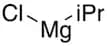
CAS:<p>Methylmagnesium bromide, 3M in ether</p>Formula:CH3MgBrColore e forma:liq.Peso molecolare:119.26i-Propylmagnesium chloride, 2-3M in ether
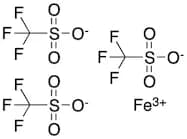
CAS:<p>i-Propylmagnesium chloride, 2-3M in ether</p>Formula:(CH3)2CHMgClColore e forma:liq.Peso molecolare:102.85Iron(III) trifluoromethanesulfonate
CAS:Prodotto controllatoFormula:C3F9FeO9S3Colore e forma:NeatPeso molecolare:503.05Chromium dioxide
CAS:Prodotto controllato<p>Applications Chromium dioxide (CAS# 12018-01-8) is a useful research chemical compound.<br></p>Formula:CrO2Colore e forma:NeatPeso molecolare:83.99





![BIS[BIS(TRIMETHYLSILYL)AMINO]TIN(II), 95%](/_next/image/?url=https%3A%2Fstatic.cymitquimica.com%2Fproducts%2F3H%2Fthumb-webp%2FSNB1025.webp&w=3840&q=75)