Monosaccaridi
I monosaccaridi sono la forma più semplice dei carboidrati e fungono da blocchi fondamentali per zuccheri più complessi e polisaccaridi. Queste singole molecole di zucchero svolgono ruoli critici nel metabolismo energetico, nella comunicazione cellulare e nei componenti strutturali delle cellule. In questa sezione troverai una vasta gamma di monosaccaridi essenziali per la ricerca in biochimica, biologia molecolare e glicoscienza. Questi composti sono cruciali per studiare le vie metaboliche, i processi di glicosilazione e lo sviluppo di agenti terapeutici. Da CymitQuimica, offriamo monosaccaridi di alta qualità per supportare le tue esigenze di ricerca, garantendo precisione e affidabilità nelle tue indagini scientifiche.
Sottocategorie di "Monosaccaridi"
- Alloses(11 prodotti)
- Arabinosi(21 prodotti)
- Eritrosio(11 prodotti)
- Fruttosio(9 prodotti)
- Fucosio(36 prodotti)
- Galactosamina(41 prodotti)
- Galattosio(261 prodotti)
- Glucosio(365 prodotti)
- Acidi glucuronici(51 prodotti)
- Glicosubstrati per enzima(77 prodotti)
- Gulosio(6 prodotti)
- Idosio(4 prodotti)
- Inositoli(15 prodotti)
- Lixosio(4 prodotti)
- Mannosio(65 prodotti)
- O-Glicani(48 prodotti)
- Psicosi(3 prodotti)
- Rhamnosio(10 prodotti)
- Ribosi(61 prodotti)
- Acidi Sialici(100 prodotti)
- Sorbosio(4 prodotti)
- Zuccheri(173 prodotti)
- Tagatosio(4 prodotti)
- Talosio(8 prodotti)
- Xyloses(20 prodotti)
Mostrare 17 più sottocategorie
Trovati 6090 prodotti di "Monosaccaridi"
Ordinare per
Purezza (%)
0
100
|
0
|
50
|
90
|
95
|
100
1,2-Di-O-acetyl-3-deoxy-3-fluoro-5-O-toluoyl-a-D-ribofuranose
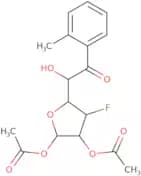
CAS:1,2-Di-O-acetyl-3-deoxy-3-fluoro-5-O-toluoyl-a-D-ribofuranose is a fluorinated sugar molecule. It is a methylated saccharide that has been modified with click chemistry and glycosylation. The modified sugar can be used to synthesize a variety of complex carbohydrates including oligosaccharides and polysaccharides. This product is available in high purity with CAS No. 1884324-99-5.Purezza:Min. 95%2,4-O-Benzylidene-D-Threose
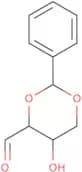
CAS:2,4-O-Benzylidene-D-Threose is a chemical compound that is used as a reagent in the synthesis of glycosphingolipids. It is prepared by the Wittig reaction of 2,4-dibromobenzaldehyde with potassium azide and phytosphingosine. The compound has also been used as a tool in biological studies to study the biosynthesis of glycosphingolipids. This product can react with carbinols to produce acetylides or diphosphate esters. 2,4-O-Benzylidene-D-Threose can be used as a reagent for the synthesis of methylmagnesium chloride, which is a Grignard reagent.Purezza:Min. 95%1,2,3,4-Tetra-O-acetyl-β-D-glucopyranose
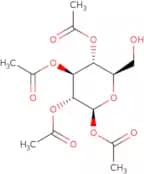
CAS:Building block for the 6-O-modification of Glc, including 6-O-glycosylationsFormula:C14H20O10Purezza:Min. 98 Area-%Colore e forma:PowderPeso molecolare:348.3 g/molMethyl 4-O-methyl-β-L-arabinopyranoside
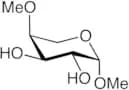
CAS:Methyl 4-O-methyl-β-L-arabinopyranoside is an L-arabinose analogueFormula:C7H14O5Purezza:Min. 95%Colore e forma:PowderPeso molecolare:178.18 g/mol2,3:4,5-Di-O-isopropylidene-L-arabitol
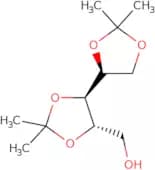
CAS:2,3:4,5-Di-O-isopropylidene-L-arabitol is a modification of an oligosaccharide in which the hydroxyl group at position 4 on the D-ribose moiety has been replaced with an isopropylidene group. The synthesis of 2,3:4,5-Di-O-isopropylidene-L-arabitol can be achieved by methylation and fluorination of L-arabinose. This compound is used in glycosylations and polysaccharide syntheses. 2,3:4,5-Di-O-isopropylidene-L--arabitol is also found as a natural constituent of many plants. 2,3:4,5--Di--O--isopropylidene--L--arabitol is chemically described as α-(1→6)-D--glucopFormula:C11H20O5Purezza:Min. 95%Colore e forma:PowderPeso molecolare:232.27 g/mol1,2,3,6-Tetra-O-methyl-D-glucopyranoside
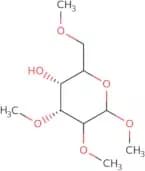
Tetra-O-methylglucose is a sugar that has four methyl groups at the 1,2,3,6 positions. It is a custom synthesis for research purposes and it has not been found in nature. Tetra-O-methylglucose can be synthesized by the fluorination of glucose followed by glycosylation with an acetylating agent and finally methylation with an alkylating agent. Tetra-O-methylglucose has not been used as a food additive or pharmaceutical product.Formula:C10H20O6Purezza:Min. 95%Peso molecolare:236.26 g/molL-Arabinose
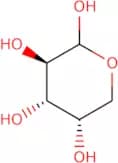
CAS:The aldopentose L-arabinose (Ara) is, after xylose, the second most abundant pentose in nature. It is found in plant cell walls as a component of polysaccharides, including: hemicelluloses, pectin, arabinogalactan-protein complexes and in exudate plant gums, such as: Gum Arabic (Feher, 2018). L-Arabinopyranose is an important component of the mycobacterial cell wall and is involved in the synthesis of arabinogalactan and lipoarabinomannan, which suggests that it can modulate cell wall permeability and drug resistance. Mycobacterium smegmatis is a useful tool for research into Mycobacteria due to it being a "fast grower" and non-pathogenic (Zhou, 2019).Formula:C5H10O5Purezza:Min. 99 Area-%Colore e forma:White PowderPeso molecolare:150.13 g/mol1,2,3,4-Tetra-O-benzoyl-6-O-tert-butyldiphenylsilyl-a-D-mannopyranose
CAS:1,2,3,4-Tetra-O-benzoyl-6-O-tert-butyldiphenylsilyl-a-D-mannopyranose is a custom synthesis. It is a fluorinated monosaccharide that can be used as a glycosylation or polysaccharide modification reagent. This product has been modified with methyl groups at the 2 and 3 positions of the phenolic ring and tetra-(1,2,3,4)-benzoate groups at the 4 position. The purity of this product is >98%.Formula:C40H42O10SiPurezza:Min. 95%Peso molecolare:710.86 g/mol3-Deoxy-3-fluoro-D-xylofuranose, Aqueous solution
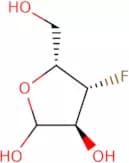
CAS:3-Deoxy-3-fluoro-D-xylofuranose - Aqueous solution is a substrate for the enzyme glucose isomerase. This enzyme catalyses the isomerisation of 3-deoxy-3-fluoro-D-xylofuranose to D-ribose in aqueous solution. The immobilised glucose isomerase can be used as an alternative to the free form, which has been shown to have low yields and high levels of product inhibition.Formula:C5H9FO4Purezza:Min. 95%Colore e forma:Yellow PowderPeso molecolare:152.12 g/molmyo-Inositol 1,3,4,5,6-pentakisphosphate decasodium salt
CAS:Myo-inositol 1,3,4,5,6-pentakisphosphate decasodium salt is a complex carbohydrate that has been modified with fluorine. This modification has been shown to increase the solubility of myo-inositol 1,3,4,5,6-pentakisphosphate decasodium salt in organic solvents. Myo-inositol 1,3,4,5,6-pentakisphosphate decasodium salt is used in the synthesis of oligosaccharides and polysaccharides. It also serves as a substrate for methylation and glycosylation reactions. The synthesis of this compound can be achieved by a Click reaction.Formula:C6H17O21P5·10NaPurezza:Min. 95%Colore e forma:PowderPeso molecolare:809.95 g/molCaffeic acid 3-O-b-D-glucopyranoside
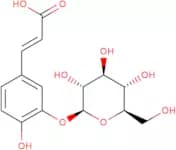
CAS:Caffeic acid 3-O-b-D-glucopyranoside is a naturally occurring phenolic compound found in plants. It is a white to off-white powder that is soluble in methanol, ethanol, and water. Caffeic acid 3-O-b-D-glucopyranoside has been shown to have antioxidant properties by increasing the mitochondrial membrane potential in erythrocytes and reducing free radicals. It also may have anticancer activity due to its ability to inhibit tumor growth in vivo studies.Formula:C15H18O9Purezza:Min. 98 Area-%Colore e forma:Off-White PowderPeso molecolare:342.3 g/molTri-O-benzyl-isofagomine hydrochloride
<p>Tri-O-benzyl-isofagomine hydrochloride is a modification of an oligosaccharide and a carbohydrate. It is synthesized by the methylation and glycosylation of isofagomine. Tri-O-benzyl-isofagomine hydrochloride has been shown to have high purity and can be used in the treatment of cancer, as well as being a potential drug for diabetes mellitus. This drug also prevents the formation of glycosaminoglycan polymers, which are responsible for cartilage rigidity. The CAS number for this drug is 569287-73-2.</p>Purezza:Min. 95%N-Butyldeoxynojirimycin hydrochloride
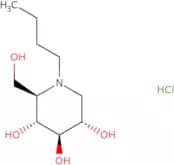
CAS:<p>Competitive inhibitor of ceramide-glycosyltransferase used for substrate reduction therapy in lysosomal storage disorders. It inhibits glucosylceramide synthase, which catalyses the initial step in glycosphingolipid biosynthetic pathway. This compound delays the onset of symptoms in type 1 Gaucher disease, Sandhoff disease and Tay-Sachs disease. It also reduces brain abnormalities in mucolipidosis type IV.</p>Formula:C10H21NO4•HClPurezza:Min. 95%Colore e forma:PowderPeso molecolare:255.74 g/moln-Octyl-β-D-glucopyranoside
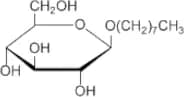
CAS:Octyl-beta-D-glucopyranoside is an alkylglycoside non-ionic detergent and is one of the most commonly used in membrane protein isolation. As it is uncharged, it is unlikely to cause protein denaturation or refolding issues, allowing for the isolation of intact macromolecular complexes without affecting protein-protein interactions. Octyl-beta-D-glucopyranoside, also known as octylglucoside or OG, forms small, uniformed micelles and has an aggregation number of between 27-100. It is readily dialyzable from membrane protein preparations due to its high Critical Micelle Concentration (CMC) of 18-20mM. Octyl-beta-D-glucopyranoside has similar uses and properties to that of another frequently used surfactant, Octyl-beta-D-thioglucopyranoside.Formula:C14H28O6Peso molecolare:292.38 g/molRef: 3D-O-2000
1gPrezzo su richiesta25gPrezzo su richiesta50gPrezzo su richiesta100gPrezzo su richiesta250gPrezzo su richiesta-Unit-ggPrezzo su richiesta4,6-O-(4-Methoxybenzylidene)-1,2,3-tri-O-pivaloyl-b-D-glucopyranose
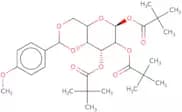
4,6-O-(4-Methoxybenzylidene)-1,2,3-tri-O-pivaloyl-b-D-glucopyranose is a Glycosylation compound that has been modified with methyl groups on the 4 and 6 carbons of the sugar. It is a complex carbohydrate that has been fluorinated at the C5 position. This product is available for custom synthesis in quantities of 10g or more. The CAS number for this compound is 13357007.Formula:C29H42O10Purezza:Min. 95%Peso molecolare:550.65 g/mol2,3,4,6-Tetra-O-pivaloyl-b-D-galactopyranosyl amine
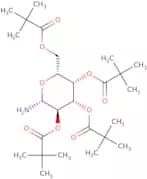
CAS:2,3,4,6-Tetra-O-pivaloyl-b-D-galactopyranosyl amine is a glycosylated monosaccharide with four pivaloyl groups. It is an important component of the glycoconjugate family and has been used in research as a model for glycoprotein synthesis. This compound is synthesized from 2,3,4,6-tetra-O-pivaloylglucose through the use of Click chemistry and fluorination. The 2,3,4,6-Tetra-O-pivaloylglucose can be modified to produce a variety of sugar derivatives including methylated sugars and polysaccharides. This product is custom synthesized to meet customer specifications. 2,3,4,6-Tetra-O-pivaloylglucose can be obtained by reacting 2 equivalents of triacetinFormula:C26H45NO9Purezza:Min. 95%Colore e forma:PowderPeso molecolare:515.64 g/molD-Galactose-6-O-sulphate sodium
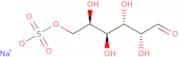
CAS:D-Galactose-6-O-sulphate sodium salt is used as a diagnostic agent to measure the level of galactose in blood and tissues. The enzyme that hydrolyzes D-galactose-6-O-sulphate, galactose oxidase, is present in leukocytes and chorionic villi. The enzymatic assay for this chemical is based on the reaction between D-galactose and sulfite to form D-galactosulfonic acid. This reaction is catalysed by a sulphatase enzyme. A fluorimetric method can be used to measure the formation of D-galactosulfonic acid.Formula:C6H11O9SNaPurezza:Min. 95%Colore e forma:White PowderPeso molecolare:282.2 g/molMethyl 4,6-O-benzylidene-2-benzyloxycarbonylamino-2-deoxy-a-D-glucopyranose
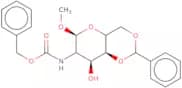
CAS:Methyl 4,6-O-benzylidene-2-benzyloxycarbonylamino-2-deoxy-a-D-glucopyranose is a custom synthesized compound. It is a polysaccharide that is modified with fluorine and methyl groups. The chemical structure of this compound includes a glucose molecule with an amino group at the C1 position and an acetyl group at the C4 position. This modification increases the solubility and stability of this compound. Methyl 4,6-O-benzylidene-2-benzyloxycarbonylamino-2-deoxy--A D glucopyranose has been used in research as a model for glycosylation.Formula:C22H25NO7Purezza:Min. 95%Peso molecolare:415.44 g/molGDP-L-fucose disodium - low endotoxin grade
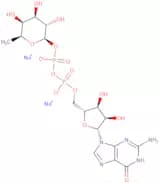
CAS:GDP-L-fucose is a natural fucosyl donor and substrate for fucosyltransferases (FUT) that catalyses the fucosylation of, for example, human milk oligosaccharides or glycoproteins. GDP-L-fucose is widely used in (chemo)enzymatic synthesis of glycans. Cymit Quimicaesis of GDP-L-fucose, a nucleotide sugar consisting of an L-fucose that is β-glycosidically linked to the nucleotide guanosine diphosphate (GDP), is achieved either through de novo synthesis via GDP-mannose or through a salvage pathway from free fucose. Fucosylation is catalysed by fucosyltransferases (~ 13 FUT genes have been identified in the human genome to date) to generate α-1,2, α-1,3, α-1-4 and α-1-6 linkages of fucose to other sugars, as well as direct linkages to peptides, with release of GDP (Lairson, 2008).Formula:C16H23N5O15P2Na2Purezza:Min. 95%Colore e forma:White PowderPeso molecolare:633.31 g/molSunitinib N-glucuronide
Sunitinib N-glucuronide is a synthetic small molecule with a molecular weight of 517.63 Da and a chemical formula of C14H18F3N5O6S. Sunitinib N-glucuronide is a monosaccharide sugar that is modified with fluorine. It is one of the products of the methylation, custom synthesis, and click modification reactions. The CAS number for this product is 70698-74-7. Sunitinib N-glucuronide has a purity level of 98%, which means that it has less than 2% impurities. This product can be used in oligosaccharides, polysaccharides, or saccharides as a complex carbohydrate or high purity carbohydrate. It can also be used as an additive to modify the properties of monosaccharides and sugars.Purezza:Min. 95%