Monosaccaridi
I monosaccaridi sono la forma più semplice dei carboidrati e fungono da blocchi fondamentali per zuccheri più complessi e polisaccaridi. Queste singole molecole di zucchero svolgono ruoli critici nel metabolismo energetico, nella comunicazione cellulare e nei componenti strutturali delle cellule. In questa sezione troverai una vasta gamma di monosaccaridi essenziali per la ricerca in biochimica, biologia molecolare e glicoscienza. Questi composti sono cruciali per studiare le vie metaboliche, i processi di glicosilazione e lo sviluppo di agenti terapeutici. Da CymitQuimica, offriamo monosaccaridi di alta qualità per supportare le tue esigenze di ricerca, garantendo precisione e affidabilità nelle tue indagini scientifiche.
Sottocategorie di "Monosaccaridi"
- Alloses(11 prodotti)
- Arabinosi(21 prodotti)
- Eritrosio(11 prodotti)
- Fruttosio(9 prodotti)
- Fucosio(36 prodotti)
- Galactosamina(41 prodotti)
- Galattosio(261 prodotti)
- Glucosio(365 prodotti)
- Acidi glucuronici(51 prodotti)
- Glicosubstrati per enzima(77 prodotti)
- Gulosio(6 prodotti)
- Idosio(4 prodotti)
- Inositoli(15 prodotti)
- Lixosio(4 prodotti)
- Mannosio(65 prodotti)
- O-Glicani(48 prodotti)
- Psicosi(3 prodotti)
- Rhamnosio(10 prodotti)
- Ribosi(61 prodotti)
- Acidi Sialici(100 prodotti)
- Sorbosio(4 prodotti)
- Zuccheri(173 prodotti)
- Tagatosio(4 prodotti)
- Talosio(8 prodotti)
- Xyloses(20 prodotti)
Mostrare 17 più sottocategorie
Trovati 6090 prodotti di "Monosaccaridi"
Ordinare per
Purezza (%)
0
100
|
0
|
50
|
90
|
95
|
100
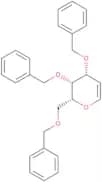
3,4,6-Tri-O-benzyl-D-galactal
CAS:3,4,6-Tri-O-benzyl-D-galactal is a hydrogen bond donor and has been shown to have physiological activities. It was found to increase the number of lymphocytes in unimmunized mice. It also inhibits the growth of psoralea virus. The glycosidic bond between 3,4,6-tri-O-benzyl-D-galactal and glucose produces a product with an acetylated hydroxyl group and an aldehyde group. This type of bond is stereoselective and benzofuran derivatives are formed from the reaction. 3,4,6-Tri-O-benzyl-D-galactal has been shown to have anticancer activity against cancer cells in laboratory experiments.Formula:C27H28O4Purezza:Min. 95%Colore e forma:White PowderPeso molecolare:416.51 g/mol2,3,4-Tri-O-acetyl-D-arabinopyranosyl bromide - Stabilised with 2% CaCO3
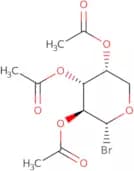
CAS:2,3,4-Tri-O-acetyl-D-arabinopyranosyl bromide - Stabilised with 2% CaCO3 is an organic compound that belongs to the group of glycosylations. It is a sugar derivative of arabinose and has been fluorinated with trifluoromethanesulfonic acid. This product is custom synthesized and can be used for Glycosylation reactions as well as methylations and click modifications. It is also a complex carbohydrate and can be used in the production of polysaccharides. The CAS number for this compound is 113889-50-2 and it has a monosaccharide content of 100%. This product is available for purchase at high purity.Formula:C11H15BrO7Purezza:Min. 95%Colore e forma:PowderPeso molecolare:339.14 g/mol3-Deoxypentulose
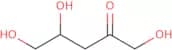
CAS:3-Deoxypentulose is a kinetic, reactive and chromatographic compound that belongs to the family of glycolysis. It is present in small amounts in the blood and is derived from pentose sugars. The reaction mechanism of 3-deoxypentulose can be divided into two steps: glyoxal formation and hydroxide solution modification. In the first step, 3-deoxypentulose reacts with glucose to form glyoxal. In the second step, 3-deoxypentulose reacts with hydroxide solution to form galactose, which can further react with other compounds or be modified by enzymatic reactions. This compound has been used as a tagatose substitute in food products and as an oligosaccharide modifier. Recently, it has been shown that 3-deoxypentulose may be used as a chemical probe for studying glycolic acid synthesis in bacteria.Formula:C5H10O4Purezza:Min. 95%Colore e forma:PowderPeso molecolare:134.13 g/mol2-Methoxycarbonylphenyl β-D-glucopyranoside
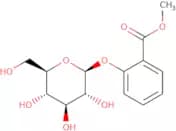
CAS:<p>2-Methoxycarbonylphenyl b-D-glucopyranoside is a modification that can be used to synthesize complex carbohydrates. It is an oligosaccharide, which consists of a series of monosaccharides linked together by glycosidic bonds. The synthesis of this compound requires the use of methylation and fluorination reactions. This product has high purity and can be used for a variety of purposes, including as a sugar or as a polysaccharide.</p>Formula:C14H18O8Purezza:Min. 95%Colore e forma:PowderPeso molecolare:314.29 g/molN-Acetyl-2,3-dehydro-2-deoxyneuraminic acid sodium
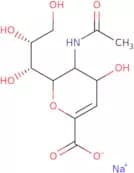
CAS:<p>Inhibitor of viral, bacterial and animal sialidase</p>Formula:C11H16NNaO8Purezza:Min. 95%Colore e forma:White PowderPeso molecolare:313.24 g/mol6-Chloro-6-deoxy-D-glucose
CAS:<p>6-Chloro-6-deoxy-D-glucose is a sugar that is used as a carbon source in the process of spermatozoa production. It has been shown to increase the fertility of animals by increasing the uptake of phosphorus pentachloride and ganglion cells in the testes. This drug also has contraceptive and antifertility effects, which may be due to its ability to inhibit the uptake of adenine nucleotide in cells. 6-Chloro-6-deoxy-D-glucose may have a role in ATP levels, with intracellular levels being higher than those in control analysis.</p>Formula:C6H11ClO5Purezza:Min. 95%Colore e forma:White Off-White PowderPeso molecolare:198.6 g/mol3,5,6-Trichloro-2-pyridinol β-D-glucuronide
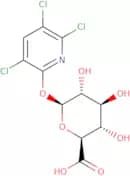
CAS:3,5,6-Trichloro-2-pyridinol b-D-glucuronide is a synthetic glycosylate that has been modified by fluorination and methylation. It is used as an intermediate in the manufacture of a variety of saccharides and oligosaccharides. The sugar has been synthesized to have a high purity. 3,5,6-Trichloro-2-pyridinol b-D-glucuronide is a complex carbohydrate that can be modified using click chemistry. Click chemistry is a modification technique that uses copper (II) ions as catalysts for the formation of carbon–carbon bonds. This process can be used to modify saccharides and oligosaccharides with functional groups such as amines, thiols, alcohols, carboxylic acids, or nitriles.Formula:C11H10Cl3NO7Purezza:Min. 95%Colore e forma:White PowderPeso molecolare:374.56 g/molL-Talitol
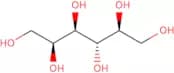
CAS:L-Talitol is a naturally occurring sugar alcohol that is found in the human body and in many vegetables, fruits, and grains. It has been shown to be a potent inhibitor of the bacterium Klebsiella aerogenes. L-talitol has been used as a model system to study the effect of matrix on the growth of cells. It has also been shown to have chronic pulmonary effects and to be effective for treating selenium deficiency. L-talitol can inhibit b-raf by binding to the hydroxyl group on its kinase domain and inhibiting downstream signaling pathways. This inhibition leads to reduced levels of transcriptional regulation in cells, which may be due to decreased protein synthesis or increased degradation of mRNA. L-Talitol also inhibits d-talitol dehydrogenase, which results in an increase in d-talitol concentrations in cells.Formula:C6H14O6Purezza:Min. 95%Colore e forma:PowderPeso molecolare:182.17 g/molUDP-D-glucuronide trisodium salt
CAS:<p>Substrate for glucuronosyltransferases</p>Formula:C15H19N2Na3O18P2Purezza:Min. 98 Area-%Colore e forma:White Off-White PowderPeso molecolare:646.24 g/molL-Allono-1,4-lactone
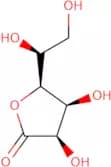
CAS:L-Allono-1,4-lactone is a molecule with a stereocenter. It has been shown to be a target molecule for glycosidase inhibitors. The inhibition of the enzyme by L-allono-1,4-lactone may be due to its ability to form a hydrogen bond with the oxygen atom in the active site of the enzyme and its hydroxyl group that can form an additional hydrogen bond with water molecules. This inhibition prevents the transfer of glucose from one substrate to another, which leads to inefficient glycosidase activity. The synthesis of L-allono-1,4-lactone has been studied using piperidine as a starting material.Formula:C6H10O6Purezza:Min. 95%Colore e forma:PowderPeso molecolare:178.14 g/mol2,3,4-Tri-O-acetyl-1,6-anhydro-b-D-galactopyranose
CAS:<p>2,3,4-Tri-O-acetyl-1,6-anhydro-b-D-galactopyranose is a sugar that has been modified with fluorination. This modification is done in an effort to increase the solubility of this product. It is also used as the backbone for other sugars in order to create complex carbohydrates or polysaccharides. In addition, 2,3,4-Tri-O-acetyl-1,6-anhydro-b-D-galactopyranose can be methylated and glycosylated in order to modify its properties. This product is available for custom synthesis and has a purity level of 99%.</p>Formula:C12H16O8Purezza:Min. 95%Colore e forma:PowderPeso molecolare:288.25 g/mol3,5,6-Tri-O-benzyl-1,2-O-Isopropylidene-a-D-glucofuranose
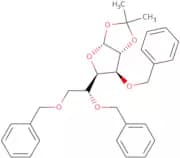
CAS:3,5,6-Tri-O-benzyl-1,2-O-isopropylidene-a-D-glucofuranose is a synthetic monosaccharide that has been fluorinated at the C3 position. It is an oligosaccharide with a complex carbohydrate structure. This glycosylation product can be custom synthesized and has been modified by methylation. 3,5,6-Tri-O-benzyl-1,2-O-isopropylidene Glucuronic acid can be used in the synthesis of polysaccharides or as a sugar for click chemistry. The chemical formula is C13H28O4F3 and its molecular weight is 322.32 g/mol.Formula:C30H34O6Purezza:Min. 95%Colore e forma:PowderPeso molecolare:490.59 g/mol2,3,4,6-Tetra-O-acetyl-β-D-glucopyranosyl-Fmoc serine
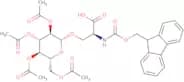
CAS:<p>2,3,4,6-Tetra-O-acetyl-b-D-glucopyranosyl-Fmoc serine is a protein that belongs to the group of bifunctional glycosides. It is used in recombinant virus production as a component of the viral coat protein (VP). 2,3,4,6-Tetra-O-acetyl-b-D-glucopyranosyl-Fmoc serine binds to tyrosine kinase receptors and inhibits their activity. This inhibition prevents cell adhesion and migration and can cause tumor regression in some cancers. 2,3,4,6-Tetra-O-acetyl-b-D--glucopyranosyl--Fmoc serine also has antiviral activity due to its ability to inhibit the replication of viruses containing RNA genomes.</p>Formula:C32H35NO14Purezza:Min. 95%Colore e forma:SolidPeso molecolare:657.63 g/molMethyl 3,5-di-O-(p-chlorobenzoyl)-α-D-ribofuranoside
Methyl 3,5-di-O-(p-chlorobenzoyl)-a-D-ribofuranoside is an organic compound. It is a synthetic product that is used in the synthesis of saccharides and polysaccharides. This chemical can be modified with Click chemistry to create a glycosylate or fluorinated complex carbohydrate. The compound has CAS number 62700-92-3 and can be custom synthesized to meet customer specifications.Purezza:Min. 95%Methyl α-L-daunosamide hydrochloride
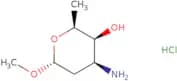
CAS:Methyl α-L-daunosamide hydrochloride is a drug that inhibits the production of DNA. It is used to treat infectious diseases such as malaria, in which it can inhibit the growth of the parasite by preventing DNA replication and transcription. The methyl α-L-daunosamide hydrochloride molecule is a polymerase chain inhibitor that binds to the enzyme adriamycin synthetase, which catalyzes the conversion of daunosamine into adriamycin. This binding prevents the formation of stable complexes with the target enzymes and blocks their activity, leading to inhibition of DNA synthesis and transcription. Methyl α-L-daunosamide hydrochloride has been shown to inhibit glycan biosynthesis in rat liver microsomes and does not have significant interactions with other drugs or with glycan in human serum.Formula:C7H15NO3•HClPurezza:Min. 85 Area-%Colore e forma:PowderPeso molecolare:197.66 g/mol2,3,4,6-Tetra-O-benzoyl-1-deoxy-D-arabino-hex-1-enopyranose
CAS:2,3,4,6-Tetra-O-benzoyl-1-deoxy-D-arabino-hex-1-enopyranose is a glycosyl compound that has been synthesized by the elimination of trifluoride and alcohols. It is used as a starting material for the synthesis of other compounds. This compound can react with halides to form etherate or ester derivatives. 2,3,4,6-Tetra-O-benzoyl-1-deoxy-D-arabino hexane can also be reacted with boron trifluoride or boron trifluoride etherate to form eliminations.Formula:C34H26O9Purezza:Min. 95%Peso molecolare:578.57 g/mol2-Acetamido-1,3,4,6-tetra-O-benzyl-2-deoxy-β-D-thioglucopyranose
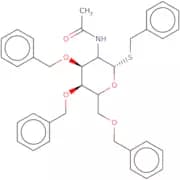
2-Acetamido-1,3,4,6-tetra-O-benzyl-2-deoxy-b-D-thioglucopyranose is a modification of the natural molecule glucose. It is an Oligosaccharide with a complex carbohydrate structure. The molecule has been custom synthesized and is synthesized to be of high purity. It has CAS No.: 52268-42-9. 2-Acetamido-1,3,4,6-tetra-O-benzyl-2-deoxyglucopyranose is a Monosaccharide that can be methylated and glycosylated to form Polysaccharides. This molecule can be used as a sugar in food products or as a Fluorination agent for other molecules.Formula:C36H39NO5SPurezza:Min. 95%Peso molecolare:597.76 g/mol6-O-Malonylgenistin, free acid
CAS:Genistin is an isoflavone found in soybeans and other plants. It has antioxidative properties, which may be due to its ability to scavenge free radicals. Genistin also has protein-binding activity, and it can inhibit the growth of certain insects by binding to their DNA. Genistin can also bind to a number of enzymes and affect their activities, including amylase, chymotrypsin, trypsin, and lipase. It is also involved in energy metabolism and protein synthesis. The physiological effects of genistin are not well understood but may be related to its ability to act as a phytoestrogen or mimic estrogen.Formula:C24H22O13Purezza:Min. 95%Colore e forma:Slightly Brown PowderPeso molecolare:518.42 g/molN-Methyl-D-glucamine HCl
CAS:N-Methyl-D-glucamine HCl is a salt of N-methylglucamine and hydrochloric acid. It is used as a buffer to maintain the pH of solutions at a desired level. N-Methyl-D-glucamine HCl has an inhibition constant (Ki) of 0.5 mM for glutamate, which can be used to measure the concentration of glutamate in tissue samples or reaction mixtures. This compound also inhibits locomotor activity, and its effect on blood pressure may be due to its ability to inhibit amines. The Ki for chloride is approximately 2 mM, and it can be used to measure the concentration of chloride in solution.Formula:C7H17NO5·HClColore e forma:PowderPeso molecolare:231.67 g/molN-Methyldeoxynojirimycin
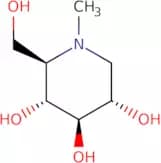
CAS:N-Methyldeoxynojirimycin is a monoclonal antibody that is a competitive inhibitor of the melanoma antigen gp75. It is also an inhibitor of oligosaccharide synthesis and has been shown to have anti-inflammatory properties. N-Methyldeoxynojirimycin binds to the golgi alpha-mannosidases, preventing them from processing high-mannose type oligosaccharides. This leads to decreased chemoattractant protein production by neutrophils, which are important in the inflammatory process. N-Methyldeoxynojirimycin has also been shown to inhibit myocardial infarct size and glomerular filtration rate in rats, as well as increase biochemical markers for inflammation, such as α subunit of α1 acid glycoprotein and basic fibroblast growth factor.Formula:C7H15NO4Purezza:Min. 95%Colore e forma:White PowderPeso molecolare:177.2 g/mol