Peptidi
I peptidi sono catene corte di amminoacidi legate da legami peptidici, che svolgono ruoli chiave come molecole biologiche importanti nei processi cellulari. Funzionano come ormoni, neurotrasmettitori e molecole di segnalazione, e sono ampiamente utilizzati in applicazioni terapeutiche e diagnostiche. I peptidi sono anche cruciali nella ricerca per lo studio delle interazioni proteiche, delle attività enzimatiche e dei percorsi di segnalazione cellulare. Presso CymitQuimica, offriamo una vasta selezione di peptidi di alta qualità per supportare le vostre esigenze di ricerca e sviluppo in biotecnologia e farmacologia.
Sottocategorie di "Peptidi"
Trovati 30094 prodotti di "Peptidi"
Ordinare per
Purezza (%)
0
100
|
0
|
50
|
90
|
95
|
100
Laminin Penta Peptide, amide
<p>Catalogue peptide; min. 95% purity</p>Formula:C26H43N9O7Peso molecolare:593.7 g/molRef: 3D-VAC-00887
Prodotto fuori produzione[Des-Pro2] Bradykinin
<p>Catalogue peptide; min. 95% purity</p>Formula:C45H66N14O10Peso molecolare:963.12 g/molRef: 3D-VAC-00674
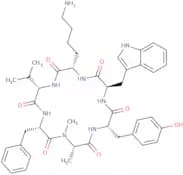
Prodotto fuori produzioneSeglitide acetate
CAS:Prodotto controllato<p>Seglitide is a cyclic peptide that is a model system for the receptor activity of somatostatin. Somatostatin inhibits cells by binding to its receptors, which are found on the surface of endocrine cells and in the hypothalamus. Seglitide has been shown to inhibit cell growth in tissue culture and is a potent inhibitor of epidermal growth factor (EGF) production. Seglitide also activates locomotor activity in mice, suggesting that it may have some clinical relevance. Structural analysis has revealed that seglitide's amino acid sequence is similar to somatostatin's, making them closely related compounds. It also binds to DNA-dependent RNA polymerase, preventing transcription and replication.</p>Formula:C44H56N8O7·C2H4O2Purezza:Min. 95%Peso molecolare:869.02 g/molbeta-Amyloid (12-28)
<p>Catalogue peptide; min. 95% purity</p>Formula:C89H135N25O25Peso molecolare:1,955.22 g/molRef: 3D-VAC-00797
Prodotto fuori produzionebeta-Amyloid Protein Precursor 770 (135-155)
<p>Catalogue peptide; min. 95% purity</p>Formula:C116H173N35O31S2Peso molecolare:2,617.95 g/molRef: 3D-VAC-00391
Prodotto fuori produzioneDefensin (human) HNP-2
<p>Catalogue peptide; min. 95% purity</p>Formula:C147H217N43O37S6Peso molecolare:3,370.94 g/molRef: 3D-VAC-00299
Prodotto fuori produzioneH-Ile-Arg-Pro-OH
CAS:<p>Please enquire for more information about H-Ile-Arg-Pro-OH including the price, delivery time and more detailed product information at the technical inquiry form on this page</p>Formula:C17H32N6O4Purezza:Min. 95%Peso molecolare:384.47 g/molHead activator
<p>Catalogue peptide; min. 95% purity</p>Formula:C54H84N12O14Peso molecolare:1,125.36 g/molRef: 3D-VAC-00194
Prodotto fuori produzioneCarassin (Carrassius Auratus)
<p>Catalogue peptide; min. 95% purity</p>Formula:C103H175N35O27SPeso molecolare:2,367.83 g/molRef: 3D-VAC-00733
Prodotto fuori produzioneRef: 3D-VAC-00643
Prodotto fuori produzioneTirzepatide acetate
CAS:<p>Cymit Quimica provides this product solely for uses within the scope of any statute or law providing for an immunity, exemption, or exception to patent infringement (“Exempted Uses”), including but not limited to 35 U.S.C. § 271(e)(1) in the United States, the Bolar type exemption in Europe, and any corresponding exception to patent infringement in any other country. It is the sole responsibility of the purchaser or user of this product, and the purchaser or user of this product agrees to engage only in such Exempted Uses, and to comply with all applicable intellectual property laws and/or regulations. The purchaser of this product agrees to indemnify Cymit Quimica against all claims in connection with the performance of the respective commercial agreement (e.g. supply agreement) and possible infringements of intellectual property rights.</p>Purezza:Min. 95%Myelin Oligodendrocyte Glycoprotein (35-55) (mouse, rat) trifluoroacetate
CAS:<p>Myelin oligodendrocyte glycoprotein (MOG) is a myelin protein found in the central nervous system. MOG is a ligand for CD200, which is an inhibitory receptor expressed by astrocytes. It has been shown that MOG can induce the proliferation and differentiation of primary cultures of rat astrocytes in vitro. MOG induces the production of reactive oxygen species in mitochondria and increases the expression of acid-binding protein, which are both important factors in the demyelination process. MOG has also been implicated as a potential factor in the development of multiple sclerosis. Further research into this protein may lead to new treatments or cures for disorders such as encephalomyelitis, nervous system diseases, or even cancer.</p>Formula:C118H177N35O29S•C2HO2F3Purezza:Min. 95%Colore e forma:PowderPeso molecolare:2,695.98 g/molRef: 3D-FM109206
Prodotto fuori produzioneA-A-A-Y-G-G-F-L
<p>Catalogue peptide; min. 95% purity</p>Formula:C37H52N8O10Peso molecolare:768.87 g/molRef: 3D-VAC-00206
Prodotto fuori produzioneRef: 3D-VAC-00800
Prodotto fuori produzione


![[Des-Pro2] Bradykinin](/_next/image/?url=https%3A%2Fstatic.cymitquimica.com%2Fproducts%2F3D%2Fthumb-webp%2FVAC-00674.webp&w=3840&q=75)