Substrati enzimatici
I substrati enzimatici sono molecole su cui agiscono gli enzimi per catalizzare reazioni chimiche. Il substrato si lega al sito attivo dell'enzima, dove subisce una trasformazione specifica per formare il prodotto della reazione. I substrati enzimatici sono strumenti essenziali nella ricerca per studiare la cinetica enzimatica, la specificità e il meccanismo d'azione. Sono utilizzati anche in saggi diagnostici e studi biochimici. Presso CymitQuimica, offriamo una selezione diversificata di substrati enzimatici di alta qualità per supportare le vostre ricerche in enzimologia e biochimica.
Sottocategorie di "Substrati enzimatici"
Trovati 1529 prodotti di "Substrati enzimatici"
Ordinare per
Purezza (%)
0
100
|
0
|
50
|
90
|
95
|
100
Coelenterazine cp
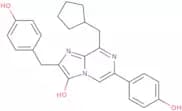
CAS:Coelenterazine cp is a coelenterazine analog for Renilla luciferase. In certain studies, it has been shown to be highly sensitive for the detection of human papilloma virus (HPV) and can be used in the diagnosis of cervical cancer.Formula:C25H25N3O3Purezza:Min. 95%Peso molecolare:415.48 g/molResorufin b-D-cellobioside
CAS:<p>Resorufin b-D-cellobioside is a fluorogenic substrate for measurement of cellulase activity. The product of enzyme reaction, resorufin, exhibits fluorescence emission at 585 nm with excitation at 571 nm at or near physiological pH values.</p>Formula:C24H27NO13Purezza:Min. 95 Area-%Colore e forma:Brown Orange PowderPeso molecolare:537.47 g/mol3-Nitrophenyl β-D-glucopyranoside
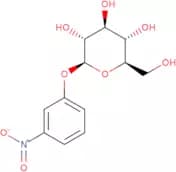
CAS:3-Nitrophenyl beta-D-glucopyranoside is a chromogenic enzyme substrate commonly used to assay for beta-glucosidase activity. Upon hydrolysis by the enzyme, it produces a yellow product that can be easily detected by spectrophotometry. This substrate is often used in the field of carbohydrate chemistry and biochemistry to study enzyme kinetics and inhibition in both in vitro and in vivo systems.Formula:C12H15NO8Purezza:Min. 95%Colore e forma:White Yellow PowderPeso molecolare:301.25 g/mol3-Indolyl 2-acetamido-2-deoxy-b-D-glucopyranoside
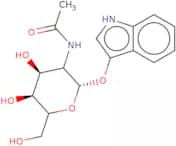
CAS:3-Indolyl 2-acetamido-2-deoxy-b-D-glucopyranoside is a substrate used for the detection of the enzyme N-acetylglucosaminidase (NAG). The enzyme hydrolyzes the NAG conjugate, releasing indole that can be detected through a colorimetric assay. This method is commonly used in clinical chemistry to evaluate kidney function, as NAG is excreted in urine and increased levels may indicate renal injury or disease. The indole NAG assay is also used in microbiology to detect the presence of NAG-producing bacteria.Purezza:Min. 95%Peso molecolare:336.34 g/molNaphthol AS-BI β-L-fucopyranoside
CAS:Substrate for the detection of beta-D-fucosidaseFormula:C24H24BrNO7Purezza:Min. 95%Peso molecolare:518.35 g/mol4-Methylumbelliferyl b-D-glucosaminide - Moscerdam™ biochemical purity
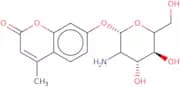
CAS:<p>A substrate used for the diagnosis of Sanfilippo disease C (MPS III C).</p>Formula:C16H19NO7Purezza:Min. 98 Area-%Colore e forma:White PowderPeso molecolare:337.32 g/molL-Alanine-7-amido-4-methylcoumarin hydrochloride
CAS:L-Alanine-7-amido-4-methylcoumarin hydrochloride is a synthetic peptide substrate used as a fluorogenic substrate for alanine aminopeptidase.Formula:C13H14N2O3·HClPurezza:Min. 90%Colore e forma:PowderPeso molecolare:282.72 g/molAldol® 484 beta-D-galactopyranoside, Biosynth Patent: EP 2427431 and US 8940909
CAS:<p>Aldol® 484 beta-D-galactopyranoside is a chromogenic enzyme substrate for beta-galactosidase activity. The colorless product is cleaved by lactose-utilizing bacteria in liquid or solid media, yielding intense red color. Aldol® 484 beta-D-galacto-pyranoside can also be used in beta-gal reporter gene assays or for identification of beta-gal positive transformants on agar. Aldol® 484 beta-D-galactopyranoside can be used under aerobic and anaerobic conditions.</p>Formula:C26H24ClFN2O7Purezza:Min. 95%Colore e forma:PowderPeso molecolare:530.93 g/mol2-Chloro-4-nitrophenyl β-D-glucopyranoside
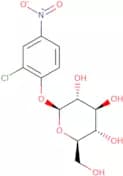
CAS:2-Chloro-4-nitrophenyl β-D-glucopyranoside is a chromogenic substrate for beta-glucosidases. In biochemical enzyme assays and in vitro diagnostics analysis, the substrate is used to monitor the glycosyltransferase activity. When 2-chloro-4-nitrophenyl β-D-glucopyranoside is cleaved by beta-glucosidase, 2-chloro-4-nitrophenol is released and quantified.Formula:C12H14ClNO8Purezza:Min. 95%Colore e forma:White PowderPeso molecolare:335.69 g/mol4-Methylumbelliferyl-β-D-xylopyranoside
CAS:Fluorogenic substrate for β-D-xylosidase. Identification within the family of Enterobacteriaceae.Formula:C15H16O7Purezza:Min. 99.0 Area-%Peso molecolare:308.29 g/mol2-Nitrophenyl 2-acetamido-2-deoxy-a-D-glucopyranoside
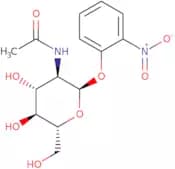
CAS:2-Nitrophenyl 2-acetamido-2-deoxy-alpha-D-glucopyranoside is a chromogenic substrate used to assay the activity of enzymes that cleave N-acetyl-alpha-D-glucosaminide, such as chitinases and lysozymes. Upon cleavage by the enzyme of interest, the substrate releases a yellow-colored 2-nitrophenol that can be measured spectrophotometrically. This substrate is widely used in the food industry to monitor the activity of lysozyme in cheese, as well as in biomedical research for studying cellular and molecular mechanisms involved in conditions such as inflammation and cancer.Purezza:Min. 95%Colore e forma:PowderPeso molecolare:342.3 g/molSalmon-pal
CAS:<p>6-Chloro-1H-indol-3-yl hexadecanoate is a chromogenic substrate for an enzyme that oxidizes it to produce a blue color. It can be used in the diagnosis of bacterial infections, such as tuberculosis and leprosy. 6CHIH is a ligand for various enzymes, including lactate dehydrogenase, which catalyzes the conversion of pyruvate to lactic acid. This compound reacts with oxygen to produce light in the presence of a catalyst. 6CHIH is also used as a fluorescent tag for protein labeling and detection.<br>6CHIH has been shown to be effective in detecting bacteria in food products and water samples using bioluminescence techniques. The high purity and quality of this compound make it suitable for use in diagnostics, culture media, and environmental testing.</p>Purezza:Min. 95%Peso molecolare:406 g/mol4-Methylumbelliferyl-β-D-glucuronic acid dihydrate
CAS:4-Methylumbelliferyl beta-D-glucuronide (MUG) is commonly used as a substrate for detecting beta-glucuronidase. MUG is used for identifying E. coli contamination in food, drinking water, clinical samples and for rapid bacterial identification in blood cultures. It is recommended in international normatives (ISO, DIN) as a fluorogenic substrate for detection of E. coli. MUG is also a tool assaying the glucuronidase gene in plants.Formula:C16H20O11Purezza:Min. 99 Area-%Peso molecolare:388.33 g/mol4-Nitrophenyl-β-D-glucuronic acid
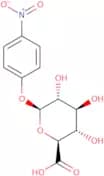
CAS:Chromogenic β-glucuronidase substrate yielding a yellow solution upon cleavage. Used to detect E. coli contamination in food and drinking water due to their β-glucuronidase activity.Formula:C12H13NO9Purezza:Min. 98.0 Area-%Peso molecolare:315.24 g/molD-Luciferin Firefly, sodium salt monohydrate
CAS:Water soluble substrate for firefly luciferase.Formula:C11H9N2NaO4S2Purezza:Min. 99.0 Area-%Peso molecolare:320.32 g/mol4-Nitrophenyl-β-D-galactopyranoside
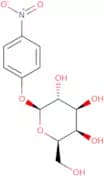
CAS:Chromogenic β-galactosidase substrate yielding a yellow solution upon cleavage. Can be used for the detection of coliforms due to their β-galactosidase activity.Formula:C12H15NO8Purezza:Min. 98.0 Area-%Peso molecolare:301.26 g/molLuc-Enterobacteria Na
<p>Luc-Enterobacteria Na is a fluorogenic substrate that can be used for the detection of Enterobacteriaceae. This product has been shown to have high purity and a CAS number. Luc-Enterobacteria Na is also conjugated with an enzyme substrate, making it suitable for detecting the presence of bacterial colonies in culture media.</p>Purezza:Min. 95%Isopropyl-β-D-thiogalactopyranoside, <5ppm dioxane, plant origin (ex peach gum)
CAS:<p>A non-metabolizable allolactose analogue, widely used in molecular biology for overexpression of recombinant proteins from inducible systems under the control of lac promoter. IPTG binds to the LacI repressor and causes its release from the lac operator, allowing gene expression to take place. Present in vectors of pGEX, pGEM-T, pET, pRSET, pMAL class and others.</p>Formula:C9H18O5SPurezza:Min. 99.0 Area-%Peso molecolare:238.30 g/molRef: 3D-I-8070
1kgPrezzo su richiesta50gPrezzo su richiesta100gPrezzo su richiesta250gPrezzo su richiesta500gPrezzo su richiesta-Unit-ggPrezzo su richiesta1-Naphthyl b-D-glucuronide sodium salt
CAS:<p>1-Naphthyl b-D-glucuronide sodium salt is a chromogenic substrate commonly used to assay the activity of beta-glucuronidase enzymes. It is hydrolyzed by beta-glucuronidase to yield a yellow-colored product, 1-naphthol, which can be quantified spectrophotometrically. This substrate is widely used in diagnostic tests for detection of beta-glucuronidase activity, particularly in clinical microbiology for the identification of E. coli and other enteric bacteria. With its sodium salt form, it boasts increased solubility in aqueous solutions, ensuring seamless integration into various experimental settings.</p>Formula:C16H15NaO7Purezza:Min. 95%Colore e forma:PowderPeso molecolare:342.28 g/molL-Proline 7-amido-4-methylcoumarin hydrobromide
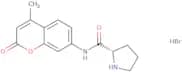
CAS:L-Proline 7-amido-4-methylcoumarin hydrobromide is a fluorogenic substrate that is used to measure esterase and peptidase activity in a variety of animal and microbial sources. This compound has been shown to have a lipase activity. L-Proline 7-amido-4-methylcoumarin hydrobromide is also used as an enzyme preparation and as an enzyme source.Formula:C15H17BrN2O3Peso molecolare:353.22 g/molRef: 3D-P-7280
1gPrezzo su richiesta5gPrezzo su richiesta10gPrezzo su richiesta500mgPrezzo su richiesta2500mgPrezzo su richiesta-Unit-ggPrezzo su richiesta