Substrati enzimatici
I substrati enzimatici sono molecole su cui agiscono gli enzimi per catalizzare reazioni chimiche. Il substrato si lega al sito attivo dell'enzima, dove subisce una trasformazione specifica per formare il prodotto della reazione. I substrati enzimatici sono strumenti essenziali nella ricerca per studiare la cinetica enzimatica, la specificità e il meccanismo d'azione. Sono utilizzati anche in saggi diagnostici e studi biochimici. Presso CymitQuimica, offriamo una selezione diversificata di substrati enzimatici di alta qualità per supportare le vostre ricerche in enzimologia e biochimica.
Sottocategorie di "Substrati enzimatici"
Trovati 1527 prodotti di "Substrati enzimatici"
Ordinare per
Purezza (%)
0
100
|
0
|
50
|
90
|
95
|
100
1-Naphthyl β-D-galactopyranoside
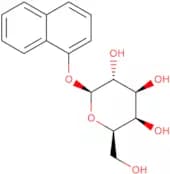
CAS:1-Naphthyl b-D-galactopyranoside is a chromogenic substrate used to detect the presence of beta-galactosidase enzymes. The enzyme cleaves the substrate to produce a colored product that can be quantified and visualized. This substrate is commonly used in applications such as the detection of lacZ gene expression in bacterial colonies or in histochemical staining of tissues to identify beta-galactosidase activity.Formula:C16H18O6Purezza:Min. 95%Colore e forma:PowderPeso molecolare:306.32 g/mol6-Bromo-2-naphthyl b-D-glucuronide
CAS:6-Bromo-2-naphthyl beta-D-glucuronide is a substrate for beta-glucuronidase, an enzyme involved in detoxification and bacterial metabolism. Upon enzymatic hydrolysis, it releases 6-bromo-2-naphthol, which forms a detectable dye when reacted with diazonium salts. This compound is widely used in microbiology to detecting E. coli in water testing and histochemical staining. 6-Bromo-2-naphthyl beta-D-glucuronide is also been used in cancer research studies. It has been found that some tumors are related to a high activity of beta-glucuronidase, responsible to reactivate the carcinogens and promote tumor progression, developing a drug resistance to chemotherapy.Formula:C16H15BrO7Purezza:Min 97%Colore e forma:White Off-White PowderPeso molecolare:399.2 g/mol4-Methylumbelliferyl 3-deoxy-D-glycero-a-D-galacto-2-nonulosonic acid sodium salt
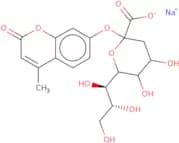
CAS:<p>4-Methylumbelliferyl 3-deoxy-D-glycero-a-D-galacto-2-nonulosonic acid sodium salt is a fluorogenic substrate that can be used to detect enzyme activity. It reacts with the enzyme β-galactosidase, which hydrolyzes lactose in the presence of oxygen and hydrogen peroxide. The product is 4methylumbelliferone, which emits light in the presence of luciferin and an oxidizing agent. This product is used for diagnostics, food testing, and environmental testing. CAS No. 123269-95-4</p>Purezza:Min. 95%Peso molecolare:489.41 g/molBCM® Histamine-producing bacteria Broth
Growth medium for the detection of histamine-producing bacteria in food and water samples. The medium contains an indicator that turns orange/red (absorbance at 555 nm) due to metabolites released by histidine decarboxylase. The BCM® Histamine-producing bacteria Broth contains tryptone (FT09555) and yeast extract, together with the chromogenic agent. High-level histamine-producing bacteria yield orange to red coloration in less than 2 days and even after 24 hours, while cultures of other bacteria remain yellow.Purezza:Min. 95%4-Methylumbelliferyl-beta-D-glucopyranoside
CAS:<p>Fluorogenic substrate for beta-glucosidase yielding a blue fluorescent solution. Used for the detection of beta-glucosidase as an indicator of Enterococci.</p>Formula:C16H18O8Purezza:Min. 99 Area-%Peso molecolare:338.32 g/molNaphthol AS-MX acetate
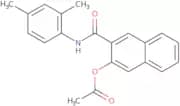
CAS:<p>Modified naphtol AS substrate used in histochemical and cytochemical staining</p>Formula:C21H19NO3Purezza:Min. 80%Colore e forma:White Off-White PowderPeso molecolare:333.38 g/mol4-Methylumbelliferyl phosphate bis(cyclohexylammonium) salt
CAS:Sensitive fluorogenic substrate for fluorometric and UV-spectrophotometric assays of phosphatases. This may also be used for in-gel assaysFormula:C22H35N2O6PPurezza:Min 99%Colore e forma:White to off-white solid.Peso molecolare:454.50 g/mol5-Nitro-3-indolyl-b-D-galactopyranoside
<p>5-Nitro-3-indolyl-b-D-galactopyranoside is a substrate for a number of enzymes, including beta-galactosidase, beta-glucuronidase, and beta-mannosidase. It is used as an enzyme substrate in diagnostics to measure the activity of these enzymes. 5N3IG was also used to study the effects of conjugation on enzyme activity. 5N3IG is available in high purity and high quality at CAS No.</p>Purezza:Min. 95%4-Methylumbelliferyl-β-L-fucopyranoside
CAS:<p>4-Methylumbelliferyl-beta-L-fucopyranoside is a fluorogenic substrate that is used in food testing. It also has uses as a chromogenic substrate and a ligand for biological studies. 4-Methylumbelliferyl-beta-L-fucopyranoside is a conjugate of 4-methylumbelliferone and beta-D-fucopyranosyl ester, which is an enzyme substrate for the detection of phosphatases. This product can be used to detect the activity of phosphatase enzymes in various media, including culture media, environmental testing, and staining. 4MUFBPY also has chemiluminescent properties that can be used for bioluminescence assays.</p>Formula:C16H18O7Peso molecolare:322.31 g/molRef: 3D-M-5541
1gPrezzo su richiesta5gPrezzo su richiesta250mgPrezzo su richiesta500mgPrezzo su richiesta2500mgPrezzo su richiesta-Unit-ggPrezzo su richiesta4-Chloro-3-Indoxyl-1,3-diacetate
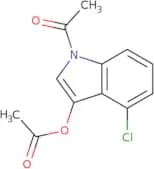
CAS:<p>4-Chloro-3-indoxyl-1,3-diacetate is a fluorogenic or chromogenic substrate used in food testing. It is also an enzyme substrate that can be used to detect the presence of bioluminescence. 4-Chloro-3-indoxyl-1,3-diacetate has been shown to have high purity and high quality for use in diagnostic kits. 4-Chloro-3-indoxyl-1,3-diacetate is a ligand that is conjugated with other molecules to form complexes for use in fluorescence and chemiluminescence experiments.</p>Purezza:Min. 95%Peso molecolare:251.67 g/mol4-Methylumbelliferyl phosphate, free acid
CAS:A sensitive fluorogenic substrate for fluorometric and UV-spectrophotometric assays of phosphatases. It is used for the detection of C. perfringens because acid phosphatase is a highly specific indicator for C. perfringens.Formula:C10H9O6PPeso molecolare:256.15 g/mol3,4-Cyclohexenoesculetin β-D-galactopyranoside
CAS:<p>Chromogenic substrate for beta-galactosidase</p>Formula:C19H22O9Purezza:Min. 95 Area-%Peso molecolare:394.37 g/molRef: 3D-W-201644
1gPrezzo su richiesta5gPrezzo su richiesta10gPrezzo su richiesta2500mgPrezzo su richiesta-Unit-ggPrezzo su richiesta4-Methylumbelliferyl-α-D-glucopyranoside
CAS:Fluorogenic substrate for α-D-glucosidase. It has been used in studies of Pompe's disease (Glycogen Storage Disease). Used for differentiation and enumeration of Enterobactersakazakii based on α-glucosidase activity.Formula:C16H18O8Purezza:Min. 99 Area-%Peso molecolare:338.32 g/mol2-Naphthyl b-D-galactopyranoside
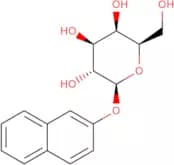
CAS:<p>2-Naphthyl beta-D-galactopyranoside is a glycoside that is found in the flowers of the plant Eschscholzia californica. It is used as a localizer for bacterial strains and can be hydrolyzed by enzymes to release naphthalene. 2-Naphthyl beta-D-galactopyranoside has been shown to inhibit the growth of corynebacterium and diazonium salt, which may be due to its ability to bind to DNA and disrupt protein synthesis. The potential use of this molecule is for its insolubility, which prevents it from being absorbed by skin cells.</p>Formula:C16H18O6Purezza:Min. 99 Area-%Colore e forma:PowderPeso molecolare:306.31 g/molLuc-Enterococcus K
<p>Luc-Enterococcus K (LK) is a Chromogenic substrate that can be used for the detection of Enterococcus. LK is a conjugate of beta-lactamase and luciferase, which are both enzymes. LK is used in diagnostics to detect the presence of Enterococcus in food and environmental samples. LK can also be used as a chemiluminescent substrate for the detection of Enterococcus in clinical specimens or as an enzyme substrate for the detection of Enterococcus in clinical specimens. CAS No.: 64739-74-8</p>Formula:C17H17KN2O8S2Purezza:Min. 94 Area-%Peso molecolare:480.55 g/molCoelenterazine - lyopholised
CAS:<p>Coelenterazine is a bio-luminescent substrate of luciferases such as Renilla luciferase (Rluc) and Gaussia luciferase (Gluc). The main applications of Coelenterazine are monitoring of reporter genes and chemiluminescence-based methods for Calcium detection. The substrate is also used in bioluminescence resonance energy transfer (BRET), ELISA, HTS and chemiluminescent detection of superoxide anion and peroxynitritein cells or tissues. About this grade Coelenterazine, native, dried (C-7002): in order to provide milligram and sub-milligram quantities of native Coelenterazine we pre-dissolve the substance; defined amounts of Coelenterazine are subsequently dried under nitrogen in individual vials. Coelenterazine, native, dried is identical in quality and chemistry to our product Coelenterazine, native which is provided as a powder.<br>Information to the user: since Coelenterazine is sensitive to oxygen, degas your solvents for stock solutions, if possible. To dissolve Coelenterazine, native, dried please proceed as follows. 1) Add the appropriate amount of solvent. If possible through the septum using a needle. Otherwise open the cap with pliers. 2) Vortex the closed vial briefly to completely dissolve the content of the vial. 3) Take out the solution, if possible with a needle through the septum.</p>Formula:C26H21N3O3Purezza:Min. 95 Area-%Peso molecolare:423.48 g/mol7-((4'-L-Alaninamido)-rac-3'-hydroxybutyloxy) coumarin
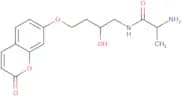
<p>This Clips-O substrate 7-((4'-L-Alaninamido)-rac-3'-hydroxybutyloxy) coumarin allows the detection of single and dual enzymatic activity (L-alanine aminopetidase and oxidation of 4-amino-3-hydroxybutyloxy spacer either enzymatically or by exposure to sodium periodate) with a single substrate resulting in a fluorescent signal. The main virtues of Clips-O substrates are an increased stability towards non-enzymatic hydrolysis that results in a reduced background and high sensitivity.</p>Formula:C16H20N2O5Purezza:Min. 95%Colore e forma:PowderPeso molecolare:320.35 g/mol5-Bromo-4-chloro-3-indolyl palmitate
CAS:<p>5-Bromo-4-chloro-3-indolyl palmitate is a chromogenic substrate used to detect the specific enzymatic activity of lipase. After cleavage, 5-bromo-4-chloro-indoxyl is released, resulting in a blue to blue-green color change in bacterial colonies or media. 5-Bromo-4-chloro-3-indolyl palmitate is used in lipase activity assays or cystic fibrosis diagnostics.</p>Purezza:Min. 95%Colore e forma:PowderPeso molecolare:484.9 g/molAldol® 518 alpha-D-glucopyranoside, Biosynth Patent: EP 2427431 and US 8940909
CAS:<p>Aldol® 518 alpha-D-glucopyranoside is a fluorogenic enzyme substrate used for detection of alpha-D-glucosidase activity. The colorless enzyme substrate is cleaved by alpha-D-glucosidase, generating red fluorescent signal and in some conditions, an orange colour in the visible spectrum can get formed, staining bacterial colonies in faint orange coloration. Aldol® 518 alpha-D-glucopyranoside can be used under aerobic and anaerobic conditions.</p>Formula:C29H29ClN2O7Purezza:Min. 95.0 Area-%Peso molecolare:553 g/mol3-Indoxyl-β-D-galactopyranoside
CAS:<p>Chromogenic substrate for β-D-galactosidase, yielding a blue precipitate upon cleavage.</p>Formula:C14H17NO6Purezza:Min. 98 Area-%Peso molecolare:295.29 g/molRef: 3D-I-6000
5gPrezzo su richiesta10gPrezzo su richiesta25gPrezzo su richiesta50gPrezzo su richiesta100gPrezzo su richiesta-Unit-ggPrezzo su richiesta