Substrati enzimatici
Sottocategorie di "Substrati enzimatici"
Trovati 1528 prodotti di "Substrati enzimatici"
4-Nitrophenyl a-D-mannopyranoside
CAS:4-Nitrophenyl a-D-mannopyranoside is a chromogenic pNP enzyme substrate that enables the detection and quantification of a-D-mannosidase activity in various biological samples through a colorimetric assay. The hydrolysis of the substrate by the enzyme releases 4-nitrophenol, a yellow compound whose absorption can be measured spectrophotometrically. Applications for this substrate span biomedical research, disease diagnostics, and industrial enzyme production.
Formula:C12H15NO8Purezza:Min. 98.0 Area-%Colore e forma:Off-White PowderPeso molecolare:301.25 g/mol8-Hydroxyquinoline-beta-D-glucuronic acid, sodium salt
CAS:8-Hydroxyquinoline-beta-D-glucuronic acid, sodium salt is a fluorogenic substrate that can be used for enzymatic detection of peroxidase. The substrate is available in a variety of forms, including powder and liquid. This product has been tested for environmental and bioluminescence activity, as well as food safety. It has also been shown to be a useful ligand in immunoassays.
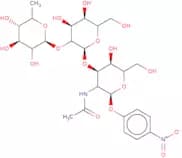
Formula:C15H14NNaO7Purezza:Min. 98 Area-%Colore e forma:White PowderPeso molecolare:343.26 g/mol4-Nitrophenyl 2-acetamido-3-O-[2-O-a-L-fucopyranosyl-b-D-galactopyranosyl)-2-deoxy-b-D-galactopyranoside
CAS:4-Nitrophenyl 2-acetamido-3-O-[2-O-a-L-fucopyranosyl-b-D-galactopyranosyl)-2-deoxyb-D-galactopyranoside is a water soluble, fluorescent probe that can be used for detecting the presence of β-(1→4) -linked galactosaminoglycans. The dye is a substrate for enzymes such as α--mannosidase, β--glucuronidase and β--galactosidase. The dye is also an excellent ligand for lectins such as concanavalin A and wheat germ agglutinin. This product is a diagnostic reagent that has been shown to have high purity and quality. It has CAS No. 93496-53-8 and can be used in food testing, bioluminescence, environmental testing, or high purity applications.
Formula:C26H38N2O17Purezza:Min. 95%Peso molecolare:650.58 g/molAldol® 515 caprylate solution, 0.50 M in DMSO, Biosynth Patent: EP 2427431 and US 8940909
CAS:Aldol® 515 caprylate is a chromogenic and fluorogenic enzyme substrate used for detection of lipase activity. The colorless enzyme substrate is cleaved by C8 esterases, yielding development of red coloration. In addition, red fluorescence is generated when Aldol® 355 fluorescence enhancer or a suitable matrix is present. Aldol® 515 caprylate can be used in enzyme assays and live bacterial cultures. Aldol® 515 caprylate is suitable for use in liquid and solid media, under aerobic as well as anaerobic conditions.Formula:C31H34N2O3Purezza:Of Solute (Hplc) Min. 90.0 Area-%Peso molecolare:482.62 g/molRef: 3D-A-4758_P00
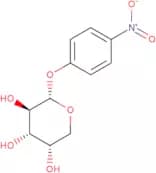
-Unit-ggPrezzo su richiesta1gPrezzo su richiesta5gPrezzo su richiesta10gPrezzo su richiesta2500mgPrezzo su richiesta4-Nitrophenyl a-L-arabinopyranoside
CAS:Substrate for a-L-arabinopyranosidaseFormula:C11H13NO7Purezza:Min. 98 Area-%Colore e forma:White PowderPeso molecolare:271.22 g/molAldol® 514 inositol-phosphate, ammonium salt, Biosynth Patent: EP 2427431 and US 8940909
CAS:Aldol® 514 inositol-phosphate is a chromogenic enzyme substrate used for detection of phosphatidylinositol specific phospholipase C (PI-PLC, EC 4.6.1.13). The colorless enzyme substrate is cleaved by PI-PLC positive microorganisms, yielding a red-orange color. The substrate thus enables the detection and identification of various bacteria, such as, pathogenic strains of Listeria, Clostridium, Bacillus, and Staphylococcus. Aldol® 514 inositol-phosphate is suitable for use under aerobic and anaerobic conditions.
Formula:C26H28BrClN3O10PPurezza:Min. 95.0 Area-%Peso molecolare:688.85 g/mol5-Bromo-4-chloro-3-indolyl b-D-galactofuranoside
5-Bromo-4-chloro-3-indolyl b-D-galactofuranoside is a chromogenic substrate used to detect the specific enzymatic activity of beta-D-galactofuranosidase. After cleavage, 5-bromo-4-chloro-indoxyl is released, resulting in a blue to blue-green color change in bacterial colonies or media. 5-Bromo-4-chloro-3-indolyl b-D-galactofuranoside is used in assays for detecting bacterial pathogens (e.g., Mycobacterium tuberculosis).Formula:C14H15BrClNO6Purezza:Min. 95%Colore e forma:PowderPeso molecolare:408.63 g/mol6-Chloro-3-indoxyl-beta-D-galactopyranoside
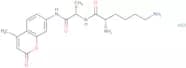
CAS:6-Chloro-3-indoxyl-beta-D-galactopyranoside is a chromogenic substrate for beta-galactosidase that yields a salmon or rose-coloured precipitate and hence is also known as Salmon-Gal. It can be used in conjunction with isopropyl-beta-D-thiogalactopyranoside (IPTG) as an alternative to the chromogenic substrate 5-bromo-4-chloro-3-indolyl beta-D-galactopyranoside (X-Gal) for detection of beta-galactosidase activity in bacterial colonies in colorimetric assays. Where beta-galactosidase expressed from a reporter gene in molecular biology experiments, recombinant colonies on growth plates are salmon-coloured while non-recombinants appear as white. Use of nitroblue tetrazolium salt (NBT) with Salmon-Gal may provide faster results, yielding a clear, purple precipitate, than for Salmon-Gal alone. In conjunction with 5-bromo-4-chloro-3-indolyl-beta-D-glucoside (X-Glc), Salmon-Gal is useful for simultaneous detection of GUS and Lac activities in the same medium.Formula:C14H16ClNO6Purezza:Min. 98.0 Area-%Peso molecolare:329.74 g/molL-Lysyl-L-alanine 7-amido-4-methylcoumarin dihydrochloride
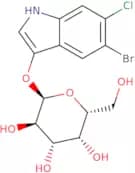
CAS:L-Lysyl-L-alanine 7-amido-4-methylcoumarin dihydrochloride is a fluorogenic peptide substrate for aminopeptidase. This AMC peptide substrate is normally used to rapidly profile the N-terminal specificity of proteases.Purezza:Min. 98.0 Area-%Colore e forma:Powder5-Bromo-6-chloro-3-indolyl a-D-galactopyranoside
CAS:5-Bromo-6-chloro-3-indolyl a-D-galactopyranoside is a chromogenic substrate that yields a magenta-colored product after cleavage. The chromophore 5-bromo-6-chloro-indoxyl is released, generating the observable color. It is used in glycolipid metabolism studies.Formula:C14H15BrClNO6Colore e forma:White to off-white solid.Peso molecolare:408.63 g/mol2-Chloro-4-nitrophenyl α-D-mannopyranoside
CAS:2-Chloro-4-nitrophenyl alpha-D-mannopyranoside is a substrate used to measure the alpha-mannosidase activity. This enzyme plays a crucial role in the lysosomal degradation of asparagine-linked carbohydrate cores of glycoproteinsis. The use of 2-Chloro-4-nitrophenyl alpha-D-mannopyranoside in diagnostic assays is important as a deficiency in alpha-mannosidase leads to the accumulation of mannose-rich oligosaccharides in lysosomes, causing a range of health problems collectively known as alpha-mannosidosis.
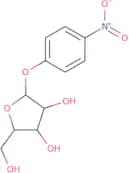
Formula:C12H14ClNO8Purezza:Min. 98 Area-%Colore e forma:White PowderPeso molecolare:335.69 g/mol4-Nitrophenyl b-L-arabinofuranoside
CAS:Chromogenic substrate targeting alpha-L-arabinofuranosidase
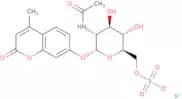
Purezza:Min. 95%Colore e forma:White/Off-White SolidPeso molecolare:271.22 g/mol4-Methylumbelliferyl 2-acetamido-2-deoxy-α-D-glucopyranoside-6-sulfate potassium
CAS:4-Methylumbelliferyl 2-acetamido-2-deoxy-alpha-D-glucopyranoside-6-sulfate potassium is a fluorogenic substrate for N-acetylglucosamine-6-sulfatase. After enzymatic cleaveage, free 4-methylumbelliferone (also known as hymecromone) is released, exhibiting blue fluorescence upon excitation with UV light. The strongest fluorescence of 4-methylumbelliferone requires deprotonation of the hydroxyl group (thus requires alkaline pH), with a maximal fluorescence intensity obtained with excitation at 350 to 370 nm and emission at 440 to 470 nm. The use of 4-methylumbelliferyl 2-acetamido-2-deoxy-alpha-D-glucopyranoside-6-sulfate potassiumas a substrate for measuring the N-acetylglucosamine-6-sulfatase activity is used for screening of Mucopolysaccharidosis IIID (MPS IIID) (a rare lysosomal storage disorder) and Sanfilippo D syndrome diagnosis.Formula:C18H20KNO11SPurezza:Min. 95%Colore e forma:White PowderPeso molecolare:497.52 g/molResorufin-β-D-glucuronic acid, sodium salt
CAS:Resorufin-beta-D-glucuronic acid, sodium salt is a fluorogenic substrate that can be used in diagnostic applications. It is a conjugate of resorufin and beta-D-glucuronic acid. The enzyme substrate reacts with the enzyme luciferase to produce light. The high purity and quality of this product make it ideal for use in the detection of the presence of glucose in urine, which can be used to diagnose diabetes mellitus.Formula:C18H14NNaO9Purezza:Min. 90.0 Area-%Peso molecolare:411.30 g/molRef: 3D-R-2150
-Unit-ggPrezzo su richiesta2mgPrezzo su richiesta5mgPrezzo su richiesta10mgPrezzo su richiesta25mgPrezzo su richiesta50mgPrezzo su richiesta4-Nitrophenyl-α-D-maltopyranoside
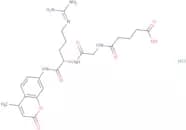
CAS:Chromogenic α-maltosidase substrate yielding a yellow solution upon cleavage.Formula:C18H25NO13Purezza:Min. 98.0 Area-%Peso molecolare:463.40 g/molGlutaryl-glycyl-L-arginine 7-amido-4-methylcoumarin hydrochloride
CAS:Glutaryl-glycyl-L-arginine 7-amido-4-methylcoumarin hydrochloride is a synthetic peptide substrate used as a fluorogenic substrate for aminopeptidase.
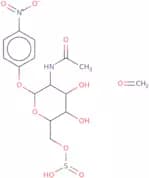
Formula:C23H30N6O7·HClPurezza:Min. 95%Colore e forma:PowderPeso molecolare:538.98 g/mol4-Nitrophenyl 2-acetamido-2-deoxy-b-D-glucopyranoside-6-sulfate
4-Nitrophenyl 2-acetamido-2-deoxy-b-D-glucopyranoside is a chemiluminescent substrate that can be used in the detection of various enzymes. This product has been tested for sterility and purity, and it has passed all tests. It is also free of any detectable levels of heavy metals or other contaminants. 4NP2AG6S is a high quality bioluminescent substrate with CAS No. 71498-92-5. It is a fluorescent compound that reacts with an enzyme to produce light. The reaction can be detected by measuring the emitted light intensity at 680 nm (max).Purezza:Min. 95%Resorufin b-D-xylobioside
Resorufin b-D-xylobioside is a fluorogenic substrate for xylanases useful for xylanase activity assays.Purezza:Min. 95%Colore e forma:PowderPeso molecolare:477.42 g/molAldol® 584 β-D-glucuronic acid, triethylammonium salt, Biosynth Patent: EP 2427431 and US 8940909
CAS:Aldol® 584 is a fluorogenic substrate that can be used for enzymatic and chemical assays. It is an important component of the Cymit Quimica Aldol Reagent Kit and other diagnostic kits. Aldol® 584 is used in immunoassays, such as ELISA, to measure the activity of serine proteases, including cathepsin D, elastase, and leukocyte elastase. This product has a CAS number of 2484873-11-0.Formula:C37H46ClN3O10Purezza:Min. 95.0 Area-%Peso molecolare:728.20 g/molAc-Abu-Tle-Leu-Gln-AMC TFA salt
A fluorogenic substrate for detection of enzymatic activity of the SARS-CoV-2 Mpro protease. The fluorophore 7-Amino-4-methylcoumarin (AMC) is linked to the tetrapeptide via a peptide bond at the C-terminal of the glutamine residue. Following the hydrolytic activity of the Mpro protease, the fluorogenic AMC group get released from the substrate, generating a fluorescent signal (Ex 380 nm / Em 455 nm).Formula:C33H48N6O8(freebase)Purezza:Min. 95.0 Area-%Peso molecolare:656.77 g/mol