Substrati enzimatici
I substrati enzimatici sono molecole su cui agiscono gli enzimi per catalizzare reazioni chimiche. Il substrato si lega al sito attivo dell'enzima, dove subisce una trasformazione specifica per formare il prodotto della reazione. I substrati enzimatici sono strumenti essenziali nella ricerca per studiare la cinetica enzimatica, la specificità e il meccanismo d'azione. Sono utilizzati anche in saggi diagnostici e studi biochimici. Presso CymitQuimica, offriamo una selezione diversificata di substrati enzimatici di alta qualità per supportare le vostre ricerche in enzimologia e biochimica.
Sottocategorie di "Substrati enzimatici"
Trovati 1527 prodotti di "Substrati enzimatici"
Ordinare per
Purezza (%)
0
100
|
0
|
50
|
90
|
95
|
100
5-Bromo-6-chloro-3-indolyl a-D-galactopyranoside
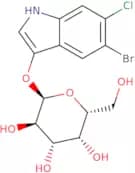
CAS:<p>5-Bromo-6-chloro-3-indolyl a-D-galactopyranoside is a chromogenic substrate that yields a magenta-colored product after cleavage. The chromophore 5-bromo-6-chloro-indoxyl is released, generating the observable color. It is used in glycolipid metabolism studies.</p>Formula:C14H15BrClNO6Colore e forma:White to off-white solid.Peso molecolare:408.63 g/mol2-Nitrophenyl b-D-galactopyranoside-6-phosphate cyclohexylammonium salt
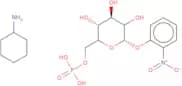
CAS:<p>2-Nitrophenyl beta-D-galactopyranoside-6-phosphate cyclohexylammonium salt is a chromogenic substrate used to detect the enzymatic activity of beta-galactosidase-6-phosphatase. After cleavage, the nitrophenyl moiety is released exhibiting a light yellowish color. 2-Nitrophenyl beta-D-galactopyranoside-6-phosphate cyclohexylammonium salt is used in diagnostic assays such as lysosomal storage disorder.</p>Purezza:Min. 95%Colore e forma:PowderPeso molecolare:480.4 g/molResorufin b-D-xylobioside
<p>Resorufin b-D-xylobioside is a fluorogenic substrate for xylanases useful for xylanase activity assays.</p>Purezza:Min. 95%Colore e forma:PowderPeso molecolare:477.42 g/molNaphthol AS nonanoate
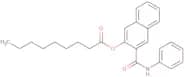
CAS:<p>Modified naphtol AS substrate used in histochemical and cytochemical staining</p>Formula:C26H29NO3Purezza:Min. 95%Colore e forma:PowderPeso molecolare:403.51 g/molL-Histidine 7-amido-4-methylcoumarin hydrochloride
CAS:<p>L-Histidine 7-amido-4-methylcoumarin hydrochloride is a synthetic peptide substrate used as a fluorogenic substrate for histidine aminopeptidase.</p>Formula:C16H17ClN4O3Purezza:Min. 95%Peso molecolare:348.79 g/mol4-Nitrophenyl phosphate mono(2-amino-2-ethyl-1,3-propanediol) salt monohydrate
CAS:<p>4-Nitrophenyl phosphate mono(2-amino-2-ethyl-1,3-propanediol) salt monohydrate is a chromogenic substrate that can be used to detect the presence of alkaline phosphatase. It is also used in food testing and diagnostics. 4NPPMD is a substrate for the enzyme alkaline phosphatase, which has been shown to play a role in the inflammatory response. The production of 4NPPMD by bacteria in the environment can be detected with chemiluminescence or bioluminescence. This product has been shown to react with both horseradish peroxidase and alkaline phosphatase, as well as other enzymes that are involved in metabolic pathways. This substrate also has high purity and fluorescence properties.</p>Formula:C11H21N2O9PPurezza:Min. 95 Area-%Peso molecolare:356.26 g/molCoelenterazine e
CAS:<p>Coelenterazine and its derivatives spontaneously complex with aequorin to develop a Ca2+-dependent fluorescent signal.</p>Formula:C28H23N3O3Purezza:Min. 95%Colore e forma:PowderPeso molecolare:449.5 g/molAquaSpark® HRP probe
CAS:<p>Please enquire for more information about AquaSpark® HRP probe including the price, delivery time and more detailed product information at the technical inquiry form on this page</p>Formula:C38H38ClNO11Peso molecolare:720.16 g/molAc-Abu-Tle-Leu-Gln-AMC TFA salt
<p>A fluorogenic substrate for detection of enzymatic activity of the SARS-CoV-2 Mpro protease. The fluorophore 7-Amino-4-methylcoumarin (AMC) is linked to the tetrapeptide via a peptide bond at the C-terminal of the glutamine residue. Following the hydrolytic activity of the Mpro protease, the fluorogenic AMC group get released from the substrate, generating a fluorescent signal (Ex 380 nm / Em 455 nm).</p>Formula:C33H48N6O8(freebase)Purezza:Min. 95.0 Area-%Peso molecolare:656.77 g/molAldol® 458 phosphate, disodium salt, Biosynth Patent: EP 2427431 and US 8940909
CAS:<p>Aldol® 458 phosphate is a chromogenic and fluorogenic enzyme substrate used for detection of phosphatase activity. The colorless enzyme substrate is cleaved by phosphatases secreted by bacteria grown in liquid media, yielding yellow color and green fluorescence. Aldol® 458 phosphate can also be used in assays involving phosphatase-coupled antibodies in immunoassay applications (ELISA). Aldol® 458 phosphate can be used under aerobic and anaerobic conditions.</p>Formula:C16H12NNa2O6PPurezza:Min. 95%Colore e forma:PowderPeso molecolare:391.22 g/mol5-Bromo-4-chloro-3-indolyl β-D-xylopyranoside
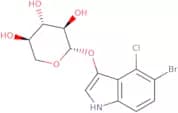
CAS:<p>5-Bromo-4-chloro-3-indolyl b-D-xylopyranoside is an enzyme substrate. This chromogenic substrate is used for beta-D-xylosidase enzyme. In culture media, 5-Bromo-4-chloro-3-indolyl b-D-xylopyranoside is utilised for identification of bacteria such as Klebsiella and Enterobacter.</p>Formula:C13H13BrClNO5Purezza:Min. 95%Colore e forma:PowderPeso molecolare:378.6 g/mol4-Methylumbelliferyl myo-inositol 1-phosphate lithium salt
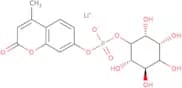
CAS:<p>4-Methylumbelliferyl myo-inositol 1-phosphate lithium salt is a fluorogenic substrate that is used in food testing to detect the presence of glucose. It can also be used in environmental testing to measure bacterial activity and as a chromogenic substrate in diagnostic applications. 4-Methylumbelliferyl myo-inositol 1-phosphate lithium salt is also used as an enzyme substrate in the determination of conjugates, ligands, and other substances. 4-Methylumbelliferyl myo-inositol 1-phosphate lithium salt has high purity and high quality, enabling it to be used for chemiluminescence and bioluminescence reactions.</p>Purezza:Min. 95%Peso molecolare:424.22 g/mol5-Bromo-3-indoxyl caprylate
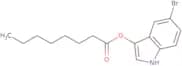
CAS:<p>Also known as Lapis-caprylate; targeting esterase with C8 activity; Blue color</p>Formula:C16H20BrNO2Purezza:Min. 98 Area-%Colore e forma:PowderPeso molecolare:338.24 g/mol4-Nitrophenyl 3-O-(β-D-glucopyranosyl)-β-D-glucopyranoside
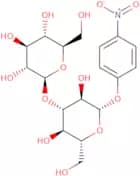
CAS:Chromogenic substrate for beta-glucanaseFormula:C18H25NO13Purezza:Min. 95 Area-%Colore e forma:PowderPeso molecolare:463.39 g/mol5-Bromo-4-chloro-3-indolyl b-D-glucuronide sodium salt
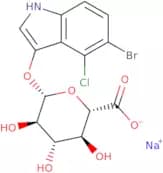
CAS:<p>Chromogenic substrate for beta-glucuronidase</p>Formula:C14H12BrClNNaO7Purezza:Min. 98 Area-%Colore e forma:White Off-White PowderPeso molecolare:444.59 g/molAldol® 515 palmitate, Biosynth Patent: EP 2427431 and US 8940909
CAS:<p>Aldol® 515 palmitate is a chromogenic substrate that is used in food testing, diagnostics, and other applications. It has a high purity and is conjugated to various ligands for specific applications. Aldol® 515 palmitate is an excellent chemiluminescent substrate for the detection of ATP and other nucleotides. It also has high bioluminescence activity for the detection of adenosine-5'-triphosphate (ATP) or luciferin as well as enzyme substrates to measure β-galactosidase or β-glucuronidase activity.</p>Formula:C39H50N2O3Purezza:Min. 95.0 Area-%Peso molecolare:594.83 g/mol4-Methylumbelliferyl-α-L-rhamnopyranoside
CAS:<p>4-Methylumbelliferyl-alpha-L-rhamnopyranoside is a fluorogenic substrate used in enzyme assays. It is a substrate of the enzyme beta-galactosidase, which catalyzes the hydrolysis of terminal galactose residues from polysaccharides and glycoproteins. The fluorescent product 4-methylumbelliferone (4MU) is formed by cleavage of the terminal galactose residue and can be measured spectrophotometrically at 360 nm. 4-Methylumbelliferone has been used for chemiluminescent detection in immunoassays and as a substrate for bioluminescence reactions.</p>Formula:C16H18O7Purezza:Min. 98.0 Area-%Peso molecolare:322.32 g/molRef: 3D-M-6185
1gPrezzo su richiesta5gPrezzo su richiesta10gPrezzo su richiesta500mgPrezzo su richiesta2500mgPrezzo su richiesta-Unit-ggPrezzo su richiestaIPTG - non animal origin
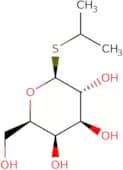
CAS:<p>Isopropyl-beta-D-thiogalactopyranoside (IPTG) is a non-metabolizable allolactose analogue, widely used in molecular biology for overexpression of recombinant proteins from inducible systems under the control of lac promoter. IPTG binds to the LacI repressor and causes its release from the lac operator, allowing gene expression of lac operon to take place. IPTG is present in vectors of pGEX, pGEM-T, pET, pRSET, pMAL class and others.</p>Formula:C9H18O5SPurezza:Min. 99 Area-%Colore e forma:White PowderPeso molecolare:238.3 g/mol4-Methylumbelliferyl β-D-cellohexaoside
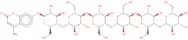
CAS:<p>4-Methylumbelliferyl beta-D-cellohexaoside is a fluorogenic substrate for cellulase. After enzymatic cleaveage, free 4-methylumbelliferone (also known as hymecromone) is released, exhibiting blue fluorescence upon excitation with UV light. The strongest fluorescence of 4-methylumbelliferone requires deprotonation of the hydroxyl group (thus requires alkaline pH), with a maximal fluorescence intensity obtained with excitation at 350 to 370 nm and emission at 440 to 470 nm. The use of 4-methylumbelliferyl beta-D-cellohexaosideas a substrate for measuring the cellulase activity is used for detecting bacterial infection and gut microbiome analysis.</p>Formula:C46H68O33Purezza:Min. 95%Colore e forma:PowderPeso molecolare:1,149.01 g/mol6-Chloro-3-indoxyl-β-D-glucuronic acid methyl ester, Biosynth Patent: EP 2718458 and US 9127303
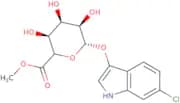
<p>6-Chloro-3-indoxyl-beta-D-glucuronic acid methyl ester is a chromogenic substrate that can be used for the detection of indoxyl glucuronide in urine and other biological fluids. 6-Chloro-3-indoxyl-beta-D-glucuronic acid methyl ester is a white or light yellow crystalline solid that is soluble in water. It has a melting point of about 80°C and is stable at pH levels ranging from 2 to 12. The CAS number for this compound is 13982-87-6.</p>Formula:C15H16ClNO7Purezza:Min. 97.0 Area-%Peso molecolare:357.74 g/mol