Substrati enzimatici
Sottocategorie di "Substrati enzimatici"
Trovati 1527 prodotti di "Substrati enzimatici"
4-(Bromomethyl)phenyl-β-D-triacetylglucuronic acid methyl ester
4-(Bromomethyl)phenyl-beta-D-triacetylglucuronic acid methyl ester, also known as 4-bromo-4'-(N,N-dimethylamino)biphenyl, is a bioluminescent substrate. It is used for the detection of beta-glucuronidase activity in biological samples and for the detection of bacterial β-glucuronidase activity in culture media. Beta-glucuronidase catalyzes the hydrolysis of glucuronic acid by breaking down a conjugate molecule into two smaller molecules, which can be detected using bioluminescence. 4-(Bromomethyl)phenyl-beta-D-triacetylglucuronic acid methyl ester is a chromogenic substrate that has been shown to be an excellent ligand in biomolecular research because it reacts with many different enzymes. This product is highly pure and
Formula:C20H23BrO10Purezza:Min. 95 Area-%Peso molecolare:503.29 g/mol6-Chloro-3-indoxyl-beta-D-galactopyranoside
CAS:6-Chloro-3-indoxyl-beta-D-galactopyranoside is a chromogenic substrate for beta-galactosidase that yields a salmon or rose-coloured precipitate and hence is also known as Salmon-Gal. It can be used in conjunction with isopropyl-beta-D-thiogalactopyranoside (IPTG) as an alternative to the chromogenic substrate 5-bromo-4-chloro-3-indolyl beta-D-galactopyranoside (X-Gal) for detection of beta-galactosidase activity in bacterial colonies in colorimetric assays. Where beta-galactosidase expressed from a reporter gene in molecular biology experiments, recombinant colonies on growth plates are salmon-coloured while non-recombinants appear as white. Use of nitroblue tetrazolium salt (NBT) with Salmon-Gal may provide faster results, yielding a clear, purple precipitate, than for Salmon-Gal alone. In conjunction with 5-bromo-4-chloro-3-indolyl-beta-D-glucoside (X-Glc), Salmon-Gal is useful for simultaneous detection of GUS and Lac activities in the same medium.Formula:C14H16ClNO6Purezza:Min. 98.0 Area-%Peso molecolare:329.74 g/molIsopropyl-β-D-thiogalactopyranoside, <5ppm dioxane
CAS:IPTG is a gratuitous beta-D-galactosidase inducer. In Escherichia coli IPTG functions by binding to the lac repressor and altering its conformation. This inactivation prevents the repressor binding to the operator of the lac operon and thus the repression of the beta-galactosidase coding gene lacZ. IPTG is a commonly used reagent in cloning procedures that require induction of beta-galactosidase activity and is used in conjunction with X-Gal or Lapis-β-D-Gal in blue-white color selection of recombinant bacterial colonies.Formula:C9H18O5SPurezza:Min. 99.0 Area-%Peso molecolare:238.30 g/molRef: 3D-I-8000
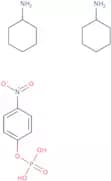
1gPrezzo su richiesta5gPrezzo su richiesta10gPrezzo su richiesta25gPrezzo su richiesta50gPrezzo su richiesta-Unit-ggPrezzo su richiesta4-Nitrophenyl phosphate, bis(cyclohexylammonium) salt
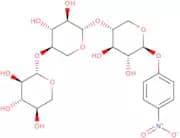
CAS:Chromogenic substrate yielding a soluble yellow chromophor for the colorimetric assay of phosphatases.Formula:C18H32N3O6PPurezza:97.0 To 103.0%Peso molecolare:417.45 g/mol4-Nitrophenyl b-D-xylotrioside
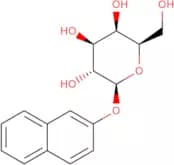
CAS:Chromogenic substrate targeting beta-D-xylosidase. A xylanase substrate.Formula:C21H29NO15Purezza:Min. 98 Area-%Colore e forma:PowderPeso molecolare:535.45 g/mol2-Naphthyl-beta-D-galactopyranoside
CAS:2-Naphthyl-β-D-galactopyranoside is a substrate for β-galactosidase. 2-Naphthol is released upon hydrolyzation. By simultaneous coupling with a suitable staining reagent, such as hexazonium p-rosaniline, the corresponding reddish-brown azo-dye is formed. Naphthols can also be detected by fluorescence analysis.Formula:C16H18O6Purezza:Min. 99 Area-%Peso molecolare:306.32 g/mol5-Bromo-6-chloro-3-indoxyl caprylate, Patent WO 2022/038120
CAS:5-Bromo-6-chloro-3-indolyl caprylate is also known as magenta caprylate. Upon the cleavage of the ester bond in the substrate by esterase enzymes, 5-bromo-6-chloro-1H-indol-3-ol is released. When exposed to oxygen (such as in the air) this undergoes dimerization to form 5,5'-dibromo-6,6'-dicholoro-indigo, which is a magenta coloured chromophore (λmax 565nm). Bacteria such as Salmonella and some Klebsiella and Enterobacter produce caprylate esterase and so this substrate can be used for the detection of these bacteria in samples, such as in food. This product is patent pending, as polymorphs of this product can have different physicochemical properties and can improve solubility and stability. Cymit Quimica is able to product high quality, stable product to detect esterase enzyme activity.
Formula:C16H19BrClNO2Purezza:Min. 99.0 Area-%Peso molecolare:372.7 g/mol5-Bromo-4-chloro-3-indolyl b-D-galactofuranoside
5-Bromo-4-chloro-3-indolyl b-D-galactofuranoside is a chromogenic substrate used to detect the specific enzymatic activity of beta-D-galactofuranosidase. After cleavage, 5-bromo-4-chloro-indoxyl is released, resulting in a blue to blue-green color change in bacterial colonies or media. 5-Bromo-4-chloro-3-indolyl b-D-galactofuranoside is used in assays for detecting bacterial pathogens (e.g., Mycobacterium tuberculosis).Formula:C14H15BrClNO6Purezza:Min. 95%Colore e forma:PowderPeso molecolare:408.63 g/mol2-Naphthyl b-D-galactopyranoside
CAS:2-Naphthyl beta-D-galactopyranoside is a glycoside that is found in the flowers of the plant Eschscholzia californica. It is used as a localizer for bacterial strains and can be hydrolyzed by enzymes to release naphthalene. 2-Naphthyl beta-D-galactopyranoside has been shown to inhibit the growth of corynebacterium and diazonium salt, which may be due to its ability to bind to DNA and disrupt protein synthesis. The potential use of this molecule is for its insolubility, which prevents it from being absorbed by skin cells.
Formula:C16H18O6Purezza:Min. 99 Area-%Colore e forma:PowderPeso molecolare:306.31 g/molMethionine Assay Kit (Fluorometric)
The Methionine Assay Kit (Fluorometric) is a kit containing the fluorogenic substrate needed for the determination of total methionine content. The kit is used to detect and quantify methionine in various food products, as well as in environmental samples. This assay can be used to measure free or protein-bound methionine. The fluorometric kit contains a conjugate that binds to the methionine molecule and provides a fluorescent signal proportional to the amount of bound methionine. The fluorescence intensity is measured on a fluorometer and converted into concentrations of methionine per gram of sample.Purezza:Min. 95%4-Methylumbelliferyl phosphate, free acid
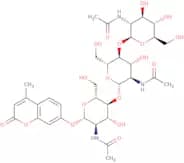
CAS:A sensitive fluorogenic substrate for fluorometric and UV-spectrophotometric assays of phosphatases. It is used for the detection of C. perfringens because acid phosphatase is a highly specific indicator for C. perfringens.Formula:C10H9O6PPeso molecolare:256.15 g/mol4-Methylumbelliferyl N,N',N''-triacetyl-b-D-chitotrioside
CAS:4-Methylumbelliferyl N,N',N''-triacetyl-beta-D-chitotrioside is a fluorogenic substrate for chitinase. After enzymatic cleaveage, free 4-methylumbelliferone (also known as hymecromone) is released, exhibiting blue fluorescence upon excitation with UV light. The strongest fluorescence of 4-methylumbelliferone requires deprotonation of the hydroxyl group (thus requires alkaline pH), with a maximal fluorescence intensity obtained with excitation at 350 to 370 nm and emission at 440 to 470 nm. The use of 4-methylumbelliferyl N,N',N''-triacetyl-beta-D-chitotriosideas a substrate for measuring the chitinase activity is used for fungal infection assays.Formula:C34H47N3O18Purezza:Min. 95.0 Area-%Colore e forma:White Off-White PowderPeso molecolare:785.75 g/mol4-Methylumbelliferyl-β-L-fucopyranoside
CAS:4-Methylumbelliferyl-beta-L-fucopyranoside is a fluorogenic substrate that is used in food testing. It also has uses as a chromogenic substrate and a ligand for biological studies. 4-Methylumbelliferyl-beta-L-fucopyranoside is a conjugate of 4-methylumbelliferone and beta-D-fucopyranosyl ester, which is an enzyme substrate for the detection of phosphatases. This product can be used to detect the activity of phosphatase enzymes in various media, including culture media, environmental testing, and staining. 4MUFBPY also has chemiluminescent properties that can be used for bioluminescence assays.Formula:C16H18O7Peso molecolare:322.31 g/molRef: 3D-M-5541
1gPrezzo su richiesta5gPrezzo su richiesta250mgPrezzo su richiesta500mgPrezzo su richiesta2500mgPrezzo su richiesta-Unit-ggPrezzo su richiesta5-Bromo-6-chloro-3-indoxyl-beta-D-glucuronic acid, cyclohexylammonium salt
CAS:Chromogenic substrate for β-D-glucuronidase (GUS) yielding a magenta precipitate. It is used fordetection of GUS+ bacterial colonies as analternative to 5-bromo-4-chloro-3-indoxyl-β-D-glucuronide (X-GlcA).
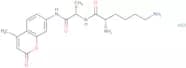
Formula:C20H26BrClN2O7Purezza:Min. 99 Area-%Peso molecolare:521.80 g/molL-Lysyl-L-alanine 7-amido-4-methylcoumarin dihydrochloride
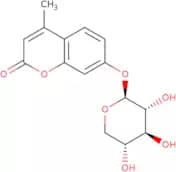
CAS:L-Lysyl-L-alanine 7-amido-4-methylcoumarin dihydrochloride is a fluorogenic peptide substrate for aminopeptidase. This AMC peptide substrate is normally used to rapidly profile the N-terminal specificity of proteases.Purezza:Min. 98.0 Area-%Colore e forma:Powder4-Methylumbelliferyl α-D-xylopyranoside
CAS:4-Methylumbelliferyl alpha-D-xylopyranoside is a fluorogenic substrate for alpha-xylosidase. After enzymatic cleaveage, free 4-methylumbelliferone (also known as hymecromone) is released, exhibiting blue fluorescence upon excitation with UV light. The strongest fluorescence of 4-methylumbelliferone requires deprotonation of the hydroxyl group (thus requires alkaline pH), with a maximal fluorescence intensity obtained with excitation at 350 to 370 nm and emission at 440 to 470 nm. The use of 4-methylumbelliferyl alpha-D-xylopyranosideas a substrate for measuring the alpha-xylosidase activity is used for oligosaccharidosis monitoring and other lysosomal storage disorder diagnosis.Formula:C15H16O7Purezza:Min. 98 Area-%Colore e forma:White PowderPeso molecolare:308.28 g/mol5-Bromo-6-chloro-3-indolyl a-D-galactopyranoside
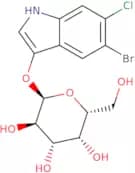
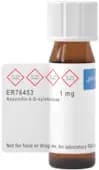
CAS:5-Bromo-6-chloro-3-indolyl a-D-galactopyranoside is a chromogenic substrate that yields a magenta-colored product after cleavage. The chromophore 5-bromo-6-chloro-indoxyl is released, generating the observable color. It is used in glycolipid metabolism studies.Formula:C14H15BrClNO6Colore e forma:White to off-white solid.Peso molecolare:408.63 g/molResorufin b-D-xylobioside
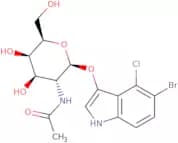
Resorufin b-D-xylobioside is a fluorogenic substrate for xylanases useful for xylanase activity assays.Purezza:Min. 95%Colore e forma:PowderPeso molecolare:477.42 g/mol5-Bromo-4-chloro-3-indoxyl-N-acetyl-beta-D-galactosaminide
CAS:5-Bromo-4-Chloro-3-Indoxyl-N-Acetyl-Beta-D-Galactosaminide is a chromogenic substrate for detecting beta-galactosidase and GalNAc-transferase enzymes. Upon hydrolysis by the enzyme, it produces a blue-green colored compound that can be detected visually or measured spectrophotometrically. This substrate is useful in characterizing the activity of Beta-Galactosidase and GalNAc-transferase enzymes involved in glycobiology research and diagnostic applications.Formula:C16H18BrClN2O6Purezza:Min. 98 Area-%Colore e forma:Crystalline PowderPeso molecolare:449.68 g/molAc-Abu-Tle-Leu-Gln-AMC TFA salt
A fluorogenic substrate for detection of enzymatic activity of the SARS-CoV-2 Mpro protease. The fluorophore 7-Amino-4-methylcoumarin (AMC) is linked to the tetrapeptide via a peptide bond at the C-terminal of the glutamine residue. Following the hydrolytic activity of the Mpro protease, the fluorogenic AMC group get released from the substrate, generating a fluorescent signal (Ex 380 nm / Em 455 nm).Formula:C33H48N6O8(freebase)Purezza:Min. 95.0 Area-%Peso molecolare:656.77 g/mol