Substrati enzimatici
Sottocategorie di "Substrati enzimatici"
Trovati 1525 prodotti di "Substrati enzimatici"
Luc-E.coli K
Bioluminescent substrate for detection of E. coli.Formula:C17H14K2N2O9S2Purezza:Min. 94 Area-%Peso molecolare:532.63 g/molResorufin a-D-mannopyranoside
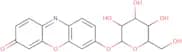
CAS:Resorufin alpha-D-glucopyranoside is a sensitive fluorogenic substrate that generates a red fluorescent product (resorufin) upon interaction with alpha-glucosidase.Purezza:Min. 95%Colore e forma:Brown PowderPeso molecolare:375.33 g/mol4-Nitrophenyl a-L-galactopyranoside
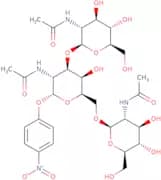
Chromogenic substrate targeting alpha-D-galactosidasePurezza:Min. 95%Peso molecolare:301.25 g/mol4-Nitrophenyl 2-acetamido-3,6-di-O-(2-acetamido-2-deoxy-b-D-glucopyranosyl)-2-deoxy-a-D-galactopyranoside
CAS:4-Nitrophenyl 2-acetamido-3,6-di-O-(2-acetamido-2-deoxy-b-D-glucopyranosyl)-2-deoxy-a-D-galactopyranoside is a fluorogenic substrate that is used in enzyme assays to detect the presence of an enzyme. The substrate reacts with the enzyme to produce a fluorescent product. 4NPAAG can be used for diagnostics, culture media, food testing and environmental testing.Formula:C30H44N4O18Purezza:Min. 95%Peso molecolare:748.69 g/molcis-6,7-Dimethyl-5,6,7,8-tetrahydropterin hydrochloride
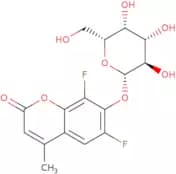
CAS:Please enquire for more information about cis-6,7-Dimethyl-5,6,7,8-tetrahydropterin hydrochloride including the price, delivery time and more detailed product information at the technical inquiry form on this pageFormula:C8H13N5O•HClPurezza:Min. 95%Peso molecolare:231.68 g/mol6,8-Difluoro-4-methylumbelliferyl β-D-galactopyranoside
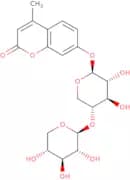
CAS:6,8-Difluoro-4-methylumbelliferyl b-D-galactopyranoside, commonly known as DiFMUG, is a fluorogenic substrate to detect beta-galactosidase. It has higher sensitivity than the common MUG (4-methylumbelliferyl beta-D-galactopyranoside) subtrate.Formula:C16H16F2O8Purezza:Min. 95%Colore e forma:PowderPeso molecolare:374.29 g/mol4-Methylumbelliferyl b-D-xylobioside
CAS:4-Methylumbelliferyl beta-D-xylobioside is a fluorogenic substrate for xylanase. After enzymatic cleaveage, free 4-methylumbelliferone (also known as hymecromone) is released, exhibiting blue fluorescence upon excitation with UV light. The strongest fluorescence of 4-methylumbelliferone requires deprotonation of the hydroxyl group (thus requires alkaline pH), with a maximal fluorescence intensity obtained with excitation at 350 to 370 nm and emission at 440 to 470 nm. The use of 4-methylumbelliferyl beta-D-xylobiosideas a substrate for measuring the xylanase activity is used for detecting bacterial infection and gut microbiome analysis.Formula:C20H24O11Purezza:Min. 95 Area-%Colore e forma:White PowderPeso molecolare:440.4 g/mol1,8,15,22,29,36-Hexaazacyclodotetracontane-2,7,16,21,30,35-hexone
CAS:Please enquire for more information about 1,8,15,22,29,36-Hexaazacyclodotetracontane-2,7,16,21,30,35-hexone including the price, delivery time and more detailed product information at the technical inquiry form on this pageFormula:C36H66N6O6Purezza:Min. 95%Colore e forma:PowderPeso molecolare:678.9 g/mol4-Methylumbelliferyl α-L-idopyranosiduronic acid 2-sulfate disodium salt
CAS:4-Methylumbelliferyl alpha-L-idopyranosiduronic acid 2-sulfate disodium salt is a chromogenic substrate that is used in the detection of glycosidases. It reacts with enzymes such as alpha-amylase, beta-galactosidase, and beta-glucosidase to produce a fluorescent product. This product can be detected using a fluorometer or spectrophotometer. The CAS number for 4-methylumbelliferyl alpha-L-idopyranosiduronic acid 2-sulfate disodium salt is 1045020-74-3.
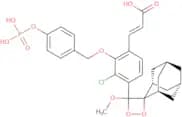
Formula:C16H14Na2O12SPurezza:Min. 99.0 Area-%Peso molecolare:476.32 g/molAquaSpark® Broad Range Phosphatase Substrate, 2 mM in DMSO, Ramot at Tel-Aviv University Ltd. Patent family WO 2017/130191
CAS:Chemiluminescent phosphatase substrate in a wide pH range (pH 6 - 10)
Formula:C28H30ClO10PColore e forma:Clear LiquidPeso molecolare:592.96 g/mol4-Nitrophenyl decanoate
CAS:4-Nitrophenyl decanoate is a chromogenic substrate for lipase. Upon hydrolysis, para-nitrophenol is released yielding a yellowish colour. 4-Nitrophenyl decanoate is used in different applications such as the Pancreatic insufficiency diagnosis, lipid metabolism studies
Formula:C16H23NO4Purezza:Min. 97 Area-%Colore e forma:PowderPeso molecolare:293.36 g/molRef: 3D-EN29174
Prodotto fuori produzione5-Bromo-4-chloro-3-indolyl a-L-rhamnoside
5-Bromo-4-chloro-3-indolyl a-L-rhamnoside is a chromogenic substrate used to detect the specific enzymatic activity of alpha-L-rhamnosidase. After cleavage, 5-bromo-4-chloro-indoxyl is released, resulting in a blue to blue-green color change in bacterial colonies or media. 5-Bromo-4-chloro-3-indolyl a-L-rhamnoside is used in bacterial rhamnose metabolism studies (e.g. E. coli).
Formula:C14H15BrClNO5Purezza:Min. 95%Colore e forma:SolidPeso molecolare:392.63 g/molRef: 3D-EB170531
Prodotto fuori produzione5-Bromo-4-chloro-3-indoxyl-alpha-D-galactopyranoside
CAS:Chromogenic substrate for α-galactosidase yielding a blue precipitate. Used for species differentiation within the family Enterobacteriaceae and differentiation of Bifido bacteria species from Lactobacillus species.
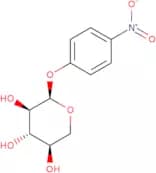
Formula:C14H15BrClNO6Purezza:Min. 99 Area-%Peso molecolare:408.64 g/mol4-Nitrophenyl a-D-xylopyranoside
CAS:The 4-Nitrophenyl a-D-xylopyranoside is a highly sensitive and reliable chromogenic substrate tailored for the detection and analysis of alpha-D-xylosidase enzyme activity. Upon enzymatic hydrolysis, it forms 4-nitrophenol, a yellow compound with remarkable fluorescence that enables a straightforward, quantitative assay in areas including environmental science, metabolism studies, and enzyme modifier exploration.
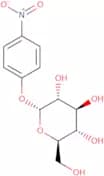
Formula:C11H13NO7Purezza:Min. 95%Colore e forma:White PowderPeso molecolare:271.22 g/mol4-Nitrophenyl a-D-glucopyranoside
CAS:Chromogenic substrate for alpha-glucosidase
Formula:C12H15NO8Purezza:Min. 98 Area-%Colore e forma:White PowderPeso molecolare:301.25 g/molCoelenterazine e
CAS:Coelenterazine and its derivatives spontaneously complex with aequorin to develop a Ca2+-dependent fluorescent signal.
Formula:C28H23N3O3Purezza:Min. 95%Colore e forma:PowderPeso molecolare:449.5 g/molRef: 3D-FC36333
Prodotto fuori produzioneBis(4-methylumbelliferyl)phosphate
CAS:Bis(4-methylumbelliferyl)phosphate is a fluorescent probe that can be used for the diagnosis of β-glucosidase. It has a phosphate group and can be used to study phosphodiesterases and phosphodiesters. Bis(4-methylumbelliferyl)phosphate is also a liposomal probe that can be used in kinetic studies. This compound has been shown to inhibit β-glucosidase, which is an enzyme found in human saliva and pancreatic juice, at high concentrations. The inhibition of this enzyme leads to the accumulation of glucose and galactose in the blood, which can lead to diabetes mellitus or cancer.
Formula:C20H15O8PPeso molecolare:414.31 g/molRef: 3D-B-3500
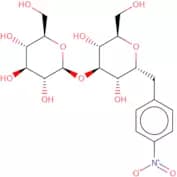
Prodotto fuori produzione4-Nitrophenyl 3-O-(β-D-glucopyranosyl)-α-D-glucopyranoside
4-Nitrophenyl 3-O-(beta-D-glucopyranosyl)-alpha-D-glucopyranoside is a chromogenic substrate for alpha-glucosidase. Upon hydrolysis, para-nitrophenol is released yielding a yellowish colour. 4-Nitrophenyl 3-O-(beta-D-glucopyranosyl)-alpha-D-glucopyranoside is used in different applications such as the Gaucher disease screening, carbohydrate metabolism studies
Formula:C18H25NO13Purezza:Min. 95%Peso molecolare:463.39 g/molRef: 3D-EN04815
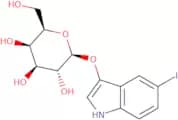
Prodotto fuori produzione5-Iodo-3-indolyl b-D-galactopyranoside
CAS:5-Iodo-3-indolyl b-D-galactopyranoside is a chromogenic substrate used for beta-galactosidase. It is incorporated into media or detection kits for rapid and direct identification of microorganisms.
Formula:C14H16INO6Purezza:Min. 98 Area-%Colore e forma:PowderPeso molecolare:421.18 g/molAquaSpark® α-D-galactoside, 10 mM in DMSO, Ramot at Tel-Aviv University Ltd. Patent family WO 2017/130191
CAS:AquaSpark™ α-D-galactoside is a dioxetane-based substrate for the luminescence detection of α-galactosidase activity. It is the first single-compound chemiluminescent substrate commercially available for the detection of α-galactosidase activity. α-galactosidase assays are used in molecular biology to monitor the transcriptional activity of the GLA gene that is correlated with metabolic diseases or gene mutations. In microbiology the α-galactosidase activity is used to detect specific bacteria such as α-galactosidase positive Salmonella strains (Salmonella Enteritidis RKI 05/07992).
Formula:C34H39ClO12Peso molecolare:675.12 g/mol