Substrati cromogenici
I substrati cromogeni sono composti che producono un cambiamento di colore visibile quando vengono metabolizzati da specifici enzimi. Questi substrati sono ampiamente utilizzati nei test diagnostici, nella ricerca biochimica e negli immunoassay enzimatici (ELISA) per rilevare e quantificare l'attività enzimatica. Il cambiamento di colore consente una facile e rapida identificazione visiva delle reazioni enzimatiche, rendendo i substrati cromogeni strumenti essenziali nell'analisi di laboratorio. Presso CymitQuimica, offriamo una vasta selezione di substrati cromogeni di alta qualità per supportare le vostre applicazioni di ricerca e diagnostica.
Trovati 712 prodotti di "Substrati cromogenici"
Ordinare per
Purezza (%)
0
100
|
0
|
50
|
90
|
95
|
100
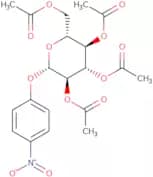
4-Nitrophenyl 2,3,4,6-tetra-O-acetyl-b-D-glucopyranoside
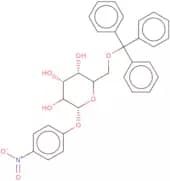
CAS:<p>4-Nitrophenyl 2,3,4,6-tetra-O-acetyl-β-D-glucopyranoside is a versatile chromogenic substrate designed for the detection and quantification of various glycosidase enzymes. This substrate is widely used in enzyme assays, producing a yellow color upon cleavage by target enzymes. The 4-Nitrophenol released in this reaction can be easily monitored spectrophotometrically, allowing for rapid and accurate enzyme analysis. This high-quality substrate provides a convenient and reliable tool for researchers in biochemistry, enzymology, and related fields.</p>Formula:C20H23NO12Purezza:Min. 95 Area-%Colore e forma:PowderPeso molecolare:469.4 g/mol4-Nitrophenyl 6-O-trityl-a-D-glucopyranoside
CAS:<p>4-Nitrophenyl 6-O-trityl-a-D-glucopyranoside is a high-quality trityl pNP substrate that performs excellently in various enzymatic assays. Containing a trityl-protected sugar moiety, this substrate is perfect for investigating alpha-D-glucopyranoside-specific enzymes and providing precise data for your experiments.</p>Purezza:Min. 95%Peso molecolare:543.56 g/mol4-Nitrophenyl 2-acetamido-3-azido-2,3-dideoxy-b-D-galactopyranoside
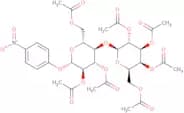
<p>4-Nitrophenyl 2-acetamido-3-azido-2,3-dideoxy-b-D-galactopyranoside is a fluorogenic substrate for beta-galactosidase. It has been used in the detection of beta-galactosidase activity in culture media, and for the detection of beta-galactosidase activity in environmental samples. 4NPAG can be conjugated to a variety of molecules, including antibodies, proteins, nucleotides, and oligonucleotides. 4NPAG can be used as an enzyme substrate for both chromogenic and fluoroquinolone substrates.</p>Purezza:Min. 95%4-Nitrophenyl hepta-O-acetyl-b-lactoside
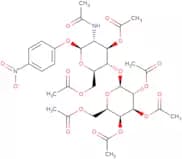
CAS:<p>4-Nitrophenyl hepta-O-acetyl-b-lactoside is a high-quality chromogenic pNP enzyme substrate that exhibits excellent sensitivity and specificity in enzyme assays. This synthetic compound is designed to react with β-galactosidase enzymes, generating a yellow product (4-nitrophenol) upon cleavage. The resulting color change allows for quantitative measurement of enzyme activity, providing valuable insights in various research applications including enzyme kinetics, screening of inhibitors, drug discovery, and molecular diagnostics. Our product ensures consistent results with minimal interference, making it a reliable choice for a wide range of biochemical applications.</p>Purezza:Min. 95%Peso molecolare:757.65 g/mol4-Nitrophenyl 2-acetamido-3,6-di-O-acetyl-4-O-(2,3,4,6-tetra-O-acetyl-b-D-galactopyranosyl)-2-deoxy-b-D-glucopyranoside
CAS:<p>4-Nitrophenyl 2-acetamido-3,6-di-O-acetyl-4-O-(2,3,4,6-tetra-O-acetyl-b-D-galactopyranosyl)-2-deoxy-b-D-glucopyranoside is modified acetylated chromogenic substrate designed for the detection and quantification of enzyme activity. This highly specific substrate is cleaved by enzymes, releasing a yellow 4-nitrophenol product that can be easily measured spectrophotometrically. This allows for accurate and sensitive analysis of enzyme kinetics, inhibition studies, and substrate specificity determination.</p>Purezza:Min. 95%Peso molecolare:756.66 g/mol4-Nitrophenyl 3,4-O-isopropylidene-a-D-galactopyranoside
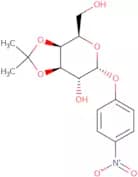
CAS:<p>4-Nitrophenyl 3,4-O-isopropylidene-a-D-galactopyranoside is a chemiluminescent substrate for detecting beta-galactosidase activity in bacteria. This product is a high purity, high quality compound that can be used as a culture media and environmental testing agent. It has been shown to be effective in diagnostics, chromogenic substrate, and enzyme substrate reactions. 4NPPG has been shown to be a fluorogenic substrate for beta-galactosidase assay and can be used as food testing agent with conjugate.</p>Purezza:Min. 95%Peso molecolare:341.31 g/mol4-Nitrophenyl 4,6-O-benzylidene-3-O-(2,3,4,6-tetra-O-acetyl-b-D-glucopyranosyl)-b-D-glucopyranoside
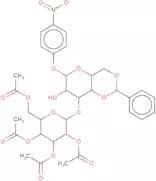
<p>4-Nitrophenyl 4,6-O-benzylidene-3-O-(2,3,4,6-tetra-O-acetyl-b-D-glucopyranosyl)-b-D-glucopyranoside is a high purity fluorescent reagent that can be used as a substrate for many enzymes. It is also used in environmental testing and to detect the presence of nitrophenols in food. This product has CAS number 545414.</p>Purezza:Min. 95%Peso molecolare:719.64 g/mol4-Nitrophenyl 2,3,4,6-tetra-O-acetyl-a-D-glucopyranoside
CAS:<p>4-Nitrophenyl 2,3,4,6-tetra-O-acetyl-a-D-glucopyranoside is a useful substrate for enzymatic assays. This high-sensitivity chromogenic pNP substrate offers enhanced selectivity and increased detection ability, allowing for a broad range of applications in the field of glycosidase research. Featuring rapid colorimetric readouts with easily detectable endpoint determination, this substrate delivers clear and accurate results every time.</p>Purezza:Min. 95%Peso molecolare:469.4 g/mol4-Nitrophenyl b-D-thiomannopyranoside
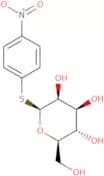
CAS:<p>4-Nitrophenyl b-D-thiomannopyranoside acts as a substrate for β-mannosidase and thioglycoligase. Upon enzymatic cleavage, these substrates release 4-nitrophenol, a yellow chromophore that can be detected spectrophotometrically at 405 nm, facilitating quantitative measurements of enzymatic activity. Consequently, these substrates are widely used in biochemical research, clinical diagnostics, and drug discovery for evaluating the function of specific enzymes in various biological processes.</p>Purezza:Min. 95%Peso molecolare:317.32 g/mol5-Bromo-4-chloro-3-indolyl 2-acetamido-2-deoxy-a-D-galactopyranoside
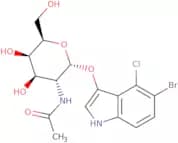
CAS:<p>Substrate for a-N-acetyl-galactosaminidase</p>Formula:C16H18BrClN2O6Purezza:Min. 95%Colore e forma:White to off-white solid.Peso molecolare:449.68 g/mol2-Nitrophenyl 6-O-trityl-b-D-galactopyranoside
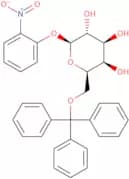
CAS:<p>2-Nitrophenyl 6-O-trityl-b-D-galactopyranoside is a chromogenic enzyme substrate used in assays to detect galactosidase activity. It is a derivative of galactose that can be hydrolyzed by galactosidase to release the yellow-colored 2-nitrophenyl group, which can be detected spectrophotometrically. The trityl group helps to stabilize the molecule and prevent undesired hydrolysis during storage. This substrate is commonly used in the study of carbohydrate metabolism and in the detection of galactosidase activity in microorganisms.</p>Purezza:Min. 95%Peso molecolare:543.56 g/mol4-Nitrophenyl lacto-N-tetraoside
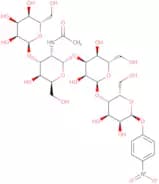
CAS:<p>4-Nitrophenyl lacto-N-tetraoside is a chromogenic substrate for enzymes that cleave lactose-specific linkages, such as beta-galactosidases. Upon enzyme cleavage, the pNP group is released, resulting in a yellow-colored solution that can be spectrophotometrically quantified at 405 nm. This substrate is commonly used in detecting lactose hydrolysis activity, such as in dairy industry for production optimization studies, or in microbiology for bacterial lactose fermentation assays. Its tetrasaccharide structure resembles that of lactose and makes it a specific substrate for lactose-utilizing enzymes. The properties of 4-nitrophenyl lacto-N-tetraoside make it a useful tool in enzyme kinetics studies and screening of new lactose-utilizing microorganisms.</p>Purezza:Min. 95%Peso molecolare:828.72 g/mol4-Nitrophenyl 2-O-(α-L-fucopyranosyl)-β-D-galactopyranoside
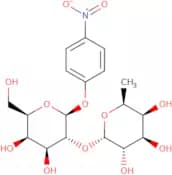
CAS:<p>4-Nitrophenyl 2-O-(α-L-fucopyranosyl)-β-D-galactopyranoside is a chromogenic enzymatic substrate for the detection and quantification of glycosidases, such as fucosidases and galactosidases. Upon enzymatic cleavage, the substrate releases the p-nitrophenol chromophore, which can be quantified via colorimetric analysis. This pNP-conjugated compound enables the rapid, sensitive, and high-throughput detection of enzyme activity in various applications, including enzymatic assays, inhibitor screening, and mechanistic studies. Its precise specificity for α-L-fucopyranosyl and β-D-galactopyranoside moieties makes it an excellent tool for advancing research in glycobiology and related fields.</p>Formula:C18H25NO12Purezza:Min. 95%Colore e forma:White Off-White PowderPeso molecolare:447.39 g/mol4-Methyl-2-nitrophenyl b-D-galactopyranoside
<p>4-Methyl-2-nitrophenyl b-D-galactopyranoside is a fluorogenic substrate for β-galactosidase. It has a high purity and is of high quality. 4-Methyl-2-nitrophenyl b-D-galactopyranoside is used as an enzyme substrate in diagnostics, as a chromogenic substrate in staining, and as a conjugate in chemiluminescence. It can be used for the detection of β-galactosidase in culture media and for the detection of β-galactosidase in environmental testing. This chemical also has bioluminescent properties that make it useful for food testing.</p>Purezza:Min. 95%Peso molecolare:315.28 g/mol4-Nitrophenyl O-(N-acetyl-a-neuraminosyl)-(2-3)-b-D-galactopyranosyl-(1-4)-b-D-glucopyranoside
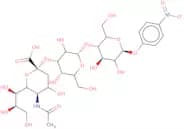
CAS:<p>4-Nitrophenyl O-(N-acetyl-a-neuraminosyl)-(2-3)-b-D-galactopyranosyl-(1-4)-b-D-glucopyranoside is a fluorescent substrate that can be used for the detection of β-galactosidase. It fluoresces when cleaved by β-galactosidase, which is an enzyme that catalyzes the hydrolysis of terminal galactose residues in the glycosidic linkage of β-galactosides. This product is an excellent substrate for use in chemiluminescence and bioluminescence assays. 4NPBG has been used to detect β-galactosidase activity in diverse environments, such as food testing, staining, fluorogenic substrate, environmental testing, chromogenic substrate, and conjugate. It is also used in diagnostics, ligand binding assays,</p>Purezza:Min. 95%Peso molecolare:754.64 g/mol4-Nitrophenyl phosphate bis(tris) salt
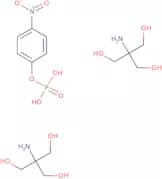
CAS:<p>Substrate for alkaline phosphatase</p>Formula:C6H6NO6P•(C4H11NO3)2Purezza:(%) Min. 99%Colore e forma:PowderPeso molecolare:461.36 g/mol4-Nitrophenyl 2-O-(2,3,4-tri-O-acetyl-a-L-fucopyranosyl)-6-O-benzoyl-3,4-O-isopropylidene-a-D-galactopyranoside
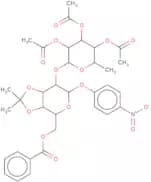
CAS:<p>4-Nitrophenyl 2-O-(2,3,4-tri-O-acetyl-a-L-fucopyranosyl)-6-O-benzoyl-3,4-O-isopropylidene a D galactopyranoside is an analog of galactose that binds to the DNA and regulates gene expression. This compound has been shown to be able to regulate gene expression levels in cells. 4NP2B6OB was used as a probe for microarray analysis of gene expression profiles from environmental samples. It was found that 4NP2B6OB could be used as a probe for the identification of genes in high density arrays.</p>Purezza:Min. 95%Peso molecolare:717.67 g/molN-Acetyl-L-glutamine p-nitroanilide
CAS:<p>N-Acetyl-L-glutamine p-nitroanilide is a fluorogenic substrate that can be used in the diagnosis of bacterial infections. It is a ligand that can bind to enzymes involved in the production of bioluminescence, such as luciferase, and can be used for the detection of bacteria. It is also used for food testing, environmental testing, and diagnostics. N-Acetyl-L-glutamine p-nitroanilide has high purity and high quality, which makes it suitable for conjugation with other molecules.</p>Formula:C13H15N3O6Purezza:Min. 95%Colore e forma:PowderPeso molecolare:309.27 g/mol4-Nitrophenyl 2-acetamido-3-O-[2-O-(2,3,4-tri-O-benzoyl-a-L-fucopyranosyl)-3,4,6-tri-O-acetyl-D-galactopyranosyl]-2-deoxy-6-O-trityl -b-D-glucopyranoside
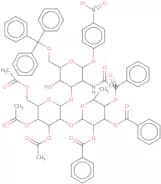
<p>4-nitrophenyl 2-acetamido-3-O-[2-O-(2,3,4-tri-O-benzoyl-a-L-fucopyranosyl)-3,4,6-tri-O-acetyl -D -galactopyranosyl]-2 deoxy 6 O trityl b D glucopyranoside is a chemiluminescent substrate that can be used in biochemical assays. It reacts with oxygen to produce light when it is excited by a UV or blue light source. This product has been tested for purity and quality by HPLC analysis and spectroscopy.</p>Purezza:Min. 95%Peso molecolare:1,331.33 g/mol6-Chloro-3-indolyl phosphate disodium salt
CAS:<p>6-Chloro-3-indolyl phosphate disodium salt is a substrate for visualising alkaline phosphatase activity. It produces a red colored insoluble end product that is detected visually, when used together with nitroblue tetrazolium. The substrate system is versatile and functions in a variety of applications, including Northern, Southern, and Western blotting, in situ hybridization, ELISAs and immunohistochemistry. DMF soluble.</p>Formula:C8H5ClNNa2O4PPurezza:Min. 98 Area-%Colore e forma:PowderPeso molecolare:291.54 g/mol