Substrati cromogenici
I substrati cromogeni sono composti che producono un cambiamento di colore visibile quando vengono metabolizzati da specifici enzimi. Questi substrati sono ampiamente utilizzati nei test diagnostici, nella ricerca biochimica e negli immunoassay enzimatici (ELISA) per rilevare e quantificare l'attività enzimatica. Il cambiamento di colore consente una facile e rapida identificazione visiva delle reazioni enzimatiche, rendendo i substrati cromogeni strumenti essenziali nell'analisi di laboratorio. Presso CymitQuimica, offriamo una vasta selezione di substrati cromogeni di alta qualità per supportare le vostre applicazioni di ricerca e diagnostica.
Trovati 712 prodotti di "Substrati cromogenici"
Ordinare per
Purezza (%)
0
100
|
0
|
50
|
90
|
95
|
100
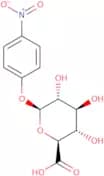
4-Nitrophenyl-beta-D-glucuronic acid
CAS:Chromogenic β-glucuronidase substrate yielding a yellow solution upon cleavage. Used to detect E. coli contamination in food and drinking water due to their β-glucuronidase activity.Formula:C12H13NO9Purezza:Min. 98.0 Area-%Peso molecolare:315.24 g/molAldol® 515 L-alanine amide, hydrochloride, Biosynth Patent: EP 2427431 and US 8940909
CAS:Aldol® 515 L-alanine amide is a chromogenic and fluorogenic enzyme substrate used for detection of L-alanine aminopeptidase activity. The colorless enzyme substrate is cleaved by L-alanine aminopeptidase produced by microorganisms, grown in liquid or solid media yielding red color. In addition, red fluorescence is generated when a fluorescence enhancer or a suitable matrix is present. Aldol® 515 L-alanine amide can be used under aerobic and anaerobic conditions.
Formula:C26H27ClN4O2Purezza:Min. 95.0 Area-%Peso molecolare:462.97 g/mol4-Nitrocatechol sulfate dipotassium salt
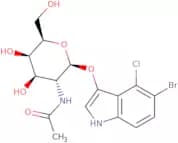
CAS:Chromogenic sulfatase substrateFormula:C6H3NO7SK2Purezza:Min. 98 Area-%Colore e forma:PowderPeso molecolare:311.35 g/mol5-Bromo-4-chloro-3-indoxyl-N-acetyl-beta-D-galactosaminide
CAS:5-Bromo-4-Chloro-3-Indoxyl-N-Acetyl-Beta-D-Galactosaminide is a chromogenic substrate for detecting beta-galactosidase and GalNAc-transferase enzymes. Upon hydrolysis by the enzyme, it produces a blue-green colored compound that can be detected visually or measured spectrophotometrically. This substrate is useful in characterizing the activity of Beta-Galactosidase and GalNAc-transferase enzymes involved in glycobiology research and diagnostic applications.Formula:C16H18BrClN2O6Purezza:Min. 98 Area-%Colore e forma:Crystalline PowderPeso molecolare:449.68 g/mol5-Cyano-3-indoxyl-β-D-galactopyranoside
For detection of beta-galactosidase activity. The colors of the chromogen can be adjusted by incorporating different functional groups, e.g. cyano or nitro group, which yields purple or black green colonies with beta-galactosidase positive strain.Formula:C15H16N2O6Peso molecolare:320.3 g/molAldol® 484 beta-D-galactopyranoside, Biosynth Patent: EP 2427431 and US 8940909
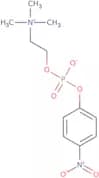
CAS:Aldol® 484 beta-D-galactopyranoside is a chromogenic enzyme substrate for beta-galactosidase activity. The colorless product is cleaved by lactose-utilizing bacteria in liquid or solid media, yielding intense red color. Aldol® 484 beta-D-galacto-pyranoside can also be used in beta-gal reporter gene assays or for identification of beta-gal positive transformants on agar. Aldol® 484 beta-D-galactopyranoside can be used under aerobic and anaerobic conditions.Formula:C26H24ClFN2O7Purezza:Min. 95%Colore e forma:PowderPeso molecolare:530.93 g/mol4-Nitrophenylphosphorylcholine
CAS:Chromogenic substrate used to measure phospholipase C (PLC) activity
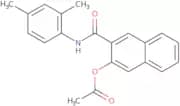
Formula:C11H17N2O6PPurezza:Min. 95 Area-%Colore e forma:PowderPeso molecolare:304.24 g/molNaphthol AS-MX acetate
CAS:Modified naphtol AS substrate used in histochemical and cytochemical staining
Formula:C21H19NO3Purezza:Min. 80%Colore e forma:White Off-White PowderPeso molecolare:333.38 g/mol4-Chloro-1-naphthol
CAS:Substrate for horseradish peroxidase
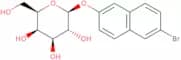
Formula:C10H7ClOPurezza:Min. 96.0 Area-%Colore e forma:Brown PowderPeso molecolare:178.61 g/mol6-Bromo-2-naphthyl β-D-galactopyranoside
CAS:6-Bromo-2-naphthyl β-D-galactopyranoside is a chromogenic substrate commonly used for the detection of the enzymatic activity of β-galactosidase. It can produce a yellow precipitate upon hydrolysis by β-galactosidase, indicating the presence of the enzyme. It is often used in molecular biology applications to detect gene expression or to monitor cloning efficiency.Formula:C16H17BrO6Purezza:Min. 98 Area-%Colore e forma:PowderPeso molecolare:385.21 g/mol5-Nitro-3-indoxyl-β-D-galactopyranoside
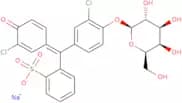
Please enquire for more information about 5-Nitro-3-indoxyl-β-D-galactopyranoside including the price, delivery time and more detailed product information at the technical inquiry form on this pageFormula:C14H16N2O8Purezza:Min. 95%Peso molecolare:340.29 g/molChlorophenol red-b-D-galactopyranoside sodium salt
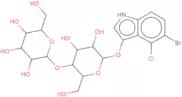
CAS:Chlorophenol red-b-D-galactopyranoside sodium salt is the salt from of CPRG (chlorophenol red-b-D-galactopyranoside), that has a higher solubility. It is a chromogenic substrate for beta-galactosidases that, after enzymatic cleavage, releases chlorophenol red, a dark red compound quantified by absorbance at 570 nm.Formula:C25H21Cl2O10SNaPurezza:Min. 96 Area-%Colore e forma:PowderPeso molecolare:607.4 g/mol5-Bromo-4-chloro-3-indolyl a-D-maltopyranoside
CAS:5-Bromo-4-chloro-3-indolyl a-D-maltopyranoside is a chromogenic substrate used to detect the specific enzymatic activity of alpha-glucosidase. After cleavage, 5-bromo-4-chloro-indoxyl is released, resulting in a blue to blue-green color change in bacterial colonies or media. 5-Bromo-4-chloro-3-indolyl a-D-maltopyranoside is used in Pompe disease screening and glycogen storage disorder diagnosis.Formula:C20H25BrClNO11Purezza:Min. 95%Colore e forma:PowderPeso molecolare:570.77 g/mol4-Nitrophenyl 3-O-(a-D-glucopyranosyl)-a-D-glucopyranoside
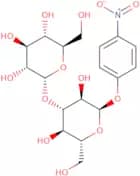
CAS:4-Nitrophenyl 3-O-(a-D-glucopyranosyl)-a-D-glucopyranoside (pNP-Glc-Glc) is a highly sensitive and potent chromogenic substrate for the enzymatic detection and measurement of alpha-glucosidase activity. The rapid color change triggered by the hydrolysis of pNP-Glc-Glc provides a clear and efficient method for monitoring enzyme kinetics, screening inhibitors, and functional characterization of α-glucosidases. This substrate is soluble in aqueous and polar organic solvents and yields a detectable 4-nitrophenol product with a distinct yellow color under both visible and ultraviolet light, enabling quantitative spectrophotometric measurements. With a superior signal-to-noise ratio and maximal sensitivity, pNP-Glc-Glc is a reliable and robust option for biochemical and biomedical research involving glucosidase enzymes.Purezza:Min. 95%Colore e forma:PowderPeso molecolare:463.39 g/mol2-Naphthyl-alpha-L-fucopyranoside
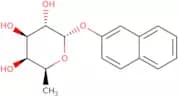
CAS:Chromogenic substrate for α-L-Fucosidase. 2-naphthol is released upon hydrolyzation. By simultaneous coupling with a suitable staining reagent, such as hexazonium p-rosaniline, the corresponding azo-dye is formed. Naphthols can also be detected by fluorescence analysis.Formula:C16H18O5Purezza:Min. 98 Area-%Peso molecolare:290.32 g/mol5-Bromo-4-chloro-3-indolyl a-L-arabinofuranoside
5-Bromo-4-chloro-3-indolyl a-L-arabinofuranoside is a chromogenic substrate used to detect the specific enzymatic activity of alpha-L-arabinofuranosidase. After cleavage, 5-bromo-4-chloro-indoxyl is released, resulting in a blue to blue-green color change in bacterial colonies or media. 5-Bromo-4-chloro-3-indolyl a-L-arabinofuranoside is used in bacterial arabinan degradation assays (e.g. Bacillus spp.).Formula:C13H13BrClNO5Purezza:Min. 98.0 Area-%Colore e forma:PowderPeso molecolare:378.6 g/mol4-Nitrophenyl phosphate, bis(cyclohexylammonium) salt
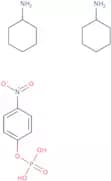
CAS:Chromogenic substrate yielding a soluble yellow chromophor for the colorimetric assay of phosphatases.Formula:C18H32N3O6PPurezza:97.0 To 103.0%Peso molecolare:417.45 g/mol2-Naphthyl caprylate
CAS:2-Naphthyl caprylate is a substrate that is employed in an assays for carboxylesterase and lipase and when hydrolyzed, produces 2-naphthol, a compound that can also be identified via fluorescence analysis. By combining it with a diazonium salt, the formation of the corresponding azo dye occurs. In particular, this substrate is used to detect the extracellular lipase of Pseudomonas fluorescens B52.Formula:C18H22O2Purezza:Min. 95%Colore e forma:White PowderPeso molecolare:270.37 g/mol2-Fluoro-4-nitrophenyl b-D-galactopyranoside
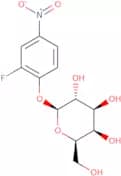
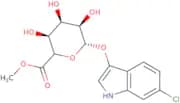
CAS:2-Fluoro-4-nitrophenyl b-D-galactopyranoside is a chromogenic substrate in enzymatic assays with β-galactosidase. Commonly abbreviated as PFONPG, it is a hydrophilic compound that can be dissolved in saline and blood samples, which makes it a suitable candidate for diagnostic applications as a gene reporter probe by simple analytic methodologies. 2-Fluoro-4-nitrophenyl b-D-galactopyranoside have been used to detect and monitor the growth of prostate tumor cells.Purezza:Min. 95%Colore e forma:PowderPeso molecolare:319.24 g/mol6-Chloro-3-indoxyl-β-D-glucuronic acid methyl ester, Biosynth Patent: EP 2718458 and US 9127303
6-Chloro-3-indoxyl-beta-D-glucuronic acid methyl ester is a chromogenic substrate that can be used for the detection of indoxyl glucuronide in urine and other biological fluids. 6-Chloro-3-indoxyl-beta-D-glucuronic acid methyl ester is a white or light yellow crystalline solid that is soluble in water. It has a melting point of about 80°C and is stable at pH levels ranging from 2 to 12. The CAS number for this compound is 13982-87-6.Formula:C15H16ClNO7Purezza:Min. 97.0 Area-%Peso molecolare:357.74 g/mol