Substrati cromogenici
Trovati 712 prodotti di "Substrati cromogenici"
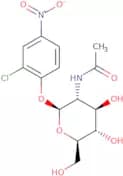
2-Chloro-4-nitrophenyl 2-acetamido-2-deoxy-β-D-glucopyranoside
CAS:2-Chloro-4-nitrophenyl 2-acetamido-2-deoxy-β-D-glucopyranoside is a chromogenic substrate used for beta-N-acetylglucosaminidase assays. Upon enzymatic hydrolysis, 2-chloro-4-nitrophenol is released, which has a yellowish color. It is used in diagnostic applications such as lysosomal storage disorder diagnosis (for example, Tay-Sachs disease) and glycosidase inhibition studies.Formula:C14H17ClN2O8Purezza:Min. 98 Area-%Colore e forma:White PowderPeso molecolare:376.75 g/mol2-Nitrobenzyl 2-deoxy-2-fluoro-L-fucopyranoside
The photorelease of 2-deoxy-2-fluoro-L-fucose from 2-nitrobenzyl-2-deoxy-2-fluoro-L-fucopyranoside was performed under a 365 nm LED illumination. It has been shown in plant cells this liberated 2-deoxy-2-fluoro-L-fucose can be converted by the endogenous metabolic machinery into the corresponding nucleotide-sugar, which then efficiently inhibits Golgi-localized fucosyltransferases.Formula:C13H16FNO6Purezza:Min. 95%Colore e forma:PowderPeso molecolare:301.27 g/molMethyl 4-nitrophenyl hexylphosphonate
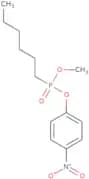
CAS:Methyl 4-nitrophenyl hexylphosphonate is a phosphonate inhibitor of the enzyme serine esterase. It has been shown to be more potent than other irreversible inhibitors such as ethyl 4-nitrophenyl hexylphosphonate and methyl 4-nitrophenoxybutyl phosphate. This compound is an immobilized form of the methyl 4-nitrophenyl hexylphosphonate that is immobilized on an inert surface, such as silica gel, via a covalent bonding process. The immobilization of the molecule ensures that it will not leach from the surface and is stable over time. The molecular weight of this substance is 411.5 Daltons and its molecular formula is C8H15NO4P. This substance has a diameter of 0.8 nm and can be found in crystalline form with a melting point of 143 degrees Celsius at atmospheric pressure. Methyl 4-nitrophenyl
Formula:C13H20NO5PPurezza:Min. 95%Peso molecolare:301.27 g/mol4-Nitrophenyl a-L-galactopyranoside
Chromogenic substrate targeting alpha-D-galactosidasePurezza:Min. 95%Peso molecolare:301.25 g/mol4-Nitrophenyl-myo-inositol-1-yl phosphate
CAS:4-Nitrophenyl-myo-inositol-1-yl phosphate is a highly specific chromogenic substrate used for the detection, quantification, and characterization of phosphoinositide phosphatases. When cleaved by the target enzyme, it generates a highly absorbing 4-nitrophenyl moiety, producing a yellow color that can be measured spectrophotometrically. This versatile substrate is valuable in examining phosphoinositide phosphatase activity, enzyme kinetics, substrate specificity, and inhibition studies in various cellular processes, including signal transduction, lipid metabolism, and membrane trafficking.
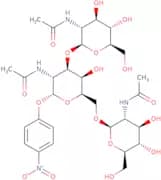
Purezza:Min. 95%Peso molecolare:381.23 g/mol4-Nitrophenyl 2-acetamido-3,6-di-O-(2-acetamido-2-deoxy-b-D-glucopyranosyl)-2-deoxy-a-D-galactopyranoside
CAS:4-Nitrophenyl 2-acetamido-3,6-di-O-(2-acetamido-2-deoxy-b-D-glucopyranosyl)-2-deoxy-a-D-galactopyranoside is a fluorogenic substrate that is used in enzyme assays to detect the presence of an enzyme. The substrate reacts with the enzyme to produce a fluorescent product. 4NPAAG can be used for diagnostics, culture media, food testing and environmental testing.Formula:C30H44N4O18Purezza:Min. 95%Peso molecolare:748.69 g/mol2-O-(4-Nitrophenyl)-a-D-N-glycolylneuraminic acid
CAS:2-O-(4-Nitrophenyl)-a-D-N-glycolylneuraminic acid is commonly used to measure the activity of sialidase enzymes, specifically those that cleave glycoconjugates containing 2-O-(4-nitrophenyl)-alpha-D-N-glycolylneuraminic acid. The resulting product can be detected by measuring the absorbance at a specific wavelength using a spectrophotometer. This substrate offers a high degree of specificity for glycolylneuraminic acid-containing substrates and is useful for both research and diagnostic purposes.Purezza:Min. 95%Colore e forma:PowderPeso molecolare:446.36 g/molBronze-Gal
Bronze-Gal (Bronze-beta-D-galactopyranoside) is a chromogenic indicator for beta-galactosidase activity. The colorless product is cleaved by lactose-utilizing bacteria in liquid media or on agar plates and yields a bronze colored precipitate. Bronze-Gal can also be used as detecting agent for beta-galactosidase activity in reporter gene assays or for identification of positive transformants on agar plates when using the α-complementation approach. Read more in the Application Notes.
Purezza:Min. 95%Peso molecolare:443.57Aldol® 455 β-D-galactopyranoside, Biosynth Patent: EP 2427431 and US 8940909
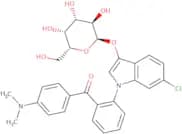
CAS:Aldol® 455 beta-D-galactopyranoside is a chromogenic substrate for the enzyme β-galactosidase. It is used to detect the activity of β-galactosidase in cell culture, and has been shown to be highly purified and of high quality. This product can be used as a ligand for receptor binding studies or as an agent in enzyme substrates in fluorescence and chemiluminescence reactions.
Formula:C27H24ClNO7Purezza:Min. 93.0 Area-%Peso molecolare:509.94 g/molCrimson-Gal
Crimson-Gal (Crimson-beta-D-galactopyranoside) is a chromogenic indicator for beta-galactosidase activity. The colorless product is cleaved by lactose-utilizing bacteria in liquid media or on agar plates and yields a crimson colored precipitate. Crimson-Gal can also be used as detecting agent for beta-galactosidase activity in reporter gene assays or for identification of positive transformants on agar plates when using the α-complementation approach. Read more in the Application Notes.
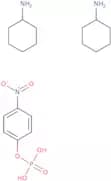
Purezza:Min. 95%4-Nitrophenyl phosphate bis(cyclohexylammonium)
CAS:4-Nitrophenyl phosphate bis(cyclohexylammonium) is an excellent chromogenic substrate designed for the detection and quantification of phosphatase enzyme activities. Aided by the presence of the cyclohexylammonium cation, it undergoes enzymatic hydrolysis, yielding the colored 4-nitrophenolate ion, which can be readily observed at 405 nm. The substrate has become an essential tool for biomedical research, playing a crucial role in unearthing cellular mechanisms, function, and potential drug targets.
Formula:C18H32N3O6PPurezza:97.0 To 103.0%Colore e forma:PowderPeso molecolare:417.44 g/molAldol® 515 nonanoate hydrochloride, Biosynth Patent: EP 2427431 and US 8940909
CAS:Aldol® 515 nonanoate hydrochloride is a chromogenic and fluorogenic enzyme substrate for detection of lipase activity. The colorless product is cleaved by C9 esterases produced by bacteria in liquid or solid media, yielding a red color and red fluorescence when Aldol® 355 fluorescence enhancer or a suitable matrix is present. Aldol® 515 nonanoate can be used under aerobic and anaerobic conditions. Well detectable color/fluorescence of bacterial colonies or liquid cultures is obtained within 24-48 h. In the presence of a purified lipase, color and fluorescence develops within minutes to few hours.
Formula:C32H36ClN2O3Purezza:Min. 95%Colore e forma:PowderPeso molecolare:533.1 g/molRef: 3D-EA175382
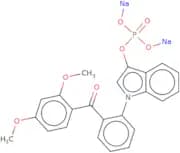
Prodotto fuori produzioneAldol® 470 phosphate, disodium salt, Biosynth Patent: EP 2427431 and US 8940909
CAS:Aldol® 470 phosphate, disodium salt is a fluorogenic substrate that is used in the detection of enzyme activity. It can be used to detect the presence of an enzyme by measuring the light emitted from the substrate after it has been converted to fluorescent product. Aldol® 470 phosphate, disodium salt is a chromogenic substrate that is used for detecting and measuring enzyme activity. The product of this reaction can be measured by absorbance or fluorescence spectroscopy, making it useful for many different types of diagnostic tests. This product can be conjugated with a variety of ligands for use in diagnostic assays and research. Aldol® 470 phosphate, disodium salt can also be used in culture media as a bioluminescent substrate for bacterial growth and metabolism studies. This product can also be used as an environmental testing reagent or as a staining agent in microscopy applications.
Formula:C23H18NNa2O7PPurezza:Min. 95%Colore e forma:PowderPeso molecolare:497.34 g/molRef: 3D-EA175336
Prodotto fuori produzione2-Chloro-4-nitrophenyl-α-L-fucopyranoside
CAS:2-Chloro-4-nitrophenyl-alpha-L-fucopyranoside is a compound that is commonly used as an enzyme substrate for glycogen synthase kinase (GSK). It is activated by GSK-3β and has been shown to inhibit the activity of this enzyme. This compound has also been found to have inhibitory effects on other enzymes such as carbonic anhydrase and lactate dehydrogenase. Additionally, 2-Chloro-4-nitrophenyl-alpha-L-fucopyranoside exhibits antifungal activity against various fungi, including those resistant to other antifungal agents such as fluopyram and prothioconazole. Its mechanism of action involves interfering with ergosterol biosynthesis, an essential component of fungal cell membranes. Furthermore, this compound has potential applications in the development of new drugs targeting GSK-3β and β-catenin signaling pathways, which are implicated in various diseases including cancer and neuro
Formula:C12H14ClNO7Purezza:Min. 98 Area-%Peso molecolare:319.7 g/molAldol® 518 α-D-galactopyranoside, Biosynth Patent: EP 2427431 and US 8940909
CAS:Aldol® 518 alpha-D-galactopyranoside is a chromogenic and fluorogenic enzyme substrate used for detection of alpha-galactosidase activity. The enzyme substrate is cleaved by alpha-galactosidase positive bacteria and yeasts in liquid or solid media, yielding red color and red fluorescence signal. Aldol® 518 alpha-D-galactopyranoside can also be used to detect alpha-galactosidase (encoded by the Mel1 gene) in yeast gene reporter assays or for identification of alpha-gal positive transformants on agar plates. Aldol® 518 alpha-D-galactopyranoside can be used under aerobic and anaerobic conditions.
Formula:C29H29ClN2O7Purezza:Min. 95%Colore e forma:PowderPeso molecolare:553.01 g/molRef: 3D-EA175377
Prodotto fuori produzione5-Amino-3-indoxyl-β-D-galactopyranoside
5-Amino-3-indoxyl-b-D-galactopyranoside is a chromogenic substrate for the enzyme galactosidase. 5-Amino-3-indoxyl-b-D-galactopyranoside is used in diagnostic tests to identify the presence of lactose intolerance. It can also be used to detect traces of blood in food, water, and other substances. This product has a high purity that makes it suitable for conjugation applications.
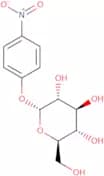
Formula:C14H18N2O6Purezza:Min. 95%Peso molecolare:310.31 g/mol4-Nitrophenyl a-D-glucopyranoside
CAS:Chromogenic substrate for alpha-glucosidase
Formula:C12H15NO8Purezza:Min. 98 Area-%Colore e forma:White PowderPeso molecolare:301.25 g/mol4-Chloro-1-naphthol
CAS:4-Chloro-1-naphthol is a chemical compound that has been used in clinical pathology to identify human immunoglobulin. It is also used as a potential biomarker for the diagnosis of Alzheimer's disease. 4-Chloro-1-naphthol binds to the amyloid fibrils and has anti-angiogenic effects in the hippocampus, which may be due to its ability to inhibit the formation of new blood vessels. This chemical compound can be used as a substrate molecule for electrochemical impedance spectroscopy and is used in wastewater treatment.
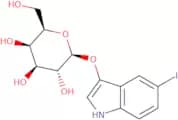
Formula:C10H7ClOPurezza:Min. 97.0 Area-%Peso molecolare:178.62 g/mol5-Iodo-3-indolyl b-D-galactopyranoside
CAS:5-Iodo-3-indolyl b-D-galactopyranoside is a chromogenic substrate used for beta-galactosidase. It is incorporated into media or detection kits for rapid and direct identification of microorganisms.
Formula:C14H16INO6Purezza:Min. 98 Area-%Colore e forma:PowderPeso molecolare:421.18 g/mol5-Bromo-4-chloro-3-indolyl a-L-rhamnoside
5-Bromo-4-chloro-3-indolyl a-L-rhamnoside is a chromogenic substrate used to detect the specific enzymatic activity of alpha-L-rhamnosidase. After cleavage, 5-bromo-4-chloro-indoxyl is released, resulting in a blue to blue-green color change in bacterial colonies or media. 5-Bromo-4-chloro-3-indolyl a-L-rhamnoside is used in bacterial rhamnose metabolism studies (e.g. E. coli).
Formula:C14H15BrClNO5Purezza:Min. 95%Colore e forma:SolidPeso molecolare:392.63 g/molRef: 3D-EB170531
Prodotto fuori produzione