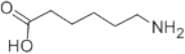
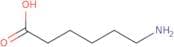
CAS 60-32-2
:Ácido 6-aminohexanoico
Descrição:
Ácido 6-aminohexanoico, também conhecido como ácido ε-aminocaprônico, é um aminoácido de seis carbonos com a fórmula molecular C6H13NO2. Apresenta um grupo amino (-NH2) e um grupo ácido carboxílico (-COOH) em sua cadeia de carbono, tornando-se um composto versátil em aplicações bioquímicas. Este sólido cristalino incolor é solúvel em água e exibe uma natureza levemente ácida devido ao seu grupo ácido carboxílico. Ácido 6-aminohexanoico é usado principalmente na síntese de poliamidas, particularmente nylon-6, e serve como um bloco de construção em várias reações químicas. Além disso, tem aplicações na medicina, particularmente como um agente antifibrinolítico para reduzir o sangramento durante a cirurgia. O composto é geralmente considerado seguro quando usado adequadamente, mas pode causar efeitos colaterais em alguns indivíduos. Suas propriedades estruturais permitem que participe de várias vias bioquímicas, tornando-o significativo em contextos industriais e farmacêuticos.
Fórmula:C6H13NO2
InChI:InChI=1S/C6H13NO2/c7-5-3-1-2-4-6(8)9/h1-5,7H2,(H,8,9)
Chave InChI:InChIKey=SLXKOJJOQWFEFD-UHFFFAOYSA-N
SMILES:C(CC(O)=O)CCCN
Sinónimos:- 177 J.D.
- 6-Amino-n-hexanoic acid
- 6-Aminohexanoate
- 6-Aminohexanoic acid
- A 14719
- ACS
- Acepramin
- Acepramine
- Acide aminocaproique
- Acido Aminocaproico
- Acikaprin
- Afibrin
- Amicar
- Amikar
- Aminocaproic acid
- Aminocapronsaure
- Aminokapron
- An 0064-1
- Caplamin
- Capramol
- Caprocid
- Caproic acid, ε-amino-
- Caprolisin
- Cl 10304
- Cy 116
- E-Aminocaproic Acid
- Eaca
- Eacs
- Epsamon
- Epsicapron
- Epsikapron
- Epsilcapramin
- Epsilon S
- Epsilon-Aminocapronsaeure
- H-6-Aca-OH
- H-6-Ahx-OH
- H-EAhx-OH
- Hemocaprol
- Hemopar
- Hepin
- Hexanoic acid, 6-amino-
- Ipsilon
- Nsc 212532
- Nsc 26154
- Nsc 400230
- Respramin
- epsilon-Aminocaproic acid
- ε-Amino-n-caproic acid
- ε-Amino-n-hexanoic acid
- ε-Aminohexanoic acid
- ε-Leucine
- ε-Norleucine
- ω-Aminocaproic acid
- Ver mais sinónimos
Ordenar por
Pureza (%)
0
100
|
0
|
50
|
90
|
95
|
100
21 produtos.
6-Aminohexanoic Acid [for Biochemical Research]
CAS:Fórmula:C6H13NO2Pureza:>98.0%(T)Cor e Forma:White to Almost white powder to crystalPeso molecular:131.186-Aminohexanoic Acid
CAS:Fórmula:C6H13NO2Pureza:>98.0%(T)Cor e Forma:White to Almost white powder to crystalPeso molecular:131.186-Aminohexanoic acid, 99%
CAS:<p>6-aminohexanoic acid, 60-32-2, also known as aminocaproic acid, is commonly used to solubilize membrane proteins for electrophoresis. Learn more at Thermo Fisher Scientific.</p>Fórmula:C6H13NO2Pureza:99%Cor e Forma:White, Crystalline powderPeso molecular:131.18AMINOCAPROIC ACID CRS
CAS:<p>AMINOCAPROIC ACID CRS</p>Fórmula:C6H13NO2Cor e Forma:PowderPeso molecular:131.1729Aminocaproic Acid
CAS:Amino-acids and their esters other than those containing more than one kind of oxygen function, excluding aromatic amino-acids, nesoiFórmula:C6H13NO2Cor e Forma:White PowderPeso molecular:131.176-Aminocaproic acid
CAS:<p>6-Aminocaproic acid (EACA) is an antifibrinolytic agent that acts by inhibiting plasminogen activators which have fibrinolytic properties.</p>Fórmula:C6H13NO2Pureza:99.55%Cor e Forma:Fine White Crystalline Powder SolidPeso molecular:131.176-Aminohexanoic acid
CAS:Fórmula:C6H13NO2Pureza:(Titration) 98.0 - 102.0 % (anhydrous basis)Cor e Forma:White or almost white crystalline powder, or colourless crystalsPeso molecular:131.186-Aminohexanoic acid
CAS:6-Aminohexanoic acidFórmula:C6H13NO2Pureza:99%Cor e Forma: white crystalline solidPeso molecular:131.17g/mol6-Aminohexanoic acid, USP grade
CAS:Fórmula:C6H13NO2Pureza:98.5 - 101.5 % (anhydrous basis)Cor e Forma:White crystalline powder or colourless crystalsPeso molecular:131.186-Aminohexanoic Acid
CAS:Produto Controlado<p>Applications 6-Aminohexanoic Acid is a reagent commonly used for the extraction of aldehydes from reaction mixtures. 6-Aminohexanoic Acid has also been shown to improve solubilization of membrane proteins in electrophoresis. Studies suggest that 6-Aminohexanoic Acid inhibits the activation of the first component of the complement system.<br>References Ohta ,S. et al.: Chem. Pharm. Bull., 28, 1917 (1980); Shagger, H. et al.: Anal. Biochem., 199, 223 (1991); Soter, N.A. et al.: J. Immunol., 114, 928 (1975);<br></p>Fórmula:C6H13NO2Cor e Forma:WhitePeso molecular:131.176-Aminocaproic acid
CAS:Fórmula:C6H13NO2Pureza:97%Cor e Forma:Solid, Crystalline PowderPeso molecular:131.175Aminocaproic Acid BP, 98.5-101%
CAS:Fórmula:C6H13NO2Pureza:98.5 - 101.0%Cor e Forma:Whiteor almost white , Colourless, Crystalline powder, Crystals, Clear on standing standing 24hrs., Colourless, Solution S is colourless and remains clear on standing 24 hrs.Peso molecular:131.17Aminocaproic Acid USP, 98.5-101%
CAS:Fórmula:C6H13NO2Pureza:98.5 -101.5% (On anhydrous bassis)Cor e Forma:White or almost white , colourless, Crystalline powder or crystalsPeso molecular:131.176-Aminocaproic Acid extrapure, 99%
CAS:Fórmula:C6H13NO2Pureza:min. 99%Cor e Forma:White, Crystalline powder, Clear, ColourlessPeso molecular:131.17Aminocaproic Acid IP
CAS:Fórmula:C6H13NO2Pureza:98.5 - 101.0%Cor e Forma:Colourless or white, Crystals, crystalline powder, 20% aq. solution clear and colourless for 24 hrs.Peso molecular:131.17Aminocaproic acid
CAS:<p>Aminocaproic acid is a non-specific lysing agent that is used in the treatment of acute blood clots. Aminocaproic acid has minimal toxicity and low-dose effects, and can be used for the treatment of thrombotic disorders. It also has biological properties that are different from those of aminocaproate, which can lead to a more rapid dissolution of the clot. Aminocaproic acid is an organic compound that belongs to the class of dicarboxylic acids. It is synthesized from two molecules of aminoacetic acid by the enzyme aminocaproic acid synthetase. The synthesis occurs in a two-step process: first, caprylic acid reacts with ATP to form aminopropyl-adenylate (APA), followed by hydrolysis by APA lyase to form aminocaproic acid.</p>Fórmula:C6H13NO2Cor e Forma:PowderPeso molecular:131.17 g/mol
![6-Aminohexanoic Acid [for Biochemical Research]](/_next/image/?url=https%3A%2Fstatic.cymitquimica.com%2Fproducts%2F3B%2Fthumb%2FA2255.jpg&w=3840&q=75)