Building Blocks
Esta seção contém produtos fundamentais para a síntese de compostos orgânicos e biológicos. Building blocks são os materiais de partida essenciais usados para construir moléculas complexas através de várias reações químicas. Eles desempenham um papel crítico na descoberta de medicamentos, ciência dos materiais e pesquisa química. Na CymitQuimica, oferecemos uma ampla gama de building blocks de alta qualidade para apoiar suas pesquisas inovadoras e projetos industriais, garantindo que você tenha os componentes essenciais para uma síntese bem-sucedida.
Subcategorias de "Building Blocks"
- Ácidos Borónicos e Derivados de Ácido Borónico(5.756 produtos)
- Building Blocks Quirais(1.242 produtos)
- Building Blocks Hidrocarbonetos(6.093 produtos)
- Building Blocks orgânicos(60.534 produtos)
Foram encontrados 195534 produtos de "Building Blocks"
Ordenar por
Pureza (%)
0
100
|
0
|
50
|
90
|
95
|
100
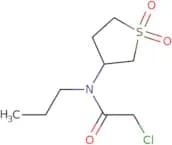
N-(1,1-Dioxothiolan-3-yl)-2-chloro-N-propylacetamide
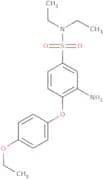
CAS:<p>Versatile small molecule scaffold</p>Fórmula:C9H16ClNO3SPureza:Min. 95%Peso molecular:253.75 g/mol3-Amino-4-(4-ethoxyphenoxy)-N,N-diethylbenzene-1-sulfonamide
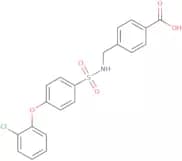
CAS:<p>Versatile small molecule scaffold</p>Fórmula:C18H24N2O4SPureza:Min. 95%Peso molecular:364.5 g/mol4-(((4-(2-Chlorophenoxy)phenyl)sulfonamido)methyl)benzoic Acid
CAS:<p>Versatile small molecule scaffold</p>Fórmula:C20H16NO5SClPureza:Min. 95%Peso molecular:417.86 g/mol4-(([4-(3-Methylphenoxy)phenyl]sulfonyl)amino)benzoic acid
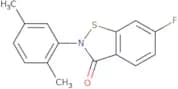
CAS:<p>Versatile small molecule scaffold</p>Fórmula:C20H17NO5SPureza:Min. 95%Peso molecular:383.4 g/mol2-(2,5-Dimethylphenyl)-6-fluoro-2,3-dihydro-1,2-benzothiazol-3-one
CAS:<p>2-(2,5-Dimethylphenyl)-6-fluoro-2,3-dihydro-1,2-benzothiazol-3-one is an industrial and biochemical compound that has a wide range of applications. It is commonly used as an inhibitor in various assays and experiments. This compound has been found to have genotoxic properties, meaning it can cause damage to DNA. Additionally, it has been identified as a phytoalexin, a substance produced by plants as a defense mechanism against pathogens.</p>Fórmula:C15H12FNOSPureza:Min. 95%Peso molecular:273.3 g/mol6-Iodopyrimidine-2,4-diamine
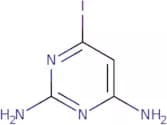
CAS:<p>6-Iodopyrimidine-2,4-diamine is an alkynyl compound that can be synthesized efficiently via a cross-coupling reaction. It has cytostatic activity and can be used in the treatment of cancer cells. 6-Iodopyrimidine-2,4-diamine inhibits the growth of cells by binding to DNA and preventing synthesis of proteins. This chemical also reacts with DNA to form covalent bonds, which prevents the replication of cells.</p>Fórmula:C4H5IN4Pureza:Min. 95%Peso molecular:236.01 g/mol2-Chloro-4-(chloromethyl)-6-methoxypyridine
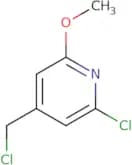
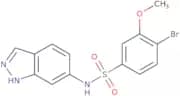
CAS:<p>Versatile small molecule scaffold</p>Fórmula:C7H7NOCl2Pureza:Min. 95%Peso molecular:192.05 g/mol4-Bromo-N-(2H-indazol-6-yl)-3-methoxybenzene-1-sulfonamide
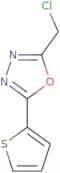
CAS:<p>Versatile small molecule scaffold</p>Fórmula:C14H12BrN3O3SPureza:Min. 95%Peso molecular:382.23 g/mol2-(Chloromethyl)-5-thien-2-yl-1,3,4-oxadiazole
CAS:<p>Versatile small molecule scaffold</p>Fórmula:C7H5ClN2OSPureza:Min. 95%Peso molecular:200.65 g/mol2-[2-(2-Chlorophenoxy)ethyl]-2,3-dihydro-1H-isoindole-1,3-dione
CAS:<p>Versatile small molecule scaffold</p>Fórmula:C16H12ClNO3Pureza:Min. 95%Peso molecular:301.72 g/mol2-Bromo-6-(chloromethyl)pyridine
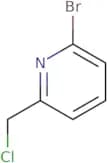
CAS:<p>2-Bromo-6-(chloromethyl)pyridine is a ligand that binds to transition metal ions. It has been shown to have a high affinity for thionyl, which is an endogenous substrate. The ligand has also been used in the immobilization of biomolecules, such as proteins and DNA. The ligand has been synthesized by reacting cyanuric chloride with 2-bromopyridine. This method is different from the traditional synthetic pathway, which typically involves reacting chloroform with methyl bromide in the presence of a base or acid. The synthesis of this ligand can be done using two methods: (1) reaction of histidine with hydroxylamine hydrochloride and methyl bromide; or (2) reaction of methylamine with ethyl chlorocarbonate and 1,4-diazabicyclo[2.2.2]octane.</p>Fórmula:C6H5BrClNPureza:Min. 95%Peso molecular:206.47 g/mol5-Amino-1-(2,4-difluorophenyl)-1H-pyrazole-4-carbonitrile
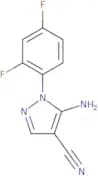
CAS:<p>Versatile small molecule scaffold</p>Fórmula:C10H6N4F2Pureza:Min. 95%Peso molecular:220.18 g/mol2-Bromo-1-(3-chloro-4-methoxyphenyl)propan-1-one
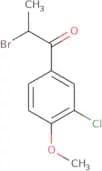
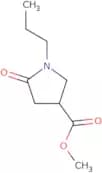
CAS:<p>Versatile small molecule scaffold</p>Fórmula:C10H10BrClO2Pureza:Min. 95%Peso molecular:277.54 g/molMethyl 5-oxo-1-propylpyrrolidine-3-carboxylate
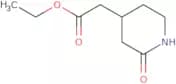
CAS:<p>Versatile small molecule scaffold</p>Fórmula:C9H15NO3Pureza:Min. 95%Peso molecular:185.22 g/molEthyl 2-(2-oxopiperidin-4-yl)acetate
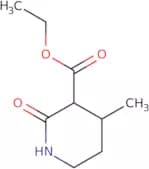
CAS:<p>Versatile small molecule scaffold</p>Fórmula:C9H15NO3Pureza:Min. 95%Peso molecular:185.22 g/molEthyl 4-methyl-2-oxopiperidine-3-carboxylate
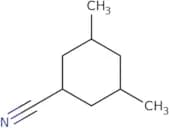
CAS:<p>Versatile small molecule scaffold</p>Fórmula:C9H15NO3Pureza:Min. 95%Peso molecular:185.22 g/mol3,5-Dimethylcyclohexane-1-carbonitrile
CAS:<p>Versatile small molecule scaffold</p>Fórmula:C9H15NPureza:Min. 95%Peso molecular:137.22 g/molN-Cyclopentylthiourea
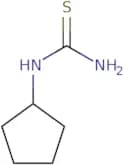
CAS:<p>N-Cyclopentylthiourea is an inhibitor of the NS3 protease that is involved in hepatitis C virus (HCV) replication. It has been shown to inhibit the activity of NS3 protease in vitro and in cell-based assays. N-Cyclopentylthiourea inhibits the enzyme by binding to its active site and blocking access to the substrate. It has also been shown to be effective against hepatitis B virus (HBV) replication, although it is not active against HIV or influenza A. This drug also has anti-inflammatory properties, which may be due to its inhibition of cyclooxygenase and nitric oxide synthase enzymes.</p>Fórmula:C6H12N2SPureza:Min. 95%Peso molecular:144.24 g/mol[4-(Butan-2-yl)phenyl]methanol
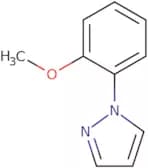
CAS:<p>Versatile small molecule scaffold</p>Fórmula:C11H16OPureza:Min. 95%Peso molecular:164.24 g/mol1-(2-Methoxyphenyl)-1H-pyrazole
CAS:<p>Versatile small molecule scaffold</p>Fórmula:C10H10N2OPureza:Min. 95%Peso molecular:174.2 g/mol

![4-(([4-(3-Methylphenoxy)phenyl]sulfonyl)amino)benzoic acid](/_next/image/?url=https%3A%2Fstatic.cymitquimica.com%2Fproducts%2F3D%2Fthumb-webp%2FCEB68953.webp&w=3840&q=75)
![2-[2-(2-Chlorophenoxy)ethyl]-2,3-dihydro-1H-isoindole-1,3-dione](/_next/image/?url=https%3A%2Fstatic.cymitquimica.com%2Fproducts%2F3D%2Fthumb-webp%2FCEB36876.webp&w=3840&q=75)
![[4-(Butan-2-yl)phenyl]methanol](/_next/image/?url=https%3A%2Fstatic.cymitquimica.com%2Fproducts%2F3D%2Fthumb-webp%2FCEA93460.webp&w=3840&q=75)