Outros
Foram encontrados 6274 produtos de "Outros"
Ordenar por
Pureza (%)
0
100
|
0
|
50
|
90
|
95
|
100
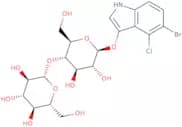
5-Bromo-4-chloro-3-indoxyl-α-D-galactopyranoside
CAS:<p>Chromogenic substrate for α-galactosidase yielding a blue precipitate. Used for species differentiation within the family Enterobacteriaceae and differentiation of Bifido bacteria species from Lactobacillus species.</p>Fórmula:C14H15BrClNO6Pureza:Min. 99 Area-%Peso molecular:408.64 g/mol4-Nitrophenyl a-D-mannopyranoside
CAS:<p>4-Nitrophenyl a-D-mannopyranoside is a chromogenic pNP enzyme substrate that enables the detection and quantification of a-D-mannosidase activity in various biological samples through a colorimetric assay. The hydrolysis of the substrate by the enzyme releases 4-nitrophenol, a yellow compound whose absorption can be measured spectrophotometrically. Applications for this substrate span biomedical research, disease diagnostics, and industrial enzyme production.</p>Fórmula:C12H15NO8Pureza:Min. 98.0 Area-%Cor e Forma:Off-White PowderPeso molecular:301.25 g/mol2-Nitrophenyl butyrate
CAS:<p>2-Nitrophenyl butyrate is a chromogenic enzyme substrate that is commonly used in enzymatic assays to detect lipases and esterases. When hydrolyzed by these enzymes, the substrate yields a yellow product that can be detected spectrophotometrically at 405 nm. The advantage of using 2-nitrophenyl butyrate is its high sensitivity and specificity for detecting lipolytic and esterolytic activities. This substrate is widely used in various applications, including enzyme kinetics studies, inhibitor screening, and the determination of esterase activity in biological samples such as serum, plasma, and cell lysates.</p>Fórmula:C10H11NO4Pureza:Min. 95%Cor e Forma:Clear LiquidPeso molecular:209.2 g/mol2-Naphthyl caprylate
CAS:<p>2-Naphthyl caprylate is a substrate that is employed in an assays for carboxylesterase and lipase and when hydrolyzed, produces 2-naphthol, a compound that can also be identified via fluorescence analysis. By combining it with a diazonium salt, the formation of the corresponding azo dye occurs. In particular, this substrate is used to detect the extracellular lipase of Pseudomonas fluorescens B52.</p>Fórmula:C18H22O2Pureza:Min. 95%Cor e Forma:White PowderPeso molecular:270.37 g/molAldol® 518 ammonium myo-inositol-1-phosphate, Biosynth Patent: EP 2427431 and US 8940909
CAS:<p>Aldol® 518 myo-inositol phosphate is a chromogenic and fluorogenic enzyme substrate used for detection of phosphatidylinositol specific phospholipase C (PI-PLC, EC 4.6.1.13) activity. The colorless enzyme substrate is cleaved by PI-PLC positive microorganisms grown in liquid or solid media, yielding intense red color. In combination with Aldol® 355 fluorescence enhancer, red fluorescence can also be obtained. Aldol® 518 myo-inositol phosphate thus enables the detection and identification of various bacteria, such as, pathogenic strains of Listeria, Clostridium, Bacillus, and Staphylococcus species. Aldol® 518 myo-inositol phosphate is suitable for use under aerobic and anaerobic conditions.</p>Fórmula:C29H33ClN3O10PPureza:Min. 95.0 Area-%Peso molecular:650.02 g/molAlizarin-2-β-D-galactopyranoside
CAS:<p>Chromogenic substrate targeting beta- galactosidase and whose color is dependent on the metal chelating.Alizarin-2-beta-D-galactopyranoside is a chromogenic substrate for enzymes based on alizarin and has been reported for the detection of bacterial beta-galactosidase by researchers at the University of Northumbria and the Freeman Hospital, Newcastle upon Tyne in the UK (James, 2000).</p>Fórmula:C20H18O9Pureza:Min. 98.0 Area-%Peso molecular:402.36 g/molAldol® 515 acetate, Biosynth Patent: EP 2427431 and US 8940909
CAS:<p>Aldol® 515 acetate is a chromogenic and fluorogenic substrate, used for detection of esterase activity. The colorless product is cleaved by purified esterase, or esterase secreted by microorganisms in liquid or solid media, yielding a red color and red fluorescence signal when Aldol® 355 fluorescence enhancer or a suitable matrix is present. Aldol® 515 acetate can be used under aerobic and anaerobic conditions. Well detectable color/fluorescence of bacterial colonies or liquid cultures is obtained within 16-48 h. In the presence of a purified esterase, color and fluorescence develops within minutes to few hours.</p>Fórmula:C25H22N2O3Pureza:Min. 95.0 Area-%Peso molecular:398.45 g/mol4-Chloro-3-indolyl β-D-galactopyranoside
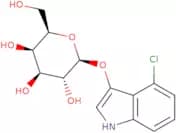
CAS:<p>2-Chloro-4-nitrophenyl b-D-lactoside is a chromogenic enzyme substrate used to study the activity of enzymes. It produces a color when hydrolyzed, which makes it a valuable tool in screening for enzyme activity and studying enzyme kinetics.</p>Fórmula:C14H16ClNO6Pureza:Min. 95%Cor e Forma:SolidPeso molecular:329.73 g/molCalcium 2-naphthylphosphate
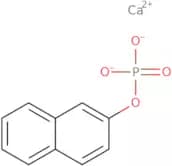
CAS:<p>Calcium 2-naphthylphosphate, which is the calcim salt of 2-naphthylphosphate, is a chromogenic substrate to measure alkaline phosphatase activity. After enzymatic cleavage, the product yielded (2-naphthol) generates a red-colored complex upon reaction with a diazonium salt like Fast Blue RR or Fast Garnet GBC.</p>Pureza:(%) Min. 95%Cor e Forma:PowderPeso molecular:282.24 g/mol5-Bromo-4-chloro-3-indolyl-D-thymidine-3'-phosphate cyclohexylammonium salt
CAS:<p>5-Bromo-4-chloro-3-indolyl-D-thymidine-3'-phosphate cyclohexylammonium salt is a chromogenic substrate used to detect the specific enzymatic activity of alkaline phosphatase. After cleavage, 5-bromo-4-chloro-indoxyl is released, resulting in a blue to blue-green color change in bacterial colonies or media. 5-Bromo-4-chloro-3-indolyl-D-thymidine-3'-phosphate cyclohexylammonium salt is used in immunohistochemistry (IHC) and Western blot detection, immunoassays used to detect proteins.</p>Fórmula:C18H17BrClN3O8P·C6H14NPureza:Min. 95%Cor e Forma:White PowderPeso molecular:649.86 g/mol4-Nitrophenyl O-(N-acetyl-a-neuraminosyl)-(2,3)-O-b-D-galactopyranosyl-(1,3)-2-acetamido-2-deoxy-a-D-galactopyran oxide
CAS:<p>4-Nitrophenyl O-(N-acetyl-a-neuraminosyl)-(2,3)-O-b-D-galactopyranosyl-(1,3)-2-acetamido-2-deoxy-a-D-galactopyran oxide is a fluorogenic substrate that is used in the detection of glycosidases. It has been shown to be an excellent ligand for the enzyme beta galactosidase, which cleaves the glycan substrate 4NPOBGPA into 4NP and O-(N acetyl) neuraminic acid. 4NPOBGPA can be used as a chromogenic substrate for detecting beta galactosidase activity and can also be conjugated to other fluorescent molecules. This product is high purity and high quality.</p>Pureza:Min. 95%Peso molecular:795.7 g/mol4-Nitrophenyl-β-D-maltopyranoside
CAS:<p>Chromogenic beta-maltosidase substrate</p>Fórmula:C18H25NO13Pureza:Min. 95%Cor e Forma:White PowderPeso molecular:463.39 g/mol2-O-(4-Nitrophenyl)-a-D-N-acetylneuraminic acid sodium salt
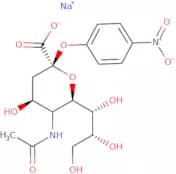
CAS:<p>2-O-(4-Nitrophenyl)-alpha-D-N-acetylneuraminic acid sodium salt is a chromogenic substrate used to detect the enzymatic activity of neuraminidase or sialidase. After cleavage, the nitrophenyl moiety is released exhibiting a light yellowish color. 2-O-(4-Nitrophenyl)-alpha-D-N-acetylneuraminic acid sodium salt is used in bacterial neuraminidase activity assays.</p>Pureza:Min. 95%Cor e Forma:Yellow PowderPeso molecular:452.35 g/mol4-Nitrophenyl-β-D-cellobioside
CAS:<p>Chromogenic substrate for β-D-Cellobiosidase yielding a yellow solution upon cleavage.</p>Fórmula:C18H25NO13Pureza:Min. 98 Area-%Peso molecular:463.39 g/mol2-Naphthyl-β-D-Glucuronide Sodium Salt
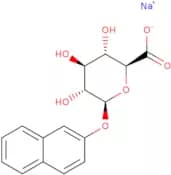
CAS:<p>2-Naphthyl-beta-D-glucuronide sodium salt is an enzyme substrate to detect beta-glucuronidase. The enzyme cleaves the glycosidic bond in 2-naphthyl-beta-D-glucuronide to release 2-naphtol and glucuronic acid. Beta-glucuronidase activity assays are important in many fields such as cancer research, as the enzyme is expressed in some tumors and its activity can be targeted for cancer therapy. The enzyme has also an important role in drug metabolism as it recognizes and binds to drug glucuronide conjugate (as 2-naphthyl-beta-D-glucuronide) facilitating its hydrolysis to release the active part. 2-Naphthyl-beta-D-glucuronide sodium salt has a higher solubility as it is in its salt form.</p>Fórmula:C16H15NaO7Pureza:Min. 95%Cor e Forma:PowderPeso molecular:342.28 g/molNaphthol AS-TR phosphate
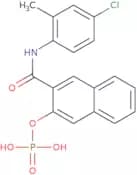
CAS:<p>Modified naphtol AS substrate used in histochemical and cytochemical staining</p>Fórmula:C18H15ClNO5PPureza:Min. 95%Cor e Forma:Off-White PowderPeso molecular:391.74 g/molNaphthol AS-E phosphate, 60%
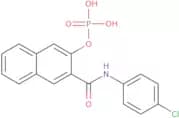
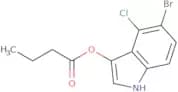
CAS:<p>Histochemical substrate for alkaline phosphatase</p>Fórmula:C17H13ClNO5PPureza:(%) Min. 60%Cor e Forma:SolidPeso molecular:377.72 g/mol5-Bromo-4-chloro-3-indoxyl butyrate
CAS:<p>5-Bromo-4-chloro-3-indoxyl butyrate is a colorimetric substrate used to detect and quantify esterase activity. Upon hydrolysis by esterases, it yields a blue-green dye, allowing the detection and quantification of enzyme activity. It is commonly used in assays for the screening of esterase-producing microorganisms and in research aimed at understanding the role of esterases in various cellular processes.</p>Fórmula:C12H11BrClNO2Pureza:Min. 95%Cor e Forma:PowderPeso molecular:316.58 g/mol5-Bromo-4-chloro-3-indolyl a-L-rhamnoside
<p>5-Bromo-4-chloro-3-indolyl a-L-rhamnoside is a chromogenic substrate used to detect the specific enzymatic activity of alpha-L-rhamnosidase. After cleavage, 5-bromo-4-chloro-indoxyl is released, resulting in a blue to blue-green color change in bacterial colonies or media. 5-Bromo-4-chloro-3-indolyl a-L-rhamnoside is used in bacterial rhamnose metabolism studies (e.g. E. coli).</p>Fórmula:C14H15BrClNO5Pureza:Min. 95%Cor e Forma:SolidPeso molecular:392.63 g/mol4-Nitrophenyl 2,3,4,6-tetra-O-acetyl-b-D-thioglucopyranoside
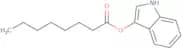
CAS:<p>4-Nitrophenyl 2,3,4,6-tetra-O-acetyl-b-D-thioglucopyranoside is a fluorescent dye that is used in recording and registration. It has been shown to be a very sensitive reporter of protein interactions in living cells. This dye binds to proteins via the hydroxyl groups on its sugar moiety, and has been shown to bind to a variety of proteins such as myosin light chain kinase and phosphatidylinositol 4-kinase. The fluorescent properties of this dye make it useful for tracking protein localization in the cell.</p>Pureza:Min. 95%Peso molecular:485.46 g/mol3-Indoxyl caprylate
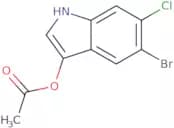
CAS:<p>3-Indoxyl caprylate is a chemiluminescent substrate that is used in the detection of bacteria. It has been shown to be a very sensitive and selective fluorogenic substrate for the detection of bacterial activity, which can be used with an appropriate enzyme reaction. 3-Indoxyl caprylate has also been shown to be a potent quencher of bioluminescence, and can be used as a chromogenic substrate in diagnostic assays. 3-Indoxyl caprylate is often used as a culture media supplement or food additive to enhance its growth properties. It has been found to have high purity and quality levels, making it suitable for use in diagnostics and research.</p>Pureza:Min. 95%Peso molecular:259.34 g/mol5-Bromo-6-chloro-3-indolyl acetate
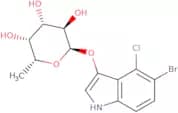
CAS:<p>5-Bromo-6-chloro-3-indolyl acetate is a chromogenic substrate that yields a magenta-colored product after cleavage. The chromophore 5-bromo-6-chloro-indoxyl is released, generating the observable color. It is used in bacterial esterase detection (e.g. Staphylococcus spp.).</p>Fórmula:C10H7BrClNO2Pureza:Min. 98 Area-%Cor e Forma:PowderPeso molecular:288.52 g/mol5-Bromo-4-chloro-3-indolyl α-D-fucopyranoside
CAS:<p>This powerful chromogenic substrate is designed specifically for the assay and detection of a-L-fucosidase enzyme activity. With a unique combination of bromo, chloro, and indolyl moieties, it offers enhanced stability and promotes color development that is unparalleled in clarity and intensity. Ideal for biochemistry, molecular biology, and related life sciences applications, this substrate provides unmatched performance and reliability for all your a-L-fucosidase enzyme research needs.</p>Fórmula:C14H15BrClNO5Pureza:Min. 95%Cor e Forma:PowderPeso molecular:392.63 g/mol5-Bromo-6-chloro-3-indolyl α-D-glucopyranoside
CAS:<p>5-Bromo-6-chloro-3-indolyl α-D-glucopyranoside is a chromogenic substrate that yields a magenta-colored product after cleavage. The chromophore 5-bromo-6-chloro-indoxyl is released, generating the observable color. It is used in Pompe disease diagnostics, a glycogen storage disorder, that measures the deffiency of alpha-glucosidase (GAA) that could lead to the accumulation of glycogen in lysosomes.</p>Fórmula:C14H15BrClNO6Pureza:Min. 95%Cor e Forma:PowderPeso molecular:408.63 g/mol1-Naphthyl β-D-mannopyranoside
CAS:<p>1-Naphthyl β-D-mannopyranoside is a chromogenic (also fluorogenic) substrate. After cleavage, 1-naphthol is released and is used to quantify beta-mannosidase activity.</p>Fórmula:C16H18O6Pureza:Min. 95%Cor e Forma:PowderPeso molecular:306.31 g/mol4-Chloro-1-naphthol
CAS:<p>Substrate for horseradish peroxidase</p>Fórmula:C10H7ClOPureza:Min. 96.0 Area-%Cor e Forma:Brown PowderPeso molecular:178.61 g/molAldol® 455 β-D-glucopyranoside, Biosynth Patent: EP 2427431 and US 8940909
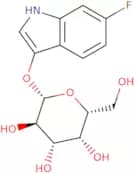
CAS:<p>Aldol® 455 beta-D-glucopyranoside is a chromogenic and fluorogenic enzyme substrate used for detection of beta-glucosidase activity. The colorless enzyme substrate is cleaved by beta-glucosidase producing bacteria grown in liquid or solid media, yielding a yellow color and green to orange fluorescence. Aldol® 455 beta-D-glucopyranoside can be used under aerobic and anaerobic conditions.</p>Fórmula:C27H24ClNO7Pureza:Min. 92.0 Area-%Peso molecular:509.94 g/mol6-Fluoro-3-indoxyl-β-D-galactopyranoside
CAS:<p>6-Fluoro-3-indoxyl-beta-D-galactopyranoside is a fluorescent chromogenic substrate that is commonly used for the detection and quantification of beta-galactosidase activity. When this substrate is hydrolyzed by beta-galactosidase, it produces a fluorescent blue product that can be easily detected and measured using a fluorometer or spectrophotometer. This substrate is often used in microbiology and molecular biology research to study gene expression and enzyme kinetics, and is also used in medical diagnostics as a marker for specific diseases and conditions.</p>Fórmula:C14H16FNO6Pureza:Min. 98.0 Area-%Peso molecular:313.29 g/molAldol® 518 choline phosphate, Biosynth Patent: EP 2427431 and US 8940909
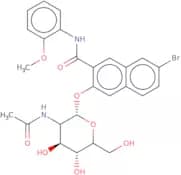
<p>Aldol® 518 choline phosphate is a fluorogenic substrate that is used in the detection of enzyme activity. It has been shown to be an effective substrate for enzymes such as beta-galactosidase and phosphatases, and can be used in the detection of bacterial growth. Aldol® 518 choline phosphate is also a chromogenic substrate for the detection of alkaline phosphatase. It has been shown to have high purity and bioluminescence properties, making it useful for detecting bacteria in culture media or environmental testing. The conjugate of Aldol® 518 choline phosphate with various ligands can be used to detect specific proteins or antibodies.</p>Fórmula:C28H31ClN3O5PPureza:Min. 95 Area-%Peso molecular:556 g/molNaphthol AS-BI N-acetyl-b-D-galactosaminide
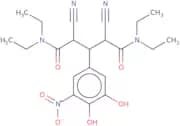
CAS:<p>Modified naphtol AS substrate used in histochemical and cytochemical staining</p>Fórmula:C26H27BrN2O8Pureza:Min. 95%Cor e Forma:PowderPeso molecular:575.41 g/mol2,4-Dicyano-3-(3,4-dihydroxy-5-nitrophenyl)-N1,N1,N5,N5-tetraethylpentanediamide
<p>2,4-Dicyano-3-(3,4-dihydroxy-5-nitrophenyl)-N1,N1,N5,N5-tetraethylpentanediamide is a white crystalline solid that is used as an analytical reference standard in HPLC. It is used for the determination of purity and impurities in pharmaceuticals and drug products. This compound can be custom synthesized or obtained from natural sources. It can be found in the USP Drug Impurity Standards and the European Pharmacopoeia.</p>Fórmula:C21H27N5O6Pureza:Min. 95%Peso molecular:445.47 g/mol4-Nitrophenyl 6-O-(b-D-galactopyranosyl)-b-D-galactopyranoside
CAS:<p>4-Nitrophenyl 6-O-(b-D-galactopyranosyl)-b-D-galactopyranoside is a fluorescent substrate that is used in diagnostics and culture media. It can be used to detect the presence of aminoglycoside antibiotics, such as gentamicin, by using the fluorogenic or chromogenic reaction. 4NP6BG has been shown to bind to the beta subunit of RNA polymerase and inhibit transcription, which can be useful for testing environmental samples for the presence of aminoglycosides.</p>Pureza:Min. 95%Aldol® 518 palmitate, Biosynth Patent: EP 2427431 and US 8940909
<p>Aldol 518 Palmitate is a high purity and high quality, bioluminescent substrate for use in diagnostic applications. Aldol 518 Palmitate is an enzyme substrate that is used for the detection of hydrogen peroxide through chemiluminescence or bioluminescence. It can be used in the diagnosis of bacterial infections and to test food products for spoilage. The enzyme substrate has a CAS number of 646-12-2.</p>Fórmula:C39H49ClN2O3Pureza:Min. 95 Area-%Peso molecular:629.28 g/molAldol® 455 α-D-maltopyranoside, Biosynth Patent: EP 2427431 and US 8940909
<p>Aldol® 455 alpha-D-maltopyranoside is a chromogenic substrate developed by Cymit Quimica, designed for the detection of maltosidases.</p>Fórmula:C33H34ClNO12Pureza:Min. 95.0 Area-%Peso molecular:672.08 g/mol2-Nitrophenyl b-D-fucopyranoside
CAS:<p>2-Nitrophenyl b-D-fucopyranoside is a chromogenic substrate used in various enzymatic assays to detect the presence of fucosidase enzymes. It consists of a nitrophenyl group attached to a fucose sugar molecule. When acted upon by enzymes such as fucosidases, it releases the colored nitrophenyl group, which can be detected using spectrophotometry.</p>Fórmula:C12H15NO7Pureza:Min. 95%Cor e Forma:White Off-White PowderPeso molecular:285.25 g/molAldol® 470 L-alanine ester, hydrochloride, Biosynth Patent: EP 2427431 and US 8940909
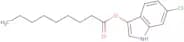
CAS:Produto Controlado<p>Aldol® 470 L-alanine ester, hydrochloride is a fluorescent chemiluminescent substrate. It is a ligand with high purity and high quality, which has been patented in the European Patent Office (EP 2427431) and the United States Patent and Trademark Office (US 8940909). The product can be used for chemiluminescence, staining, fluorescence, bioluminescence, enzyme substrate and food testing. Aldol® 470 L-alanine ester, hydrochloride is an excellent fluorescent chemiluminescent substrate that can be used for conjugation to enzymes or antibodies.</p>Fórmula:C26H25ClN2O5Pureza:Min. 95%Cor e Forma:PowderPeso molecular:480.95 g/mol6-Chloro-3-indoxyl nonanoate
CAS:<p>6-Chloro-3-indoxyl nonanoate is a fluorescent substrate that is used in the detection of beta-galactosidase activity. It has been used to detect the enzyme levels in various culture media and as a high quality, food testing, and environmental testing. The product is also used as a ligand for enzyme inhibition studies. 6-Chloro-3-indoxyl nonanoate has shown to be an excellent fluoroquinolone substrate for chemiluminescence assays. This product is CAS No. 133950-72-8 and is of high purity and high quality.</p>Pureza:Min. 95%Peso molecular:307.81 g/molAldol® 495 β-D-glucuronic acid, Biosynth Patent: EP 2427431 and US 8940909
CAS:<p>Aldol® 495 beta-D-glucuronic acid is a chromogenic and fluorogenic enzyme substrate used for detection of beta-glucuronidase activity. The living cells of Escherichia coli can be reliably detected in growth media containing Aldol® 495 beta-D-glucuronic acid, as beta-glucuronidase occurs almost exclusively in E. coli. Aldol® 495 beta-D-glucuronic acid can also be in GUS reporter assays. Aldol® 495 beta-D-glucuronic acid can be used in liquid culture and solid media, and is suitable for use under aerobic and anaerobic conditions. Upon exposure to active beta-glucuronidase, Aldol® 495 beta-D-glucuronic acid develops orange colour and green fluorescence.</p>Fórmula:C26H23ClN2O8Pureza:Min. 95.0 Area-%Peso molecular:526.93 g/mol5-Bromo-4-chloro-3-indoxyl-β-D-cellobioside
CAS:<p>Chromogenic substrate for β-D-Cellobiosidase yielding a blue precipitate.</p>Fórmula:C20H25BrClNO11Pureza:Min. 99.0 Area-%Peso molecular:570.78 g/mol5-Bromo-4-chloro-3-indoxyl phosphate, disodium salt sesquihydrate
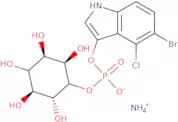
CAS:<p>Water soluble, chromogenic substrate for visualizing alkaline phosphatase activity. Produces a blueinsoluble end product that is detected visually when used together with nitroblue tetrazolium. The substrate system is versatile and functions in a variety of applications, including Northern, Southern, and Western blotting, in situhybridization, ELISAs and immunohistochemistry.</p>Fórmula:C8H4BrClNNa2O4P·5(H2O)Pureza:Min. 98.0 Area-%Peso molecular:397.45 g/mol5-Bromo-4-chloro-3-indoxyl myo-inositol-1-phosphate, ammonium salt
CAS:<p>This product is designed for the sensitive color detection andidentification of various bacteria, such as pathogenic strains of Listeria, Clostridium, Bacillus and Staphylococcus. 5-Bromo-4-chloro-3-indoxyl myo-inositol-1-phosphate (X-phos-inositol; X-IP) is a chromogenic indicator for phosphatidyl-inositol specific phospholipase C(PI-PLC, EC 4.6.1.13). The colorless product is cleaved by PI-PLC positive microorganisms in liquid media or on solid culture media and yields a blue-green color precipitate.</p>Fórmula:C14H19BrClN2O9PPureza:Min. 90.0 Area-%Peso molecular:505.64 g/mol5-Bromo-6-chloro-3-indoxyl-β-D-glucopyranoside
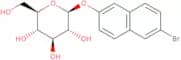
CAS:<p>Chromogenic substrate for β-D-glucosidase yielding a magenta precipitate. Differentiation of Salmonella spp. (negative) from other Enterobacteriaceae.</p>Fórmula:C14H15BrClNO6Pureza:Min. 99 Area-%Peso molecular:408.64 g/mol6-Bromo-2-naphthyl b-D-glucopyranoside
CAS:<p>6-Bromo-2-naphthyl b-D-glucopyranoside is an enzyme substrate used in chromogenic assays with beta-glucosidases. It has been used in culture media for the identification of Legionella pneumophila.</p>Fórmula:C16H17BrO6Pureza:Min. 98 Area-%Cor e Forma:PowderPeso molecular:385.21 g/mol4-Nitrophenyl b-L-arabinopyranoside
CAS:<p>4-Nitrophenyl beta-L-arabinopyranoside is a chromogenic substrate for beta-L-arabinosidase. Upon hydrolysis, para-nitrophenol is released yielding a yellowish colour. 4-Nitrophenyl beta-L-arabinopyranoside is used in different applications such as the Bacterial arabinan degradation assays, gut microbiome analysis</p>Fórmula:C11H13NO7Pureza:Min. 98 Area-%Cor e Forma:White PowderPeso molecular:271.22 g/molAldol® 515 4-acetoxybutyrate solution, 0.75 M in DMSO, Biosynth Patent: EP 2427431 and US 8940909
CAS:Produto Controlado<p>Aldol® 515 4-acetoxybutyrate solution, 0.75 M in DMSO, is a chromogenic substrate that can be used to measure the activity of aldolase. It is a liquid at room temperature and has a pH of 7.2. The Aldol® 515 4-acetoxybutyrate solution, 0.75 M in DMSO, is soluble in water and organic solvents such as DMSO and ethanol. This product does not contain any preservatives or additives and is suitable for use with humans and animals. Aldol® 515 4-acetoxybutyrate solution, 0.75 M in DMSO, is manufactured by Cymit Quimica under patents EP 2427431 and US 8940909.br>br><br>Aldolase catalyzes the conversion of dihydroxyacetone phosphate (DHAP) to glyceraldehyde 3-phosphate</p>Fórmula:C29H28N2O5Pureza:Min. 95 Area-%Peso molecular:484.54 g/mol3,4-Cyclohexenoesculetin β-D-glucuronide
<p>Chromogenic substrate for beta-glucuronidase</p>Pureza:Min. 95%4-Chloro-1-naphthol
CAS:<p>Substrate for horseradish peroxidase (HRP). HRP catalyzes oxidation of 4-chloro-1-naphthol in the presence of peroxide to the blue insoluble product 4-chloro-1-naphthon. It is used for both blotting and immunohistochemical staining but is less sensitive than other precipitating HRP substrates.</p>Fórmula:C10H7ClOPureza:Min. 97.0 Area-%Peso molecular:178.62 g/molRef: 3D-C-5180
1kgA consultar100gA consultar250gA consultar500gA consultar2500gA consultar-Unit-ggA consultar4-Nitrophenyl-α-D-maltopyranoside
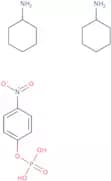
CAS:<p>Chromogenic α-maltosidase substrate yielding a yellow solution upon cleavage.</p>Fórmula:C18H25NO13Pureza:Min. 98.0 Area-%Peso molecular:463.40 g/mol4-Nitrophenyl phosphate, bis(cyclohexylammonium) salt
CAS:<p>Chromogenic substrate yielding a soluble yellow chromophor for the colorimetric assay of phosphatases.</p>Fórmula:C18H32N3O6PPureza:97.0 To 103.0%Peso molecular:417.45 g/molAldol® 484 β-D-galactopyranoside, Biosynth Patent: EP 2427431 and US 8940909
CAS:<p>Aldol® 484 beta-D-galactopyranoside is a chromogenic enzyme substrate for beta-galactosidase activity. The colorless product is cleaved by lactose-utilizing bacteria in liquid or solid media, yielding intense red color. Aldol® 484 beta-D-galacto-pyranoside can also be used in beta-gal reporter gene assays or for identification of beta-gal positive transformants on agar. Aldol® 484 beta-D-galactopyranoside can be used under aerobic and anaerobic conditions.</p>Fórmula:C26H24ClFN2O7Pureza:Min. 95%Cor e Forma:PowderPeso molecular:530.93 g/mol