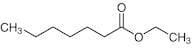
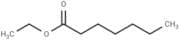
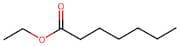
CAS 106-30-9
:Ethylheptanoat
Beschreibung:
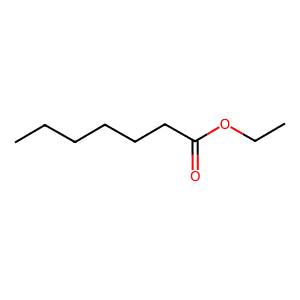
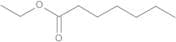
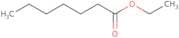
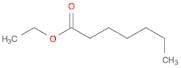
Ethylheptanoat, mit der CAS-Nummer 106-30-9, ist ein Ester, der aus der Reaktion von Heptansäure und Ethanol gebildet wird. Er zeichnet sich durch sein fruchtiges Aroma aus, das oft an Äpfel oder Birnen erinnert, was ihn zu einem gängigen Aromastoff in der Lebensmittelindustrie macht. Ethylheptanoat ist bei Raumtemperatur eine farblose Flüssigkeit und ist leicht in Wasser löslich, aber besser in organischen Lösungsmitteln wie Ethanol und Ether. Seine chemische Formel ist C9H18O2, und er hat einen relativ niedrigen Siedepunkt, was zu seiner Flüchtigkeit und Duftnote beiträgt. Die Substanz wird nicht nur zur Aromatisierung von Lebensmitteln, sondern auch in der Parfümerie und als Lösungsmittel in verschiedenen chemischen Anwendungen verwendet. Ethylheptanoat wird allgemein als sicher für die Verwendung in Lebensmitteln angesehen, sollte jedoch aufgrund seiner entzündlichen Natur mit Vorsicht behandelt werden. Seine chemische Struktur umfasst eine lange Kohlenwasserstoffkette, die zu seinen hydrophoben Eigenschaften beiträgt und sein Verhalten in verschiedenen Umgebungen beeinflusst.
Formel:C9H18O2
InChl:InChI=1/C38H72N2O12/c1-15-27-38(10,46)31(42)24(6)40(13)19-20(2)17-36(8,45)33(52-35-29(41)26(39(11)12)16-21(3)48-35)22(4)30(23(5)34(44)50-27)51-28-18-37(9,47-14)32(43)25(7)49-28/h20-33,35,41-43,45-46H,15-19H2,1-14H3/t20-,21-,22+,23-,24-,25+,26+,27-,28+,29-,30+,31-,32+,33-,35+,36-,37-,38-/m1/s1
InChI Key:InChIKey=TVQGDYNRXLTQAP-UHFFFAOYSA-N
SMILES:C(CCCCCC)(OCC)=O
Synonyme:- (2R,3S,4R,5R,8R,10R,11R,12S,13S,14R)-2-ethyl-3,4,10-trihydroxy-3,5,6,8,10,12,14-heptamethyl-15-oxo-11-{[3,4,6-trideoxy-3-(dimethylamino)-beta-D-xylo-hexopyranosyl]oxy}-1-oxa-6-azacyclopentadecan-13-yl 2,6-dideoxy-3-C-methyl-3-O-methyl-alpha-L-ribo-hexopyranoside
- Aether oenanthicus
- Ai3-24251
- Brn 1752311
- Ccris 1344
- Cognac oil
- Enanthic acid, ethyl ester
- Enanthylic ether
- Ethyl enantate
- Ethyl enanthate
- Ethyl heptanoate (natural)
- Ethyl heptoate
- Ethyl heptylate
- Ethyl n-heptanoate
- Ethyl oenanthate
- Ethyl oenanthylate
- FEMA No. 2437
- Grape oil
- Heptanoic acid, ethyl ester
- Nsc 8891
- Oenanthic ether
- Oleum vitis viniferae
- Wine oil
- 4-02-00-00960 (Beilstein Handbook Reference)
- RARECHEM AL BI 0165
- ethylenantate
- enanthylicether
- Ethyl ester of heptanoic acid
- N-HEPTANOIC ACID ETHYL ESTER
- OENANTHIC ACID ETHYL ESTER
- FEMA 2441
- FEMA 2437
- Weitere Synonyme anzeigen
Sortieren nach
Reinheit (%)
0
100
|
0
|
50
|
90
|
95
|
100
14 Produkte.
Ethyl Heptanoate
CAS:Formel:C9H18O2Reinheit:>98.0%(GC)Farbe und Form:Colorless to Almost colorless clear liquidMolekulargewicht:158.24Ethyl heptanoate, 98+%
CAS:This Thermo Scientific Chemicals brand product was originally part of the Alfa Aesar product portfolio. Some documentation and label information may refer to the legacy brand. The original Alfa Aesar product / item code or SKU reference has not changed as a part of the brand transition to Thermo SciFormel:CH3(CH2)5CO2CH2CH3Reinheit:98+%Farbe und Form:Liquid, Clear colorlessMolekulargewicht:158.24Ethyl heptanoate
CAS:Ethyl heptanoate is a RIFM spice that is produced and volatilized by the fermentation of eight packets of tempeh.Formel:C9H18O2Farbe und Form:SoildMolekulargewicht:158.24Ethyl Heptanoate(Heptanoic Acid Ethyl Ester)
CAS:Kontrolliertes ProduktFormel:C9H18O2Farbe und Form:NeatMolekulargewicht:158.24Ethyl heptanoate
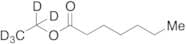
CAS:Formel:C9H18O2Reinheit:98%Farbe und Form:No data available.Molekulargewicht:158.241Heptanoic Acid Ethyl-d5 Ester
CAS:Kontrolliertes ProduktFormel:C9H13D5O2Farbe und Form:NeatMolekulargewicht:163.27Ethyl Heptanoate(Heptanoic Acid Ethyl Ester)
CAS:Ethyl Heptanoate is a colorless liquid that has a strong odor. It is used as a chemical intermediate in the production of ethyl decanoate, which is an ester. Ethyl Heptanoate is soluble in glycol ether and insoluble in water. It has been shown to be chemically stable under normal conditions, but can decompose at temperatures above 300°C. Ethyl Heptanoate has been used in studies to identify signal pathways that are involved in the regulation of cell growth and proliferation by inhibiting the activity of dibutyltin oxide (DBTO). This study was conducted on K562 cells, which were grown in microcapsules with ethyl heptanoate as the only source of oxygen. The results showed that DBTO inhibited cell proliferation by decreasing the activity of sodium carbonate (NaCO) and inhibiting the formation of ethyl decanoate from ethyl heptanoate and caproic acid (C6Formel:C9H18O2Reinheit:Min. 95%Molekulargewicht:158.24 g/mol