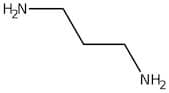
CAS 109-76-2
:1,3-Propandiamin
Beschreibung:
1,3-Propandiamin, auch bekannt als Trimethylendiamin, ist eine organische Verbindung, die durch ihre aliphatische Aminstruktur gekennzeichnet ist, mit zwei Aminogruppen (-NH2), die an eine drei Kohlenstoffatome umfassende Kette gebunden sind. Es handelt sich um eine farblose bis blassgelbe Flüssigkeit mit einem starken Amin-Geruch und es ist hygroskopisch, was bedeutet, dass es leicht Feuchtigkeit aus der Luft aufnimmt. Diese Verbindung ist in Wasser und polaren organischen Lösungsmitteln löslich, was sie in verschiedenen chemischen Anwendungen vielseitig macht. 1,3-Propandiamin wird hauptsächlich in der Synthese von Polyamiden, Tensiden und als Härter in Epoxidharzen verwendet. Es zeigt basische Eigenschaften aufgrund der Anwesenheit von Aminogruppen, die es ihm ermöglichen, an verschiedenen chemischen Reaktionen teilzunehmen, einschließlich nucleophiler Substitutionen und Kondensationsreaktionen. Darüber hinaus kann es als Ligand in der Koordinationschemie wirken. Es ist jedoch wichtig, diese Verbindung mit Vorsicht zu behandeln, da sie reizend für Haut, Augen und Atemwege sein kann. Es sollten geeignete Sicherheitsmaßnahmen getroffen werden, wenn mit 1,3-Propandiamin in Labor- oder Industrieumgebungen gearbeitet wird.
Formel:C3H10N2
InChl:InChI=1S/C3H10N2/c4-2-1-3-5/h1-5H2
InChI Key:InChIKey=XFNJVJPLKCPIBV-UHFFFAOYSA-N
SMILES:C(CN)CN
Synonyme:- 1,3-Diamino-n-propane
- 1,3-Diaminopropan
- 1,3-Propandiamine
- 1,3-Propane Diamine
- 1,3-Propanediamine
- 1,3-Propylenediamine
- 1,3-Trimethylenediamine
- 3-Aminopropylamine
- DAP
- Nsc 8154
- Propane, 1,3-Diamino-
- Propane-1,3-Diaminium
- Tmeda
- Trimethylendiamin
- Trimethylenediamine
- Trimetilendiamina
- α,ω-Propanediamine
- Weitere Synonyme anzeigen
Sortieren nach
Reinheit (%)
0
100
|
0
|
50
|
90
|
95
|
100
7 Produkte.
1,3-Diaminopropane
CAS:Formel:C3H10N2Reinheit:>98.0%(GC)Farbe und Form:Colorless to Almost colorless clear liquidMolekulargewicht:74.131,3-Diaminopropane, 98%
CAS:1,3-Diaminopropane is commonly used in the preparation of cholinesterase inhibitors and thrombosis inhibitors. It is also used as a polymer cross linkage agent, polyurethane extender and spray coatings. It is involved in the preparation of agrochemicals and pharmaceutical intermediates. Further, itFormel:C3H10N2Reinheit:98%Farbe und Form:Liquid, Clear colorlessMolekulargewicht:74.131,3-Diaminopropane
CAS:Kontrolliertes ProduktApplications 1,3-Diaminopropane is a common chemical reagent, used in the synthesis of 7-methoxytacrine-adamantylamine heterodimers as cholinesterase inhibitors applied in the treatment of Alzheimer’s disease. Also used in the synthesis of thrombosis inhibitors.
Not a dangerous good if item is equal to or less than 1g/ml and there is less than 100g/ml in the package
References Spilovska, K. et al.: Molecules, 18, 2397 (2013); Smith, S. et al.: Blood, 120, 5103 (2012);Formel:C3H10N2Farbe und Form:NeatMolekulargewicht:74.121,3-Diaminopropane
CAS:1,3-Diaminopropane is a molecule that belongs to the group of organic compounds known as diamine. It is a colorless liquid with an unpleasant odor. 1,3-Diaminopropane has inhibitory properties and can be used in the treatment of squamous cell carcinoma and galleria mellonella. The mechanism of action for this compound has been determined by x-ray crystal structures. 1,3-Diaminopropane reacts with picolinic acid (PA) to form an intramolecular hydrogen bond, which inhibits PA's ability to react with other molecules. This results in PA being unable to form reactive intermediates that normally lead to cancerous changes in cells.Formel:C3H10N2Reinheit:Min. 95%Farbe und Form:Clear LiquidMolekulargewicht:74.12 g/mol