CAS 110-44-1
:2,4-Hexadiensäure
Beschreibung:
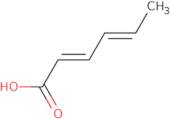
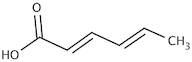
2,4-Hexadiensäure, auch bekannt als Sorbinsäure, ist eine ungesättigte Fettsäure, die durch ihre zwei Doppelbindungen an der zweiten und vierten Kohlenstoffposition der Hexansäurekette gekennzeichnet ist. Sie hat die chemische Formel C6H8O2 und liegt typischerweise als farblose bis blassgelbe Flüssigkeit mit einem leicht stechenden Geruch vor. Diese Verbindung ist in organischen Lösungsmitteln löslich und zeigt eine begrenzte Löslichkeit in Wasser. 2,4-Hexadiensäure ist bekannt für seine antimikrobiellen Eigenschaften, was es zu einem gängigen Konservierungsmittel in Lebensmitteln macht, um das Wachstum von Schimmel und Hefe zu hemmen. Darüber hinaus wird es in verschiedenen industriellen Anwendungen eingesetzt, einschließlich der Herstellung von Kunststoffen, Harzen und als Aromastoff in der Lebensmittelindustrie. Die Reaktivität der Verbindung wird durch ihre Doppelbindungen beeinflusst, was es ihr ermöglicht, an verschiedenen chemischen Reaktionen, wie der Polymerisation, teilzunehmen. Sicherheitsüberlegungen umfassen mögliche Haut- und Augenreizungen, und es sollte mit den entsprechenden Vorsichtsmaßnahmen in Labor- und Industrieumgebungen gehandhabt werden.
Formel:C6H8O2
InChl:InChI=1/C6H8O2/c1-2-3-4-5-6(7)8/h2-5H,1H3,(H,7,8)/p-1
InChI Key:InChIKey=WSWCOQWTEOXDQX-MQQKCMAXSA-N
SMILES:C(=C/C=C/C)\C(O)=O
Synonyme:- (2-Butenylidene)Acetic Acid
- (2E,4E)-2,4-Hexadienoic acid
- (2E,4E)-hexa-2,4-dienoic acid
- (E,E)-1,3-Pentadiene-1-carboxylic acid
- (E,E)-2,4-hexadienoic acid
- 1,3-Pentadiene-1-Carboxylic Acid
- 2,4-Hexadienoic acid, (2E,4E)-
- 2,4-Hexadienoic acid, (E,E)-
- 2-Propenylacrylic acid
- 2E,4E-Hexadienoic acid
- Acide hexa-2,4-dienoique
- Acido Hexa-2,4-Dienoico
- Alpha-Trans-Gamma-Trans-Sorbic Acid
- Crotylidene Acetic Acid
- E 200
- Hexa-2,4-Dienoate
- Hexa-2,4-Dienoic Acid
- Hexa-2,4-Dienoic Acid, (E,E)-
- Hexa-2,4-diensaure
- Hexadienoic Acid
- Hexadienoic acid, (E,E)
- Nsc 35405
- Nsc 49103
- Nsc 50268
- Panosorb
- Preservastat
- So 215
- Sorbic acid
- Sorbinic acid
- Sorbinsaeure
- Sorbistat
- Trans,Trans-2,4-Hexadienoic Acid
- Trans,Trans-Sorbic Acid
- α-trans-γ-trans-Sorbic acid
- RARECHEM AL BE 0146
- (e,e)-4-hexadienoicacid
- ACIDUM SORBICUM
- FEMA 3921
- 2,4-Hexadienoicacid,(E,E)-
- (E,E)-Sorbic acid
- 2e,4e-hexadienoicacid
- 2,4-HEXADIENOIC ACID
- (2-butenylidene)-aceticaci
- 2,4-HEXANEDIENOIC ACID
- 2-PROPENYL ACRYLIC ACID
- Acetic acid, (2-butenylidene)-
- Weitere Synonyme anzeigen
Filtern nach
Reinheitsanteil
0
100
|
0
|
50
|
90
|
95
|
100
- Niedrigster Preis
- Höchster Preis
- Niedrigste Reinheit
- Höchste Reinheit
- Schnellste Lieferung
Sorbic acid
CAS:Unsaturated acyclic monobasic carboxylic acidFormel:C6H8O2Reinheit:≥ 98.0 % (HPLC)Farbe und Form:PowderMolekulargewicht:112.13Sorbic acid
CAS:Sorbic acid is an organic acid that is used as a food preservative and antimicrobial agent. It is effective against yeasts and molds, which are the main causes of food spoilage. Sorbic acid has been shown to be non-genotoxic in biological studies, but it has been found to be genotoxic at high concentrations. Sorbic acid has also been found to have cardioprotective properties. The optimum concentration for sorbic acid is 0.1% and it does not require refrigeration. Sorbic acid can be made by reacting p-hydroxybenzoic acid with potassium hydroxide or sodium hydroxide in aqueous solution. This process can be analyzed by gas chromatography, which separates compounds based on their boiling points, or by liquid chromatography, which separates compounds based on their solubility in an organic solvent like benzyl alcohol or methanol.Formel:C6H8O2Reinheit:Min. 95%Farbe und Form:PowderMolekulargewicht:112.13 g/molSorbic Acid pure, 98%
CAS:Formel:C6H8O2Reinheit:min. 98%Farbe und Form:White, Crystalline powder, Clear, ColourlessMolekulargewicht:112.13Sorbic Acid 6,6,6-d3
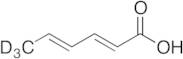
CAS:Kontrolliertes ProduktFormel:C6H5D3O2Farbe und Form:NeatMolekulargewicht:115.15(2E,4E)-Hexa-2,4-dienoic acid
CAS:Formel:C6H8O2Reinheit:98%Farbe und Form:SolidMolekulargewicht:112.1265