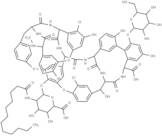
CAS 110882-85-4
:Formel:C83H88Cl2N8O29
InChl:InChI=1S/C83H88Cl2N8O29/c1-3-4-5-6-7-8-9-10-11-12-56(99)88-65-68(102)70(104)73(81(114)115)122-82(65)121-72-53-27-38-28-54(72)118-50-22-17-37(25-45(50)84)66(100)64-79(111)92-63(80(112)113)43-29-39(95)30-52(119-83-71(105)69(103)67(101)55(33-94)120-83)57(43)42-24-35(15-20-47(42)96)60(76(108)93-64)89-77(109)61(38)90-78(110)62-44-31-41(32-49(98)58(44)85)117-51-26-36(16-21-48(51)97)59(86-2)75(107)87-46(74(106)91-62)23-34-13-18-40(116-53)19-14-34/h13-22,24-32,46,55,59-71,73,82-83,86,94-98,100-105H,3-12,23,33H2,1-2H3,(H,87,107)(H,88,99)(H,89,109)(H,90,110)(H,91,106)(H,92,111)(H,93,108)(H,112,113)(H,114,115)/t46-,55-,59-,60-,61-,62+,63+,64+,65-,66-,67-,68-,69+,70+,71+,73+,82-,83+/m1/s1
InChI Key:IMGYVEMZPBHISV-PSDJNXLUSA-N
SMILES:CCCCCCCCCCCC(=O)N[C@@H]1[C@H]([C@@H]([C@H](O[C@H]1OC2=C3C=C4C=C2OC5=C(C=C(C=C5)[C@H]([C@H]6C(=O)N[C@@H](C7=C(C(=CC(=C7)O)O[C@@H]8[C@H]([C@H]([C@@H]([C@H](O8)CO)O)O)O)C9=C(C=CC(=C9)[C@H](C(=O)N6)NC(=O)[C@@H]4NC(=O)[C@@H]1C2=C(C(=CC(=C2)OC2=C(C=CC(=C2)[C@H](C(=O)N[C@H](CC2=CC=C(O3)C=C2)C(=O)N1)NC)O)O)Cl)O)C(=O)O)O)Cl)C(=O)O)O)O
Filtern nach
Reinheitsanteil
0
100
|
0
|
50
|
90
|
95
|
100
3 Produkte gefunden.
- Niedrigster Preis
- Höchster Preis
- Niedrigste Reinheit
- Höchste Reinheit
- Schnellste Lieferung
Parvodicin C2
CAS:Parvodicin C2, a glycopeptide antibiotic derived from A. parvosata and part of the parvodicin complex, serves as a component of the A40926 antibiotic complex utilized as a precursor for synthesizing dalbavancin. It exhibits activity against methicillin-sensitive and methicillin-resistant strains of S. aureus, S. epidermidis, S. saprophyticus, S. hemolyticus, and E. faecalis.Formel:C83H88Cl2N8O29Farbe und Form:SolidMolekulargewicht:1732.53Parvodicin C2
CAS:Parvodicin C2 is a natural antibiotic compound, which is derived from the fermentation of specific actinomycete strains. This antibiotic functions through the inhibition of bacterial protein synthesis, specifically targeting the ribosomal subunits and leading to disruption in the peptide chain elongation process. The targeted mode of action allows it to effectively limit the replication and survival of susceptible bacterial strains.
Formel:C83H88Cl2N8O29Reinheit:Min. 95%Molekulargewicht:1,732.5 g/mol