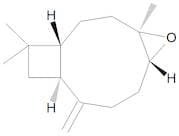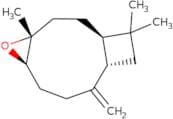
CAS 1139-30-6
:Caryophyllenoxid
Beschreibung:
Caryophyllenoxid ist ein bicyclisches Sesquiterpenoxid, das aus Caryophyllen, einer natürlichen Verbindung, die in verschiedenen ätherischen Ölen vorkommt, insbesondere in Nelken- und schwarzem Pfefferöl, abgeleitet ist. Es zeichnet sich durch seine einzigartige Struktur aus, die einen Cyclobutanring und eine Epoxidfunktionalität umfasst. Diese Verbindung ist typischerweise eine farblose bis blassgelbe Flüssigkeit mit einem charakteristischen, würzigen Aroma. Caryophyllenoxid ist bekannt für seine potenziellen therapeutischen Eigenschaften, einschließlich entzündungshemmender, antimikrobieller und antioxidativer Aktivitäten, was es sowohl für pharmazeutische als auch kosmetische Anwendungen von Interesse macht. Es wird auch für seine Rolle in der Geschmacks- und Duftindustrie anerkannt, da es zu den sensorischen Profilen verschiedener Produkte beiträgt. Darüber hinaus wird Caryophyllenoxid als natürliches Insektenschutzmittel angesehen und wurde auf seine Auswirkungen auf die menschliche Gesundheit untersucht, insbesondere in Bezug auf seine Wechselwirkungen mit Cannabinoid-Rezeptoren. Seine Stabilität und Reaktivität können je nach Umweltbedingungen variieren, was seine Anwendungen in verschiedenen Bereichen beeinflusst.
Formel:C15H24O
InChl:InChI=1S/C15H24O/c1-10-5-6-13-15(4,16-13)8-7-12-11(10)9-14(12,2)3/h11-13H,1,5-9H2,2-4H3/t11-,12-,13-,15-/m1/s1
InChI Key:InChIKey=NVEQFIOZRFFVFW-RGCMKSIDSA-N
SMILES:C[C@@]12[C@](O1)(CCC(=C)[C@@]3([C@@](CC2)(C(C)(C)C3)[H])[H])[H]
Synonyme:- (-)-Epoxydihydrocaryophyllene
- (-)-β-Caryophyllene epoxide
- (-)-β-Caryophyllene oxide
- (1R,4R,6R,10S)-4,12,12-Trimethyl-9-methylene-5-oxatricyclo[8.2.0.0<sup>4,6</sup>]dodecane
- (1R,4R,6R,10S)-4,12,12-trimethyl-9-methylidene-5-oxatricyclo[8.2.0.0~4,6~]dodecane
- (1R,4R,6S,10R)-4,12,12-trimethyl-9-methylidene-5-oxatricyclo[8.2.0.0~4,6~]dodecane
- (1R-(1R*,4R*,6R*,10S*))-4,12,12-Trimethyl-9-methylene-5-oxatricyclo(8.2.0.04,6)dodecane
- (1S,4R,6S,10R)-4,12,12-trimethyl-9-methylidene-5-oxatricyclo[8.2.0.0~4,6~]dodecane
- (1S,4R,6S,10S)-4,12,12-trimethyl-9-methylidene-5-oxatricyclo[8.2.0.0~4,6~]dodecane
- (1S,9R)-6,10,10-trimethyl-2-methylidene-5-oxatricyclo[7.2.0.0~4,6~]undecane
- 4,11,11-Trimethyl-8-methylene-5-oxatricyclo(8.2.0.0(4,6))dodecane
- 4,12,12-Trimethyl-9-Methylidene-5-Oxatricyclo[8.2.0.0~4,6~]Dodecane
- 4,12,12-Trimethyl-9-methylene-5-oxatricyclo(8.2.0.04,6)dodecane, (1R,4R,6R,10S)-
- 4β,5α-Epoxycaryophyllene
- 5-Oxatricyclo(8.2.0.0(4,6))dodecane, 4,12,12-trimethyl-9-methylene-, (1R,4R,6R,10S)-
- 5-Oxatricyclo(8.2.0.0(sup 4,6))dodecane, 4,12,12-trimethyl-9-methylene-, (1R,4R,6R,10S)-
- 5-Oxatricyclo(8.2.0.04,6)dodecane, 4,12,12-trimethyl-9-methylene-, (1R,4R,6R,10S)-
- 5-Oxatricyclo[8.2.0.04,6]dodecane, 4,12,12-trimethyl-9-methylene-, [1R-(1R*,4R*,6R*,10S*)]-
- 5-Oxatricyclo[8.2.0.0<sup>4,6</sup>]dodecane, 4,12,12-trimethyl-9-methylene-, (1R,4R,6R,10S)-
- 5-Oxatricyclo[8.2.0.0<sup>4,6</sup>]dodecane, 4,12,12-trimethyl-9-methylene-, [1R-(1R*,4R*,6R*,10S*)]-
- 5-Oxatricyclo[8.2.O.04.6]Dodecane, 4,12,12-Trimethyl-9-Methylene-, [1R,,4R,6R,10S)]-
- 6,7-Epoxy-3(15)-caryophyllene
- Caryophylene Epoxide
- Caryophylene monoepoxide
- Caryophylene oxide
- Caryophyllene 4β,5α-epoxide
- Caryophyllene 4β,5α-oxide
- Caryophyllene epoxide
- Caryophyllene oxide
- Epoxycaryophyllene
- Hsdb 5466
- [1R-(1R*,4R*,6R*,10S*)]-4,12,12-Trimethyl-9-methylen-5-oxatricyclo[8.2.0.04,6]dodecan
- [1R-(1R*,4R*,6R*,10S*)]-4,12,12-Trimethyl-9-methylen-5-oxatricyclo[8.2.0.04,6]dodecane
- [1R-(1R*,4R*,6R*,10S*)]-4,12,12-Trimethyl-9-methylene-5-oxatricyclo[8.2.0.0.4.6]dodecane
- [1R-(1R*,4R*,6R*,10S*)]-4,12,12-trimetil-9-metilen-5-oxatriciclo[8.2.0.04,6]dodecano
- beta-Caryophyllene oxide
- trans-Caryophyllene oxide
- Weitere Synonyme anzeigen
Sortieren nach
Reinheit (%)
0
100
|
0
|
50
|
90
|
95
|
100
b-Caryophyllene Epoxide
CAS:<p>Applications β-Caryophyllene Epoxide, and its derivatives has shown to have microbial transformation and butyrylcholinesterase inhibitory activity. It is also the main active constituent of essential oils obtained from various plants, used for flavoring and fragrances.<br>References Iqbal, M., et al.: J. Natural Products, 69(10), 1429 (2006); Guo, Y., et al.: Zhongguo Shiyan Fangjixue Zazhi, 19, 110 (2013);<br></p>Formel:C15H24OFarbe und Form:WhiteMolekulargewicht:220.35b-Caryophyllene oxide
CAS:b-Caryophyllene oxide is a metal chelate that has been shown to have antimicrobial properties against oral pathogens. It has been shown to inhibit voltage-dependent calcium channels and possesses significant cytotoxicity. This compound also inhibits the growth of oral bacteria, including Streptococcus mutans, Actinomyces viscosus, and Porphyromonas gingivalis. b-Caryophyllene oxide has also been shown to inhibit inflammation in experimental models. It has been shown to interact with caryophyllene and other terpenes found in the essential oil of black pepper (Piper nigrum).Formel:C15H24OReinheit:Min. 95%Farbe und Form:White Off-White PowderMolekulargewicht:220.35 g/mol