CAS 1159-68-8
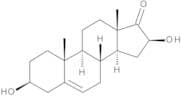
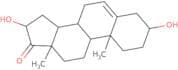
:(3beta,16beta)-3,16-dihydroxyandrost-5-en-17-on
Beschreibung:
Die chemische Substanz, die als (3beta,16beta)-3,16-dihydroxyandrost-5-en-17-on bekannt ist, mit der CAS-Nummer 1159-68-8, ist eine steroidale Verbindung, die zur Klasse der Androgene gehört. Sie weist zwei Hydroxylgruppen (-OH) auf, die sich an den Positionen 3 und 16 des Steroidgerüsts befinden, was zu ihrer biologischen Aktivität beiträgt. Das Vorhandensein einer Doppelbindung zwischen den Positionen 5 und 6 der Steroidstruktur ist charakteristisch für Androstenderivate. Diese Verbindung wird häufig auf ihre potenziellen Auswirkungen auf die hormonelle Aktivität und ihre Rolle in verschiedenen biochemischen Wegen untersucht. Sie kann Eigenschaften im Zusammenhang mit anaboler Aktivität aufweisen, die das Muskelwachstum und die Entwicklung beeinflussen. Darüber hinaus können ihre strukturellen Modifikationen ihre Löslichkeit, Stabilität und Wechselwirkung mit biologischen Rezeptoren beeinflussen. Als Steroid ist es auch im Kontext der Pharmakologie und Endokrinologie relevant, wo es für therapeutische Anwendungen oder als Vorläufer bei der Synthese anderer steroidaler Verbindungen untersucht werden kann.
Formel:C19H28O3
InChl:InChI=1/C19H28O3/c1-18-7-5-12(20)9-11(18)3-4-13-14(18)6-8-19(2)15(13)10-16(21)17(19)22/h3,12-16,20-21H,4-10H2,1-2H3/t12-,13+,14-,15-,16-,18-,19-/m0/s1
Synonyme:- 3beta,16beta-Dihydroxyandrost-5-en-17-one
- Androst-5-En-17-One, 3,16-Dihydroxy-, (3Beta,16Beta)-
Sortieren nach
Reinheit (%)
0
100
|
0
|
50
|
90
|
95
|
100
2 Produkte.
16β-Hydroxydehydroepiandrosterone
CAS:Kontrolliertes ProduktFormel:C19H28O3Farbe und Form:NeatMolekulargewicht:304.4016β-Hydroxy dhea
CAS:Kontrolliertes ProduktDhea is a steroid hormone that is formed in the adrenal glands and brain. Dhea has been shown to have receptor binding activity in human cells, which may be due to its ability to bind to glucocorticoid receptors. Dhea also binds to mineralocorticoid receptors and has been shown to increase blood pressure. Dhea can be conjugated with glucuronic acid or sulfate, which will affect its distribution in the body. The conjugates are hydrolyzed by esterases or glucuronidases and release dhea into the circulation. The major route of elimination of dhea is through the kidneys where it undergoes glomerular filtration and tubular secretion. In infants, dhea is transferred from maternal milk to the infant's blood stream via diffusion across the mammary gland barrier. Mass spectrometry-based assays have been developed for determining plasma concentrations of dhea, estradiol, and progesterone in humans.Formel:C19H28O3Reinheit:Min. 95%Molekulargewicht:304.4 g/mol